Center’s Visiting Researcher Mine Turhan reflects on her year at Georgia Law

The Dean Rusk International Law Center Visiting Researcher for 2023-2024, Mine Turhan, Assistant Professor of Administrative Law in the Faculty of Law at the Izmir University of Economics in Türkiye, recently concluded her research year at the University of Georgia School of Law under the supervision of  Georgia Athletic Association Professor in Law David E. Shipley. Below are some of Turhan’s reflections on her research findings regarding administrative procedure and procedural fairness at Georgia Law.
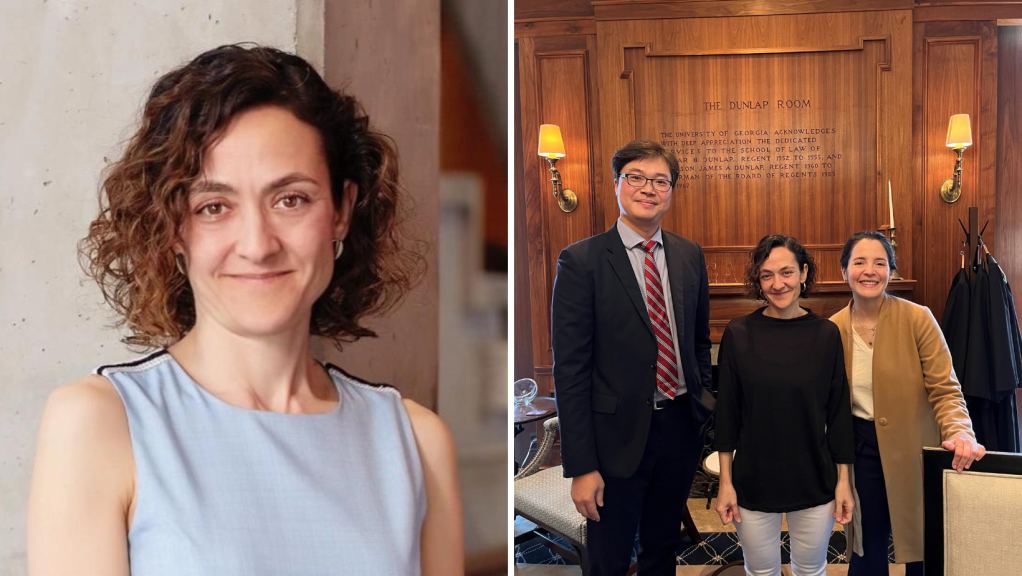
I was a visiting researcher at the University of Georgia School of Law and the Dean Rusk International Law Center for my post-doc research during 2023-2024 academic year.

My research was related to administrative procedure and procedural fairness. The concept of administrative procedure serves a dual purpose within a legal framework. Primarily, it defines and establishes the limits of the authority of administrative agencies by outlining the structured steps and processes they must follow. Simultaneously, administrative procedure prevents arbitrary actions of agencies by ensuring accurate decisions by the proper application of the law to the facts. This dual function promotes transparency, fairness, and accountability in the functions of administrative agencies.

My research focused on the right to be heard in administrative procedure, and administrative hearings during the process of individual measures which would adversely affect the person concerned. I looked specifically at American and European procedural rights in adjudicative proceedings, in particular the right to be heard before administrative agencies. I tried to answer how procedural rights were protected by different administrative procedures in the U.S. and European countries against arbitrary actions of administrative agencies. I also tried to understand the administrative hearing procedures and components of hearings in common law and civil law systems.

Administrative procedure acts have a significant role in protecting the procedural rights. Therefore, I focused on the administrative procedure acts of different countries to find an answer. The U.S. Administrative Procedure Act, dated 1946, was helpful for my research. I have analyzed the court precedents regarding the right to be heard and I also have observed administrative hearings in U.S. to better understand administrative hearing procedures in U.S.

Throughout my time at the Dean Rusk International Law Center, I have been impressed by the dedication of the faculty, scholars, and staff to fostering a dynamic learning environment. The guidance and mentorship I received from Professor David Shipley has been instrumental in shaping my research. His expertise and encouragement have inspired me to push the boundaries of my intellectual curiosity and pursue excellence in my studies. The resources available at the School of Law, including the extensive library collections and research databases, have greatly enriched my research endeavors.

As I reflect on my time at the Dean Rusk International Law Center, I am filled with appreciation for the enriching experiences and lasting connections forged during my research. The skills and insights gained through my research studies will undoubtedly serve me well in my future endeavors, both academically and professionally.

I extend my heartfelt thanks to everyone at the Dean Rusk International Law Center and the University of Georgia School of Law for their support and encouragement. I am proud to have been a part of such an vibrant academic community and look forward to carrying forward the relationships formed as I embark on the next chapter of my journey.

Reflections on Global Atlanta Event, “Georgia and Japan: 50 Years of Commerce and Culture — Debriefing on the 2023 SEUS-Japan Conference”

One of the Dean Rusk International Law Center’s current Visiting Research Scholars, Daesun Kim, Esq., attended this week’s Global Atlanta event, “Georgia and Japan: 50 Years of Commerce and Culture — Debriefing on the 2023 SEUS-Japan Conference.” Global Atlanta is one of the Center’s institutional partners. Below are some of Kim’s reflections of the event.

Global Atlanta, Baker Donelson, and the Japan-America Society of Georgia gathered on November 30 to discuss the October 2023 SEUS-Japan Conference. Around 50 economic and development leaders from Georgia participated in the October conference, which took place in Tokyo for the first time since COVID and included representatives from the 16 states in the Southeastern United States (SEUS). The visit by the Georgia delegation, in particular, holds significant meaning as it coincides with the 50th anniversary, commemorating the longstanding tradition and history between Japan and the state of Georgia.

The speakers at this week’s event, who reflected on their experience visiting Japan as part of this delegation, included:

  • Bob Johnson, immigration attorney at Baker Donelson, and board member of the Japan-America Society of Georgia
  • Trevor Williams, Managing Editor at Global Atlanta (moderator)
  • Jim Whitcomb, Chair of the Japan-America Society of Georgia
  • Jessica Cork, VP of Community Engagement and Communications at YKK, who was honored with the Busbee Award
  • Mellissa Takeuchi, Project Manager at the Georgia Department of Economic Development

The panelists’ takeaways from the SEUS-Japan Conference included the level of significance attributed to developing and maintaining personal connections with various government high-level officials. Georgia is a hub for Japanese businesses in the southeastern United States, with currently more than 500 Japanese-affiliated companies operating in the state, including YKK (USA) America, Inc., Kubota Manufacturing of America Corp., NACOM Corporation, and Yamaha Motor Mfg. Corp. of America. These officials see their establishment of personal and professional connections as significant contributors to the enhancement of economic and diplomatic cooperation.

These relationships are of particular importance for Georgia, whose Savannah Port acts as a gateway between Japan and the southeastern region of the U.S and thus plays a crucial role in the auto-EV-battery supply chain. It is anticipated that all states within SEUS will contribute to this industry’s growth; in particular, the panelists saw the development of certain business relationships, such as Toyota’s automotive and EV battery ventures, as important outcomes of the SEUS-Japan Conference.

Takeuchi highlighted the significance of the longstanding 50-year collaboration between SEUS and Japan. She noted a renewed energy from Japan to engage more actively and collaborate further with SEUS following the recent Japan visit. Additionally, she noted the importance of the Georgia-kai, a Georgia-based organization of Japanese expatriates, which holds a pivotal role in the state’s continued engagement with both existing and prospective Japanese industries.

The panelists agreed that Georgia and Japan’s growing relationship across economic, business, diplomatic, and cultural sectors is a direct result of this mutual investment in sustained communication and relationship building, the direct result of initiatives like the SEUS-Japan Conference.

South Korean Consul General Suh featured at Global Atlanta Consular Conversation

One of the Dean Rusk International Law Center’s current Visiting Research Scholars, Daesun Kim, Esq., attended last week’s Consular Conversation with Sangpyo Suh, the Consul General of Korea in Atlanta. This event, organized by one of the Center’s institutional partners, Global Atlanta, is part of an ongoing series presented by Miller & Martin PLLC. Below are some of Kim’s reflections of the event.

Consul General of South Korea in Atlanta Sangpyo Suh serves as his country’s top diplomatic in the Southeastern United States. In a wide-ranging conversation with Trevor Williams, Global Atlanta’s managing editor, Suh detailed his diplomatic service before his arrival in Atlanta, including: Korea’s Ambassador to the OECD; Korea’s Ambassador to Gabon; Head of Energy, Climate Change and Environment, United Nations Mission; and, most recently, Korea’s Ambassador to Pakistan.

Suh explained that he first came to Atlanta in the mid-90s to study English as a diplomat at Georgia State University. During that time, the population of Koreans in Georgia was around 10,000. Now, in 2023, the population exceeds 150,000 and is growing. Korean investments in Georgia reflect this trend, with over $12.5 billion allocated towards foreign direct investment projects in Georgia alone as part of the $30 to $40 billion annually invested in the United States. The Hyundai electric vehicle plant project, currently under construction near Savannah, is worth more than $7 billion alone. The number of Korean companies in Georgia has increased dramatically in recent years, and Suh hopes to continue to strengthen the economic ties between the Southeast and Korea.

Suh is aware of more than 250 Korean companies in the Southeast, including 150 in Georgia. Outside of automotive investment, there has been trade and investment activity in response to the IRA/ CHIPS Act, with collaborations focusing on semiconductors, EVs, and batteries. He believes that the region serves as an important regional base for these key industries of the future.

This year marks the 70th anniversary of the U.S.-ROK alliance. While the economic partnership between the U.S. and Korea has grown, so have the countries’ cultural ties. Suh talked about how the number of students in the U.S. studying the Korean language is exploding. He credits this in no small part to the soft power of what is known as K-culture, including Korean “K-pop” music, Korean cinema, and television. Suh views part of his role as Consul General to promote these cultural ties and find ways to further develop them.

Welcoming Mine Turhan, Visiting Scholar at UGA Law’s Dean Rusk International Law Center

We at the University of Georgia School of Law Dean Rusk International Law Center are pleased to welcome a new Visiting Research Scholar: Mine Turhan, Assistant Professor of Administrative Law in the Faculty of Law at the Izmir University of Economics in Türkiye. She holds an LL.M. degree and a Ph.D. in Public Law from Dokuz Eylül University in Izmir, Türkiye.

Professor Turhan plans to conduct research on comparative administrative procedure between the United States and the European Union during her stay at the Dean Rusk International Law Center. Her project will focus on procedural due process rights, in particular the right to be heard before administrative agencies, and it will analyze how individual rights are protected by different procedures in the U.S. and the European Union against arbitrary actions on the part of administrative agencies.

Professor Turhan is sponsored as a Visiting Research Scholar by UGA Law Professor David E. Shipley, the Georgia Athletic Association Professor in Law. Professor Shipley teaches administrative law and civil procedure.

Turhan’s research is supported by a fellowship from the Scientific and Technological Research Council of Türkiye (TÜBİTAK) within the scope of the International Postdoctoral Research Fellowship Program. Her visit continues our Center’s long tradition of hosting scholars and researchers whose work touches on issues of international, comparative, or transnational law. Details and an online application to become a visiting scholar here.

Welcoming Ammar Zafar, Visiting Scholar at University of Georgia School of Law

We at the University of Georgia School of Law Dean Rusk International Law Center are pleased to welcome a new Visiting Research Scholar: Ammar Zafar, a PhD candidate at the University of Liverpool in the United Kingdom.

Zafar’s doctoral research focuses on the potential of central bank digital currencies, implemented through blockchain technology with the aim of establishing an inclusive and sustainable monetary system. While at the Dean Rusk International Law Center, he plans to conduct comparative research on how U.S. financial regulations and Federal Reserve fiscal policies address legal and macroeconomic issues related to CBDCs and blockchain technology. Zafar holds a master’s degree in Banking and Corporate Finance and a Master of Laws (LL.M.) degree in Legal Practice from Britain’s University of Bristol, as well as a bachelor’s degree in Business Economics from Karnataka State University, India, and an LL.B. degree from BPP Law University in London.

Serving as Zafar’s Georgia Law faculty sponsor will be Professor Usha Rodrigues, who holds the M.E. Kilpatrick Chair of Corporate Finance and Securities Law.

Zafar is visiting pursuant to an institutional partnership between the University of Liverpool and the University of Georgia. His visit continues our Center’s long tradition of hosting, for brief or extended stays, scholars and researchers whose work touches on issues of international, comparative, or transnational law. Details and an online application to become a visiting scholar here.

Visiting Scholar Piotr Uhma Delivers Lecture on International Law and Democracy

IMG_2095Last week, Georgia law faculty, students, and friends from other departments were treated to a lecture by Dr. Piotr Uhma, Visiting Research Scholar at the Dean Rusk International Law Center. Uhma presented his new paper, completed while in residence at the Center, What democracy is the value of international law? In it, he focuses on the linkages between democracy and international law, explores the shape of democracy in the context of a changing international order, and the issue of non-liberal democracy. In particular, he discussed Poland’s recent political changes and what they mean for democracy and the rule of law.

Uhma serves as a lecturer in international law and postdoctoral researcher at the Andrzej Frycz Modrzewski Kraków University, located in Kraków, Poland. He formerly held multiple posts with the Organization for Security and Co-operation in Europe, and worked as Director of the Legal and Corporate Communications Office of the Polish Electric Power Grid company, PSE Operator S.A. He has been visiting at the Center during the spring 2018 semester.