Georgia Law Professor Diane Marie Amann publishes “Child-Taking” in Michigan Journal of International Law

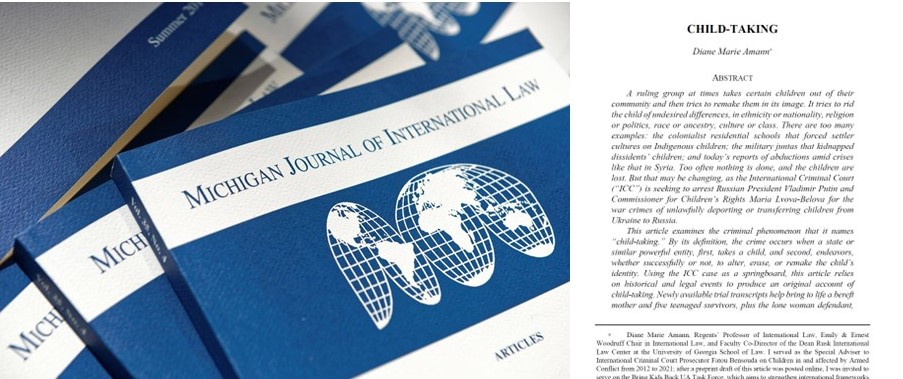
“Child-Taking,” an article by University of Georgia School of Law Professor Diane Marie Amann, has just been published at 45 Michigan Journal of International Law 305-79 (2024).

As theorized in the article, “child-taking” occurs when a state or similar powerful entity takes a child and then endeavors to alter, erase, or remake the child’s identity. It is a criminal phenomenon that has been repeated across decades and centuries. On rare occasion, criminal prosecutions have occurred, as with the Situation in Ukraine before the International Criminal Court. More often redress, if any, must take place in other forums. The article thus considers these other types of transitional justice, with particular attention to the legacies of forced residential schooling imposed upon Indigenous children in the United States, Canada, and elsewhere.

Amann presented aspects of this research at numerous venues, including King’s College London, Yale University, the University of Cambridge, University College London, and the American Society of International Law Annual Meeting.

Amann is Regents’ Professor of International Law, Emily & Ernest Woodruff Chair in International Law, and a Faculty Co-Director of our Dean Rusk International Law Center here at Georgia Law. She served from 2012 to 2021 as International Criminal Court Prosecutor Fatou Bensouda’s Special Adviser on Children in & affected by Armed Conflict.

Here’s the abstract of the “Child-Taking” article, the print version of which is available here:

A ruling group at times takes certain children out of their community and then tries to remake them in its image. It tries to rid the child of undesired differences, in ethnicity or nationality, religion or politics, race or ancestry, culture or class. There are too many examples: the colonialist residential schools that forced settler cultures on Indigenous children; the military juntas that kidnapped dissidents’ children; and today’s reports of abductions amid crises like that in Syria. Too often nothing is done, and the children are lost. But that may be changing, as the International Criminal Court (“ICC”) is seeking to arrest Russian President Vladimir Putin and Commissioner for Children’s Rights Maria Lvova-Belova for the war crimes of unlawfully deporting or transferring children from Ukraine to Russia.

“This article examines the criminal phenomenon that it names ‘child-taking.’ By its definition, the crime occurs when a state or similar powerful entity, first, takes a child, and second, endeavors, whether successfully or not, to alter, erase, or remake the child’s identity. Using the ICC case as a springboard, this article relies on historical and legal events to produce an original account of child-taking. Newly available trial transcripts help bring to life a bereft mother and five teenaged survivors, plus the lone woman defendant, who testified at a little-known child-kidnapping trial before a postwar Nuremberg tribunal. Their stories, viewed in the context of the evolution of international child law, inform this article’s definition. These sources further reveal child-taking to be what the law calls a matter of international concern. At its most serious, child-taking may constitute genocide or another crime within the ICC’s jurisdiction. Yet even if circumstances preclude punishment in that permanent criminal court, child-taking remains a grave offense warranting prosecution or other forms of local and global transitional justice. This is as true for the Indigenous children of residential schools in North America, Australia, and elsewhere, and for children in Syria and many other places in the world, as it is for the children of Ukraine.

Georgia Law Professor Assaf Harpaz publishes article on the U.N. Framework Tax Convention

University of Georgia School of Law assistant professor Assaf Harpaz published an article titled “The U.N. Framework Tax Convention: Can It Bridge the North-South Divide?” in the tax publication Tax Notes International.

In this article, Harpaz explains the key issues being addressed in the U.N. framework convention on international tax cooperation, including the global north-south divide and its role in the multilateral process.

The article’s abstract is as follows:

The United Nations recently concluded the second session of negotiations on terms of reference for a framework convention on international tax cooperation. The framework convention presents an opportunity to multilaterally address pressing global tax issues. Its goal is to “strengthen international tax cooperation and make it fully inclusive and more effective.”

The extensively negotiated terms of reference make several substantive commitments, including the fair allocation of taxing rights; tax evasion and avoidance by high-net worth individuals; sustainable development; mutual administrative assistance in tax matters; tax-related illicit financial flows; and prevention and resolution of tax disputes.

The ongoing multilateral effort brings the promise of a more equitable international tax regime. However, support for the U.N.’s work and the substantive issues identified has been sharply divided along global north-south lines. A successful U.N. process will need to acquire legitimacy from both the developed superpowers and the developing countries that have historically been excluded from international tax policymaking decisions.

The article explains the key issues being addressed in the U.N. framework convention on international tax cooperation, including the global north-south divide and its role in the multilateral process.

Assaf Harpaz joined University of Georgia School of Law as an assistant professor in summer 2024 and will teach classes in federal income tax and business taxation. Harpaz’s scholarly focus lies in international taxation, with an emphasis on the intersection of taxation and digitalization. He explores the tax challenges of the digital economy and the ways to adapt 20th-century tax laws to modern business practices.

Georgia Law Professor Jason Cade cited by U.S. Court of Appeals for the Ninth Circuit 

University of Georgia School of Law Associate Dean & Hosch Professor Jason A. Cade’s article “Deporting the Pardoned” was recently cited by the U.S. Court of Appeals for the Ninth Circuit in the case Lopez v. Garland.

Below is an excerpt from the article:

Federal immigration laws make noncitizens deportable on the basis of state criminal convictions. Historically, Congress implemented this scheme in ways that respected the states’ sovereignty over their criminal laws. As more recent federal laws have been interpreted, however, a state’s decision to pardon, expunge, or otherwise set aside a conviction under state law will often have no effect on the federal government’s determination to use that conviction as a basis for deportation. While scholars have shown significant interest in state and local laws regulating immigrants, few have considered the federalism implications of federal rules that ignore a state’s authority to determine the continuing validity of its own convictions. This Article contends that limitations on the preclusive effect of pardons, expungements, appeals, and similar post-conviction processes undermine sovereign interests in maintaining the integrity of the criminal justice system, calibrating justice, fostering rehabilitation, and deciding where to allocate resources. In light of the interests at stake, Congress should be required to clearly express its intent to override pardons and related state post-conviction procedures. A federalism-based clear statement rule for statutory provisions that restrict generally applicable criminal processes would not constrain the federal government’s power to set immigration policy. Congress remains free to make its intent clear in the statute. But the rule would ensure that Congress, rather than an administrative agency, has made the deliberative choice to upset the usual constitutional balance of federal and state power.

Jason A. Cade is Associate Dean for Clinical Programs and Experiential Learning, J. Alton Hosch Professor of Law & Community Health Law Partnership Clinic Director. In addition to overseeing the law school’s 11 in-house clinics and 7 externship programs, Cade teaches immigration law courses and directs the school’s Community Health Law Partnership Clinic (Community HeLP), in which law students undertake an interdisciplinary approach to immigrants’ rights through individual client representation, litigation, and project-based advocacy before administrative agencies and federal courts.

Additional information about the Community HeLP Clinic can be found here.