Georgia Law Professor Desirée LeClercq publishes in Cornell International Law Journal 

University of Georgia School of Law Professor Desirée LeClercq recently published an article, “Gender-Based Violence at Sea,” in the Cornell International Law Journal. The article stems from LeClercq’s previous contribution to Cornell’s Transnational Labor Law Conference as a conference co-organizer.

LeClercq’s article highlights the pervasive gender-based violence and harassment that female seafarers endure at sea. Furthermore, LeClercq argues the International Labour Organization (ILO) has failed to properly protect workers despite the protections intended by the Maritime Labour Convention, 2006.

Below is an abstract from the article:

“This Symposium contribution assesses the ability of international law to evolve to offer essential protections for workers in an increasingly globalized world. It focuses on protections for women seafarers, specifically around gender-based violence and harassment on board vessels. Even though it is the world’s oldest transnational sector, seafaring remains overwhelmingly male-dominated. Consequently, international law was not initially conceived with women seafarers in mind. Now that women have broken into the maritime profession, they count on international law to evolve in kind. Notwithstanding, they continue to face sexist, if not violent, workplaces, and report high incidents of gender-based violence and harassment at sea.

The international organization responsible for adopting and supervising protections for workers, the International Labour Organization (ILO), has long prioritized the special needs of seafarers. Its Maritime Labor Convention, 2006, promised to ensure holistic protections for all women and men at sea and to quickly adapt with evolving sectoral challenges. A close look at the prevalence of gender-based violence and harassment at sea shows, however, that the ILO’s bureaucratic pathologies and interinstitutional processes preclude it from accomplishing that mission. The ILO’s failure to quickly respond to mounting evidence of that violence and harassment has broad implications for international law, which must absorb and respond to transnational work’s dynamic and fluctuating demands to remain useful and relevant.”

LeClercq joined the University of Georgia School of Law in 2024 as an assistant professor. She teaches International Trade and Workers Rights, International Labor Law, International Law and U.S. Labor Law. This semester, LeClercq is overseeing the International Law Colloquium, a for-credit course designed to introduce students to international economic law through engagement with scholars in the international legal field. She also serves as a faculty co-director of the Dean Rusk International Law Center and as the faculty adviser for the Georgia Journal of International and Comparative Law.

Michigan Law Professor Julian Arato presents working paper at Georgia Law’s International Law Colloquium

The University of Georgia School of Law’s spring 2025 International Law Colloquium recently welcomed Michigan Law’s Professor of Law Julian Arato, who presented his working paper, “The Institutions of Exceptions.” Timothy Meyer, Professor of International Business Law at Duke University School of Law, served as Arato’s faculty discussant.

Arato currently serves as the Faculty Director of the Center for International and Comparative Law at the University of Michigan School of Law. His research focuses on public international law, international investment law and arbitration, international trade, contracts, corporations, and private law theory. Arato is also a member of the board of editors of the American Journal of International Law.

Below is an abstract of Arato’s working paper:

International economic law binds states’ hands in the interest of liberalizing markets in various ways, including cross border trade in goods and services (trade) and capital (investment). The treaty regimes for both trade and investment do this by disciplining states through legal rules, while preserving a modicum of governmental power over policy. Though not always recognized as such, the preservation of policy space in these regimes typically involves exceptions-style reasoning by adjudicators – formally in the case of most trade and some investment treaties, and informally in the investment treaty regime more generally. This “exceptions paradigm” of justification has worked well in the trade regime, where it has been especially key to securing a workable balance between market disciplines and regulatory policy space in the WTO/GATT context. But it has been less successful at striking a reasonable balance in the investment regime – irrespective of whether the paradigm has been formally codified in an exceptions clause. This Article seeks to explain why, by focusing on the institutions within which this mode of justification is embedded. Certain institutional differences between these regimes help explain the varied success of exceptionalism in trade and investment, in particular: the right of action (public vs private); the degree of judicial centralization (ad hoc arbitration vs court system); and the available remedies (retrospective compensation vs prospective injunctive relief). I argue that it is trade law’s public-oriented institutions that have made the exceptions clause workable – not the other way around. By contrast, investment law’s private-oriented institutions make that system particularly inhospitable to exceptions-style justification.

This year, Professor Desirée LeClercq is overseeing the colloquium, which is designed to introduce students to features of international economic law through engagement with scholars in the international legal field. To view the full list of International Law Colloquium speakers, visit our website.

This program is made possible through the Kirbo Trust Endowed Faculty Enhancement Fund and the Talmadge Law Faculty Fund.

Georgia Law Professor Christopher Bruner’s book featured by “Dare to Know!” podcast

University of Georgia School of Law Christopher M. Bruner was featured by the “Dare to Know!” podcast in March. The episode, titled “Re-Conceptualizing the Corporation: A New Approach,” focused on Bruner’s 2022 Oxford University Press book, The Corporation as Technology: Re-Calibrating Corporate Governance for a Sustainable Future. The interview was conducted by Fabian Corver, a PhD student in philosophy at the University of Groningen in the Netherlands.

Bruner is the Stembler Family Distinguished Professor in Business Law at the University of Georgia School of Law and serves as a faculty co-director of the Dean Rusk International Law Center. His scholarship focuses on corporate law, corporate governance, comparative law and sustainability.

Georgia Law students Grace M. Craft (J.D. ‘26) and Supreme Unukegwo (J.D. ’26) finish as quarterfinalists at 2025 Transatlantic Negotiation Competition

University of Georgia School of Law students Grace M. Craft (J.D. ’26) and Supreme Unukegwo (J.D. ’26) finished as quarterfinalists at the 2025 Transatlantic Negotiation Competition, hosted by Syracuse University College of Law and Queen’s University Belfast.

The TANC is an annual competition designed to simulate cross-border legal negotiations, and challenges the students to resolve realistic, complex scenarios involving international business, trade, and political disputes. This year’s competition featured thirty law schools from five continents, including participants from the United States, Brazil, India, Australia, and throughout Europe.

In each round, teams of two had one-hour sessions to collaboratively negotiate client outcomes, which were then evaluated by panels of renowned legal professionals from around the world. Competitors relied on strategy, teamwork, and persuasive communication across cultures. Craft and Unukegwo prepared for the competition under the guidance of Faculty Coach Daniel S. Serviansky.

Georgia Law Professor Lori A. Ringhand presents at Emory University’s International Law Review Symposium

Earlier this month, University of Georgia School of Law Professor Lori A. Ringhand presented “First Amendment Restrictions on Non-citizens’ Engagement in Campaign Spending” at the Emory International Law Review symposium “Migration, Law, and Justice: The Evolving Role of International and U.S. Policies.” The event was held at the Emory University School of Law.

This year’s symposium focused on critical issues in immigration law and policy as they relate to international law. They explored the following three topics:

  • The Role of International Law in U.S. Immigration Decisions
  • Human Rights Obligations and the Treatment of Migrants
  • Legal Pathways to Citizenship: Challenges and Opportunities

Ringhand teaches courses on constitutional law and election law. She is a nationally known Supreme Court scholar and the author of two books about the Supreme Court confirmation process: Supreme Court Confirmation Hearings and Constitutional Change (with Paul M. Collins) published by Cambridge University Press; and Supreme Bias: Gender and Race in U.S. Supreme Court Confirmation Hearings, (with Christina L. Boyd and Paul M. Collins), forthcoming Fall 2023 with Stanford University Press. She also is the co-author of Constitutional Law: A Context and Practices Casebook, which is part of a series of casebooks dedicated to incorporating active teaching and learning methods into traditional law school casebooks. Ringhand also publishes extensively on election law related issues, and was awarded a Fulbright Distinguished Chair Award at the University of Aberdeen in Scotland to explore  the different approaches to campaign finance regulation taken by the United States and the United Kingdom.

Georgia Law Dean Usha R. Rodrigues selected as European Corporate Governance Institute (ECGI) research member

University of Georgia School of Law Dean Usha R. Rodrigues was recently selected as a research member of the European Corporate Governance Institute, an international non-profit established to “improve corporate governance through fostering independent scientific research and related activities.” Rodrigues is one of 74 new members appointed in February.

Founded in 2002, the ECGI provides a platform for debate and dialogue among academics, policymakers, and business leaders, with a focus on major corporate governance, ESG, and stewardship issues. ECGI Research Members, drawn from Europe, the UK, North America, and Asia, are eligible to publish their academic work on corporate governance and stewardship in the ECGI Working Paper Series (Law and Finance), a highly regarded collection of work known for its reliability, breadth, and impact on policymaking and practice.

Rodrigues became dean of the School of Law on January 1st, 2025. Before becoming dean, she joined the School of Law’s faculty in 2005, with her teaching and research focus on corporate law, business ethics, corporations, and securities regulation. She was named the holder of the M.E. Kilpatrick Chair of Corporate Finance and Securities Law in 2014, and her other university honors and roles include service as the law school’s associate dean for faculty development, the University Council’s parliamentarian, and UGA’s interim vice provost for academic affairs.

Georgia Law alumna Victoria Agbakwuru (LL.M. ’24) publishes article on ESG reporting in Nigeria and other African countries

University of Georgia School of Law alumna Victoria Agbakwuru (LL.M. ’24) published an article earlier this month in the Penn State Journal of Law and International Affairs. The article, titled “A Comparative Analysis of ESG Reporting in Nigeria and Other African Countries,” reflects research conducted by Agbakwuru under the supervision of Georgia Law Professor Christopher M. Bruner during her time as a student.

From the article’s introduction:

This paper provides an in-depth insight into Environmental, Social, and Governance (ESG) reporting in Nigeria, Africa’s largest economy. The Adoption Readiness Working Group’s proposed implementation of the Sustainability Reporting in Nigeria would mandate ESG reporting. This paper also contrasts Nigeria’s reporting standards and regulations with those of other African nations, including Ghana, South Africa, and Egypt. It aims to provide a better understanding of ESG reporting in Africa, which would help investors and partners intending to invest in Africa.

Georgia Law Professor Christopher Bruner publishes article in Transnational Legal Theory

University of Georgia School of Law Professor Christopher M. Bruner published “Corporate Personhood, Corporate Rights, and the Contingency of Corporate Law” in the peer-reviewed journal Transnational Legal Theory (2025). The article was initially presented as a working paper at a conference titled “Decoding the Rights of Companies in the Technocene” at Lund University in Sweden.

Below is an abstract of the article:

Corporate personhood and corporate rights are co-constitutive in nature, meaning that they are mutually constructed – there is no singular, one-way causal path between a conception of corporate personhood and a conception of corporate rights. Consequently, modes of reasoning that purport to deduce the substance and extent of corporate rights from the mere fact of corporate personhood are logically circular. Although the relationship between corporate personhood and corporate rights is real and significant, this relationship cannot, in and of itself, comprehensively specify the content of corporate rights; their substance can only be specified by reference to external normative criteria. The upshot is that corporate law inevitably remains a socially and politically contingent field. Those advancing particular conceptions of corporate personhood and corporate rights should acknowledge the contingency of corporate law and present their preferred visions by reference to external normative criteria that they are prepared to acknowledge, describe, and defend.

Bruner is the Stembler Family Distinguished Professor in Business Law at the University of Georgia School of Law and serves as a faculty co-director of the Dean Rusk International Law Center. His scholarship focuses on corporate law, corporate governance, comparative law and sustainability.

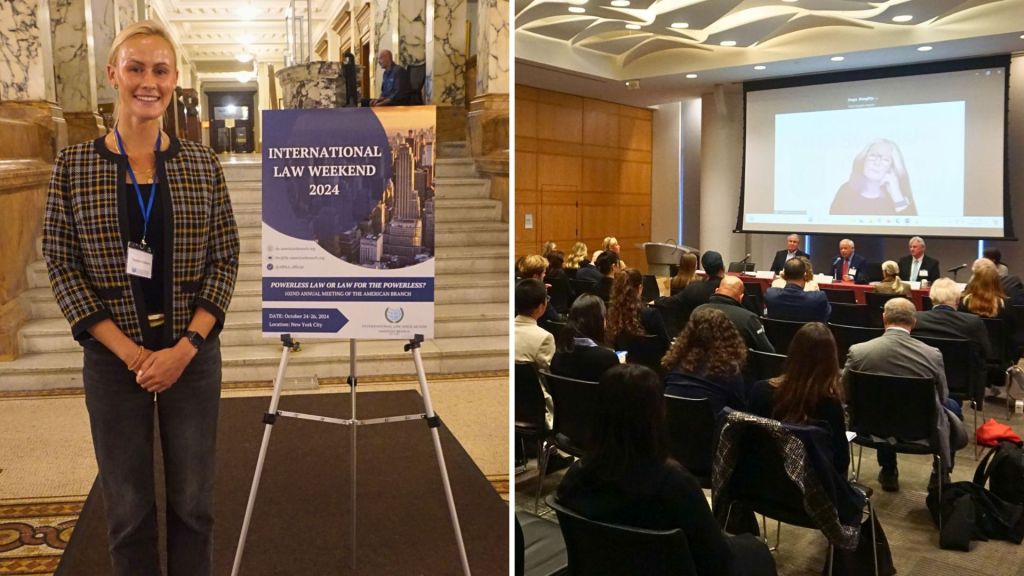
American Branch of the International Law Association shares reflections of Georgia Law student Madison Graham (J.D. ’25)

University of Georgia School of Law student Madison Graham (J.D. ’25) was recently featured in the American Branch of the International Law Association‘s blog. Graham, who served as one of ABILA’s Student Ambassadors for their 2024 International Law Weekend (ILW), writes about the panel discussion, “Empowering International Law to Address Rising Tensions in Outer Space: The Woomera Manual on the International Law of Military Space Activities and Operations.”

Jack Beard, Professor and Director of the Space, Cyber & National Security Law Program at the University of Nebraska College of Law, and member of Committee on the Use of Force for the American Branch of the International Law Association (“ABILA”), served as the panel’s moderator. Panelists included Laura Grego, Senior Scientist and Research Director for the Global Security Program of the Union of Concerned Scientists; Heather Harrison Dinniss, Senior Lecturer for the Department of International and Operational Law at the Swedish Defence University; David A. Koplow, Scott K. Ginsburg Professor of Law for the Georgetown University Law Center; and Dale Stephens, Professor and Director of the Research Unit on Military Law and Ethics at the University of Adelaide, Australia.

Graham was one of five ambassadors selected nationwide to assist with the work of ABILA in the preparation of the International Law Weekend 2024 conference. She attended ABILA’s ILW along with 7 other Georgia Law students through the support of Louis B. Sohn Professional Development stipends, detailed in a prior post (here). Graham’s full blog post can be accessed here

Georgia Law’s Environmental Law Association hosts Fernanda Hopenhaym, member of the UN Working Group on Business and Human Rights

Earlier this month, the University of Georgia School of Law’s Environmental Law Association hosted Fernanda Hopenhaym, member of the UN Working Group on Business and Human Rights, for a virtual event entitled “Corporate Environmental Responsibility: International Legal Frameworks and US Performance.” Georgia Law Professor Christopher M. Bruner, Stembler Family Distinguished Professor in Business Law & Faculty Co-Director of the Dean Rusk International Law Center, moderated the conversation.

Hopenhaym and Bruner discussed the connection between environmental sustainability and human rights, exploring key dynamics, including how communities can suffer when their rights to food, clean water, and fair working conditions are compromised and how corporations are voluntarily improving their practices, but the complexity of their structures—spanning subsidiaries and global supply chains—makes full due diligence difficult. They also talked about where the U.S. stands on corporate compliance and the challenges in providing remedies for affected communities. They concluded the event by discussing the future of corporate accountability, particularly in the context of the ongoing UN Treaty on Business and Human Rights (BHR) process.

Hopenhaym is Co-Executive Director at Project on Organizing, Development, Education and Research (PODER), an organization in Latin America dedicated to corporate accountability. For twenty years, Ms. Hopenhaym has worked on economic, social and gender justice. Since 2006 Ms. Hopenhaym has been working on issues related to human rights and financial institutions and in the last ten years, she has focused specifically on business and human rights, working to advance corporate accountability and strengthen respect for human rights vis-a-vis private and public investments or development projects, and private sector operations. She has been involved in processes related to the implementation of the UN Guiding Principles, as well as in other processes regarding relevant instruments, such as the Binding Treaty negotiations and due diligence laws. She has conducted research on cases related to corporate impact on human rights and the environment and worked with and accompanied local communities affected by public/private projects in their pursuit of justice and remedy. She has conducted advocacy in the LAC region and globally to advance corporate accountability and human rights as well as leading training and capacity building on business and human rights related issues. From January 2019 to December 2021, Ms. Hopenhaym was Chair of the Board of ESCRNet, the international network for economic, social and cultural rights; she has been a board member of EarthRights International since early 2021 and an adviser to the Business and Human Rights Award Foundation since early 2020.

Georgia Law’s Environmental Law Association “seek[s] to further the development and advancement of environmental law through activities designed to increase environmental awareness among members of the community at large and the student bodies of the University of Georgia and the Georgia School of Law.” This year’s ELA President, Kellianne Elliott (J.D. ’26), and Carolina Ruiz (LL.M. ’26) organized this event.