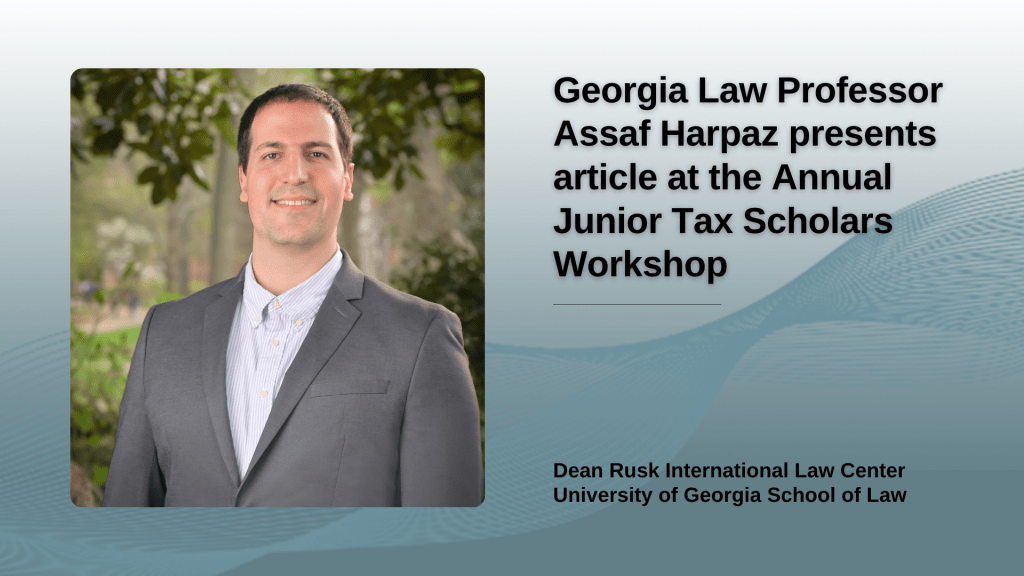
University of Georgia School of Law Professor Assaf Harpaz recently presented his article, “Toward a Theory of Tax Sovereignty,” at the Annual Junior Tax Scholars Workshop hosted by the Seattle University School of Law. While there, Harpaz also commented on Professor Jeesoo Nam’s (USC Law) article “Better to Let 10 Guilty Persons Escape Taxation than that 1 Innocent Suffer Taxation: Why Doesn’t Blackstone’s Principle Apply to Tax Law?”
Below is the article abstract:
Tax sovereignty is traditionally understood to encompass a government’s right to decide what to tax, at what rates, from whom, and without external interference. Tax sovereignty has been frequently invoked in the context of multilateral initiatives to combat tax competition and evasion, yet the concept remains vague and underdeveloped. In recent years, international taxation has been characterized by an increase in national revenue preservation, forum-shopping, and unilateralism. These dynamics are reflected in the Trump administration’s rejection of the Global Tax Deal and the imposition of global tariffs, the efforts of developing countries to shift tax policymaking to the United Nations, and the proliferation of unilateral digital services taxes targeting Big Tech.
This Article proposes a doctrinal account of tax sovereignty for an international tax order in which cooperation and standardization are progressively contested. The Article argues that tax sovereignty should operate as a doctrine with well-defined parameters and limiting principles, rather than an unrestricted claim of taxing power. It draws on tax and international law theory to distinguish between procedural sovereignty, which includes the state’s authority to freely participate in cooperative forums, and substantive sovereignty, which refers to the right to independently draft tax legislation. In doing so, the Article provides a framework for evaluating competing claims of tax sovereignty and assessing the legitimacy of tax policies with cross-border implications.
Harpaz joined the University of Georgia School of Law as an assistant professor in summer 2024 and teaches classes in federal income tax and business taxation. Harpaz’s scholarly focus lies in international taxation, with an emphasis on the intersection of taxation and digitalization. He explores the tax challenges of the digital economy and the ways to adapt 20th-century tax laws to modern business practices.

