Today, we welcome a guest post by Lauren Parramore, a member of the University of Georgia School of Law class of 2027. Parramore is the nineteenth Georgia Law student to participate in a semester-long international externship and the fifth recipient of a grant from the Halle Foundation to support her legal externship in Germany. The semester-long externships overseas initiative is an extension of the Center’s existing Global Externships Overseas and is offered jointly between the Center and the law school’s Clinical and Experiential Program. Parramore’s post describes her experience as a legal extern with Bodenheimer, a German law firm specializing in international arbitration. Parramore spent her semester in Bodenheimer’s Berlin office, where she worked under Georgia Law alumnus Dr. Christof Siefarth (LL.M., ’86). Dr. Siefarth, who is also a member of the Dean Rusk International Law Center’s Advisory Council, is a Partner at Bodenheimer.
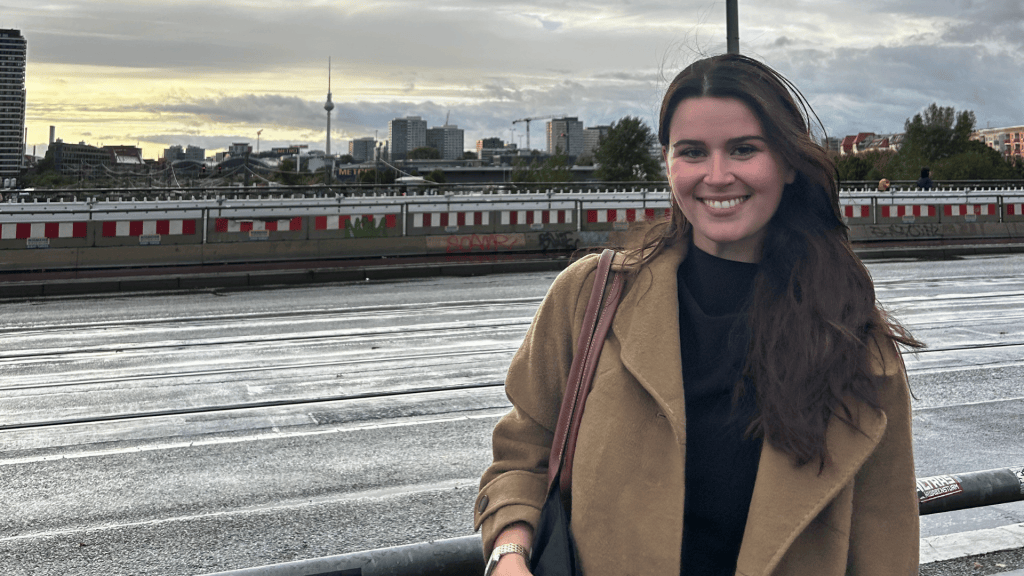
When I began planning my legal externship with BODENHEIMER, I faced a difficult choice: whether to split my time between the firm’s Cologne and Berlin offices or to commit to one for the semester. After some deliberation, I chose to spend the entire fall in BODENHEIMER’s Berlin office rather than moving to Cologne halfway through. I wanted time to learn the city, get comfortable in my new surroundings, and feel like a genuine part of the community.
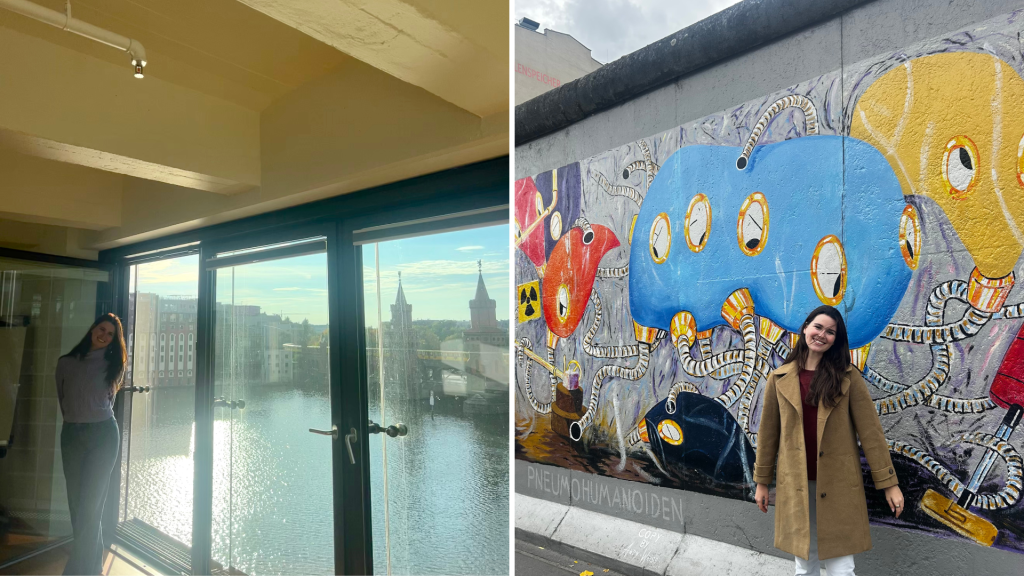
I was incredibly excited to arrive and pleased with my decision, but I found myself wrestling with a very specific kind of intimidation. Berlin carries a well-known reputation for being effortlessly cool, edgy, and endlessly dynamic, and I worried I simply wasn’t cool enough for Berlin. As I explored Berlin’s distinct neighborhoods—from quiet, family-oriented Prenzlauer Berg to historic Mitte and creative, lively Friedrichshain—I realized that every neighborhood carries its own unique vibe and draws a different kind of person. A hallmark of the city is that there is no single Berlin “type,” but rather a space for everyone.
I soon realized how much Berlin has to offer, so much that it was almost overwhelming. Embracing those opportunities, however, meant confronting a hesitation I hadn’t expected: at first, I was reluctant to explore restaurants, sights, and cultural events on my own. I quickly understood, however, that it was do it alone, or not at all. Pushing past that barrier meant learning to face new and at times uncomfortable situations alone, like navigating the Deutsche Bahn and its many delays, exploring nearby cities like Prague and Salzburg, or trying a new restaurant by myself. Each of those moments forced me to get comfortable feeling temporarily uncomfortable.
I applied that same mindset to learning the German language. While Berlin is a very international and English-friendly city, I wanted to take advantage of the opportunity for long-term immersion I likely will not have again. My very first order of business, and my most rewarding one, was mastering how to order a döner kebab, a Turkish-German staple found on nearly every street corner. Practicing with amused colleagues or a phone app was comfortable and easy. Stumbling through a real exchange at a döner counter was not, and that was the point. I quizzed my German colleagues throughout the day on the language’s intricacies and, frankly, treated them as a language textbook. Trying to speak German was a sign of respect, but it was also something more. I realized that if I didn’t put myself in awkward, unpolished situations, I wouldn’t grow. I also applied this lesson in the workplace.
At work, I had plenty to learn. BODENHEIMER offers an extraordinary vantage point into international arbitration and cross-border dispute resolution. Working alongside colleagues from across the globe, I had the opportunity to see how international matters are managed in practice.
Rather than merely reading about foreign legal frameworks or arbitral institutions in a textbook, I found myself immersed within them. Whether I was assisting with active matters, conducting research, or helping draft materials on emerging trends, each task brought to life things I had only previously encountered in textbooks. I approached every day as an opportunity to absorb as much as I could. Simply being in the office and observing conversations and attorney interactions taught me how international lawyers navigate different legal frameworks, dispute types, language barriers, and procedural hurdles.
Yet some of the most memorable learning happened away from my desk. Over lunch or coffee, my colleagues and I traded life updates and talked through the matters on their desks for that day, which provided a natural, welcoming setting to ask questions and learn about their work. My time at BODENHEIMER has demystified international practice and showed me what day-to-day work in this field actually looks like.
Looking back, the initial discomfort I felt from stepping into an unfamiliar environment became an opportunity for significant growth. Exploring a city on my own, risking embarrassment in a new language, even sitting down to a meal for one—each taught me a lesson that applies to nearly every area of life: that meaningful growth lives on the other side of comfort. The same was true at BODENHEIMER. Asking a question I worried was obvious, taking on an assignment in an unfamiliar area of law, or offering my view to lawyers trained in a different legal system each required the same willingness to be uncomfortable, and each made me a more confident future lawyer.
Most importantly, I gained confidence in my ability to adapt to new environments and trust myself in unfamiliar spaces. Professionally, I leave Berlin with a practical understanding of how international disputes are handled and the confidence to contribute in a setting where I am not yet the expert. Participating in a global externship abroad has equipped me with the concrete skills and internal resilience needed to step into the unfamiliar situations, put myself out there, and thrive, not just in Berlin, but anywhere my career takes me.
The growth I experienced in Berlin would not have been possible without the support of so many people. I am sincerely grateful to the Dean Rusk International Law Center, The Halle Foundation, and the entire team at BODENHEIMER for making this experience possible and for helping me make the most of every moment of it.
***
Applications are open for fall 2027 and spring 2028 semester-long Global Externships Overseas (GEOs). All current 1Ls and 2Ls are invited to submit an application by March 1. For more information and the application, please email: ruskintlaw@uga.edu

