International Law Society hosts gathering of globally minded students

1

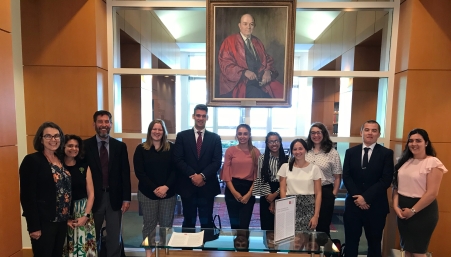
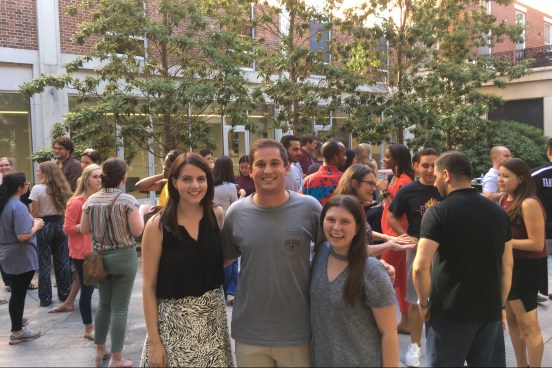
International Law Society leadership, from left: Hanna Karimipour, President; Sam Hatcher, Treasurer; and Caitlin Felt, Social Chair

The International Law Society, the University of Georgia School of Law chapter of the worldwide International Law Students Association, hosted a mixer at the end of last week to welcome new globally minded students to their community.

3Co-sponsored by the Dean Rusk International Law Center, the mixer took place last Thursday in the law school’s Eversheds Sutherland Courtyard. This much-anticipated event afforded JD, LLM, and MSL students the chance to relax and learn from each other’s interests and experiences.
IMG_5291


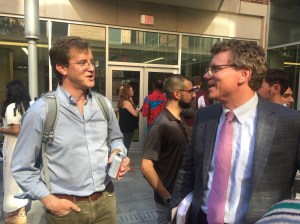
Several faculty members, including Professors Diane Marie Amann, Christopher Bruner (near right), Rob McNiff (far right), and Dan Coenen, dropped by to learn about students’ international ambitions and share their own unique advice and experiences. Staff of the Dean Rusk International Law Center was also on hand to discuss the Center’s international initiatives such as Global Externships Overseas, the Global Governance Summer School, and upcoming events.

The event kicked off with a welcome from Hanna Karimipour, International Law Society President. She gave an overview of the chapter and of opportunities afforded to its members. Kathleen A. Doty, Director of the Dean Rusk International Law Center, then provided information about upcoming events and initiatives at the Center.


A warm thank you to all who were able to attend.

LL.M. academic year kicks off at Georgia Law

LLMbrochureCLR2017It’s an exciting time for the LL.M. degree at Georgia Law: orientation for new students began today at the Dean Rusk International Law Center, as we welcomed sixteen foreign-educated lawyers from around the world to Georgia Law. They will begin classes alongside J.D. students next week.

Soon to open is the application for the LL.M. class of Fall 2019 — on September 1, 2018 — via LSAC. Generous merit scholarships will be awarded to top candidates who apply by January 15, 2019. Graduates of law schools outside the United States who are interested in studying at Georgia Law are encouraged to contact us for more information.

KagelHead

Several University of Georgia staff members have also recently returned from the EducationUSA Forum 2018 in Washington D.C., including Dr. Laura Kagel, our Center’s Associate Director for International Professional Education, Robin Catmur, Director of Immigration Services, and Chenelle Goyen, Associate Director of Admissions and International Admissions for undergraduate students. 1The Forum, hosted by EducationUSA, a U.S. Department of State network of over 425 international student advising centers in more than 175 countries, offered an array of panels focused on international recruiting trends and best practices.

Stay tuned for more information about our incoming LL.M. class; it’s shaping up to be a great year!


Law in Practice International Interns from Sheffield Hallam University visit the Dean Rusk International Law Center for training

Group Photo RuskLast week, the Dean Rusk International Law Center was pleased to co-present a training with Sheffield Hallam University on criminal law and human rights for eight law students from the United Kingdom. Organized by Dr. Laura Kagel, Associate Director for International Professional Education at the Dean Rusk International Law Center, and Michael Edwards (J.D. ’93), Senior Lecturer in Law and Criminology at Sheffield Hallam University, the four-day training was designed to prepare the students for summer internships they will undertake in the United States.
Faculty from both universities lectured on relevant topics. These included Georgia Law professors: Anne Burnett on legal research methods; Andrea Dennis on evidence; and Russel Gabriel on criminal procedure. From Sheffield Hallam University Michael Edwards lectured on international human rights and civil rights law, and Christopher Riley presented an introduction to the student internships.

IMG-1797

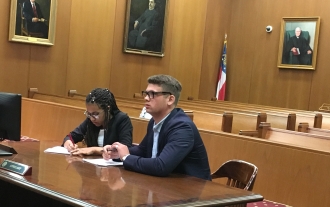
In addition to coursework, while in Athens, the students observed court proceedings and met with local prosecutors and court officials to hear about treatment and accountability courts. Organized by Assistant District Attorney Paige Otwell (J.D. ‘88), this discussion was particularly engaging, as England currently only has one court of this type. Students also spent a day learning more about advocacy and civil rights in Atlanta. The students prepared and presented mock oral arguments at the Supreme Court of Georgia, toured the State Capitol, and visited the Martin Luther King, Jr. National Historical Site. They also visited the Southern Center for Human Rights, where Tiffany Williams Roberts, Community Engagement and Movement Building Counsel, discussed the work of the non-profit law firm.

The Sheffield students are now off to begin their internships; we wish them an enriching summer!

Professor Bruner publishes chapter on “How Small Jurisdictions Compete in International Financial Services”

Christopher M. Bruner, J. Alton Hosch Professor of Law here at the University of Georgia School of Law, has just published “How Small Jurisdictions Compete in International Financial Services.”

This chapter appears in Integration and International Dispute Resolution in Small States, a 2018 Springer volume edited by Petra Butler (Victoria University of Wellington, New Zealand), Eva Lein (University of Lausanne, Switzerland), and Salim Rhonson (Open University).

Bruner’s contribution is a revised version of his keynote address at a conference on “International Financial Services and Small States,” held in London in 2017.

Professors Hall and Turner present in Netherlands, at Association for Law, Property and Society annual meeting


Professors Matthew I. Hall and Christian Turner, both members of the University of Georgia School of Law faculty, recently presented at the annual meeting of the annual conference of the Association for Law, Property & Society, held this year at the University of Maastricht in the Netherlands.

Hall (pictured top left) and Turner delivered their presentation, entitled “The Judicial Agenda and Angry Neighbors,” as part of a 5-paper panel on “Designing Optimal Rules, Markets, and Registries in Property Law.”

Known by its acronym ALPS, the Association for Law, Property & Society “brings together scholars from different disciplines to discuss their work and to foster dialogue among those working in property law, policy, planning, social scientific field studies, modeling, and theory.”

Professor Bruner compares UK, US business practices in new “Research Handbook on Fiduciary Law”

Christopher M. Bruner, J. Alton Hosch Professor of Law here at the University of Georgia School of Law, has just published “Opting Out of Fiduciary Duties and Liabilities in U.S. and U.K. Business Entities.” It appears as a chapter in a 2018 Edward Elgar volume, entitled Research Handbook on Fiduciary Law, and edited by D. Gordon Smith, Dean and Glen L. Farr Professor of Law at Brigham Young University’s J. Reuben Clark Law School,  and Andrew S. Gold, Professor of Law at DePaul University College of Law.

Here’s the SSRN abstract for Bruner’s contribution:

This chapter explores the extent of contractual freedom to opt out of fiduciary duties and liabilities in U.S. and U.K. business entities, including the U.S. corporation, general partnership, limited partnership, limited liability partnership, and limited liability company, and the U.K. limited company, general partnership, limited partnership, and limited liability partnership.

Discernible commonalities emerge from this comparative analysis. Notably, corporate law readily permits reducing liability exposure for breaches of duty in each jurisdiction, yet provides only quite limited capacity to carve back at the substance of the duties themselves. Meanwhile, unincorporated entities in each jurisdiction offer substantially greater latitude to limit the duties themselves, in some cases resulting in purely contractual business relationships.

Yet substantial differences are also apparent. U.S. corporate law permits greater insulation from liability exposure, and U.S. unincorporated entities generally provide clearer and more extensive latitude to eliminate default duties of loyalty and care outright (particularly in Delaware). One cannot comprehensively declare that U.S. law universally deviates further from the “fiduciary” governance paradigm, however, because the U.K. limited liability partnership has gone further by providing an entity form in which no such general default duties apply at all.

The analysis raises some complex comparative questions, and the chapter closes with brief reflections on why such trends, commonalities, and divergences may have arisen.

Register now for inaugural Women’s Leadership in Academia Conference, to be held July 19-20 at Georgia Law

Women law professors, librarians, and clinicians in, or interested in, leadership positions are invited to take part in the inaugural Women’s Leadership in Academia Conference, to be held July 19-20, 2018, here the University of Georgia School of Law in Athens, about 65 miles northeast of Atlanta.

Keynote speakers will be Kellye Testy, former Dean of the University of Washington School of Law, who serves as President and CEO of the Law School Admission Council (LSAC is a conference sponsor), and Professor Libby V. Morris, Director of the Institute of Higher Education and Zell B. Miller Distinguished Professor of Higher Education, as well as a former interim provost, at the University of Georgia.

Session speakers will include Hari M. Osofsky, Dean at Penn State Law; Sonja West and Emma Hetherington, Georgia Law; RonNell Anderson Jones, Utah Law; Dahlia Lithwick, Slate; Mary-Rose Papandrea, North Carolina Law; Lisa Radtke BlissAndrea A. Curcio, and Jessica Gabel Cino, Georgia State Law; Raye Rawls, University of Georgia J.W. Fanning Institute for Leadership Development; Claire Robinson May, Cleveland State Law; KerryAnn O’Meara, University of Maryland College of Education;  Tim McFeeley, Isaacson, Miller; Lucy A. Leske, Witt/Kieffer; Laura Rosenbury, Dean at Florida Law; Hillary Sale, Washington University-St. Louis Law; and Melanie Wilson, Paula Schaefer, and Joy Radice,  Tennessee Law.

The conference will focus “on building skills and providing tools and information that are directly applicable to women in legal education looking to be leaders within the academy.” As detailed in the full conference program, session topics will include:

  • #MeToo and the Legal Academy
  • Exploring the Value of Female Mentoring Relationships to Cultivate Law School Leadership
  • Strategies for Conflict Management and Dialogue
  • Engendering Equality Within Your Institution: Establishing a Women’s Committee to Achieve Meaningful Change
  • Addressing Gender Disparities in Institutional Service Workloads
  • Academic Search Process Panel
  • Negotiation Strategies
  • Leadership Challenges and Solutions over the Course of a Career
  • Deans Panel

For registration and other details, see here. And act now: the hotel bloc will close in a few days.

Georgia Law Professor Harlan Cohen presents “Multilateralism’s Life Cycle” in visit at University College London

Harlan Grant Cohen, the Gabriel M. Wilner/UGA Foundation Professor in International Law and Faculty Co-Director of the Dean Rusk International Law Center here at the University of Georgia School of Law, spent the last two weeks as a visitor of University College London (UCL) Faculty of Laws newly renovated building, Bentham House.

As part of Cohen’s visit, UCL’s Global Governance Institute invited him to give a public keynote lecture on “Multilateralism’s Life Cycle.” As previously posted, that is the topic of his forthcoming article for the American Journal of International Law.

Cohen is a member of AJIL’s Board of Editors, and serves as Editor of the journal’s International Decisions section.

Georgia Law Professor Amann presents “A New History of the Nuremberg Trials” at Oxford University’s Bonavero Institute of Human Rights

We’re pleased today to cross-post this report from Professor Diane Marie Amann, Emily & Ernest Woodruff Chair in International Law and Faculty Co-Director here at the Dean Rusk International Law Center, University of Georgia School of Law, who undertook research-intensive semester this spring:

OXFORD – A capstone of my Hilary-Trinity Term visit here took place yesterday, when I presented “A New History of the Nuremberg Trials: Figuring Women and Others into the Narrative” to law students and faculty who gathered at the Bonavero Institute of Human Rights, located at Oxford University’s Mansfield College. The Oxford Transitional Justice Research network cosponsored.

Professor Kate O’Regan, director of the institute and a former judge on the Constitutional Court of South Africa, opened my Research Visitor Seminar. Then came my  presentation of my research on the roles women played at Nuremberg – not only the Trial of the Major War Criminals before the International Military Tribunal, but also the 12 subsequent American trials before what are known as the Nuremberg Military Tribunals. Next, Dapo Akande, Professor of Public International Law at Oxford’s Blavatnik School of Government, offered discussant’s remarks before opening the floor for a stimulating round of Q&A.

I’m grateful to all at the Institute for this event and the hospitality I’ve enjoyed during my stay at a Bonavero Research Visitor and Mansfield College Visiting Fellow. Grateful, too, for the opportunities I’ve had to present this work elsewhere in Europe, at the Irish Centre for Human Rights at the National University of Ireland Galway, University of Stockholm, University of Göttingen, and Max Planck Institute Luxembourg.

Georgia Law Professor Chapman presents “Due Process of War” at Oxford University Faculty of Law

OXFORD – University of Georgia School of Law Professor Nathan S. Chapman recently visited Oxford University to deliver a paper entitled “Due Process of War.” He spoke at Oxford’s Trinity College, on the invitation of the Programme for the Foundations of Law and Constitutional Government, a project within the auspices of the Oxford Faculty of Law.

In his presentation, Chapman set forth an historical account of how thinkers in America’s founding era understood the interplay of war and due process. He then linked these understandings to much more recent events, such as the United States’ 2011 targeted killing by drone strike of an American citizen, Anwar al-Awlaki.

The paper follows from Chapman’s other works in this area, including “Due Process Abroad,” published in 2017 in the Northwestern University Law Review.