Georgia Law profs Cohen and Cade win interdisciplinary research seed grants

Two University of Georgia School of Law professors will take part in transnationally focused research projects, recent winners in a universitywide funding competition.

The 2 projects were among a dozen funded by the University of Georgia  Presidential Interdisciplinary Seed Grant Program. More than 150 faculty teams submitted proposals.

The Georgia Law award-winners are:

Harlan G. Cohen, who holds the Gabriel M. Wilner/UGA Foundation Professor in International Law, will take part in research on “Forecasting the threat of cyber attacks, nation by nation.” Also on the team for this project are faculty from the university’s Franklin College of Arts & Sciences and School of Public & International Affairs, plus a political scientist from the State University of New York-Albany.

Jason A. Cade, Assistant Professor of Law and Director of the law school’s Community Health Law Partnership Clinic. He will collaborate on “Building a network of cultural liaisons to improve the health and well-being of Athens-area Latinos.” The research project’s team also includes faculty from the university’s College of Education, College of Family & Consumer Sciences, College of Pharmacy, College of Public Health, School of Social Work, Latin American & Caribbean Studies Institute, and J.W. Fanning Institute for Leadership Development.

Distinguished India-based alumna, Priti Suri, earns prestigious ABA award

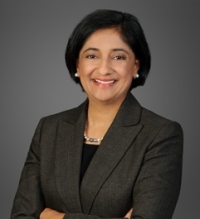
Delighted to congratulate of our our distinguished LL.M. alumnae, Priti Suri, recipient of one of the most prestigious American Bar Association awards. (photo credit)

The ABA Section of International Law bestowed its Mayre Rasmussen Award for the Advancement of Women in International Law upon Suri Wednesday, at a luncheon during the Section’s Spring Meeting in Washington, D.C. Regarding Suri’s award, the Section said:

“Priti’s role as a mentor and in opening doors for women and women lawyers in India make her the perfect candidate for the Mayre Rasmussen Award.”

In a LinkedIn post, Suri responded:

“I feel truly humbled, as the first Asian, to receive ABA’s Mayre Rasmussen career achievement award. To everyone who contributed – my incredible family, my friends, my co-workers, my teachers and to every single person who has been with me on this journey – a very big thank you. Miles and miles to go still….”

Suri is the founder-partner of PSA Legal Counsellors, an Indian business law firm with offices in New Delhi and Chennai. Its practice spans many industries, and includes cross-border M&A transactions, strategic investments, joint-ventures including tender and exchange offers, venture capital financings, structuring private equity deals, leveraged buyouts, and divestitures.

This week’s ABA honor comes not long after another: last October, Suri was named to the India Business Law Journal A-List of India’s top 100 lawyers.

Since earning her Master of Laws degree from in 1989, Suri has remained active in the University of Georgia School of Law community. She frequently welcomes Georgia Law students as part of our Global Externship Overseas, and she has been an officer of the LL.M. Alumni Association.

The ABA Rasmussen Award is named after “a pioneer in the field of international business law” who died in 1998, and is given

“to individuals who have achieved professional excellence in international law, encouraged women to engage in international law careers, enabled women lawyers to attain international law job positions from which they were excluded historically, or advanced opportunities for women in international law.”

Among the prior Rasmussen Award recipients is another member of our Georgia Law community, Associate Dean Diane Marie Amann.

Brava!

Amann elected Counselor of the American Society of International Law

Delighted to congratulate our own Associate Dean Diane Marie Amann on her election as Counselor of the American Society of International Law.
Founded in 1907, ASIL is the foremost learned society in the international law field. From its headquarters in Washington, D.C., ASIL fosters dialogue, hosts and cosponsors conferences, and produces the American Journal of International Law and other publications, on behalf of its thousands of members throughout the world.

ASIL’s governing board is the Executive Council. Advising and serving as nonvoting members of the Council are Counselors, senior ASIL members who have made significant contributions to the Society and to the study and development of international law. Amann was elected to the position at ASIL’s Annual Meeting earlier this month.

Amann’s election followed her service in many ASIL leadership positions: Vice President; Co-Chair of the 2012 ASIL Annual Meeting in Athens and Atlanta, Georgia; voting member of the Executive Council and its Executive Committee; Grotius Lecture Distinguished Discussant; and member of the ABA-ASIL Joint Task Force on Treaties in U.S. Law,  the Blacks in ASIL Task Force, the ASIL Judicial Advisory Board, and Program Committees for the 2012 Annual Meeting in Washington and for the 2007 ASIL-AALS Midyear Meeting in Vancouver. She is Editor-in-Chief of the ASIL Benchbook on International Law, and also has published in the American Journal of International Law, ASIL Annual Meeting Proceedings, and the ASIL-produced Proceedings of the International Humanitarian Law Dialogs.

In 2013, Amann received the Prominent Woman in International Law Award from ASIL’s Women in International Law Interest Group. Above, she delivers her award speech at the Annual Meeting while a cutout of Eleanor Roosevelt looks on.

At the University of Georgia School of Law – an ASIL Academic Partner – Amann holds the Emily & Ernest Woodruff Chair in International Law. Since 2015, she also has served as Associate Dean for International Programs & Strategic Initiatives; her duties include directing the law school’s 40-year-old Dean Rusk International Law Center. She teaches and publishes widely on issues related to public international law, international and transnational criminal law, the laws of war, international human rights law, and children & international law. She has served since 2012 as the International Criminal Court Prosecutor’s Special Adviser on Children in & affected by Armed Conflict.

Georgia Law team in Vienna for Vis International Arbitration Moot

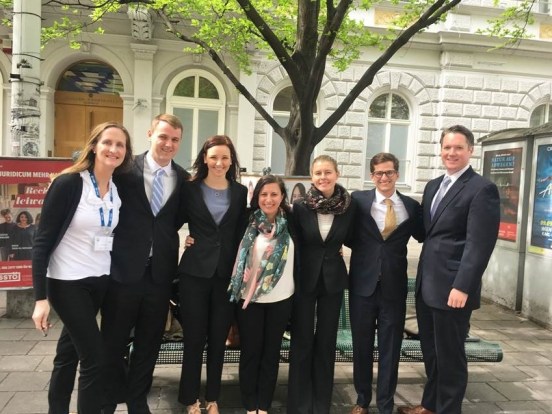
Delighted to introduce the representatives of the University of Georgia School of Law who are competing this week in Vienna, Austria, at the 24th Willem C. Vis International Commercial Arbitration Moot. They continue a long Georgia Law tradition of participation in this annual event.

At either end are two Associates at King & Spalding LLP in Atlanta: Sara Sargeantson Burns, team coach, and Christopher Smith, who was a member of Georgia Law’s Vis team while earning his J.D. degree here; in the middle is 3L Emily Cox, a member of last year’s competition team and this year its student coach. Also pictured, from the left of Burns to right, are 2L team members Jared Magnuson, Victoria Barker, Maria Kachniarz, and Wheaton Webb.

Viel Glück!

USC Shoah Foundation awards inaugural research fellowship to Associate Dean Amann

The first-ever Breslauer, Rutman and Anderson Research Fellowship has been awarded to Diane Marie Amann. Amann joined the University of Georgia School of Law in 2011, taking up the Emily & Ernest Woodruff Chair in International Law. She also has served, since 2015, as Georgia Law’s Associate Dean for International Programs & Strategic Initiatives.

Amann speaking at the 2016 launch of the International Criminal Court Office of the Prosecutor Policy on Children that she helped prepare in her role as the Prosecutor’s Special Adviser on Children in & affected by Armed Conflict.

The Breslauer, Rutman and Anderson Research Fellowship arises out of a recent gift to the Center for Advanced Genocide Research at the University of Southern California Shoah Foundation in Los Angeles.

Established by Steven Spielberg in the early 1990s, just after he completed his film Schindler’s List, the foundation contains extensive visual history archives. These include oral histories by numerous participants in the post-World War II trials in Europe. Those trials lie at the core of Amann’s scholarship on “Women at Nuremberg,” which explores the many roles women played in those proceedings, including prosecutors, defense counsel, journalists, witnesses, staffers, and defendants – everything except judges.

Among those whose oral histories may be found at these archives are two members of the U.S. prosecution team: Cecelia Goetz, who as part of the Krupp case became the only woman to deliver part of an opening statement at Nuremberg, and Belle Mayer Zeck, who helped to try the Farben case. As quoted at the USC Shoah Foundation website, Amann commented:

“I’m very interested in finding out what they remember and what they thought was important and what their feelings were about the Nuremberg project. It seems to me there’s a lost story about that era that would be worth uncovering to give a richer picture of what that period was about.”

Amann’s visit to USC will occur next January, during a research-intensive Spring 2018 semester during which she will continue to pursue a Ph.D. in Law at Leiden University in the Netherlands.

Digital Commons upload extends reach of scholarship in Georgia Law journals

The Alexander Campbell King Law Library at the University of Georgia School of Law recently celebrated the upload, to the Digital Commons Repository, of all back issues of two of the law school’s reviews:

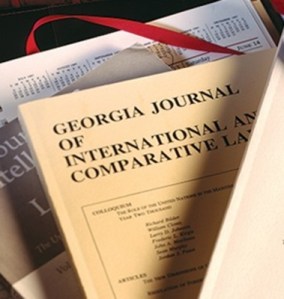
► The Georgia Journal of International and Comparative Law, started in 1971 as a student initiative supported by former U.S. Secretary of State and Georgia Law Professor Dean Rusk. GJICL publishes three time a year, featuring work by legal scholars and practitioners as well as student notes. The law school’s Dean Rusk International Law Center frequently cosponsors conferences with GJICL, as it did in September 2016 with “Humanity’s Common Heritage: Conference on the 2016 ICRC Commentary on the First Geneva Convention.” (additional posts on this event here)

► The Journal of Intellectual Property Law. Established in 1993, JIPL is among the oldest of the top 25 intellectual property law periodicals in the United States. JIPL publishes annual print volumes of two issues and online essays on areas of trade secrets, patents, trademarks, copyrights, internet law, and sports and entertainment law.

Scholarship related to international, comparative, and transnational law also often is posted at the Dean Rusk International Law Center Research Paper Series at SSRN. (prior post)

The just-completed online archive contains 44 years of GJICL scholarship and 23 years of JIPL scholarship, for a combined total of 1,721 uploaded items. At the end of last month, downloads from the two journals numbered nearly 190,000, from all countries in the world. The archive will continue to grow as future issues are added.

Global migration topic of 2-day AILA event our alumna’s helping organize

On behalf of a member of our Dean Rusk International Law Center Council, we’re pleased to announce an upcoming event:

The American Immigration Lawyers Association Global Migration Section  will host a conference entitled “Global Immigration in a Protectionist World” June 20-21, 2017, in New Orleans, Louisiana.

Panel topics include: the future of immigration law from a global perspective, running a global practice, consular processing, European Union immigration directives in light of Brexit, cybersecurity, and global mobility options for LGBT clients.

Alumna and Council member Anita E. J. Ninan (above), who is Of Counsel at Arnall Golden Gregory LLP in Atlanta and Advocate, Bar Council of Delhi, India, serves on the conference committee for this group – which, she writes, is

“the global outbound immigration section of AILA and includes foreign attorneys and legal practitioners as its members.”

Registration (early bird rates end May 10) and further details here.

Professor Wells publishes review of book on torts harmonization in Europe

Professor Michael Lewis Wells, who holds the Marion and W. Colquitt Carter Chair in Tort and Insurance Law here at the University of Georgia School of Law, has posted “Harmonizing European Tort Law and the Comparative Method: Basic Questions of Tort Law from a Comparative Perspective” at SSRN. The review of a book by a Viennese torts scholar is forthcoming in volume 9 of the peer-reviewed Journal of Civil Law Studies.

The manuscript, which forms part of our Dean Rusk International Law Center Research Paper Series at SSRN, may be downloaded here.

Here’s the abstract:

This is a book review of Basic Questions of Tort Law from a Comparative Perspective, edited by Professor Helmut Koziol. This book is the second of two volumes on “basic questions of tort law.” In the first volume, Professor Helmut Koziol examined German, Austrian, and Swiss tort law. In this volume Professor Koziol has assembled essays by distinguished scholars from several European legal systems as well as the United States and Japan, each of whom follows the structure of Koziol’s earlier book and explains how those basic questions are handled in their own systems.

This review focuses on Professor Koziol’s ultimate aim of harmonization, and on the contribution of these essays to that project. Harmonization of tort law across the member states is not just a matter of working out answers to such questions as the content of the liability rule or whether non-pecuniary harm should be recoverable. Harmonization raises an issue of European Union federalism. That question is not explicitly addressed in either volume, yet the value of the project, and prospects for its success, turn on the answer to it. I argue that Professor Koziol has not made a convincing case for EU displacement of member state tort law.

Georgia Law alum co-authors commentary on US surveillance law

Gary Ashcroft, who earned his J.D. degree cum laude from the University of Georgia School of Law just last year, has co-authored “Why Electronic Surveillance Reform is Necessary,” a commentary at Lawfare, a leading national security blog.

The post, which is drawn from a longer version here, argues for reform of the FISA (Foreign Intelligence Surveillance Act) Amendments Act of 2008, commonly known as Section 702, and relied upon by the country’s intelligence community, or “IC.” It concludes:

“Section 702 is a valuable intelligence tool that exhibits some significant deficiencies in its protections for U.S. persons in a law enforcement context and for U.S. competitive interests abroad. Policymakers should craft reforms that guard against the misuse of Section 702 by law enforcement and redefine the relationship between the IC and tech companies. As they do so, policymakers can ensure that Section 702 continues to fulfill its vital national security functions while also respecting the civil liberties and corporate interests of U.S. persons and companies. “

Ashcroft (above left) is a Fellow for National Security at Third Way, a centrist thinktank in Washington, D.C. While a law student, he served as Research Assistant to Professor Harlan G. Cohen, served as Director of Legislative Research for State Rep. Spencer Frye, interned at the ACLU of Georgia, and was a Google Policy Fellow, working on cyber issues, at D.C.’s American Enterprise Institute. Ashcroft wrote the Lawfare commentary with Mieke Eoyang, Vice President for Third Way’s National Security Program.

International courts studied in new volume co-edited by Professor Cohen

Harlan Grant Cohen, the Gabriel M. Wilner/UGA Foundation Professor in International Law here at the University of Georgia School of Law, has just posted at SSRN “Introduction: Legitimacy and the Courts”, the opening segment of a forthcoming  Cambridge University Press volume. Institutions treated in subsequent chapters include the International Court of Justice, the World Trade Organization, the International Centre for the Settlement of Investment Disputes, and the European Court of Human Rights.

Cohen co-edited the forthcoming essay collection, entitled Legitimacy and International Courts, with Baltimore Law Professor Nienke Grossman, Deputy Director of her law school’s Center for International and Comparative Law, and two Oslo Law professors who co-direct that university’s PluriCourts project, Andreas Føllesdal and Geir Ulfstein.

The “Introduction” manuscript, which forms part of our Dean Rusk International Law Center Research Paper Series at SSRN, may be downloaded here.

Here’s the abstract:

Legitimacy and International Courts examines the underpinnings of legitimacy, or the justification of the authority, of international courts and tribunals. It brings together an esteemed group of authors, noted for both their expertise in individual courts, tribunals, or other adjudicatory bodies, and their work on legitimacy, effectiveness, and governance more broadly, to consider the legitimacy of international courts from a comparative perspective. Authors explore what strengthens and weakens the legitimacy of various different international courts, while also considering broader theories of international court legitimacy. Some chapters highlight the sociological or normative legitimacy of specific courts or tribunals, while others address cross-cutting issues such as representation, democracy, independence and effectiveness.

This Introduction surveys some of the key contributions of this volume and distills some of the lessons of its varied chapters for the legitimacy of international courts. Parts II and III are largely conceptual in approach, exploring what legitimacy means for each and all of the courts. Part IV takes a more functional approach, exploring how various factors internal or external to particular courts have contributed to those courts’ normative or sociological legitimacy. Part V provides thumbnail summaries of each the chapters that follow.