Georgia Law Professor MJ Durkee discusses “Interpretive Entrepreneurs” at St. John’s international law colloquium

Melissa J. “MJ” Durkee, the Allen Post Professor here at the University of Georgia School of Law, recently presented “Interpretive Entrepreneurs” as part of the annual colloquium at the Center for International and Comparative Law, St. John’s University School of Law, New York.

Durkee’s article on the subject is forthcoming in the Virginia Law Review

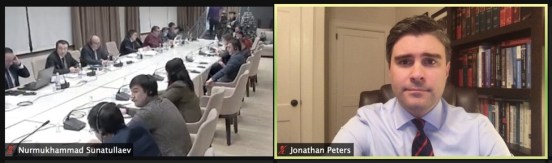
University of Georgia Professor Jonathan Peters, of Grady College and School of Law, presents on press freedom to court personnel and journalists in Uzbekistan

Pleased today to welcome a contribution from Jonathan Peters, an associate professor who has faculty appointments in the Grady College of Journalism and Mass Communication and the School of Law here at the University of Georgia. Professor Peters teaches and researches in the area of media law and policy, and his post here discusses his participation December 3 in an online training event hosted in Uzbekistan.

I was delighted recently to deliver two virtual presentations to court personnel and journalists in Uzbekistan, as part of a project facilitated by the United Nations Development Programme and supported by the United States Agency for International Development and the Supreme Court of the Republic of Uzbekistan.

The purpose of the project, called the “Rule of Law Partnership in Uzbekistan,” is to strengthen public access to the nation’s judicial system as well as public trust in it. One related priority has been to improve citizen knowledge of the courts and to encourage collaboration between court personnel and journalists. This has enabled the local media to tour Uzbekistan’s regional courts and to learn about international practices in court-journalist relations.

To those ends, I delivered presentations to a group of journalists and court personnel, including members of the Supreme Court of the Republic of Uzbekistan, on U.S. rights of access to courts and how American journalists cover legal issues. First, I discussed the tension between the First and Sixth Amendments and the various reasons that U.S. courts have generally protected media rights of access to judicial proceedings and records.

For example, the U.S. Supreme Court has observed repeatedly the historical importance of public trials and has reasoned that openness improves a trial’s functioning, that it has therapeutic value by “providing an outlet for community concern, hostility and emotion,” and that it enhances the public’s acceptance that justice is being done.

Moreover, in significant part, American journalists exercise their First Amendment rights as surrogates of the public when reporting on courts. As Justice Lewis F. Powell put it in Saxbe v. Washington Post Co., in his dissent: “For most citizens, the prospect of personal familiarity with newsworthy events is hopelessly unrealistic. In seeking out the news, the press therefore acts as an agent of the public at large. It is the means by which the people receive the … information and ideas essential to intelligent self-government.”

Then, in my second presentation, on how American journalists cover legal issues, I explored how the rule of law is preserved partly by public knowledge of court decisions and activities, and thus the media is a critical link between the judiciary and the public. So it is democratically important for journalists to explain what courts are doing and why—and to convey the implications (if any) for the public.

That means the journalists must be able to translate legal terms and concepts for a lay audience, and they must be able to distill into a short news story a complex legal action. It is also helpful for them to develop sources in the court system, while appreciating and respecting the ethical limits within which judges, lawyers, and court aides usually work.

After these remarks, the Q&A session opened up conversations among the journalists and court personnel in attendance, allowing us to have a dialogue on some of the issues most pressing for them. I hope the ultimate result is a more open judiciary and a freer press in Uzbekistan.

Georgia Law Professor Cohen presents “Sociology of WTO Precedent” at Leiden “Behavioral Approaches” workshop

Harlan Cohen, the Gabriel M. Wilner/UGA Foundation Professor in International Law and Faculty Co-Director of the Dean Rusk International Law Center here at the University of Georgia School of Law, presented on “The Sociology of WTO Precedent” last month at a workshop entitled “Behavioral Approaches to International Law.”

It was sponsored online by the Grotius Centre for International Legal Studies at Leiden Law School in the Netherlands, in partnership with the Institute of Law and Economics at the University of Hamburg in Germany, and iCourts at the University of Copenhagen in Denmark. Organizers were Leiden Professor Daniel Peat, Copenhagen Professor Veronika Fikfak, and Hamburg Professor Eva van der Zee.

Georgia Law Professor Christopher Bruner publishes on AI and corporations in Cambridge Law Journal

Professor Christopher Bruner, the Stembler Family Distinguished Professor in Business Law here at the University of Georgia School of Law, has published “Distributed Ledgers, Artificial Intelligence and the Purpose of the Corporation” in 79 Cambridge Law Journal 431 (2020).

Here’s the abstract:

“Distributed ledgers and blockchain technology are widely expected to promote more direct shareholder involvement in corporate governance by reducing costs of voting and trade clearance. Meanwhile, artificial intelligence may shrink the decision-making terrain where corporations rely on human management. This article analyses these technologies and concludes that, while such outcomes are plausible, their potential corporate governance impacts are likely more complex and contingent. Despite the implicit libertarianism that characterises much of the discourse, we in fact have choices to make about how such technologies are developed and deployed – and these policy decisions will have to be grounded in a normative conception of corporate purpose external to the technology itself.”

Bruner presented the work at a conference on “The Future of the Firm” held last year in London.

Professor Ringhand, Center’s Interim Director, takes part in University of Oxford panel on U.S. presidential election

Lori A. Ringhand, J. Alton Hosch Professor of Law and Interim Director of the Dean Rusk International Law Center here at the University of Georgia School of Law, took part earlier this month in a University of Oxford panel discussion on the American electoral process.

The panel, entitled “‘Our Character is on the Ballot’: Reflections on the US Presidential Election 2020,” was hosted by Jesus College at Oxford. Ringhand, an Election Law scholar and recent US-UK Fulbright Distinguished Chair, earned her B.C.L. degree at Oxford. (prior posts)

Georgia Law clinics join to assist in litigation by immigrant women alleging abuse, retaliation while in ICE detention

Two clinics here at the University of Georgia School of Law have joined forces on behalf of women who allege they endured abusive gynecological and other medical treatments, as well as inhumane conditions and retaliation, while in the custody of U.S. Immigration and Customs Enforcement (ICE), at a privately run facility in south Georgia.

At 9th Circuit, Georgia Law Appellate Litigation Clinic students press client’s case for asylum, withholding of removal, relief under Convention Against Torture

The U.S. Court of Appeals for the Ninth Circuit heard arguments this week in an immigration case prepared by a team of students in the Appellate Litigation Clinic here at the University of Georgia School of Law.

Georgia Law 3L Sarah Nelson argued on behalf of client Alicia Naranjo Garcia in Case No. 19-72803, Naranjo Garcia v. Barr. On account of the covid-19 pandemic, Nelson’s argument was delivered virtually, to a panel composed of Ninth Circuit Judges Ronald M. Gould and Michelle T. Friedland, along with U.S. District Judge Stephen R. Bough, sitting by designation. (Video here; Nelson is pictured above at lower left.)

Joining Nelson on the briefs were Jonathan Kaufman and Joe Scarborough, who earned their J.D.s earlier this year.  3L Maddie Conkel, one of Nelson’s classmates in the Appellate Litigation Clinic, helped Nelson prepare for the argument.

Together they represent appellant Naranjo Garcia, the mother of two children who are U.S. citizens. The client herself came to the United States after a cartel killed her husband, stole her husband’s property, tried to recruit her son, stole her home, and twice threatened to kill her.

Both the Immigration Judge and the Board of Immigration Appeals agreed that she had been persecuted, but found that her persecution was not “on account of” a protected ground.  Because of that, they denied her asylum and withholding of removal claims.  They also found that no public official would acquiesce to her being tortured if she were returned, and thus denied her claim under the Convention Against Torture.

The Ninth Circuit panel is now deliberating.

Georgia Law Professor Amann’s “Glimpses of Women at the Tokyo Tribunal” in just-published book

Professor Diane Marie Amann, holder of the Emily & Ernest Chair in International Law and Faculty Co-Director of our Dean Rusk International Law Center here at the University of Georgia School of Law, has published an essay entitled “Glimpses of Women at the Tokyo Tribunal.”

It appears in a new book, The Tokyo Tribunal: Perspectives on Law, History and Memory, produced by four editors: Professor Kerstin von Lingen, Universität Wien, Austria; Professor Philipp Osten, Keio University, Japan; and Dr. Viviane E. Dittrich and Jolana Makraiová, both of the International Nuremberg Principles Academy, Germany. 

These four took part last week in a launch discussion, archived at YouTube, along with two others among the book’s contributors: Professor Gerry Simpson, London School of Economics and Political Science, England; and Professor Yuma Totani, University of Hawai’i, United States.

Further contributing essays to The Tokyo Tribunal were, besides Amann, David M. Crowe, Diane Orentlicher, Kayoko Takeda, Robert Cribb, Donald M. Ferencz, Marina Aksenova, David Cohen, Narrelle Morris, Beatrice Trefalt, Sandra Wilson, Franziska Seraphim, Kuniko Ozaki, and Christoph Safferling.

Here’s the abstract for Amann’s contribution (prior post):

Compared to its Nuremberg counterpart, the International Military Tribunal for the Far East has scarcely been visible in the seven decades since both tribunals’ inception. Recently the situation has changed, as publications of IMTFE documents have occurred alongside divers legal and historical writings, as well as two films and a miniseries. These new accounts give new visibility to the Tokyo Trial – or at least to the roles that men played at those trials. This essay identifies several of the women at Tokyo and explores roles they played there, with emphasis on lawyers and analysts for the prosecution and the defense. As was the case with my 2010 essay, “Portraits of Women at Nuremberg,” the discussion is preliminary, offering glimpses of the Tokyo women in an effort to encourage further research.

The Tokyo Tribunal volume, which was published by the Brussels-based Torkel Opsahl Academic Epublisher, may be downloaded as an e-book, or ordered in hard copy, here. It is also available at outlets such as Amazon.

It is the third book in the “Nuremberg Academy Series” produced by the International Nuremberg Principles Academy, located at the Palace of Justice in Nuremberg, Germany. It was in Courtroom 400 of that building that a conference took place which launched this just-published volume.

(Cross-posted from Diane Marie Amann)

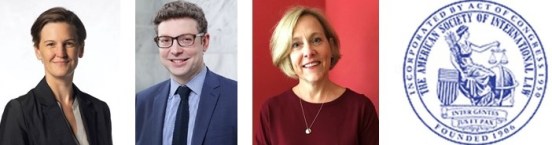
Georgia Law Professors Durkee, Cohen, and Amann present at annual ASIL Midyear Meeting and Research Forum

Last weekend marked the annual Midyear Meeting and Research Forum of the American Society of International Law, held online because of the ongoing pandemic. This year as in the past, University of Georgia School of Law faculty played key roles. They are:

► Melissa J. “MJ” Durkee, the Allen Post Professor at Georgia Law. She participated in meetings of two key ASIL entities; that is, the Executive Council, on which she is serving a 3-year term, and the Board of Editors of the American Journal of International Law, at whose meeting she presented on behalf of the publication’s online platform, AJIL Unbound, for which she serves as Supervising Editor. Additionally, during the Midyear Meeting’s Research Forum, Durkee gave a presentation on the topic of “Interpretive Entrepreneurs,” at a panel entitled “International Law in Theory.”

Harlan G. Cohen, the Gabriel M. Wilner/UGA Foundation Professor in International Law and Faculty Co-Director of our Dean Rusk International Law Center. Also a member of the Board of Editors of the American Journal of International Law, Cohen gave a report at that board’s meeting on “International Decisions,” the AJIL section for which he has served as Editor. He also helped organize a keynote panel on “Multilateralism & International Institutions,” part of ASIL’s International Law and the 2020 Election Series.

Diane Marie Amann, the Emily & Ernest Woodruff Chair in International Law and our Center’s other Faculty Co-Director. She continued a second term as an ASIL Counsellor. As part of a Research Forum panel entitled “Historic Roots of International Law,” Amann presented her work in progress, “Intersectional Sovereignties: Dr. Aline Chalufour, Woman at Nuremberg – and at Paris, Ottawa, and Dalat.”

Georgia Law is an Academic Partner of ASIL, for more than a century the United States’ premier learned society in international law.

Georgia Law Professor Amann on “Children and the Women, Peace and Security Agenda,” at Transitional Justice Institute, University of Ulster, seminar

“Children and the Women, Peace and Security Agenda” is the subject of a talk delivered today by Professor Diane Marie Amann, holder of the Emily & Ernest Chair in International Law and Faculty Co-Director of our Dean Rusk International Law Center here at the University of Georgia School of Law. The talk was her online contribution to a year-long “WPS@20” seminar series hosted by the Transitional Justice Institute at the University of Ulster.

As its title indicates, the series, which began in February, has featured numerous speakers’ reflections on the WPS Agenda, which began with the passage on October 31, 2000, of UN Security Council Resolution 1325 on Women and Peace and Security. Since that date this agenda has inspired a range of activities, in the United Nations (as depicted in this UN Women 20-year  timeline) and other international organizations, and also in nongovernmental organizations and academia.

Amann’s contribution to the series benefited greatly from the team of Georgia Law student researchers with whom she worked this summer: Zoe Ferguson (JD’20), 3L Charles Wells, and 2Ls Courtney Hogan and Michael Ramirez.

This seminar focused not on women, but on an adjunct constituency cited in Resolution 1325; that is, on children. Here’s the abstract:

UN Security Council Resolution 1325 on Women, Peace and Security contains more than a dozen mentions of young people; to be precise, it refers twice to “women and children” and more than a dozen times to “women and girls.” Since the resolution’s adoption 20 years ago this week, many initiatives have arisen to combat conflict-related harms to children. These include the Children and Armed Conflict Agenda launched by Security Council Resolution 1612 (2005) and other inter- and non-governmental efforts. This seminar will evaluate the WPS resolution, 20 years on, as a child-rights instrument. Consideration of the interim initiatives will help frame that assessment, as will evolving understandings of children’s sexual and gender identities, of children’s agency and children’s autonomy – all factors that may counsel against too-quick conjoinments of “children,” or “girls,” with “women.”

A rich set of questions followed the presentation. Moderating was Dr Catherine O’Rourke, Senior Lecturer in Human Rights/International Law at Ulster Law and TJI’s Gender Research Coordinator.

The seminar is available as a PowerPoint presentation and as an audio podcast at TJI’s Apple and Spotify accounts.

(cross-posted from Diane Marie Amann)