Sojourn stirs questions about policies in China, Cuba and the United States

Our Center’s Director of Global Practice Preparation, Kathleen A. Doty, is a World Affairs Council Young Leaders Fellow just completing her tour of China. Traveling with her have been eleven others, many from globally minded businesses. This is the last dispatch in Kate’s series of posts on her travels.

4BEIJING – The people of China are warm. They love babies. I quickly found the best way to make a friend was to coo at the child in her arms. They love long meals and good toasts, and have spent centuries mastering the art of hospitality. Being a guest in China is wonderful.

Beijing is a vastly different city than Shanghai. It is old, gritty, artistic. I heard many people say that Beijing was like Washington, D.C., and Shanghai was like New York. I think that it is a shallow comparison, and having lived in both U.S. cities, I disagree.image1

New York is much more than high rises; Beijing is a city alive and rich in a similar way. Of course, this impression has much to do with the organization of our trip; in Shanghai we were taken primarily to government developments, while in Beijing we were taking primarily to private companies and cultural sites. We visited the sleek showroom of Huawei, the Chinese version of Apple, and iQIYI, the Chinese version of Netflix, which exudes a hip imagestart-up vibe. I sipped exotic tea as I strolled through galleries in the profoundly cool 798 Art District, wandered back alleys in Old World neighborhoods, and saw a palace that has been grand since before my own country was founded. When the lights went out in a restaurant at dinner, the servers calmly brought candles to the table and we kept on with the toasts. Beijing was much more what I image2expected to find in China: a mix of the modern and the historical, of wealth and underdevelopment.

Cultural heritage was a theme I pondered throughout the trip. China is old in a way that I, a woman from Colorado, a place young even in the history of the United States, find mind-blowing. Beijing is a huge city. The several ring roads surrounding it put the Beltway or the Perimeter to shame. The city has been developed and redeveloped countless times, replacing so much of what once was. Walking the Great Wall (which is covered in scratched graffiti, in Chinese characters so foreign to my eye) and seeing the Forbidden City provided just a taste of an incredibly rich history that, little by little, is lost with improvements to modern life. I commented to a friend, an American expat living in China, that I found this sad. He responded that the history in 3China is too long to preserve the physical – you just can’t save every 5,000-year-old building – the cultural heritage of China lives in the language. Having mastered only four words in ten days – “Hello,” “Thank you,” “Cheers,” and “too expensive” – I have to admit that this is lost on me. But it emphasized the importance of intangible cultural heritage work as a means of preserving at least some of an ancient way of life.

Sitting alone in a public park one day, I marveled at how a parent or grandparent needed only to speak a word to a child and he or she behaved. Meeting times were given at strangely precise intervals (for example, 1:25) and taken very seriously. I heard more apologies for tardiness than I thought reasonable given a city of such size and with such congestion. Our guides shared their views that much of Eastern culture derives from Confucius’ thought, and emphasizes hierarchy and respect. This consideration to others was surprising given our pre-trip prepping that people push and don’t stand in line or respect your space, but it just reinforced the cultural difference in the meaning of “consideration.” In so many of my reflections about Communism and the economy, I couldn’t help but wonder how much of the attitudes I picked up on were born of pre-existing Eastern philosophy and culture, or from the current economic and political systems in the country.

I also couldn’t help but wonder about the tension between the incredible feats of the state and human rights. Much has been written about this topic and I am no expert, so I won’t belabor the point. But I found myself reflecting, much as I did during my studies in Cuba, on the tension between the social benefits of a Communist system – universal healthcare, education, and in the case of China, the elevation of an extraordinary number of people out of poverty in a short time frame – with the profound lack of freedoms.

2During our visit to the Great Wall, we were standing in an epically long line to take a shuttle bus from the base of the Wall to the parking lot where our bus was waiting. Our guide, a young man in the employ of the University who spoke nearly perfect English, sighed as we inched forward. He said:

“Thank God for the family planning policy.”

I was surprised because the one-child policy so deeply offends our Western concept of individual choice that I simply expected someone of roughly my age to concur; yet in such a populous country, a limit on the number of people is sometimes welcome. I relayed my surprise at his comment to another young Chinese woman I met, and she said,

“Oh yes. The problem with the family planning is that we now have a China that is out of balance, with too many old people and not enough young ones.”

I was so amazed; again, it was a comment totally focused on the macro. Is that Chinese culture? Is that the effect of a Communist system of government? Is it both?

These are the questions that will for me remain unanswered. After studying in Cuba, my takeaway was that they don’t have it right, but neither do we in the United States. The “right” is somewhere in the middle. My impression of China is that it is inching closer to the right balance than Cuba. I have far more context about Cuba to make that statement; this trip showed me, more than anything else, how much I don’t know about China. But standing in Tiananmen Square in the rain, I couldn’t help but think that an inch is terrifically small.

In politics, East is East and West is West even as economies grow closer

Our Center’s Director of Global Practice Preparation, Kathleen A. Doty, is a World Affairs Council Young Leaders Fellow just completing her tour of China. Traveling with her have been eleven others, many from globally minded businesses. This is another dispatch in Kate’s series of posts on her travels.

imageSHANGHAI – A Chinese official at the Pilot Free Trade Zone in Shanghai told us:

“The United States is a very different economy than China; it is much more globalized. We are still learning.”

Visiting Shanghai, one would never guess that China is still learning. The city is shockingly modern, with architecture straight out of a sci-fi movie, sparklingly clean public spaces, and every sort of of consumer product available. The brands are recognizable to Americans – from Walmart to most high-end designers. Yet the rhetoric from the officials with which we’ve met has been all about development: how to further open up China’s economy.

The efforts in this regard are impossible to miss. Almost everywhere in the city there are new buildings going up and renovations in progress.

The Chinese are obsessed with space: the first thing they tell you about any project is the number of square kilometers it will occupy and the population of people living or working there. This is understandable given the stress such a high population places on the limited physical space and infrastructure of the city.

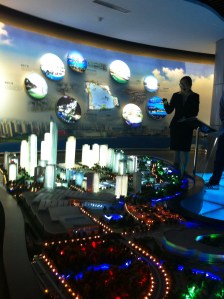
image3Perhaps more striking: they are obsessed with showcasing this development. The government has erected entire museums and project-specific showrooms dedicated to urban planning with information tailored to foreign visitors. They are surreal – we saw several unbelievably intricate miniature models of the building projects, complete with lights in the windows of the mini-buildings, and incredibly high resolution 3D video tours set to dramatic symphonic music. At one such display a colleague leaned over and said:

“Wow, it’s propaganda.”

And propaganda it is. Unlike Cuba, which is still brimming with billboards of Fidel and slogans like “¡Patria o Muerte! ¡Venceremos! (Homeland or Death! We Shall Overcome!),” the Chinese version is more subtle. It’s not centered on a leader or on separation from the rest of the world, but on the collective progress: development, innovation, opening up.

I expected Shanghai to be filled with the iconic Soviet concrete-style buildings, but the new Communism is glass and steel. It is rows of narrow, tall apartment buildings shooting out of the ground in perfectly aligned formation. But it still feels cold, a little sterile, and with pollution hanging in the air, eerie.

image1It was also quite clear that the Chinese keep a tight grip on the narrative available to foreign visitors. My trip, sponsored by the Confucius Institute, a division of the government education agency, made sure to show us the best of what China had to offer. We looked up at a major skyscraper in the distance and asked our tour guide if we were going to go there. He looked at us in complete seriousness and said:

“But why would we go there? You saw it in the model.”

I realized then that the propaganda wasn’t just for the foreign visitors, he believed it too. Government control of the narrative affects everyone.

We were told that the farmers who used to be on the land now occupied by the new industrial parks were simply removed from their land. Eminent domain is in full force in China. Here’s a statement of fact about the issue, rather than skepticism, from our same tour guide:

“You can’t bargain with the government.”

Nor can you reason with it. On my way out of the airport, after the security checkpoint where they took large liquids, I bought two waters. These were confiscated in an unexpected secondary screening on the jetway. When I asked the guard why he took them, he explained it was because of TSA rules. When I protested that they had already screened for liquids and that I purchased these past security, he just shook his head and tossed my water in a bin. Perhaps China doesn’t regulate items for purchase after security and therefore doesn’t meet TSA standards, but I find that unlikely. Despite the progress in China, it felt much more like the absurdity of life characteristic of such a strong state government.

image2China is impressive. It is actualizing public works and infrastructure projects at a rate that is unimaginable in the United States. It is developing its cities and offering its people access to a diverse marketplace of consumer goods.
Wandering a mall, I couldn’t help but wonder if this was Cuba’s future. It’s not a bad compromise between the socialist and capitalist models. (Oh, the irony; I wonder if Marx could ever have envisioned a transition back to capitalism.)

I’m not entirely certain whether the official we spoke with at the Free Trade Zone would say that the main difference between the United States and China was the economic model of each country, but I know that I left thinking that no matter how open the Chinese economy becomes, we will always be far apart, even in business, because of our different underlying political systems.

Distinguished jurist Pillay discusses state sovereignty, human rights

duo“The biggest violators of human rights are states themselves, by commission or omission.”

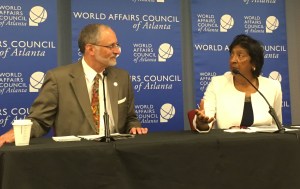
This quote by Navi Pillay aptly summarized her talk on “National Sovereignty vs. International Human Rights.” Pillay, whose renowned legal career has included posts as U.N. High Commissioner for Human Rights and as a judge on the International Criminal Court and the International Criminal Tribunal for Rwanda, spoke this morning at the University of Georgia School of Law Atlanta campus.

Elaborating on the quote above, Pillay decried national legislation aimed at restricting the activities – and with it the effectiveness – of local nongovernmental organizations. Such anti-NGO laws already have passed in Russia and are pending in Pillay’s home state of South Africa, among other countries. That said, she welcomed new means of speaking law to power; in particular, social media that permit human rights advocates to reach millions. Also welcomed were accountability mechanisms that the United Nations has developed in recent decades, such as Universal Periodic Review by the Human Rights Council, reporting processes of treaty bodies, and reports by special rapporteurs.

amann_pillayI was honored to give welcoming remarks at the breakfast. Georgia Law’s Dean Rusk International Law Center, which I lead, cosponsored this Georgia WILL event with the World Affairs Council of Atlanta and Georgia State University’s Global Studies Institute. (We owe special thanks to Judge Dorothy Toth Beasley for her hospitality this week.)

Conversing with Pillay was World Affairs Council President Charles Shapiro. They began by speaking of Pillay’s childhood in Durban, where she grew up the daughter of a bus driver. She spoke of how testifying as a 6-year-old in the trial of a man who’d stolen money from her helped spark her desire to become a lawyer – and how donations from her community helped make that dream a reality.

Shapiro then asked about capital punishment, noting a scheduled execution. Pillay acknowledged the absence of any universal treaty outlawing the death penalty, but found evidence of U.N. opposition both in the decision not to permit the penalty in U.N. ad hoc international criminal tribunals and in the growing support for the oft-repeated U.N. General Assembly resolution calling for a moratorium on capital punishment.

“It started with just 14 states against the death penalty, and is now more than 160,” said Pillay, who currently serves on the International Commission against the Death Penalty.

img_0335On this and other issues, she said, advocates endeavor to encourage states first to obligate themselves to respect and ensure human rights, and then to implement the undertakings they have made in this regard:

“The United Nations was formed by states. It is a club of governments. Look how steadily they have adopted treaties and agreed to be bound by them. That doesn’t mean we are transgressing sovereignty.”

Center Council member Anita Ninan helps promote Georgia-India links

ninan

Presenting Ninan with a Distinguish Speaker Award are, at left, Nanik Rupani, chair of the convention, and, at right, Dr. Lalit Kanodia, national president of the Indo-American Chamber of Commerce

Among those working to strengthen ties between Georgia and India is Anita E. J. Ninan, a Georgia Law alumna and member of our Dean Rusk International Law Center Council.

Ninan (LL.M. 1991) is Of Counsel, International Business Practice, at Arnall Golden Gregory LLP in Atlanta, as well as an  Advocate before the Bar Council of Delhi, India. She serves on the Board of the Georgia Indo-American Chamber of Commerce, or GIACC.

She joined a delegation of GIACC members who traveled in August to Mumbai to take part in the annual two-day conference of the Indo-American Chamber of Commerce, this year carrying the theme “Unleashing Indo-giaccU./S. economic synergy.” Ninan gave a presentation on foreign direct investment in Georgia. As quoted in a Global Atlanta article, Ninan explained:

“Indians mostly aren’t as aware of Atlanta and Georgia as they are of other places like New York, Chicago or Los Angeles so this was a good opportunity to let them know about our state’s advantages.”

Next on GIACC’s agenda: a “Bollywood Meets Georgia” film festival, set for April 2017 at Kennesaw State University.

GJICL publishes award-winning article

gjiclScholarship published in the Georgia Journal of International & Comparative Law special issue on “Children and International Criminal Justice” has just been named Article of the Year by the U.S. National Section of the Paris-based Association internationale de droit pénal/International Association of Penal Law.

The honoree is Linda A. Malone, the Marshall-Wythe Foundation Professor of Law at William & Mary Law School in Williamsburg, Virginia, for her article entitledlamalo “Maturing Justice: Integrating the Convention on the Rights of the Child into the Judgements and Processes of the International Criminal Court,” 43 Ga. J. Int’l & Comp. L. 599 (2015). The article surveys the status of international child law and offers suggestions on how it may interface with ICC practices.

Professor Malone presented her research at a plenary session (also featuring a keynote by Prosecutor Fatou Bensouda) of the conference that GJICL and the Dean Rusk International Law Center, University of Georgia School of Law, held during the preparatory phase of the ICC Office of the Prosecutor Policy on Children. The final version of the policy will be launched next month at The Hague.

Shanghai story opens World Affairs Council Young Leaders’ China sojourn

Our Center’s Director of Global Practice Preparation, Kathleen A. Doty, is a World Affairs Council Young Leaders Fellow now touring China. Traveling with her are eleven others, many from globally minded businesses. Kate will post on her travels throughout the trip; her 1st dispatch in this series is below.

img_0315SHANGHAI –

“Confucius said: it is such a delight to have friends from afar.”

And so began our first day in China, with a warm welcome from Professor Yang Li, Vice-President of Shanghai International Studies University (SISU). He shared his hope that through our exchange, “the distance between American and Chinese businesses will be bridged.” These sentiments were echoed by Kimberly Griffin, Deputy Director of the Confucius Institute at Georgia State University, and Paulina Guzman, Membership Manager at the World Affairs Council of Atlanta.

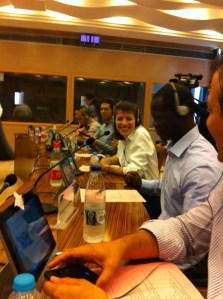
Our opening ceremony took place in the state-of-the-art conference facilities at SISU, one of the top universities in China for students of translation and interpretation. We all felt quite official, with headphones, tablets at each of our seats, and interpretation provided by the Dean, Zhang Ailing. The ceremony closed with our hosts presenting us with a lovely gift of custom-made SISU jackets.

img_0316We were then treated to a lecture by Dr. Zhang Shangwu, Professor and Deputy Dean of the College of Architecture and Urban Planning at Tonghi University. He introduced us to the historical expansion of the city of Shanghai, and its newly unveiled 2040 development plan. Shanghai has always been an important city in the region because of its rich water resources from the Yangtze river delta. Following the 1840 opium wars, the city started to take shape as an international center of commerce, because of the concessions granted to various foreign governments in the aftermath of the war. Official urban planning began in the 1920s and 1930s, but intervening conflicts and political changes meant that many of these projects were never completed.

It wasn’t until the 1990s that the Shanghai Master Plan was adopted as the blueprint of development for the city. This was a critical because it emphasized the four major areas of industry that would define the city going forward: economy, finance, trade, and shipping. It also aimed to control the incredibly densely populated city – at that time, 9 million people in fewer than 700 square kilometers – by moving approximately 80,000 people to satellite cities built to absorb them. This plan was bolstered by China’s accession to the World Trade Organization in 2001, and showcased when Shanghai hosted the 2010 World Expo, which focused on urban life. The latter also drove a new wave of infrastructure development, including a deep water port, two international airports, and a vastly improved metro system.

img_0317The economic crash forced Shanghai to re-envision its future, as the manufacturing industries and accompanying trade suffered. The city faces many challenges, including a steady population growth rate and a dwindling supply of land as urban sprawl expands. Accordingly, the 2040 plan aims to re-position the city by adding three new areas of focus to those emphasized by the 2010 plan:

► Innovation, especially in the areas of the tech and service industries;
► Culture, to make the city more attractive to newcomers and livable for current residents; and
► Environment, to include increased outdoor spaces and sustainable growth mechanism.

The overall goal is to create a better city that offers a better life.

From what we’ve seen so far, Shanghai is indeed an incredibly organized city for a place so densely populated. I look forward to exploring more and seeing this development plan in action.

Georgia Law launches women’s leadership initiative: “Georgia WILL”

georgiawillheader

Very pleased to reprint this announcement of an important Georgia Law initiative

In celebration of its own women leaders and in an effort to nurture women who will lead in the future, the University of Georgia School of Law this year is spearheading Georgia WILL (Georgia Women in Law Lead).

Georgia WILL launched with a breakfast on August 19, 2016, the centenary of the day that the State of Georgia enacted a statute entitled “Attorneys at Law; Females May Be,” and soon admitted Minnie Hale Daniel, whose previous applications had been rejected, as the state’s first woman lawyer. Celebrated along with Daniel were Georgia Law’s first alumnae, Edith House and Gussie Brooks, both members of the Class of 1925, as well as the many women who today help lead the law school. They include: Associate Deans Diane Marie Amann, Lori Ringhand, and Usha Rodrigues; Carol A. Watson, Director of Georgia Law’s Alexander Campbell King Law Library; Ramsey Bridges, Director of Law Admissions; Anne S. Moser, Senior Director of Law School Advancement; Heidi M. Murphy, Director of Communications and Public Relations; and Kathleen A. Day, Director of Business & Finance.

“This is a superb opportunity both to give recognition to our women leaders and to join in the global conversation about women’s leadership,” remarked Georgia Law Dean Peter B. “Bo” Rutledge. “Given our hope that this initiative will foster a new generation of women leaders, we’re especially pleased that our Women Law Students Association is cosponsoring all events.”

Events in the next twelve months will feature women, including members of the Georgia Law community, who are national and international pathbreakers in law, business, and public service. One highlight event will occur at the annual meeting of the Association of American Law Schools in San Francisco, where Georgia Law will host a brainstorming session for women professors who are or are interested in becoming law school or university administrators; another, at Georgia Law’s Athens main campus, where IntLawGrrls contributors will convene in March for a conference marking the blog’s 10th birthday.

Events scheduled so far (at Georgia Law’s Athens campus unless otherwise stated) are as follows:

October 13 Judge Lisa Godbey Wood (J.D. 1990), U.S. District Court for the Southern District of Georgia, will deliver “Reflections on Sentencing.” Her service as Georgia Law’s inaugural B. Avant Edenfield Jurist in Residence also includes teaching a week-long course on sentencing.

October 19 Judge Navanethem Pillay, a South African jurist whose former positions include United Nations High Commissioner for Human Rights and Judge on the International Criminal Court and the International Criminal Tribunal for Rwanda, will speak on “National Sovereignty vs. International Human Rights” at Georgia Law’s Atlanta Campus. The World Affairs Council of Atlanta cosponsors.

October 25 Ethical challenges faced by corporations will be the topic of a talk by Sloane Perras (J.D. 2002), Chief Legal Officer at Krystal Company and On The Border. Earlier this month, Perras was recognized by the Women’s In-House Counsel Leadership Institute for welcoming other women into her area of practice and also for directing corporate policy toward inclusion of women in high-level legal positions.

January 5 Georgia Law will host “Women’s Leadership in Legal Academia” at the Annual Meeting of the Association of American Law Schools in San Francisco. This brainstorming session for women professors who are or are interested in becoming law school or university administrators will feature academics, as well as Monika Kalra Varma, an executive leadership consultant who served for the last five years as Executive Director of the District of Columbia Bar Pro Bono Program.

February 4  Georgia State Representative Stacey Godfrey Evans (J.D. 2003) will provide opening remarks at “Georgia Women Run.” Joining her will be a diverse group of elected officials, who will discuss the challenges and rewards of running for office as a nontraditional candidate.

March 1 to 31 Georgia Law’s Alexander Campbell King Law Library will host a special exhibit, “Attorneys at Law; Females May Be: Celebrating the Past and Ongoing Leadership of Women in Law,” in conjunction with Women’s History Month and, on March 8, International Women’s Day.

March 2 The Women Law Students Association will present the 35th Annual Edith House Lecture, named after a graduate of Georgia Law’s Class of 1925 whose career included service as the first woman U.S. Attorney in Florida. Delivering this year’s lecture will be Judge Ketanji Brown Jackson, U.S. District Judge for the District of Columbia.

March 3 Contributors to IntLawGrrls, the pre-eminent international blog authored primarily by women, will convene for a 10th birthday conference and research forum.

March 18 Receiving the 2016 Distinguished Service Scroll Awards, given annually by Georgia Law’s Law School Association, will be Ertharin Cousin (J.D. 1982), Executive Director of the U.N. World Food Programme, based in Rome, Italy, and Audrey Boone Tillman (J.D. 1989), Executive Vice President and General Counsel of Aflac Inc.

March 27 Gabrielle Kaufmann-Kohler, Professor of Law at the University of Geneva, Switzerland, will deliver the 2d Annual Glenn Hendrix Lecture at Georgia Law’s Atlanta campus. The Atlanta International Arbitration Society cosponsors.

Fall 2017 Vice-Chancellor Tamika R. Montgomery-Reeves (J.D. 2006) of the Delaware Court of Chancery will teach a short course on advanced topics in Delaware corporate law, and also headline an alumnae reception in Atlanta.

Center’s e-newsletter recaps last year, looks forward to great 2016-17 events

Very pleased to share the e-newsletter we at the Dean Rusk International Law Center mailed to our University of Georgia School of Law community and beyond. E-mail us ruskintlaw@uga.edu to request direct mailing of future editions.

News from Georgia Law’s Dean Rusk International Law Center

Since last October, when we rededicated our Louis B. Sohn Library on International Relations and celebrated the 38th birthday of our University of Georgia School of Law Dean Rusk International Law Center, we’ve pursued a range of initiatives: conferences and scholarly endeavors; global practice preparation via externships, research projects, international advocacy, and student engagement; and partnerships with Global Atlanta and other internationally minded groups, at home and abroad. Many initiatives are profiled at our Exchange of Notes blog—we’re pleased to share highlights with you.

Conference on Geneva Conventions Commentaries leads 2016-17

The new International Committee of the Red Cross Commentary was the focus of a conference keynoted by the editor of the commentaries project, Dr. Jean-Marie Henckaerts, one of the more than 450 foreign-trained lawyers who’ve earned a Georgia LL.M. since we first awarded the degree four decades ago. Henckaerts is a Geneva-based Legal Adviser for the ICRC, which cosponsored the conference along with our Center and the Georgia Journal of International & Comparative Law—a publication for which Henckaerts once served as an Associate Editor, and which marks its 45th birthday this year. Joining him at the September 2016 conference were experts with experience in academia, armed forces and government, and international organizations. Georgia Law moderators were Professor Harlan Grant Cohen, Associate Dean Diane Marie Amann, who leads our Center, and Kathleen A. Doty, our Center’s Director of Global Practice Preparation.

Preceding Henckaerts’ visit was that of another LL.M. alumnus, Dr. Kannan Rajarathinam, who serves as Head of Office, U.N. Assistance Mission for Iraq. GJICL will publish his speech, “The United Nations at 70: Pursuing Peace in the 21st Century,” which keynoted our Center’s October 2015 rededication. Cosponsors for this official UN70 event included the Section of International Law of the American Bar Association, the American Branch of the International Law Association, and the American Society of International Law.

Other events highlights: “The Whole World Is Watching: Foreign Policy and the U.S. Presidential Election,” a September 2016 lecture by Derek Shearer, Chevalier Professor of Diplomacy & World Affairs at Occidental College and former U.S. Ambassador to Finland, cosponsored by the World Affairs Council of Atlanta and the University of Georgia School of Public & International Affairs; “The President wants it; the Candidates all oppose it: What is the TPP?,” a September 2016 talk on international trade by Professor Harlan Grant Cohen; “Common Challenges to Diverse Security Threats,” presented by Mallory Stewart, Deputy Assistant Secretary of State for Emerging Security Challenges & Defense Policy, and hosted by our Center in Washington, D.C., in partnership with ASIL’s Nonproliferation, Arms Control & Disarmament Interest Group; and “Tomb Raiders and Terrorist Financing: Cutting off the Illicit Traffic in ‘Blood Antiquities,’” a lecture delivered in April 2016 at the Georgia Museum of Art by our J.D. alumna Tess Davis, a cultural heritage expert who serves as Executive Director of the D.C.-based Antiquities Coalition.

Later in 2016-17, we look forward to welcoming: Navanethem Pillay, former U.N. High Commissioner for Human Rights and Judge at the International Criminal Court and International Criminal Tribunal for Rwanda; Viet Thanh Nguyen, whose novel The Sympathizer won the 2016 Pulitzer Prize for Fiction and whose nonfiction work that will form the basis of his visit to our Center,Nothing Ever Dies: Vietnam and the Memory of War, is a National Book Award nominee; the 10th anniversary conference of IntLawGrrls blog; and Gabrielle Kaufmann-Kohler, Professor of Law at the University of Geneva. Introduced by another international arbitration expert, our Dean Peter B. “Bo” Rutledge, Kaufmann-Kohler will deliver the 2d Glenn Hendrix Lecture, which we’re proud to cosponsor with the Atlanta International Arbitration Society. Details on these and other events here.

Global Practice Preparation

Numerous initiatives prepare Georgia Law J.D. and LL.M. students to practice law in our globalized profession—both at home and abroad, in both private and public sectors. Our Center employs Student Ambassadors to conduct research and aid its work, and it awarded Louis B. Sohn Professional Development Fellowships to support students’ participation at the 2016 ASIL annual meeting and visit to the Pentagon.

For more than a decade, our International Law Colloquium has welcomed leading scholars to workshop their works in progress with students as well as faculty discussants. Presenters have come to our Athens campus from throughout the United States and as far as Galway, Geneva, London, Montreal, Rome, and Toronto to explore an array of legal topics. Our Spring 2017 course, led by Professor Harlan Grant Cohen, continues that tradition. Confirmed professors: Duncan Hollis, Temple Law; Benedict Kingsbury, New York University Law; Jonathan Todres, Georgia State University Law; Sergio Puig, Arizona State Law; Melissa J. Durkee, University of Washington Law; and Saira Mohamed, Berkeley Law.

Overseas opportunities include: our Spring Semester at Oxford University in England, where in 2017 Professor Nathan S. Chapman, following the lead of Professor James C. Smith last year, will join Oxford colleagues to offer courses with comparative and transnational elements; and our summer study abroad in partnership with Leuven Centre for Global Governance Studies at Belgium’s University of Leuven. Our Global Externships support international and transnational law placements in firms, corporations, governmental ministries, and international and nongovernmental organizations—last year, at home, in New York, Washington, and Atlanta, and overseas, in Cambodia, China, England, Germany, Italy, Palestine, Russia, and Thailand.

Global Practice Preparation includes support for student organizations, such as: our Willem C. Vis International Commercial Arbitration Moot team, which placed 5th in the 2016 finals in Vienna (left), as well as our Jessup International Moot Court Competition team; the International Law Society, Georgia Law’s student chapter of the International Law Students Association; and the Georgia Journal of International & Comparative Law, which last year issued “Children and International Criminal Justice,” an edition publishing a keynote by International Criminal Court Prosecutor Fatou Bensouda, a foreword by Associate Dean Diane Marie Amann, and other papers from a recent symposium.

Scholarly achievements

Associate Dean Diane Marie Amann will speak in November at The Hague, Netherlands, launch of the International Criminal Court Office of the Prosecutor Policy on Children. She has assisted in the drafting of the policy since her 2012 appointment as the Prosecutor’s Special Adviser on Children in and affected by Armed Conflict. Amann presented on the crime of aggression in July at the University of Oxford in England, on international humanitarian law at an International Committee of the Red Cross panel in April in Washington, D.C., and on children at the 2015 International Law Weekend in New York. Her publications are available here.

Professor Mehrsa Baradaran published How the Other Half Banks, a book on inequality in financial services, in September 2015. Commentary with a transnational turn has included: her presentation at the World Bank in Washington, D.C.; an interview on Irish radio; and quotations in London’s Guardian as well as “What the U.S. doesn’t like about Japan’s post offices,” a Washington Postarticle.

Professor Elizabeth Chamblee Burch, an expert in complex litigation, will present in early 2017 at “Fifty Years of Class Actions—A Global Perspective,” a Theoretical Inquiries in Law conference at Tel Aviv University, Israel. In fall 2015, Zeit Online, The National Law Journal, and The New York Times quoted Burch on transnational litigation involving Volkswagen’s claims about diesel emissions.

Professor Jason A. Cade published “Enforcing Immigration Equity” in Fordham Law Review and also affiliated with the University of Georgia Latin American & Caribbean Studies Institute. His “Return of the JRAD” appeared at New York University Law Review Online and spurred many response essays by immigration law experts.

Professor Nathan S. Chapman presented a work in progress, “Due Process of War,” at Wake Forest University School of Law.


Since his 2015 appointment as Managing Editor of AJIL Unbound, the online extension of the American Journal of International Law, Professor Harlan G. Cohen has overseen the publication of 126 essays, from authors in more than 18 countries, on topics as diverse as Latin American constitutionalism, climate change, the crime of aggression, the appointment of international arbitrators, conflicts of law, and the legacy of the Sykes-Picot agreement. He has presented at many law schools; recent publications include “Methodology and Misdirection: Custom and the ICJ” at EJIL: Talk! and “A Politics-Reinforcing Political Question Doctrine,” forthcoming in the Arizona State Law Journal.

In February, our Center’s Director of Global Practice Preparation, Kathleen A. Doty, presented “Guantánamo’s Future” in a University of Georgia symposium on “Cuba and the U.S. South: A Shared History.” At the ASIL annual meeting in April, she led a panel she’d organized as chair of the Nonproliferation, Arms Control & Disarmament Interest Group, and in May she was selected for travel to Asia as a World Affairs Council of Atlanta Young Leaders Fellow.

Professor Walter Hellerstein took part in conferences and workshops in Austria, France, and Kazakhstan, and was a guest professor at the Vienna University of Economics & Business. Recent publications include “Specialized Courts in Multijurisdictional Systems: An American Perspective,” a chapter in Recent Developments in Value Added Taxes, and “Taxing Remote Sales in the Digital Age: A Global Perspective,” in the American University Law Review.

Dr. Laura Tate Kagel, our Center’s Director of International Professional Education, affiliated with the University of Georgia Latin American & Caribbean Studies Institute, and has traveled to Eastern Europe in support of our LL.M. degree initiative.

Professor Lisa C. Milot’s scholarship on performance-enhancing drugs drew attention during the 2016 Summer Olympic Games in Rio de Janeiro, Brazil: her work was featured in Vice Sports and in “El debate sobre el doping,” published in Chile’s La Tercera.

Dean Peter B. “Bo” Rutledge published “The Testamentary Foundations of Commercial Arbitration” in Ohio State Journal on Dispute Resolution, and spoke about arbitration at a New York University conference, at the annual conference of the Atlanta International Arbitration Society, and at a regional meeting of the National Association of Attorneys General.

Professor Margaret V. Sachs presented on international securities fraud during a panel entitled “Rulemaking, National and International” at the annual meeting of the Law and Society Association in New Orleans.

Ethisphere listed Professor Larry R. Thompson, former PepsiCo General Counsel and an expert on corporate responsibility, among the 100 Most Influential in Business Ethics.


Professor Sonja R. West traveled to Budapest to speak on “Improving Press Coverage of the Courts through Communication” at the European Judicial Conference on Courts and Communication, organized by Bíróság, Hungary’s National Office for the Judiciary.

Old Europe and new transnational challenges in latest Georgia Journal of International and Comparative Law

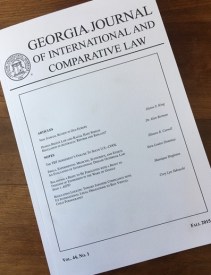
gjicl44_1Issues circling the globe are featured in  Volume 44 Issue 1 of the Georgia Journal of International and Comparative Law, or GJICL, just published and available online.

The volume begins with two articles, by scholars with ties to France, Australia, and New Zealand, as well as the United States:

kingNew Judicial Review in Old Europe, by Alyssa S. King (right)

bermanHuman Rights Law and Racial Hate Speech Regulation in Australia: Reform and Replace?, by Dr. Alan Berman (left)

Four notes, by alums who received their Georgia Law J.D.s in 2016, also appear in the volume:

carrollThe TBT Agreement’s Failure To Solve U.S.–COOL, an analysis of a World Trade Organization dispute respecting country-of-original labeling, by Elinore R. Carroll (right)

domineyEbola, Experimental Medicine, Economics, and Ethics: An Evaluation of International Disease Outbreak Law, by Sara Louise Dominey (left)

singletonBalancing a Right to Be Forgotten with a Right to Freedom of Expression in the Wake of Google Spain v. AEPD, by Shaniqua Singleton (right)

► Regulating Lolicon: Toward Japanese Compliance with Its International Legal Obligations to Ban Virtual Child Pornography, by Cory Lyn Takeuchi

How will current and future conflicts test 2016 ICRC Commentary?

It’s our pleasure today to publish this post by Chanel Chauvet, a member of the Georgia Law Class of 2018 who serves as a Student Ambassador at our Dean Rusk International Law Center. This past summer, Chanel (below left) completed a summer course on international humanitarian law at Leiden Law School’s Grotius Centre for International Legal Studies at The Hague, Netherlands. While there, she accompanied Georgia Law Associate Dean Diane Marie Amann, who serves as the Special Adviser to International Criminal Court Prosecutor Fatou Bensouda on Children in & affected by Armed Conflict, at an NGO consultation on the draft Policy on Children, set for final release this autumn. In today’s post, one in a series on our recent conference on international humanitarian law, Chanel writes:

chanel_dianeicc1I feel honored to be able to attend the University of Georgia School of Law, not only for the premier education, but also for the incredible opportunities that are extended to students.

Most recently, the law school’s Dean Rusk International Law Center and Georgia Journal of International & Comparative Law, in conjunction with the International Committee of the Red Cross, coordinated “Humanity’s Common Heritage,” a conference on the 2016 ICRC Commentary on the First Geneva Convention. Organizers included Associate Dean Diane Marie Amann, Professor Harlan Cohen, and Kathleen Doty, the Center’s Director of Global Practice Preparation. Leading experts visited UGA Law to discuss this new development in the field of international humanitarian law, or IHL.

jean-marie-henckaertsFollowing introductions, the keynote speaker and UGA Law alumnus, Dr. Jean-Marie Henckaerts (right) delivered his lecture. To begin the conference, the Dean of University of Georgia School of Law, Peter “Bo” Rutledge, had given an introductory speech, in which he emphasized that UGA Law is a “home” to students and alumni. Personally, I thought it was great to have a distinguished alumnus working within the field of IHL return to our “home” to enrich the UGA Law community.
Dr. Henckaerts discussed three themes: his background; the foundations of international humanitarian law; and the process and methodology of updating the Commentaries to the four Geneva Conventions. This updating is needed, he said, because of advancements in technology and other forms of warfare that have developed since the Commentaries were last updated more than a half-century ago. The effort is significant because of its influence in enhancing the understanding of contemporary international law.

Background

syria-water-aleppo-boy

Aleppo, Syria, 2015 (credit for ICRC photo)

Regarding his background, Dr. Henckaerts serves as the main editor to the Commentaries, and the Legal Adviser at the ICRC. A private organization that was established in 1863, the ICRC consists of 1,500 staff members in 80 different countries. They work to promote and implement IHL, in addition to other initiatives, such as assisting and protecting persons in and affected by armed conflicts. One of the ICRC’s most recent efforts to support this goal involved delivering water in Syria, a country currently plagued with an ongoing non-international armed conflict. Dr. Henckaerts noted that aside from the fact that water is a basic human need, it is also important to prevent the spread of disease.

Foundations

International humanitarian law essentially governs all aspects of war by regulating hostilities and protecting certain groups of people, including civilians and prisoners of war. It finds its basis in the four Geneva Conventions adopted in 1949, which are among some of the very few treaties that have been universally ratified or acceded to. I have listed below the primary purposes of each of the Geneva Conventions and the first two Additional Protocols:

  • GC 1: Conditions of the sick and wounded, medical personnel, medical units, medical transports, emblems, armed forces, rules on the missing, rules on the dead
  • GC 2: Conditions of the ship-wrecked and armed forces at sea
  • GC 3: Treatment of prisoners of war
  • GC 4: Protection of civilians in times of war

Additional Protocol I, which governs international armed conflicts, or IACs, and Additional Protocol II, which governs non-international armed conflicts, or NIACs, are also primary sources of international humanitarian law. These treaties are somewhat less regarded, though, demonstrated by the fact that they have not been ratified by all states.

According to Dr. Henckaerts, the value of 2016 ICRC Commentary on the First Geneva Convention is that it will serve as a tool and reference source on various topics of international humanitarian law.

Process & methodology

Jean S. Pictet (1914-2002),former ICRC Vice President, President of the Juridical Section and Director of General Affairs (photo credit)

With respect to the process and methodology of revising the Commentaries to the first Geneva Convention, he emphasized that the revision process was collaborative in nature. It was an effort between ICRC representatives and other IHL experts throughout the world to update the “Pictet Commentaries,” the Commentaries created shortly after the 1949 Geneva Conventions were adopted. Interestingly enough, the updated 2016 Commentary reflects diverging views extracted from various consultations between the experts.

Dr. Henckaerts also acknowledged that the Commentary cannot be regarded as the ultimate authority on the Geneva Conventions for a number of reasons:

  • First, states parties have not contributed to the clarification of the Commentaries. By the same token, there has not been a concerted public effort by any state to contribute its input to the updated Commentaries.
  • Second, the quality of the research and writing will determine the 2016 Commentary’s position of authority on the first Geneva Convention.

With regard to the process going forward, Dr. Henckaerts reported that the ICRC working group has both begun the revision process on the second Geneva Convention and implemented a timeline to complete the Commentaries to the remaining two Geneva Conventions.

Following this keynote address was a panel of IHL experts including Oxford Law Professor Dapo Akande, Emory Law Professor Laurie Blank, Major-General Blaise Cathcart, the Judge Advocate General of the Canadian Armed Forces, and New York University Law Professor Ryan Goodman. They offered their critiques on the 2016 Commentary. One question they asked was left unanswered: How did the ICRC determine that the Commentaries needed to be updated?

Other questions, posed by Professor Goodman, related to how the Commentaries would address the concept of transnational NIACS, and what would be the implications of this classification within the cyber realm. To illustrate this ideam he asked how the Commentaries would address people, spread across different states, who organized a coalition in the online realm and used cyber weapons.

There also seemed to be an overarching theme of the discussion. It centered on whether the Geneva Conventions should be interpreted through an originalist or an evolutionist perspective. The 2016 ICRC Commentary has provided enough deference to the original Commentaries, but it has evolved in a sense, in order to properly address the technological advances and military developments since the inception of the original Commentaries.

In any event, it is safe to say that all of the experts are curious to see how the current and future conflicts will test the 2016 ICRC Commentary.

For more information regarding the role of the Commentaries, please click here.