UGA Law 3L Meredith Williams reflects on participation in the Bavarian International Trademark Association (“BITMA”) convention in Munich, Germany

Today we welcome a guest post by Meredith Williams, a member of the University of Georgia School of Law Class of 2024. Meredith is one of several UGA Law students to participate in a semester-long international externship, a pilot extension of our existing Global Externships Overseas initiative. This pilot is a joint initiative between the Dean Rusk International Law Center and the law school’s Clinical and Experiential Program. Meredith’s post describes her experience attending an international convention as part of her externship.

I am spending the fall semester of my 3L year working as a legal extern with Weickmann, an intellectual property law firm located in Munich, Germany. I work under Dr. Udo W. Herberth (LL.M., ’96), who heads the firm’s brands and designs group.

A highlight of my global externship thus far has been attending the second annual Bavarian International Trademark Association (“BITMA”) convention, which Dr. Herberth founded. The conference took place over two days, during which I met trademark and patent attorneys from fourteen different countries. On the first day, attorneys from each country presented on the topics of 1) use and 2) jurisdiction.

My externship and this conference in particular have crystalized for me how intellectual property is an increasingly international area of law. Many clients and companies wish to register, maintain, and prevent infringement of their trademarks in more than one country; yet, there are nuanced and important distinctions between different jurisdictions’ requirements and timelines. In a field of law where adding value to a brand is crucial, it is important to be aware of these differences and stay on top of deadlines.

I enjoyed learning from the diverse group of individuals at the BITMA conference. For example, a topic I found compelling was the question of translation of trademark languages. In Canada, the Quebec charter regarding French language has been amended. Attorneys at the conference suggested this will have an impact on trademarks because the French portion of the mark must be twice the size, yet the entire trademark need not be translated. For example, in Quebec, an Apple store could display a large “Le Magasin” before “Apple,” and not have to translate “Apple” into “Pomme.” Further, in Japan, there are four different scripts, which create even more nuance to registering a word mark. These evaluations go into much more detail than we had time to cover during the conference, but it has piqued my interest as something I had never thought about living in the English-dominant US.

Another aspect of the BITMA conference that I enjoyed was the balance between personal and professional. The group of 25 of us shared many meals, watched the traditional Bavarian parade for the opening weekend of Oktoberfest, and eventually made our way to the festivities. While the substantive knowledge I acquired from this group is important, I also learned a lot from interacting with everyone on a personal level. Dr. Herberth fostered a warm and supportive atmosphere throughout the convention. This type of collegial experience served as a reminder that there is value in getting to know colleagues as people outside of work. The BITMA group treated me as an equal and were interested in my path and life. It reminded me that I want to lend a helping hand to law students and those in the early stages of their careers as I progress through mine.

I look forward to the second half of my semester working at Weickmann. I thank UGA Law for leaving such a lasting, positive impression on Dr. Herberth; it is for this reason that he was incentivized to provide educational experiences for UGA Law students like myself, and it is also why I know that I, too, want to provide this type of experience to a UGA Law student one day.

First Legal Spanish Course Offered at UGA Law This Fall

This fall, UGA Law students have the opportunity to enroll in a new Legal Spanish course taught by Professor Kristen Shepherd, Community Health Law Partnership Clinic Staff Attorney & Adjunct Instructor.

Professor Shepherd conceptualized and proposed the course as two consecutive courses, Legal Spanish I and Legal Spanish II, both offered for one credit. Each course teaches students Spanish language skills used in legal settings with a focus on listening and speaking comprehension. They also provide students with a broad overview of the basics of the legal systems in Spanish-speaking countries to enable students to communicate legal concepts more accurately and efficiently.

The opportunity for students to learn Spanish for use in legal careers has taken several forms over the past decade at UGA Law. It began as a club led by Pedro Dorado (J.D. ‘17, LL.M. ‘15) before moving to a lunchtime study session led by two students who had completed Global Externships, one in a Spanish-speaking country. During the pandemic, Legal Spanish once again became a club that met regularly on Zoom.

Across changes in instructors and format, the ability to hone Spanish language skills specific to the legal profession has continued to be a goal that students felt strongly about institutionalizing. Third-year student Patricia Fors was a driving force behind turning this club into a for-credit course. Since Spring 2022, Ms. Fors has worked with Center faculty and staff to communicate the student demand for the course and to provide a student perspective on the course proposals.

“There is a high demand for attorneys able to effectively communicate with Spanish-speaking clients,” Ms. Fors communicated to us in an email. “I’m incredibly proud to attend a law school committed to breaking down one of the barriers that Hispanic communities face accessing the legal system.”

Professor Shepherd agreed with Ms. Fors’ sentiment, stating: “I am inspired by the student movement that led to this course—it is a reflection of our students’ dedication to providing first rate legal representation to a traditionally underserved population with diligence and sensitivity. I am confident that this will lead to better legal outcomes and client relationships.”

The inaugural course enrolled 17 students, all of whom speak conversational Spanish. Not only will they benefit from this new course, but so will the clients and communities they work with across their careers.

For more information about Legal Spanish, please contact Professor Shepherd.

UGA Professor Ramnath publishes first book, “Boats in a Storm: Law, Migration, and Decolonization in South and Southeast Asia, 1942–1962”

Kalyani Ramnath, Assistant Professor in the Department of History at the Franklin College of Arts & Sciences and Assistant Professor (by courtesy) at UGA Law, is publishing her first book, Boats in a Storm: Law, Migration, and Decolonization in South and Southeast Asia, 1942–1962, with Stanford University Press.

Below is a description of the book:

For more than century before World War II, traders, merchants, financiers, and laborers steadily moved between places on the Indian Ocean, trading goods, supplying credit, and seeking work. This all changed with the war and as India, Burma, Ceylon, and Malaya wrested independence from the British empire. Set against the tumult of the postwar period, Boats in a Storm centers on the legal struggles of migrants to retain their traditional rhythms and patterns of life, illustrating how they experienced citizenship and decolonization. Even as nascent citizenship regimes and divergent political trajectories of decolonization papered over migrations between South and Southeast Asia, migrants continued to recount cross-border histories in encounters with the law. These accounts, often obscured by national and international political developments, unsettle the notion that static national identities and loyalties had emerged, fully formed and unblemished by migrant pasts, in the aftermath of empires.

Drawing on archival materials from India, Sri Lanka, Myanmar, London, and Singapore, Kalyani Ramnath narrates how former migrants battled legal requirements to revive prewar circulations of credit, capital, and labor, in a postwar context of rising ethno-nationalisms that accused migrants of stealing jobs and hoarding land. Ultimately, Ramnath shows how decolonization was marked not only by shipwrecked empires and nation-states assembled and ordered from the debris of imperial collapse, but also by these forgotten stories of wartime displacements, their unintended consequences, and long afterlives.

On September 21 at 4:00 pm, at the University of Georgia Zell Miller Learning Center, a book release and reception will be held in honor of Professor Ramnath’s work. This event is open to the public.

Georgia Law Professor Christopher Bruner presents on corporate sustainability disclosure in joint Minnesota-Dublin seminar

Christopher M. Bruner, the Stembler Family Distinguished Professor in Business Law here at the University of Georgia School of Law, recently took part in a seminar session on corporate sustainability disclosures, presented online for students at the University of Minnesota Law School and University College Dublin Sutherland School of Law.

“Sustainability Disclosure Around the World” was the title of the presentation by Bruner, a scholar of corporate law, corporate governance, comparative law, and sustainability, whose most recent book is The Corporation as Technology: Re-Calibrating Corporate Governance for a Sustainable Future (OUP 2022) (prior posts).

Joining Bruner in presenting the seminar were Professor Brett McDonnell, Dorsey & Whitney Chair in Law at Minnesota Law, and Xiaoyu Gu, who is a Managing Director at AB CarVal, a global alternative investment management firm. Professor Claire Hill, who is James L. Krusemark Chair in Law at Minnesota Law, and Professor Joe McGrath, of University College Dublin Law, convened the event.

Welcoming newest class of Master of Laws (LL.M.) students to Georgia Law

With the Fall 2022 semester in full swing, we at the Dean Rusk International Law Center are proud to welcome another class of talented lawyers, now studying for our University of Georgia School of Law Master of Laws (LL.M.) degree.

The group of 23 hail from 15 different countries in Africa, Asia, Europe, and the Americas, including Argentina, Brazil, Egypt, Georgia, Germany, India, Iran, Nigeria, Panama, Russia, Tunisia, Turkey, Ukraine, Uzbekistan, and Vietnam. Among them are a judge and lawyers specializing in a wide range of fields, including corporate transactional law, employment law, international trade, arbitration, antitrust law, and information privacy.

Some of them are pictured above, standing on the steps of Dean Rusk Hall. Left to right, they are: top row, Vladyslav Rudzinskyi, John Omotunde, Jasur Ziyautdinov, Abdulganiyu Mustapha; middle row, Tatyana Popovkina, Ngoc Quynh Vu, Anastasia Popkova, Alexandra Lampe, Khatia Zukhubaia, Rawdha Hidri, Sarthak Goel; and bottom, Saideh Ghasemi Moghadam, Manaswini Reddy Mogiligundla, Gloria Correa, Oleksandra Iordanova, Olha Kaliuzhna, Rocío Buosi, Jeremias Brusau, Mahmoud Mohamed, and Binh Nguyen. LL.M. students not pictured are Divine Atsegbua, Alexandre Laranjeira, and Abdullah Talha Tosun.

This Class of 2023 joins a tradition that began at the University of Georgia School of Law in the early 1970s, when a Belgian lawyer became the first foreign-trained practitioner to earn a Georgia Law LL.M. degree. In the ensuing four decades, the law school and its Dean Rusk International Law Center have produced nearly 600 LL.M. graduates, with ties to nearly 100 countries and every continent in the world.

Side by side with J.D. candidates, LL.M.s follow a flexible curriculum tailored to their own career goals – goals that may include preparation to sit for a U.S. bar examination, or pursuit of a concentration affording advancement in their home country’s legal profession or academic institutions.

The application for the LL.M. Class of 2024 is now open; for information or to apply for LL.M. studies, see here.

Oxford University Press publishes book on corporate governance, sustainability by Georgia Law Prof Christopher Bruner

A new book entitled The Corporation as Technology: Re-Calibrating Corporate Governance for a Sustainable Future and written by Christopher M. Bruner, the Stembler Family Distinguished Professor in Business Law here at the University of Georgia School of Law, has been released today by Oxford University Press.

Here’s OUP’s description:

“Recent decades have witnessed environmental, social, and economic upheaval, with major corporations contributing to a host of interconnected crises. The Corporation as Technology examines the dynamics of the corporate form and corporate law that incentivize harmful excesses and presents an alternative vision to render corporate activities more sustainable.

“The corporate form is commonly described as a set of fixed characteristics that strongly prioritize shareholders’ interests. This book subverts this widely held belief, suggesting that such rigid depictions reinforce harmful corporate pathologies, including excessive risk-taking and lack of regard for environmental and social impacts. Instead, corporations are presented as a dynamic legal technology that policymakers can re-calibrate over time in response to changing landscapes.

“This book explores the theoretical and practical ramifications of this alternative vision, focusing on how the corporate form can help secure an environmentally, socially, and economically sustainable future.”

Drawing upon corporate governance structures and reform efforts from around the world, Professor Bruner studies these issues in three parts, entitled, respectively, “The Dynamism of the Corporation,” “Re-Conceptualizing the Corporation,” and “Harnessing the Corporation.” Further details here.

Center celebration of 113th birthday of namesake to launch Dean Rusk exhibit

An open house and commemorative exhibit will celebrate the 113th birthday of Dean Rusk, namesake of our Dean Rusk International Law Center here at the University of Georgia School of Law.

Rusk was born February 9, 1909, in Cherokee, a Georgia county about 40 miles north of Atlanta, to parents who were schoolteachers. He would go on to be the second-longest-serving U.S. Secretary of State, in the administrations of Presidents John F. Kennedy and Lyndon B. Johnson. He then would return to Georgia to take up a position as our law school’s Samuel A. Sibley Professor of International Law. Following his death in 1994 at age 85, Rusk was buried in Oconee Hill Cemetery in Athens – 100 miles from his birthplace and just steps away from Sanford Stadium, where he spent many a Saturday afternoon watching his beloved Bulldogs play football.

Tomorrow’s 10 a.m.-4 p.m. open house at the Dean Rusk International Law Center will feature a collection of archival items about Rusk’s life and work. Portions of the display and of the accompanying Dean Rusk Digital Exhibit were made possible through a recent grant from the Digital Library of Georgia awarded to the Alexander Campbell King Law Library, in collaboration with the Georgia Law’s Office of Public Relations and Communications.

Georgia Law Community HeLP Clinic reaches successful settlement of lawsuit challenging DHS immigration practices

The University of Georgia School of Law Community Health Law Partnership Clinic recently secured significant immigration relief for its clients, by means of an agreement settling a lawsuit that it filed against the U.S. Department of Homeland Security.

The settlement concluded Oviedo de la Cruz et. al. v. Mayorkas et. al., Case No. 3:21-CV-00077, which had been prepared by the Clinic’s lawyers and law students and filed last June in the U.S. District Court for the Middle District of Georgia. (credit for M.D. Ga. courthouse photo) The lawsuit alleged that the U.S. Administrative Procedure Act had been violated by several practices of the U.S. Department of Homeland Security; for example, unreasonable delays in DHS processing of benefits for immigrant survivors of crime who assisted law enforcement.

Twenty Clinic clients benefited from the settlement. Seventeen clients received favorable agency determinations resulting in deferred action and employment authorization pending final adjudication. Three family members residing abroad also were granted relief; this will, among other things, help one of the individual plaintiffs reunite her family. The lawsuit’s success also will benefit 24 minor U.S. citizen children in the plaintiffs’ families.

The Oviedo de la Cruz litigation’s success is due to the hard work, on this lawsuit and the underlying immigration cases, of many students and staff at the Clinic. Primary drafter of the complaint was M. Paige Finley (JD’21), under the supervision of Clinic Director Jason A. Cade and Staff Attorney Kristen E. Shepherd, with administrative and interpretive support from Sarah Ehlers. Other Clinic students involved included 3Ls Navroz Tharani, Thomas Evans, Luis Gomez, and Paige Medley, as well as 2Ls M. Kaitlin Hocker and Victoria M. Hiten. Several who have since completed their JD studies also contributed, including: from the Georgia Law Class of 2021, Ansley Whiten; Class of 2020, Caitlin Felt and Christopher Larsen; Class of 2019, Gabriel A. Justus, Sarah Mirza, and Megan Alpert; Class of 2018, Alina Venick, Michael D. Aune, and Onur Yildirim; and Class of 2017, Ashley A. Rudolph and Alessandro Raimondo.

Georgia Law coursework begins for inaugural class of students seeking Graduate Certificate in International Law

Graduate Certificate in International Law students tour Hirsch Hall at the University of Georgia School of Law Friday, in anticipation of the new semester beginning this week.

This New Year marks the arrival of the inaugural class of Graduate Certificate in International Law students here at the University of Georgia School of Law.

Through the initiative of the law school’s Dean Rusk International Law Center, postgraduate students from other disciplines within the university will earn this academic certificate following their successful completion, in classes alongside J.D., LL.M., and M.L.S. students, of fifteen credit hours chosen from among the law school’s rich comparative, transnational, and international law curriculum; courses include Public International Law, International Human Rights, International Trade Law, Immigration Law, International Law Colloquium, and Global Governance.

The seven students comprising the first class include:

  • Four doctoral students: from the School of Public and International Affairs, Alma Bajramović, a Ph.D. candidate who is researching conflict and conflict resolution, with a focus on the Balkans; from the Mary Frances Early College of Education, Leslyn Beckles, candidate for a Ph.D. in Learning, Leading, and Organization Development, whose research concentrates on women political leaders in the Caribbean; and from the Franklin College of Arts and Sciences, Isaac Torres, a Ph.D. candidate in Bioinformatics who examines artificial intelligence and statistical models to address complex biology problems, and Jasmine Underwood, a Ph.D. candidate in Sociology interested in gender, development and social change, and political sociology.
  • Three master’s students, all from the School of Public and International Affairs: Megan Gerken and Nelson Millan Nales, both pursuing Master of Public Administration degrees, and Michael Sway, a candidate for the Master of International Policy degree.

Details on application of and matriculation toward the Graduate Certificate in International Law are available here and by contacting the initiative’s administrator, Sarah Quinn, Associate Director for Global Practice Preparation at the Dean Rusk International Law Center, squinn[at]uga.edu.

Georgia Law Professor Cohen presents “Court-Custom Paradox” in conference on customary international law

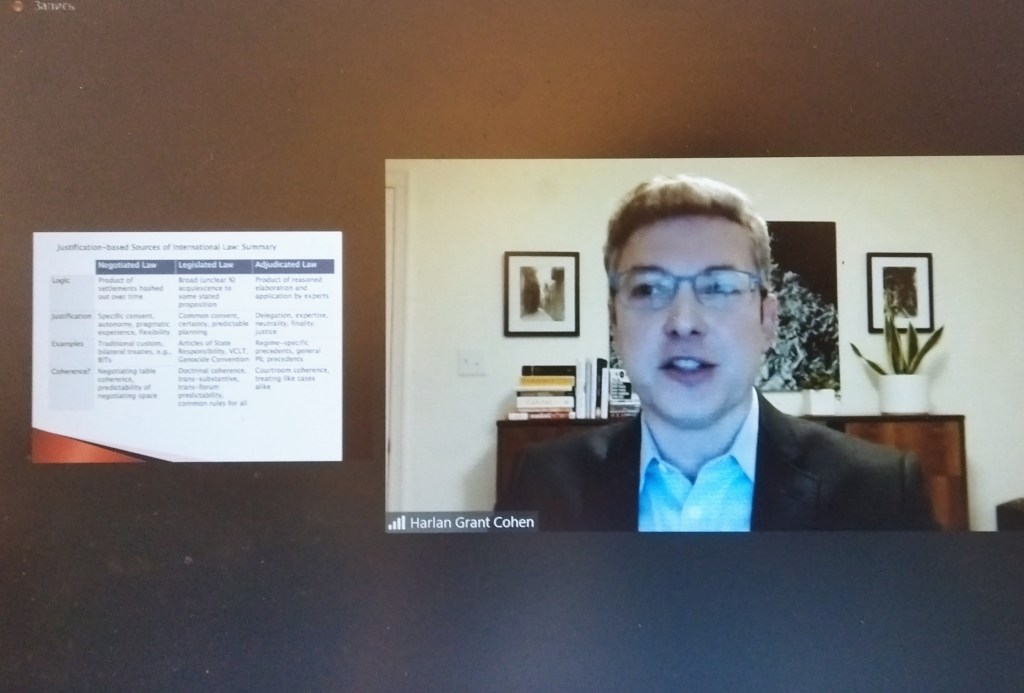
“Coherence in the interpretation of CIL is a process, not an outcome!” Professor Cohen stated, as reported in a TRICI-Law live tweet.

Harlan Cohen, who is Gabriel M. Wilner/UGA Foundation Professor in International Law and Faculty Co-Director of the Dean Rusk International Law Center here at the University of Georgia School of Law, presented Friday on “The Court-Custom Paradox” as part of “Interpretation of CIL: Methods, Interpretative Choices and the Role of Coherence,” a 2-day global conference.

Hosting the online gathering was TRICI-Law (“The Rules of Interpretation of Customary International Law”), a 5-year European Research Council Starting Grant project. Co-organizers were the PluriCourts-Centre for the Study of the Legitimate Roles of the Judiciary in the Global Order at the University of Oslo, Norway, and the Department of Transboundary Legal Studies at the University of Groningen in the Netherlands.

In addition to Professor Cohen, the conference featured Judge Liu Daqun of the International Residual Mechanism for Criminal Tribunals as well as scholars based in Austria, Canada, France, Germany, Greece, Italy, the Netherlands, Norway, Singapore, Switzerland, and the United Kingdom.