Alexander White (J.D., ’09), Bermuda’s Privacy Commissioner, speaks at UGA Law

University of Georgia School of Law alumnus Alexander White (J.D., ’09), Privacy Commissioner of Bermuda, spoke to students about current developments and careers in the field of data privacy and cybersecurity in the Dean Rusk International Law Center’s Louis B. Sohn Library this week.

Students from UGA Law’s International Law Society and Privacy, Security, and Technology Law Society attended the talk and asked questions regarding recent data privacy and cybersecurity regulations and comparative privacy regimes, such as Europe’s General Data Protection Regulation. White provided insight into the various ways students can enter into this rapidly-evolving field at both the domestic and international level, emphasizing the importance of taking related coursework and participating in international programming during law school. He mentioned the transformative impact of his own Global Externship Overseas experience in Cambodia, work that he believes mirrors his current position’s mandate to “create laws around the proper and ethical way to do something.” White also offered his perspective on emerging concepts such as Artificial Intelligence and how they impact data privacy, specifically for regulators. 

White started his career in insurance and became certified in multiple jurisdictions under the International Association of Privacy Professionals. In 2014, he transitioned into the privacy field with his appointment as the State Deputy Chief Privacy Officer for the South Carolina Department of Administration, tasked with developing a statewide privacy program. White was appointed by former Secretary Jeh Johnson to the U.S. Department of Homeland Security Data Privacy and Integrity Advisory Committee (DPIAC) for a three-year term in 2017. Three years later, the Governor of Bermuda appointed White as founding head of the country’s data protection authority as Bermuda’s first Privacy Commissioner in 2020. White also teaches a Comparative Privacy Law course at UGA Law.

UGA Law Professor Bruner publishes “A Research Agenda for Corporate Law”

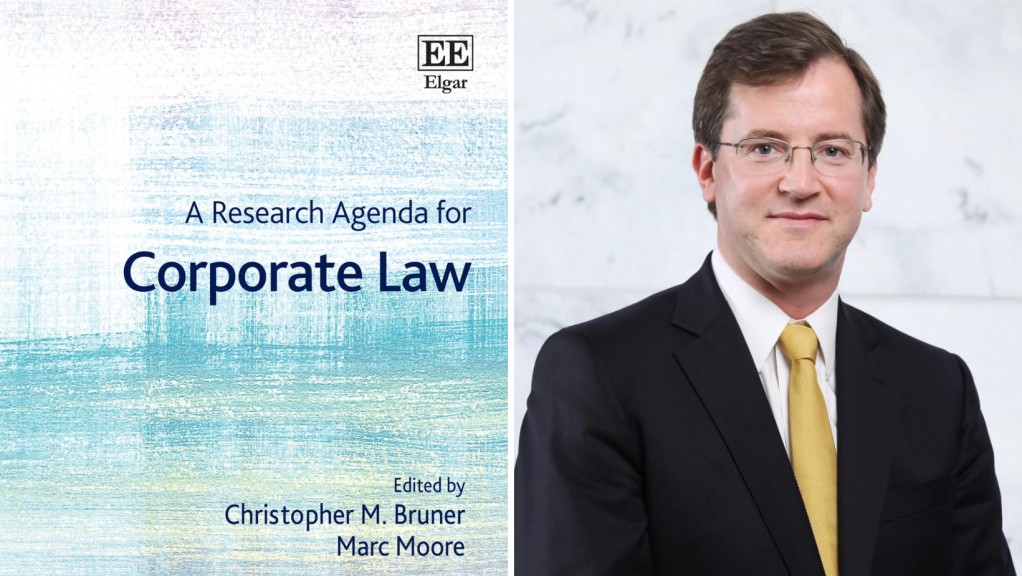
Christopher M. Bruner, Stembler Family Distinguished Professor in Business Law and Faculty Co-Director of the Dean Rusk International Law Center, recently co-edited the book A Research Agenda for Corporate Law with Marc Moore, Professor of Corporate/Financial Law, University College London Faculty of Laws.

Below is a description of the book:

This timely Research Agenda explores key dynamics and cutting-edge developments within corporate law. Bringing together a diverse range of scholars hailing from different jurisdictions, ideological perspectives, and methodological backgrounds, it provides a roadmap for future research in the field.

Through the investigation of different doctrinal and normative issues, leading scholars consider how evolving conceptual foundations, capital markets, social and cultural contexts, and technologies may impact corporate law and governance research. Ground-breaking contributions examine the increasingly global nature of corporate production and investment markets and the influence this has on the wider dynamics in the field, suggesting new directions for navigating this complex and fascinating terrain.

Students and scholars of corporate law, corporate governance, and law and business will value the innovative ideas unpacked in this state-of-the-art Research Agenda. Its forward looking and practical insights will also benefit practitioners and policymakers in corporate law, corporate governance, sustainability, and business law.

Prior posts on Bruner’s scholarship can be found here.

Applications now open for UGA Law’s summer 2024 Global Governance Summer School

Applications are now open for the summer 2024 Global Governance Summer School, jointly presented by the University of Georgia School of Law’s Dean Rusk International Law Center and KU Leuven’s Leuven Centre for Global Governance Studies. Each summer, this short-term study abroad takes UGA Law students to Belgium and the Netherlands to explore global governance: the interaction of state, regional, and international legal regimes, plus individuals, corporations, intergovernmental and nongovernmental organizations, networks, and other non-state actors.

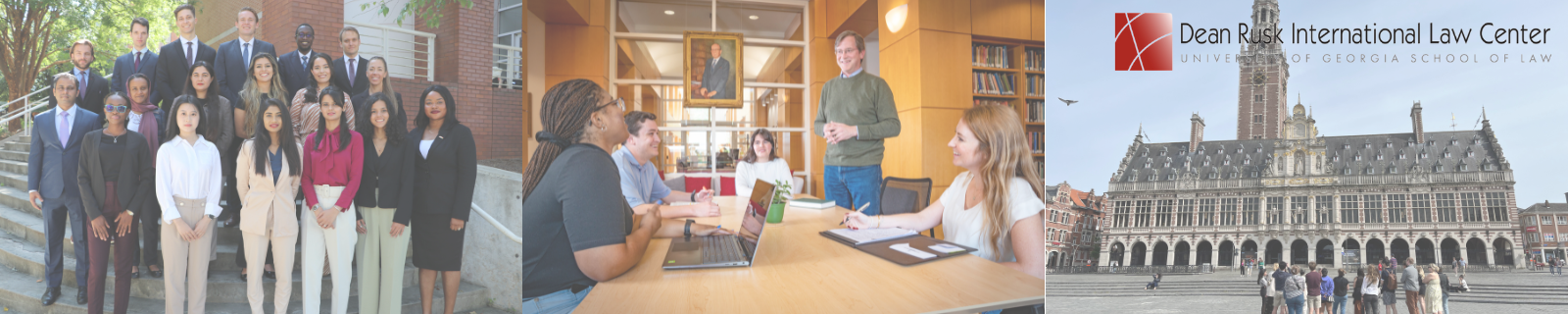
In summer 2023, the first summer GGSS ran since 2019, 17 students traveled to Europe for a week of lectures with KU Leuven professors. The first week of this for-credit course also included professional development briefings in Brussels at the European Parliament, where students were able to watch the final vote of the session cast, and a private law firm specializing in EU competition law. The programming then shifted to The Hague, Netherlands, where students received briefings at the International Criminal Court, the International Court of Justice, the International Residual Mechanism for Criminal Tribunals, and Leiden University.

The students in attendance had a variety of professional and academic motivations for participating in GGSS. For some, the professional connections, international experience, and expanded academic network will continue to benefit them as they pursue employment internationally. Erin Nalley, a current 2L who aims to work in international environmental law, stated how important the experiences of GGSS are for someone interested in an international career:

“The cultural, academic, and international experiences on this program were priceless and once in a lifetime. I made new friendships and professional connections on this trip that I most likely would not have made without GGSS.”

For others focusing their professional pursuits domestically, GGSS served as a unique professional development opportunity that will set them apart in their job search. Megan Jones, a current 2L interested in a business law career, reflected on the value of the knowledge she gained through her participation in GGSS:

“GGSS was a great opportunity for someone who sees themselves practicing domestically early in their legal career but still has an interest or desire to incorporate international aspects into their professional future. They say the best way to learn something is to immerse yourself in it, and that is exactly what GGSS is: an immersive experience that introduces you to the wide array of global opportunities the legal field has to offer.

In addition to the UGA Law students, several graduate students at UGA in the law school’s Graduate Certificate in International Law participated in GGSS. Jasmine Underwood-Starling, a Ph.D. student in the Department of Sociology, noted that the benefits of GGSS are truly interdisciplinary:

“For any student interested in international, foreign, and comparative law, the GGSS is definitely worthwhile. The ability to go from classroom learning to then seeing the knowledge and practices in action the very next day is an invaluable experience. The program was truly inspiring.”

***

Applications for the summer 2024 Global Governance Summer School are now open. Current 1Ls, 2Ls, and graduate students are encouraged to apply. This 12-day, 3-credit summer school will explore global governance through the lens of comparative administrative law led by Kent Barnett, Associate Dean for Academic Affairs & J. Alton Hosch Professor of Law. GGSS will take place from May 20 – June 1, 2024. Students are encouraged to reference this instructional video for step-by-step information regarding how to create and successfully complete an application for GGSS in UGA’s Study Away Portal by the March 1 deadline. For more information, please plan to attend the Center’s International Opportunities Information Session on Tuesday, February 13 at 12pm, or email: ruskintlaw@uga.edu

Director Emeritus Johnson presents in WITA panel discussion on the past, present, and future of U.S. Trade Policy

The Washington International Trade Association (WITA) hosted two panels last month to discuss changing attitudes toward trade in the 250 years since the Boston Tea Party. Taking part in the panel was University of Georgia School of Law alumnus and Director Emeritus of the law school’s Dean Rusk International Law Center, Ambassador C. Donald Johnson.

The two panels addressed the evolution of trade policy, trade’s present and future, and the role of the United States as a leader in global trade. The first panel (recording here), moderated by Edward Alden, Ross Dist Visiting Professor at Western Washington University and Bernard L. Schwartz senior fellow at the Council on Foreign Relations (CFR), featured the following speakers:

  • Elizabeth Baltzan, Senior Advisor, Office of the United States Trade Representative
  • Wendy Cutler, Vice President, Asia Society Policy Institute (ASPI), and Managing Director of the Washington, D.C. office; former Acting Deputy United States Trade Representative
  • Ambassador Donald Johnson, Director Emeritus, Dean Rusk Center for International Law and Policy, University of Georgia; former Chief Textile Negotiator, Office of the United States Trade Representative
  • Ambassador Susan Schwab, Strategic Advisor, Mayer Brown; former U.S. Trade Representative

Johnson’s comments contextualized the attitude towards trade during the era of the Boston Tea Party. He discusses the historical conflict between trade and labor, with roots in the Jefferson and Hamilton political philosophies, and moves through the industrialization of the 19th century.

Johnson’s book The Wealth of a Nation: a History of Trade Politics in America (Oxford University Press 2018) presents a history of trade politics from the 1790s through the Trump administration. He received the 2019 Certificate of Merit for High Technical Craftsmanship and Utility to Lawyers and Scholars (Honorable Mention) at the 113th American Society of International Law Annual Meeting, detailed in our previous post here.

Johnson served from 1998 to 2000 as Ambassador in the Office of the United States Trade Representative, and then specialized in international trade law as a partner at the Washington law firm Patton Boggs. Additionally, while serving from 1993 to 1995 as a U.S. Representative on behalf of Georgia’s 10th District, Johnson focused on national security and international economic policy, including legislation implementing North Atlantic Free Trade Agreement and the World Trade Organization. Johnson served as an Articles Editor for that journal while a student at the University of Georgia School of Law, from which he earned his J.D. in 1973. Thereafter, he studied at the London School of Economics and Political Science, earning an LL.M. degree in International Economic Law and International Relations.

UGA Law coursework to begin for new cohort of students seeking Graduate Certificate in International Law

The start of the spring 2024 semester next week marks the arrival of the third cohort of Graduate Certificate in International Law students here at the University of Georgia School of Law.

Administered through UGA Law’s Dean Rusk International Law Center, postgraduate students from other disciplines within the university will earn this academic certificate following their successful completion, in classes alongside J.D., LL.M., and M.L.S. students, of fifteen credit hours chosen from among the law school’s rich comparative, transnational, and international law curriculum; courses include Public International Law, International Human Rights, International Trade Law, Immigration Law, International Law Colloquium, and Global Governance.

Joining the law school’s first two cohorts (introduced here and here), this third class of seven students includes:

Five doctoral students, including: Madina Bekisheva and Elizabeth Stark, both a Ph.D. students in the School of Public and International Affairs studying Political Science and International Affairs; Nathanael Mickelson and Hao Yang, both Ph.D. students in the Franklin College of Arts & Sciences, studying History and Geography, respectively; and Anastasia Marx, a Ph.D. student in the School of Engineering, studying Biomedical Engineering.

Two master’s students, including: Emilio Suarez Romero, a graduate student in the College of Agricultural and Environmental Sciences, who is pursuing a Master of Science in Horticulture, and Michael Williams, a graduate student in the School of Public and International Affairs, who is pursuing a Masters of Public Administration.

All information about the Graduate Certificate in International Law, including upcoming application cycles and upcoming virtual information sessions, can be found here.

Happy Holidays from UGA Law’s Dean Rusk International Law Center

As the end of 2023 approaches, we at the University of Georgia School of Law’s Dean Rusk International Law Center want to express our gratitude. It has been a busy year full of global engagement, research, education, and service, all of which was made possible by the support of faculty, students, staff, alumni/ae, institutional partners, and friends across the globe.

If you would like to be regularly updated on our Center’s work in 2024, we invite you to subscribe to our Exchange of Notes blog and to our bi-weekly Center newsletter, which you can be added to by emailing: ruskintlaw@uga.edu

Wishing you and yours a joyful holiday season and a happy new year.

UGA Law Professor Bruner presents at conferences in Canada, Sweden

Christopher M. Bruner, Stembler Family Distinguished Professor in Business Law and Faculty Co-Director of the Dean Rusk International Law Center, recently presented working papers in Canada and Sweden.

He presented “Corporate Governance and Sustainability Incentives” at a conference titled “Addressing the Sustainability Impacts of Corporations” in October. The conference was hosted by the Nathanson Centre on Transnational Human Rights, Crime and Security at the Osgoode Hall Law School (York University) in Toronto.

Bruner also presented “Corporate Personhood, Corporate Rights, and the Contingency of Corporate Law” at “Decoding the Rights of Companies in the Technocene,” a conference hosted in December by the Lund University Faculty of Law in Lund, Sweden.

Bruner’s scholarship focuses on corporate law, corporate governance, comparative law and sustainability. He is a research member of the European Corporate Governance Institute (ECGI) and has presented his work in numerous countries around the world.

UGA Law Professor Hellerstein presents on crypto-assets at OECD

Distinguished Research Professor & Shackelford Distinguished Professor in Taxation Law Emeritus Walter Hellerstein co-presented a paper on the value added taxation of crypto-assets at the Organisation for Economic Co-operation and Development (OECD) Working Party No. 9 on Consumption Taxes in Paris, France, in November.

The Working Party No. 9 on Consumption Taxes is a forum for the discussion of consumption tax policy and administration, working with both Members and non-Members of the OECD to develop appropriate and effective taxation outcomes.

Hellerstein, a recipient of the National Tax Association’s Daniel M. Holland Medal for outstanding lifetime contributions to the study and practice of public finance, is widely regarded as the nation’s leading academician on state and local taxation. He has authored numerous books, textbooks, and law review articles, and has practiced extensively in the field. Hellerstein is currently a Visiting Professor at the Vienna University of Economics and Business, and he remains actively involved in his scholarship, consulting, and, in particular, his work as an academic advisor to the OECD.

UGA Law Professor Kadri presents on “Cyberflashing” and other projects at gatherings in Germany

University of Georgia School of Law Professor Thomas E. Kadri presented his article “Cyberflashing,” co-authored with Harvard Law School SJD candidate Brenda Dvoskin, at a workshop hosted by Goethe University’s Center for Critical Computational Studies in Frankfurt, Germany. He also discussed several current works-in-progress during a visit to the Weizenbaum Institute for the Networked Society in Berlin, Germany. 

At these gatherings, Kadri discussed several of his current projects, including his work investigating how large technology companies have adopted particular strands of feminism to gain, exercise, and justify their power to regulate sexual speech and imagery. He also presented a related project that explores a recent legislative trend to regulate “cyberflashing,” which is the act of sending a nude image to a person without receiving prior consent. Lastly, Kadri discussed a piece proposing a regulatory response to how data brokers are enabling and exacerbating interpersonal abuse like stalking and harassment. 

The Weizenbaum Institute aims to investigate “the ethical, legal, economic and political aspects of digital change” to create an empirical basis for “responsible digitalisation.” Kadri explains how his current research fits within this framework:

“With each new innovation in the digital age, it can be tempting to assume that our capacity to use technology in a certain way means that we should use it in that way. My work, in part, seeks to resist this kind of technological determinism. Digitalization has offered huge benefits for humanity, but that doesn’t mean humanity should abdicate responsibility for judging — including through law — how we should use technology. Though it’s not for me to say, my hunch is that this kind of critical approach to technology (and law) would align with the Weizenbaum Institute’s aims to create a foundation for “responsible digitalisation.”

Kadri is an Assistant Professor of Law at UGA Law, and his research focuses on torts and criminal law, with an emphasis on how technology, law, and social norms enable and affect privacy, speech, and abuse. His scholarship appears in journals including the Harvard Law Review Forum, UCLA Law Review, Texas Law Review, Utah Law Review, Maryland Law Review, and Journal of Free Speech Law and he has published shorter pieces in The New York Times and Slate. His course offerings include Torts, Cybercrime, and Regulating Digital Abuse. 

Prior posts on Kadri’s scholarship can be found here