
Pleased today to welcome a contribution from Kent Barnett, J. Alton Hosch Associate Professor of Law here at the University of Georgia School of Law. Professor Barnett concentrates his teaching and scholarship in the areas of contracts law, consumer law, and administrative law—including comparative approaches. He contributes the post below on his recent collaboration with European counterparts on the panel above, at a conference in Poland.
In what may come as a surprise for many American administrative law scholars, the world extends beyond Washington, D.C.
These scholars rarely consider comparative approaches to administrative law or debates in other legal systems. Perhaps they can be forgiven because of the ever-increasing complexity of domestic administrative law. But as conservative and liberal political and judicial factions contest an increasing number of longstanding tenants of domestic administrative law, comparative inquires may prove more useful and timely than ever.
I confirmed this intuition recently, when I accepted an invitation to participate in a conference concerning “Judicial Deference in Competition Law,” sponsored by the Centre for Antitrust and Regulatory Studies at the University of Warsaw this month. Taking part in a panel that considered general aspects of deference law, I discussed my research into the theoretical and doctrinal foundations of how American courts defer to administrative agencies’ determinations. My co-panelists—Drs. Mira Scholten and Rob Widdershoven, both professors at the Netherlands’ University of Utrecht—discussed deference in European Union courts or theoretical models for understanding deference in most legal systems.
Most of the legal models (whether of the EU, national European courts, or U.S. courts) follow similar paths when approaching how and whether to defer to agencies. In many instances, the terminology differs or the boundaries for similar doctrines may vary slightly. But in the main, these disparate legal systems have largely reached consensus on certain matters: deference to factual findings for technical matters and deference to discretionary decisions.
But my interactions with scholars in Poland confirmed that the European model has some striking differences from the American system—differences that inform two current debates:
► One difference, as numerous panelists mentioned during the conference, is that European models distinguish between civil and “criminal” punishments. “Criminal” matters are significant agency actions, such as large fines, which require significantly more judicial oversight. American law, in contrast, does not meaningfully distinguish between insignificant and significant agency actions against regulated parties. Perhaps doing so, however, would assuage growing concerns over U.S. regulatory agencies’ ability to fine regulated parties or deprive them of necessary business licenses, especially when regulated firms demonstrate good faith attempts at regulatory compliance.
► A second difference is that European courts do not defer to agencies’ interpretations of law. American courts, on the other hand, defer under the well-known Chevron doctrine to agencies’ reasonable interpretations of ambiguous statutory provisions. The European experience suggests that whatever Chevron’s constitutional or statutory demerits, deference to agency legal interpretations is not inevitable. Instead, it is a chosen policy or jurisprudential choice whose benefits or demerits support or cut against it.
In short, the conference represents but the beginning of comparative conversations that U.S. administrative scholars can and should have to inform debates about domestic administrative law.


 As Priti told me on more than one occasion, “India is not for the weak-hearted.” Living there was a difficult adjustment, in part because I stood out like a sore thumb as a tall white male in New Delhi. My fifteen-minute walk each day to and from the metro was the highlight of my time in India, but because I was so clearly foreign, strangers frequently approached me hoping I was a tourist they could refer back to a friend’s travel agency. Further, simple tasks became complex when every vendor, took-took driver, and businessman expected some bartering for each transaction. India seemed like it might be the easiest country in the world to get taken advantage of. However, these interactions speak to something I observed at the core of India.
 My externship at PSA confirmed my desire to be a lawyer. I saw thoughtful people work on difficult problems to help companies work effectively in an ever-expanding world. While it took some adjustment to be comfortable walking the streets of Paharganj, I was sad to leave India. I took one bite of the airplane pretzels, and already felt like I had made a huge mistake leaving the delicious Indian cooking behind. I will miss the warm smiles of people on the street and the friends I made over the summer. When I left India, I took home far more than my final review and certificate of internship. I took home a wider view of the world, a deeper understanding of why I want to be a lawyer, and many fond memories.
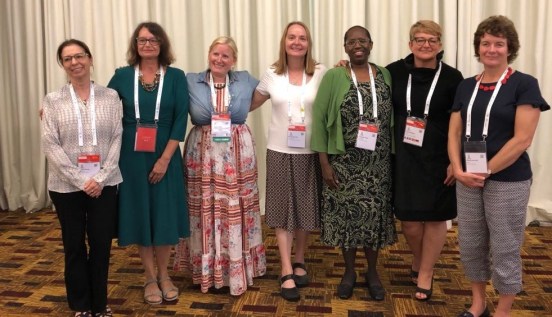

 One of my greatest pleasures in serving as an officer of the Standing Committee is my collaboration with law and government librarians from all corners of the world who share a common goal of providing and preserving access to government and legal information. Our Section Standing Committee meetings this year included members and observers from Africa, Southeast Asia, Australia, China, Canada, Australia and Europe.
 The conference schedule allowed for some sightseeing opportunities. Kuala Lumpur (KL), the capital and largest city of Malaysia, boasts record-setting skyscrapers housing national and international corporations, high-end fashion stores, insane traffic and delicious street food (right). The large convention center, where we met, is in the shadows of the twin towers (top right) of Malay’s Petroleum Company, Petronas, which are the emblematic symbol of the city. But KL’s architecture also reflects Portuguese, Dutch and British colonialism. The population is similarly diverse, with predominately Muslim Malaysians joined by significant Indian and Chinese populations. I was fortunate to take a trip to the outskirts of KL to see the Hindu temple at the
  For a recap of the year’s global law-and-practice accomplishments here at the University of Georgia School of Law, have a look at the just-published
  Law students, lawyers, and legal academics in Brazil and Argentina will soon have the opportunity to speak with graduates of the University of Georgia School of Law Master of Laws degree.
 Critical reading is the core topic of the article that
  This is one in a series of posts by University of Georgia School of Law students, writing on their participation in our


 We at the University of Georgia School of Law Dean Rusk International Law Center will welcome human rights attorney
  exchange of notes