Brexit and international trade expert, Dr. Hanspeter Tschaeni, to speak at Georgia Law

The Dean Rusk International Law Center at the University of Georgia School of Law is pleased to host Dr. Hanspeter Tschaeni for Coffee and Conversation: International Trade and Economic Law this afternoon.

Hanspeter Tschaeni

Dr. Tschaeni is Chief Trade Adviser at Trade Advisers, a consulting firm engaged in activities relating to the British exit from the European Union. He also serves on several World Trade Organization dispute settlement panels.

Previously, Dr. Tschaeni served for more than thirty years in the Swiss Federal Administration, where he was Head of Section on International Economic Law and Deputy Head of Division on Foreign Economic Services, with the rank of ambassador. In that capacity, he participated as legal counsel and headed delegations in negotiations with the European Union and in free-trade agreement negotiations with numerous countries around the globe.

Co-sponsors of the event include Georgia Law’s Business Law Society and the International Law Society.

Details here.

International arbitrators and mediators to speak at Georgia Law

We at the University of Georgia School of Law Dean Rusk International Law Center welcome international practitioners and scholars to campus today for an International Arbitration and Mediation Roundtable.

Panelists include: Dr. Christof Siefarth, Partner at the Cologne, Germany-based law firm GÖRG; Dr. Klaus Peter Berger, Professor of Law at the University of Cologne; and Dr. Beate Berger, Cologne-based attorney and mediator. They will discuss contemporary issues in international arbitration and mediation, as well as career paths and opportunities for interested students.

MediationRoundtable

From left, Christof Siefarth, Klaus Peter Berger, and Beate Berger

Co-sponsoring the event with the Dean Rusk International Law Center is the Alternative Dispute Resolution Society and the International Law Society.

Details here.

Georgia Law faculty take part in ASIL Midyear Meeting and Research Forum

From left, Melissa J. Durkee, Diane Marie Amann, Kathleen A. Doty, and Harlan G. Cohen

Four members of our University of Georgia School of Law faculty took part last weekend in the American Society of International Law Midyear Meeting and Research Forum at UCLA School of Law in Los Angeles.

Diane ASIL► Professor Diane Marie Amann, the Emily & Ernest Woodruff Chair in International Law and Faculty Co-Director of our Dean Rusk International Law Center, presented “Glimpses of Women at the Tokyo Tribunal,” which will appear as a chapter in a forthcoming volume commemorating this week’s 70th anniversary of the judgment of the International Military Tribunal for the Far East. Amann, who is serves as a Counselor of the American Society of International Law, also took part in the Society’s Executive Council meeting.

Professor Harlan G. Cohen, holder of the Gabriel M. Wilner/UGA Foundation Professorship in International Law and Faculty Co-Director of the Dean Rusk International Law Center, participated in the meeting of the Board of Editors of the American Journal of International Law. He was elected to the Board last year and serves as Editor of AJIL’s International Decisions section.MJDurkee

◄ Professor Melissa J. Durkee presented her work, “The New Functional Sovereignty: Private Authority in Global Governance,” on a panel exploring the roles of corporations in international law.

IMG_7538

► Center Director Kathleen A. Doty offered career advice to current law students and recent graduates as part of ASIL’s International Law Speed Networking. This event was part of a series of offerings at the Midyear Meeting aimed at professional development for students and early-career lawyers.


Atlanta International Arbitration Society to explore skills and cultures in upcoming conference

atlas-logoThe Dean Rusk International Law Center is delighted to serve as a cooperating entity for the 7th annual conference of the Atlanta International Arbitration Society (AtlAS). Next week’s conference will take place on Monday, November 12, and Tuesday, November 13, and will explore the theme “Skills and Cultures: the Road Ahead for International Arbitration.”

The first day of the conference will feature four Tertulia sessions — or roundtable discussions — that will focus on cultural norms in international arbitrations, and how those norms may be distinct in different parts of the world. These conversation will set the stage for the second day of the conference, which will consist of panels exploring the skills useful in today’s multicultural international arbitration practice.

3 photosSpeakers and participants will come to Atlanta from around the world, as detailed in the full program, and will feature keynote remarks by: Ann Ryan Robertson, International Partner, Locke Lord, Houston; David W. Rivkin, Partner, Debevoise & Plimpton, New  York; and Olufunke Adekoya, Partner, AELEX, Lagos.

The conference is bookmarked by two events aimed at young practitioners. On Monday before the Tertulia sessions begin, the AtlAS Young Practitioners Group will present a panel, “Document and Data Management (and Protection) In International Arbitration.” It will feature experts from Accra, Atlanta, Singapore, and Paris. On Wednesday following the conference, the Chartered Institute of Arbitrators Young Members Group and the Alliance for Equality in Dispute Resolution will co-host “Re-wiring the Brain: Practical Steps to Address Inclusion and Diversity in International Dispute Resolution.” It will feature speakers from Chicago, London, and Washington, D.C.

Three University of Georgia School of Law students will serve as rapporteurs for the conference; we look forward to posting their reflections on the conference in due course.


Drawing links between initiatives to increase protection of children during armed conflict & similar violence


“‘Protecting Children’: A Welcome Addition to Efforts to Redress Wartime Harms,” an essay I published yesterday at Just Security, underscores connections among a number of recent initiatives related to children and armed conflict.

The essay welcomes Protecting Children in Armed Conflict (Hart Publishing 2018), the 600-page report of the 2017 Inquiry on Protecting Children in Armed Conflict spearheaded by Gordon Brown, former British Prime Minister and current UN Special Envoy for Global Education. (I served on the Inquiry’s Advisory Panel.)

Leading a team of researchers was Shaheed Fatima QC, a barrister at London’s Blackstone Chambers, who spoke on this work at the International Law Weekend panel last month. (prior post here) My Just Security essay offers a detailed description and favorable critique of this research, noting the work’s connections with what the UN Security Council terms the “Six Grave Violations against Children in Armed Conflict.”

The essay further draws links between this work and the 2016 International Criminal Court Office of the Prosecutor Policy on Children, which I had the honor of helping to prepare in my ongoing service as ICC Prosecutor Fatou Bensouda’s Special Adviser on Children in & affected by Armed Conflict. (prior post here) The essay points to “the complementary potential of these and other initiatives,” and concludes:

Together, they may advance two essential goals: first, to articulate norms prohibiting wartime harms against children; and second, to secure redress for any such harms that occur.

My Just Security essay is here. It is part of a miniforum which began with a post last week jointly authored by Fatima and Brown, available here. The Just Security series will continue with forthcoming posts by Sarah Knuckey (Columbia Law), Alex Moorehead (Columbia Law), and Alex Whiting (Harvard Law).

(Cross-posted from Diane Marie Amann)

Center’s Laura Kagel to meet with prospective LLMs in Austria, Croatia, and Germany

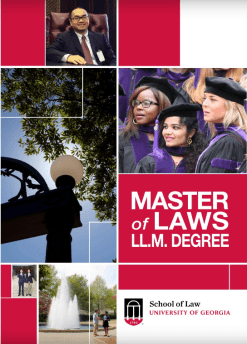
LLM cover pageLaw students in Austria, Croatia, and Germany will soon have the opportunity to talk with a Dean Rusk International Law Center staffer about pursuing a degree at here at the University of Georgia School of Law.

Later this month yours truly, Laura Tate Kagel, the Center’s Associate Director of International Professional Education, will give a presentation for students at Johannes Gutenberg University in Mainz, Germany, and take part in LL.M. fairs in Vienna, Austria, and Zagreb, Croatia. Sponsor of the fairs is EducationUSA, an arm of the U.S. Department of State.

I’ll be on hand personally to discuss the career benefits and special advantages of earning the Master of Law, or LL.M., degree at Georgia Law. (See prior posts about our current LL.M. students, as well as our hundreds of LL.M. alums, here.)

If you’d like to schedule to meet with me, please email LLM@uga.edu, and you can register for the fairs via the links below.

Monday, November 12, Mainz: 18:00-20:00, Johannes Gutenberg University, Department of Law and Economics. Email LLM@uga.edu for more details.

Wedne1sday, November 14, Vienna: 16:00 – 18:00, University of Vienna, Juridicum Dachgeschoss, 10-16 Schottenbastei, 1010. Register to attend online.

Friday, November 16, Zagreb: 18:00-20:00 at the Sheraton Hotel, Ul. kneza Borne 2, 10000. Register to attend online.

Hope to see you there!

The Carter Center’s Laura Olson to speak on the Universal Declaration of Human Rights

Picture1The Dean Rusk International Law Center at the University of Georgia School of Law welcomes Laura Olson, Director of the Human Rights Program at The Carter Center, to campus next Tuesday, November 6. She will give a lecture, “The Universal Declaration of Human Rights at 70.”

laura-olson-2

Olson has been with The Carter Center in Atlanta since July 2017. She previously held high ranking positions within the U.S. Departments of Homeland Security and the Department of State. Olson has also served as legal advisor to the International Committee of the Red Cross, supporting the ICRC Delegations in Washington DC, Geneva, and Moscow.

Sponsoring her talk with the Dean Rusk International Law Center is the International Law Society, Georgia Law’s chapter of the International Law Students Association.

Details here.

Russian law students & practitioners invited to free webinar on LL.M. study in the United States

1Law students and lawyers in Russia are invited to take part in a free webinar regarding postgraduate legal study in the United States. It’s set for 17:00 (UTC+3, Moscow time) on Wednesday, November 7, and will focus on “Understanding the LL.M. Application Process and the LL.M. experience at U.S. Law Schools.”

Hosted by EducationUSA Russia, the free webinar will feature Laura Tate Kagel, our Center’s Associate Director of International Professional Education. Joining her will be  Valeria Subocheva Smith, who completed her LL.M. degree at Georgia Law in 2018.  Valeria will share her experiences and answer questions from prospective applicants.

No registration is necessary. Details on how to join the webinar, here. Details about Georgia Law’s LL.M. degree here.

Mexican Consul General Javier Díaz de León to speak at Georgia Law, part of Center’s Consular Series

CGRALJDLThe Dean Rusk International Law Center at the University of Georgia School of Law welcomes Consul General Javier Díaz de León to campus on Tuesday, October 30. He will give a lecture, “Mexico’s Relation with Georgia: Connecting Paths.”

Díaz de León is Mexico’s Consul General in Atlanta. A career diplomat, his prior postings have included San Diego, New York, Washington, and Raleigh.

This event is presented as part of the Dean Rusk International Law Center’s Consular Series, which brings to campus perspectives on international trade, development, policy, and cooperation during the 2018-2019 academic year.

The Consular Series is co-sponsored by the International Law Society, Georgia Law’s chapter of the International Law Students Association.

Details here.

Georgia Law Professor Kent Barnett compares administrative law approaches at conference in Poland


Pleased today to welcome a contribution from Kent Barnett, J. Alton Hosch Associate Professor of Law here at the University of Georgia School of Law. Professor Barnett concentrates his teaching and scholarship in the areas of contracts law, consumer law, and administrative law—including comparative approaches. He contributes the post below on his recent collaboration with European counterparts on the panel above, at a conference in Poland.

In what may come as a surprise for many American administrative law scholars, the world extends beyond Washington, D.C.

These scholars rarely consider comparative approaches to administrative law or debates in other legal systems. Perhaps they can be forgiven because of the ever-increasing complexity of domestic administrative law. But as conservative and liberal political and judicial factions contest an increasing number of longstanding tenants of domestic administrative law, comparative inquires may prove more useful and timely than ever.

I confirmed this intuition recently, when I accepted an invitation to participate in a conference concerning “Judicial Deference in Competition Law,” sponsored by the Centre for Antitrust and Regulatory Studies at the University of Warsaw this month. Taking part in a panel that considered general aspects of deference law, I discussed my research into the theoretical and doctrinal foundations of how American courts defer to administrative agencies’ determinations. My co-panelists—Drs. Mira Scholten and Rob Widdershoven, both professors at the Netherlands’ University of Utrecht—discussed deference in European Union courts or theoretical models for understanding deference in most legal systems.

Most of the legal models (whether of the EU, national European courts, or U.S. courts) follow similar paths when approaching how and whether to defer to agencies. In many instances, the terminology differs or the boundaries for similar doctrines may vary slightly. But in the main, these disparate legal systems have largely reached consensus on certain matters: deference to factual findings for technical matters and deference to discretionary decisions.

But my interactions with scholars in Poland confirmed that the European model has some striking differences from the American system—differences that inform two current debates:

► One difference, as numerous panelists mentioned during the conference, is that European models distinguish between civil and “criminal” punishments. “Criminal” matters are significant agency actions, such as large fines, which require significantly more judicial oversight. American law, in contrast, does not meaningfully distinguish between insignificant and significant agency actions against regulated parties. Perhaps doing so, however, would assuage growing concerns over U.S. regulatory agencies’ ability to fine regulated parties or deprive them of necessary business licenses, especially when regulated firms demonstrate good faith attempts at regulatory compliance.

► A second difference is that European courts do not defer to agencies’ interpretations of law. American courts, on the other hand, defer under the well-known Chevron doctrine to agencies’ reasonable interpretations of ambiguous statutory provisions. The European experience suggests that whatever Chevron’s constitutional or statutory demerits, deference to agency legal interpretations is not inevitable. Instead, it is a chosen policy or jurisprudential choice whose benefits or demerits support or cut against it.

In short, the conference represents but the beginning of comparative conversations that U.S. administrative scholars can and should have to inform debates about domestic administrative law.