This is one in a series of posts by University of Georgia School of Law students, writing on their participation in our Global Governance Summer School or Global Externship Overseas initiative. Author of this post is James Cox, a member of the Class of 2019 who spent his 1L summer as a GEO, or Global Extern Overseas.

My summer 2017 was filled with crowded streets, a warm environment, and challenging legal work. I worked at Priti Suri & Associates (PSA) in the heart of New Delhi, India, as part of the Global Externship Overseas (GEO) initiative. With my GEO, I killed two birds with one stone: I had my first legal job, and I saw India for the first time. I did not know what to expect from either, but I left India knowing much more about myself and what it means to be a lawyer in a global context. Being in India and working at PSA were invaluable experiences.
PSA is a full-service business law firm with clientele from around the globe. Despite being a relatively small firm with about fifteen lawyers, PSA has a wide reputation for excellence. During the course of the summer, I researched competition law and blockchain technologies, and learned a great deal about the Indian legal system. My biggest project was researching and drafting this newsletter, which discusses a recent competition law decision of the Indian Supreme Court.
 Priti Suri (left), the founder of PSA and a University of Georgia School of Law LL.M. graduate, personally supervised me in writing it. Priti is hands-down one of the most impressive lawyers I have ever met. She is smart and attentive to detail. She modeled what being a professional lawyer means. I appreciated her mentorship, and found she was always willing to talk to me about the law and the projects I was working on.
All of the lawyers at PSA made me feel welcome, but I most enjoyed my time working beside the two other interns, Nikhil and Oti. They are fifth-year law students at Hidayatullah National Law University. Their school is around a twenty-two-hour drive away, and they were both “in session” while interning at PSA full time. They both had significantly more experience than I did working in firms, and they were quick to share their experience with me. I will not soon forget taking the elevator down to the ground floor and grabbing sodas with Oti and Nikhil for a quick break. They were both quick to smile, and good coworkers.
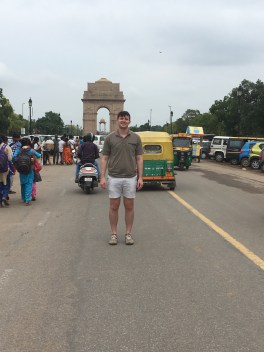 As Priti told me on more than one occasion, “India is not for the weak-hearted.” Living there was a difficult adjustment, in part because I stood out like a sore thumb as a tall white male in New Delhi. My fifteen-minute walk each day to and from the metro was the highlight of my time in India, but because I was so clearly foreign, strangers frequently approached me hoping I was a tourist they could refer back to a friend’s travel agency. Further, simple tasks became complex when every vendor, took-took driver, and businessman expected some bartering for each transaction. India seemed like it might be the easiest country in the world to get taken advantage of. However, these interactions speak to something I observed at the core of India.
Indians are overwhelmingly hard-working and determined. It is a place where everyone is trying to get ahead because they have to; I was struck by the disparity of wealth there. As a rather blunt example, I was told the richest man in India in Mumbai built his mansion literally above the slums. It can feel like the table is full before many even make it in the house in India.
 My externship at PSA confirmed my desire to be a lawyer. I saw thoughtful people work on difficult problems to help companies work effectively in an ever-expanding world. While it took some adjustment to be comfortable walking the streets of Paharganj, I was sad to leave India. I took one bite of the airplane pretzels, and already felt like I had made a huge mistake leaving the delicious Indian cooking behind. I will miss the warm smiles of people on the street and the friends I made over the summer. When I left India, I took home far more than my final review and certificate of internship. I took home a wider view of the world, a deeper understanding of why I want to be a lawyer, and many fond memories.
My only regret is not to have brought home a good recipe for Dal Makhani.

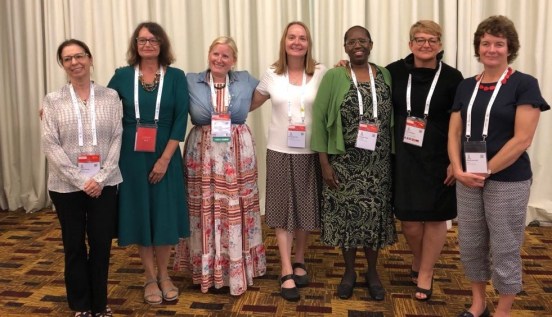

 One of my greatest pleasures in serving as an officer of the Standing Committee is my collaboration with law and government librarians from all corners of the world who share a common goal of providing and preserving access to government and legal information. Our Section Standing Committee meetings this year included members and observers from Africa, Southeast Asia, Australia, China, Canada, Australia and Europe.
 The conference schedule allowed for some sightseeing opportunities. Kuala Lumpur (KL), the capital and largest city of Malaysia, boasts record-setting skyscrapers housing national and international corporations, high-end fashion stores, insane traffic and delicious street food (right). The large convention center, where we met, is in the shadows of the twin towers (top right) of Malay’s Petroleum Company, Petronas, which are the emblematic symbol of the city. But KL’s architecture also reflects Portuguese, Dutch and British colonialism. The population is similarly diverse, with predominately Muslim Malaysians joined by significant Indian and Chinese populations. I was fortunate to take a trip to the outskirts of KL to see the Hindu temple at the
 For a recap of the year’s global law-and-practice accomplishments here at the University of Georgia School of Law, have a look at the just-published
 Law students, lawyers, and legal academics in Brazil and Argentina will soon have the opportunity to speak with graduates of the University of Georgia School of Law Master of Laws degree.

 Critical reading is the core topic of the article that
 This is one in a series of posts by University of Georgia School of Law students, writing on their participation in our


 We at the University of Georgia School of Law Dean Rusk International Law Center will welcome human rights attorney
 New York University School of Law
 While at IILJ, Cohen will work on projects reconsidering the normative narratives underpinning the global trading system and exploring and mapping international law’s various communities of practice. He will also be involved in Institute

