Elizabeth Ferguson (J.D. ’25) reflects on semester-long Global Externship Overseas in Germany

Today, we welcome a guest post by Elizabeth Ferguson, a member of the University of Georgia School of Law class of 2025. Ferguson participated in a semester-long international externship in spring 2025. The semester-long externships overseas initiative is an extension of the Center’s existing Global Externships Overseas and is offered jointly between the Center and the law school’s Clinical and Experiential Program. Ferguson’s post describes her experience as a legal extern with Bodenheimer, a law firm that handles disputes across jurisdictions, including cases in litigation, arbitration, and mediation and other ADR proceedings. Ferguson was based in Berlin, Germany, where she worked under Georgia Law alumnus Dr. Christof Siefarth (LL.M., ’86).

When I decided to participate in my semester-long Global Externship at Bodenheimer in Berlin, Germany I was looking for a new way to challenge myself academically. I concluded that taking myself far beyond the law school classroom I had spent two and a half years becoming familiar with would be the perfect opportunity. Although I was ready for a challenge, I didn’t anticipate how the lessons I learned in international arbitration would expand beyond its subject matter and into my professional life forever.

Bodenheimer is an international arbitration firm with a truly global scope. As a result, during my four months there, I researched many issues spanning multiple jurisdictions: I immersed myself in Chinese product quality standards, untangled questions of Indian law, and more.

When I received my first assignment, concerning a legal issue relying on law in an Asian country, the reality set in that I did not have the basic building blocks I needed to begin. When I received assignments on an unfamiliar issue while working at American law firms, I had a certain base knowledge to assist me because law school taught me the basics of the American civil and criminal systems and how to research them. However, in this situation, I quickly realized, I had none of those research tools or knowledge ready to go.

Although I conquered each task with the help of my colleagues, law school staff, and by familiarizing myself with the tools and knowledge used in international arbitration, I relived this fearful realization many times. Each time I received an assignment based in a jurisdiction I had not yet faced, I felt as though I was back at square one: navigating a new legal universe, where I didn’t speak the language, didn’t know the rules, and did not know where to begin. In American law firms, I had the comfort of a familiar legal system, a base knowledge to lean on, and research tools I used frequently. However, in Berlin, I often found myself staring at an assignment wondering, “Where do I even start?”

As a result, I began to struggle with something I’d never felt before: imposter syndrome. Imposter syndrome is a phenomenon where professionals experience feelings of inadequacy, despite evidence of their competence and achievements. I knew that I was given this opportunity for a reason, but nevertheless I could not shake this feeling of self-doubt and compare myself to my very impressive colleagues. Most of the attorneys in my office were fluent in at least three languages and were qualified attorneys in several countries! As someone who only spoke English and had not yet even graduated law school, I couldn’t help but compare myself to them and worry that I was simply not up to the task. As a result, my imposter syndrome began to eat away at my confidence.

But here’s the thing about throwing yourself into the deep end: you must learn to swim.

Over time, as I completed challenging assignments and learned from my helpful and knowledgeable colleagues, I developed strategies to identify, build, and promote my value as a young attorney in this unfamiliar environment which helped me combat my imposter syndrome. For example, one attorney frequently asked me to edit English language documents and made the observation that I was the only native English speaker in the office. At this moment, I realized that I was too busy comparing myself to my colleagues, who could all speak three to five languages, to recognize that my native English skills were a unique asset in my office when my colleagues needed someone to edit or translate documents into English. By the end of the semester, I was able to recognize my value in many ways and recognize the meaningful contributions I made through my work product.

Working at Bodenheimer taught me more than just the inner workings of international arbitration: it taught me how to quiet the inner critic, embrace uncertainty, and how to identify and promote my value, rather than focus on perceived shortcomings.

Berlin will always hold a special place in my heart, not just for its beautiful cathedral, the delicious Franzbrötchen, and the amazing colleagues I met, but for the reminder that growth often comes disguised as discomfort.

As I head into my next professional chapter, I’ll carry with me the lesson that the doubts you feel today will become issues you will conquer tomorrow.

***

Applications are open for spring 2026 semester-long Global Externships Overseas (GEOs). All current 2Ls and 3Ls are invited to submit an application by September 15. For more information and the application, please email: ruskintlaw@uga.edu
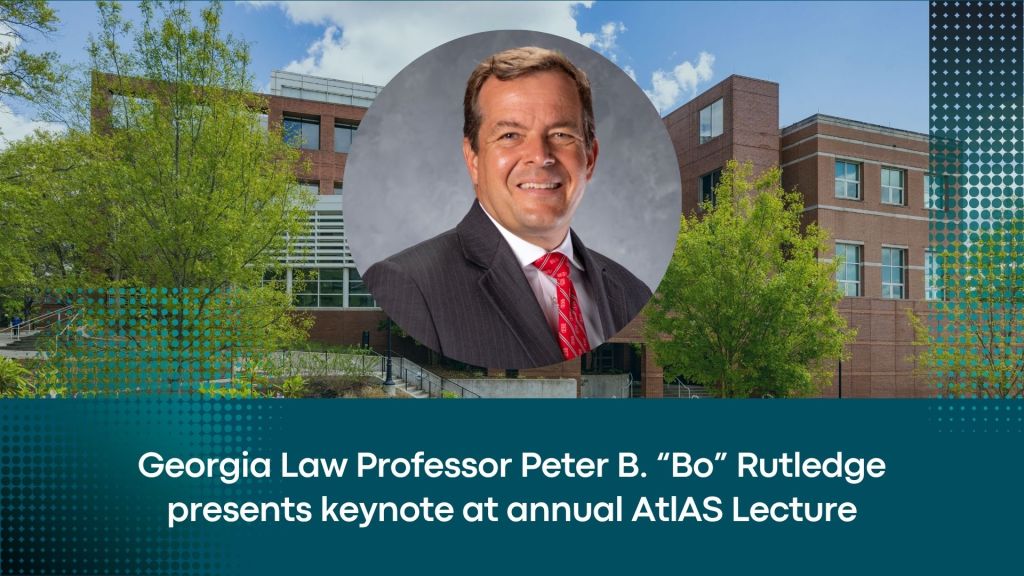
Georgia Law Professor Peter B. “Bo” Rutledge presents keynote at annual AtlAS Lecture

University of Georgia School of Law Professor Peter B. “Bo” Rutledge presented “Perpetual Peace Reconsidered: Arbitration and International Law in the 21st Century” as the keynote speaker at the 10th Annual Atlanta International Arbitration Society Lecture earlier this month. In his lecture, Rutledge considered the use of arbitration and alternative dispute resolution to resolve cross-border conflicts in the 21st century.

Rutledge holds the Talmadge Chair of Law. From 2015 through 2024, he served as dean of the University of Georgia School of Law. He is the author of the book Arbitration and the Constitution and co-author with Gary Born of the book International Civil Litigation in United States Courts. His works have been published by the Yale University Press, the Oxford University Press and the Cambridge University Press, and his articles have appeared in a diverse array of journals such as The University of Chicago Law Review, the Vanderbilt Law Review and the Journal of International Arbitration. He also regularly advises parties on matters of international dispute resolution (litigation and arbitration).

Georgia Law students Olha Kaliuzhna (J.D. ‘25) and Vladyslav Rudzinskyi (J.D. ‘25) win AtlAS Pre-Moot Invitational

University of Georgia School of Law students Olha “Olia” Kaliuzhna (J.D. ‘25) and Vladyslav “Vlad” Rudzinskyi (J.D. ‘25) won the Atlanta International Arbitration Society Pre-Moot Invitational, which took place in March. Rudzinskyi was also named the competition’s best advocate.

Law schools primarily from the Southeastern United States competed in this “warm up” tournament for the Willem C. Vis International Commercial Arbitration Moot to be held in Vienna, Austria, during April. 

Georgia Law students attend Atlanta International Arbitration Society annual conference

Last month, a group of eight University of Georgia School of Law students attended the 13th Annual Conference of the Atlanta International Arbitration Society (AtlAS).

Attendees included 3L Jacob Wood and Master of Laws (LL.M.) students Sara Dorbahani, Michael Faleye, Paria Keramatkhah, Neethu James, Fatemeh Khouei, Samuel Kuo, and Zulma Perez. Five of these students (Wood, Dorbahani, Faleye, Keramatkhah, and Khouei) received Louis B. Sohn Professional Development Fellowships to support their attendance of this conference. Awarded by the law school’s Dean Rusk International Law Center, Sohn Fellowships enable students to attend professional development opportunities related to international law.

Conference attendees attended a number of talks and events designed for practitioners and students involved in international arbitration, including the ICC Young Arbitration & ADR Forum, the AtlAS Young Practitioners Group, networking lunches, and panel discussions. Georgia Law Dean Peter B. “Bo” Rutledge led a fireside chat with alumnus and current President of AtlAS, Christof Siefarth (LL.M. ’86).

Reflecting on the variety of panels and speakers in attendance, Keramatkhah said:

My favorite [discussion] was the panel on the “Top 10 Developments in Arbitration” and Dean Rutledge’s speech. This panel covered key trends in international arbitration, such as the rise of the Borneo Arbitration Center, and UNCITRAL procedural amendments. It also highlighted the growing importance of the new IBA Rules of Disclosure and updates to the 1996 English Arbitration Act. Differences between US and European arbitration were discussed, particularly in witness handling, cross-examination, and the judge’s role. I found this panel very interesting as it was very helpful in understanding the current and future challenges of arbitration. As it regards Dean Rutledge’s speech, since I was involved in [the] research of his speech, I appreciated that it provided deep insights into dispute resolution.

In describing the ways in which this experience benefitted him professionally, Wood said:

Attending the AtlAS conference reaffirmed my desire to practice in the field of international arbitration and aided in my pursuit of this goal. I was able to meet and converse with a variety of practitioners and arbitrators from across the globe.

When asked about her favorite moment from the conference, Dorbahani explained:

One of the standout sessions delved into the art of writing for a multicultural audience. As international arbitration becomes more diverse, mastering the nuances of cross-cultural legal advocacy is vital. It emphasizes how language can either clarify or complicate arbitration across borders. Coming from a Civil Law background, I found this especially relevant, as it highlighted the delicate balance needed to communicate effectively in a global legal landscape.

To read prior posts about Georgia Law students using Sohn Fellowships to attend professional development opportunities, please click here and here.

Georgia Law LL.M. student Samuel Kuo admitted as a Fellow to the Chartered Institute of Arbitrators

University of Georgia School of Law Master of Laws (LL.M.) student Samuel Kuo was recently admitted as a Fellow of the Chartered Institute of Arbitrators (FCIArb).

Fellowship is the highest level of membership in the Chartered Institute of Arbitrators (CIArb), and as a Fellow, Kuo is now part of a distinguished group of experienced dispute resolution practitioners and eligible to join the CIArb’s, and other arbitral institutions’, dispute panels of neutrals. CIArb is a global professional organization with over 15,000 members worldwide that represents the interests of alternative dispute resolution practitioners. The headquarters are located in London and the institute was founded in 1915. Its North America Branch has over 400 members and the closest chapter to the University of Georgia geographically is Atlanta.

Kuo, who is from Taiwan and the United Kingdom, received his bachelor of laws degree with upper second class honors from the University of York in the United Kingdom. During his law studies he held a variety of editorial positions and served in leadership positions, including international societies representative, secretary of the University of York International Students’ Association and mock parliament leader. In addition to completing several legal internships, he worked in the marketing department at Gunnercooke LLP in Manchester, England. Kuo serves on the editorial board of the Journal of Legal, Ethical and Regulatory Issues (JLERI) and is a fellow of the Royal Society for the Encouragement of Arts, Manufactures and Commerce. He is a member of the Chartered Institute of Arbitrators (MCIArb) and received a Michael Mustill Scholar of Gray’s Inn and the International Dispute Resolution Centre scholarship to undertake further study in international arbitration. Prior to his LL.M. studies, Mr. Kuo served as a moot arbitrator at the 31st Willem C. Vis International Commercial Arbitration Moot and the 21st Vis East Moot as well as several pre-moots.

The Master of Laws (LL.M.) degree at Georgia Law offers foreign law graduates opportunities to learn about the U.S. legal system, deepen knowledge of an area of specialization, and explore new legal interests. To learn more and to apply, visit our website.