University of Georgia School of Law Professor Laura Phillips-Sawyer participated in the Business History Conference in Atlanta, Georgia earlier this year. She was one of several speakers in the Harvard Business School Workshop entitled “Globalization, Multinationals, and Institutions.” Additionally, she chaired the panel “Trust and Antitrust: Standard Oil and the Creation of the Global Economy.”
Phillips-Sawyer is an expert in U.S. antitrust law and policy. Broadly, she is interested in questions of economic regulation, which intersect with legal history, economic thought, business strategy and structure, and political organization. She currently holds the Jane W. Wilson Associate Professorship in Business Law at the University of Georgia School of Law.
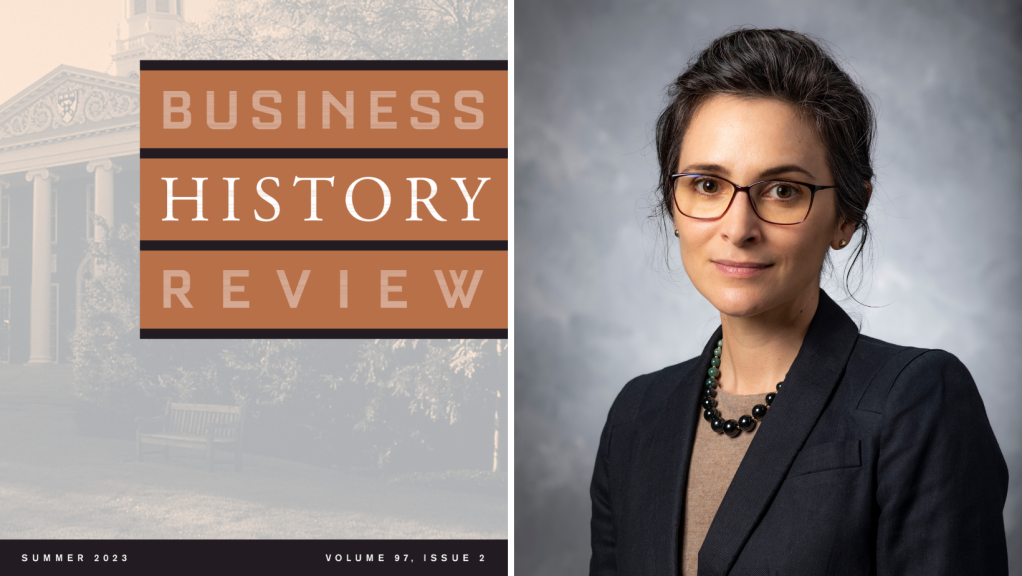
Laura Phillips-Sawyer, Jane W. Wilson Associate Professor in Business Law, recently had her review essay titled “Revisiting Interwar Global Economic Governance: Technocrats, Sovereignty, and the Perennial Problem of Legitimacy in Global Governance” published online by Cambridge University Press. Phillips-Sawyer is an expert in U.S. antitrust law and policy, and her scholarship is related to questions of economic regulation, which intersect with legal history, economic thought, business strategy and structure, and political organization.
“These two extraordinary books, written by historians of international political economy, reject that failure narrative, at least in part. While it is of course true that the League of Nations failed to stem the Great Depression or quell the forces leading to World War II, the League fundamentally changed international law. Most notably, the League represented a turn away from empire and toward international institutions, which have governed global capitalism through “technocratic internationalism” ever since (Mulder, p. 21; Martin, p. 30). Historians have too often overlooked interwar international institution-building and the steady growth of administrative rule-making because of that failure narrative. Nonetheless, recent scholarship has highlighted the novel approaches that interwar international institutions took to managing international public health, migration, drug prohibition, contraband, and colonial supervision (Martin, pp. 8, 269n21). Building on a thriving subfield of “interwar internationalism,” Mulder and Martin both argue that the First World War marked a decisive turning point in global capitalism as new international institutions eroded the power and authority of empires and created a new category of “international economic regulation” (Mulder, p. 10; Martin, p. 8). Mulder focuses on the development of economic sanctions, which were first deployed in peacetime by the League of Nations in the wake of World War I, and explains how they became commonplace despite highly undesirable and unanticipated effects. Martin shows how international institutions intervened in global capital and commodity markets in ways that shaped and limited domestic policies, especially for states with uncertain or partial sovereignty. Both books show how the devices of economic regulation developed first under the auspices of empire were repurposed for the use of international institutions and then deployed first at the periphery and then on the European continent. The bottom line is that these were novel forms of organization and intervention, which rewrote international law and laid the groundwork for post-World War II “second wave” iterations of global governance (Martin, p. 3). The League may have failed, but not for lack of power and it—alongside other international groups—left an indelible mark on global governance.”
Prior posts on Phillips-Sawyer’s scholarship can be found here.

 exchange of notes