From classmates to colleagues: LL.M. alumna Rawdha Hidri (LL.M. ’23) and 2L Carolina Mares reflect on summer work experience together

Through the Global Externships Overseas (GEO) initiative administered by the Dean Rusk International Law Center, 2L Carolina Mares spent her summer working in international arbitration at the Houerbi Law Firm in Tunis, Tunisia. In this placement, Ms. Mares worked under the supervision of Rawdha Hidri, a Fulbright recipient who completed her Master of Laws (LL.M.) at UGA Law in May 2023.

While it is not uncommon for our J.D. students to work under our LL.M. alumni/ae in GEO placements, this is the first experience in recent memory when they had the opportunity to meet on-campus and learn together as classmates prior to their experience abroad. Below, Mares and Hidri describe their experiences participating in the GEO from the perspectives of student and supervisor, respectively. Responses have been edited for length and clarity.   

* * * *

Carolina Mares, 2L

What initially interested you about the Global Externships Overseas (GEO) initiative?

With the desire to practice international law in my career moving forward, I knew that the GEO initiative was an incredible opportunity designed to encourage me to explore one potential avenue for my future. I was torn between pursuing summer work in public international law or looking for a firm that would give me some experience in international arbitration. However, when I heard about the possibility of focusing exclusively on international arbitration at Houerbi Law Firm, my mind was set.

What was your GEO experience like?

This summer, I worked at Houerbi Law Firm in Tunis, the capital of Tunisia. The firm specializes in commercial international arbitration and operates between Tunis and Paris with a focus on disputes in Europe, the Middle East, and Africa. My work consisted of reading case dockets, synthesizing parties’ positions, analyzing factual and legal exhibits, drafting an answer to a request for document production, and writing appropriate parts of an award. What I enjoyed most was the novelty of each case I got to work on. The parties in the disputes ranged from state to private parties in the UAE, Italy, Jordan, Iran, Malaysia, Tunisia, Turkey, and Morocco. I also had the chance to learn about all sorts of industries, including oil and gas, gold and fine jewelry manufacturing, and government procurement.

In addition to Rawdha, Mr. Houerbi was a phenomenal mentor to me during my time in Tunisia. With sixteen years of experience as the Arbitration and ADR Director of the ICC for the Mediterranean, the Middle East, and Africa, his positive and direct feedback played an important role in shaping my work and experience at the firm. He often invited me to sit in on team meetings that did not pertain to my particular cases so that I could gain exposure to as many disputes as possible, and he encouraged me to observe all of the virtual hearings that took place this summer.

How do you envision your GEO contributing to your academic and professional goals?

Taking part in the GEO has already impacted my professional trajectory. First, I now know that I enjoy the work involved in international arbitration, and I can picture myself pursuing a career in this practice area. Second, I’m convinced that my participation in a GEO is the reason I landed a 2L summer job fairly quickly, as it was the hot topic in all of my interviews. But more importantly, the GEO gave me a chance to take a deep dive into a niche area of law that is difficult to get into as a novice, especially in the Atlanta area. In addition to delving into international arbitration, the GEO program allowed me to develop my confidence navigating across cultures all while improving my French skills in a captivating work environment.

What was the best part of participating in a GEO?

The highlight of my GEO experience was making deep connections with my colleagues and experiencing day-to-day life in an incredibly rich culture that was brand new to me. Besides taking on the role of mentor, Rawdha was also my cultural guide. She introduced me to the coastal neighborhoods of Tunis, invited me to join her family and friends on the weekend for a shopping expedition in the Medina, pointed out the flocks of flamingos flying by in V-formation as we lounged on the beach, and took me sightseeing in Hammamet where we attended an amateur Opera concert at the Dar Sebastian villa overlooking the Mediterranean. In short, the best part of doing a GEO was getting a feel for the flow of life in Tunis and growing in my cultural competency, all of which I owe in big part to Rawdha’s support as my mentor and host.

* * * *

Rawdha Hidri (LL.M., ’23)

What interested you in serving as a placement supervisor for a GEO?

My time at UGA Law was so formative, I was eager to reciprocate and provide inquisitive American J.D. students with an experience as enriching as the one that I had in Athens. I strongly believe that immersing oneself in new experiences and can be influential on both personal and professional levels. Throughout my journey at UGA Law, I embraced the role of an informal cultural ambassador for my country Tunisia. The GEO initiative emerged as an ideal opportunity for both providing American J.D. students with professional experiences in a distinct legal framework and within a specific geopolitical context and with rich cultural immersion in my home country.

How did hosting a UGA Law student contribute to your firm’s work?

Carolina’s ability to methodically structure and articulate her thoughts has been a valuable addition to our team dynamics. Her innate attention to detail was evident from the outset, as she engaged diligently with the tasks assigned to her. Encouraging her to delve further and uncover nuances within cases became a rewarding challenge, showcasing her dedication to thorough exploration.

How did you approach integrating a UGA Law student into the local community and culture?

In the spirit of fostering a sense of belonging, I took it upon myself to introduce Carolina to the richness of Tunisian culture, ensuring she tried traditional Tunisian cuisine and experienced the crystal-clear waters of the Mediterranean. The entire team enthusiastically engaged in this process, sharing suggestions of places to visit, offering language lessons, and collectively enjoying lunches together outside the office on a weekly basis. This collaborative approach not only enhanced Carolina’s integration but also fostered a supportive and inclusive environment, benefitting both her and the entire team.

What did you enjoy about serving as a supervisor for a GEO?

Serving as a supervisor for a GEO was incredibly rewarding on a personal level. It expanded upon my own Fulbright journey that I started at UGA Law, allowing me to share my perspective and insights with someone eager to learn. The most fulfilling aspect was knowing that the student I hosted would carry their experiences in Tunisia with them, and that perspective would continue to guide them in their professional pursuits. This connection ensures a lasting impact, creating a sense of continuity and mutual understanding that extended beyond the program itself.

* * * *

Global Externships Overseas (GEOs) are four-to-twelve week summer placements in diverse areas of legal practice around the world. Students return to Athens with new colleagues and mentors, legal practice skills, and a deeper appreciation of the global legal profession. Over the last fifteen years, more than 200 UGA Law students have completed a GEO. Students secure placements tailored to their career goals with the aid of the Dean Rusk International Law Center.

For more information about GEOs, visit our website.

Georgia Law Dean Rutledge and student Rudzinskyi comment on appeals decision affecting international arbitration

A decision in which the U.S. Court of Appeals for the Eleventh Circuit overturned its precedent regarding international arbitration awards, and thus ruled in line with other federal appellate courts, is the subject of a new commentary by  Peter B. “Bo” Rutledge (above left) and student Vladyslav Rudzinskyi, a member of the Master of Laws (LL.M.) Class of 2023.

Their article, entitled “Eleventh Circuit Switches Stance on Grounds for the Vacatur of Non-Domestic Awards,” appeared on May 11 in the Daily Report.

The article discusses Corporacion AIC, SA v. Hidroelectrica Santa Rita S.A., an en banc April 13, 2023, decision in which the Eleventh Circuit set aside panel precedents to hold that vacatur proceedings related to non-domestic awards are governed by chapter 1 the Federal Arbitration Act. Noting that the new decision corresponds with others in the Second, Third, Sixth, and Tenth Circuits, Rutledge and Rudzinskyi concluded noted:

“Previously, arbitration practitioners in the Eleventh Circuit (especially hubs like Atlanta and Miami) could tout its distinctive vacatur standards as a reason to site disputes there.

“Those standards had aligned the Eleventh Circuit with international jurisdictions following the UNCITRAL Model Arbitration Law (whose vacatur standards track those under the New York Convention). Corporacion strips the Eleventh Circuit of that potential comparative advantage as an arbitral forum.”

They further warned that “[t]he new standard risks diluting the enforceability of international awards.”

Georgia Law students compete in Vis arbitration moot in Vienna, Austria

Top row, Benjamin Price; front row, l to r, Emily Crowell, Hanna Esserman, Yekaterina Ko, Sandon Fernandes, Savannah Grant

A team of students recently represented the University of Georgia School of Law at the annual Willem C. Vis International Commercial Arbitration Moot in Vienna, Austria. 

This year’s team comprised 2Ls Hanna Esserman, Sandon Fernandes, Benjamin Price, and Yekaterina Ko. Among those who supported their efforts were numerous coaches: 3Ls Emily Crowell and Savannah Grant, with support from 3Ls Collin Douglas and Ligon Fant, and Georgia Law Dean Peter B. “Bo” Rutledge.  

Fernandes reflected on his Vis experience, which included not only the team’s competition in Vienna but also its third-place finish in the Florida Bar International Law Section Richard DeWitt Memorial Vis Pre-Moot in Miami this past February: 

“The Vis Moot Court competition provides students with the opportunity to collaborate on a challenging international commercial dispute as if it were a real case. Competing against 378 teams from around the world has given me the ability to analyze complex legal issues from a global perspective.”

Georgia Law LL.M. students win top honors at 10th International Commercial and Investment Arbitration Moot

Members of the University of Georgia School of Law LL.M. Class of 2023 won top honors at last weekend’s 10th International Commercial & Investment Arbitration Moot Competition.

Forming the champion team at the competition were the three students pictured above, from left: Tatiana Popovkina, Alexandra F. Lampe, and John A. Omotunde, The competition’s best oralist, meanwhile, was Olha Kaliuzhna, pictured above right; Lampe was the third runner-up. Kaliuzhna, along with Oleksandra Iordanova and Vladyslav Rudzinskyi, formed the second Georgia Law team, which also competed in advance rounds.

Coaching the teams were another LL.M. student, Gloria María Correa, as well as Georgia Law’s Dean, Peter B. “Bo” Rutledge, whose specialty is international arbitration.

The competition took place at American University Washington College of Law in Washington, D.C. (prior post)

Georgia Law’s Master of Laws (LL.M.) curriculum offers U.S. legal education to lawyers trained overseas. The participants and coach in the D.C. competition, for instance, were trained in Germany, Nigeria, Panama, Ukraine, and Uzbekistan.

For more information about the curriculum, which is administered by the law school’s Dean Rusk International Law Center, is available here.

Georgia Law LL.M. teams headed to Washington for International Commercial and Investment Arbitration Moot

Six members of the LL.M. Class of 2023 at the University of Georgia School of Law will travel to Washington, D.C., this weekend to take part in the 10th International Commercial & Investment Arbitration Moot Competition.

The students, who comprise two teams, earned their initial training as lawyers in 4 different countries. They are, left to right above: John Omotunde, Nigeria; Oleksandra Iordanova, Ukraine; Vladyslav Rudzinskyi, Ukraine; Tatyana Popovkina, Uzbekistan; Olha Kaliuzhna, Ukraine; and Alexandra Lampe, Germany. Their coach is Georgia Law Dean, Peter B. “Bo” Rutledge, an expert in international arbitration law.

The competition – which will take place March 24 and 25 at American University Washington College of Law – involves a commercial dispute to be resolved under the rules of the Japan Commercial Arbitration Association.

Georgia Law’s Dean Rusk International Law Center administers the Master of Laws (LL.M.) curriculum. Details here.

Invitation to virtual AtlAS Lecture this Thursday, cosponsored by our Center and featuring international arbitration expert Horacio Grigera Naón

The University of Georgia School of Law Dean Rusk International Law Center is honored to host the 5th annual Atlanta International Arbitration Society Lecture at 6 p.m. this Thursday, April 23. The event will be held remotely this year due to the ongoing COVID-19 situation.

Delivering the lecture will be Dr. Horacio Grigera Naón, whose expertise in international arbitration spans more than 30 years, and who is now serving as a Distinguished Practitioner in Residence and the Director of the International Commercial Arbitration Center of the Washington College of Law, American University, Washington, D.C.

Grigera Naón’s previous positions include Secretary General of the International Court of Arbitration of the International Chamber of Commerce and Senior Counsel for the International Finance Corporation. He holds LL.M. and S.J.D degrees from Harvard Law School, LL.B and LL.D. degrees from the School of Law of the University of Buenos Aires, and is a member of the Bars of the Argentine Federal, New York, District of Columbia and United States Supreme Court Bars.

This lecture series began in 2016 in honor of Glenn Hendrix, the founding president of the Atlanta International Arbitration Society, a non-profit organization that seeks to grow the international arbitration community in the southeastern United States. AtlAS sponsors the annual event in conjunction with academic institutions in the region – including Georgia Law, a founding AtlAS member.

This year’s event will begin with introductory remarks from AtlAS President Philip W. “Whit” Engle and Georgia Law Dean Peter B. “Bo” Rutledge.

Joining AtlAS and Georgia Law’s Dean Rusk International Law Center in presenting this year’s event is King & Spalding LLP, a founding law firm of AtlAS.

Registration for the free event is required and available here.

Georgia Law Dean Bo Rutledge, student Katherine Larsen publish commentary on promise of new international mediation treaty

A new treaty seems poised to raise the profile of mediation as a way of resolving disputes, according to commentary by the dean and a student researcher here at the University of Georgia School of Law.

Coauthoring the Daily Report article, entitled “Singapore Convention Presents an Opportunity for Georgia in Mediation,” were international dispute resolution expert Peter B. “Bo” Rutledge, Dean and Herman E. Talmadge Chair of Law at Georgia  Law, and 3L Katherine Larsen.

The United States belongs to a number of treaties – most notably, the UN Convention on the Recognition and Enforcement of Foreign Arbitral Awards, concluded in New York in 1958 and so known as the New York Convention – that make make arbitration awards enforceable. This membership, the article observed, “has given arbitration a comparative advantage over other forms of dispute resolution.”

But that could change once the 2018 UN Convention on International Settlement Agreements Resulting from Mediation – named the Singapore Convention in recognition of the city where it was concluded last December –  enters into force. Some predict that could happen within a year, the authors wrote, then focused on the significance of this for the state of Georgia:

“Much like it adopted an international arbitration code, the state should consider enacting an international mediation law tied to the provisions of the Singapore Convention. Such legislation could enhance Georgia’s appeal as a mediation forum and build upon its reputation as a jurisdiction hospitable to business, including the resolution of business disputes.”

The full commentary is available here. A Global Atlanta news report on a related talk that Dean Rutledge delivered at the annual conference of the Atlanta International Arbitration Society is here.

Global Governance Summer School visits the Hague Conference on Private International Law & museum

THE HAGUE — Students spent their second day in The Hague engaged in a mix of legal and cultural excursions.

Students spent the morning meeting with lawyers from the Hague Conference on Private International Law. There, they were treated to an overview of the world organization responsible for cross-border cooperation in civil and commercial matters. Students met with Laura Martinez-Mora, Secretary of the Permanent Bureau, and Frédéric Breger, Legal Officer (left). They provided an introduction to the history and structure of the HCCH, and provided a detailed overview of some of its many conventions, which cover topics including: family law matters such as child abduction, intercountry adoption, child protection, and maintenance obligations; forum selection as other procedural issues such as choice of court, taking evidence abroad, service abroad, and apostille. Finally, they touched upon the newly concluded Convention of 2 July 2019 on the Recognition and Enforcement of Foreign Judgments in Civil or Commercial Matters, which Dean Peter B. “Bo” Rutledge, raised during his session on international dispute resolution in Leuven last week. Students were interested to hear about the treaty-making process, as well as the aspects of the treaties, particularly those covering family law, that reinforced human rights treaties, such as the Convention on the Rights of the Child.

From left, Ayman Tartir, Steven Miller, Gamble Baffert, Charles Wells, Emily Snow, Holly Stephens, Lauren Taylor, Briana Blakely, Jessica Parker, and Kathleen Doty.


In the afternoon, the group visited Escher in Het Paleis, the museum dedicated to M.C. Escher, set in Queen Emma’s winter palace. There, students took in masterpieces, and thoroughly enjoyed the interactive top floor of the museum. Everyone’s inner child came out to play!

Tomorrow, students will visit the International Court of Justice and the International Criminal Court before concluding the 2019 Global Governance Summer School.


Global Governance Summer School explores developments in climate change and international commerce

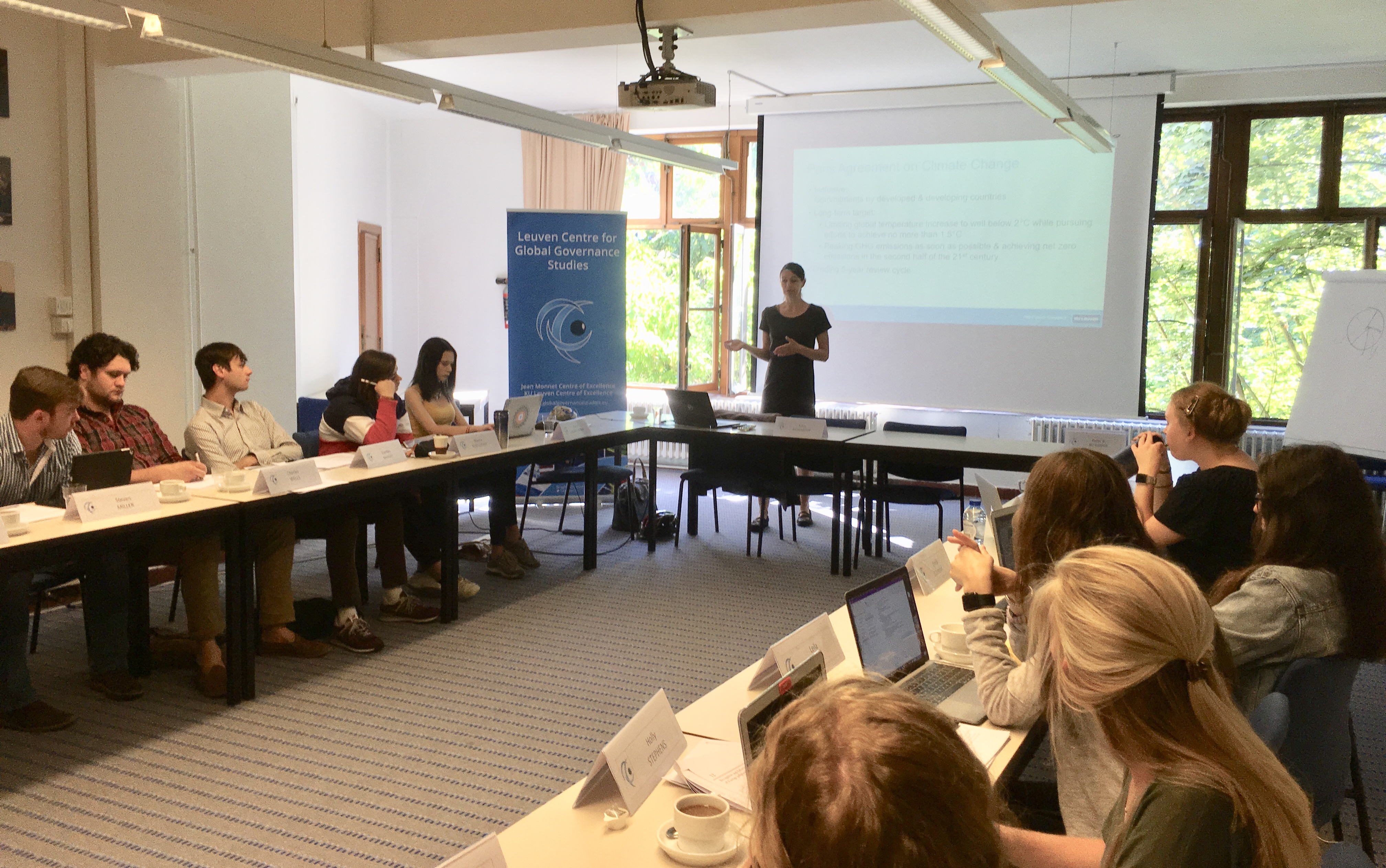
LEUVEN – After a full day of professional development briefings yesterday, students at the Georgia Law-Leuven Global Governance School returned to the classroom today. They took part in four lectures exploring developments in climate change and international commerce:

First, Professor Katja Biedenkopf (right), Assistant Professor at Leuven International and European Studies (LINES) at KU Leuven and an expert in European Union environmental and climate policy, addressed climate change. She focused on the international instruments at play, in particular the Paris Agreement. Professor Biedenkopf also highlighted challenges to climate change governance and encouraged students to consider international, regional, and local solutions.

Second, Peter B. “Bo” Rutledge (left), Dean of the University of Georgia School of Law, provided an introduction to international dispute resolution. He led students through a hypothetical cross-border dispute, thereby introducing the architecture of the international dispute resolution framework. He highlighted the differences between arbitration, mediation, and litigation.

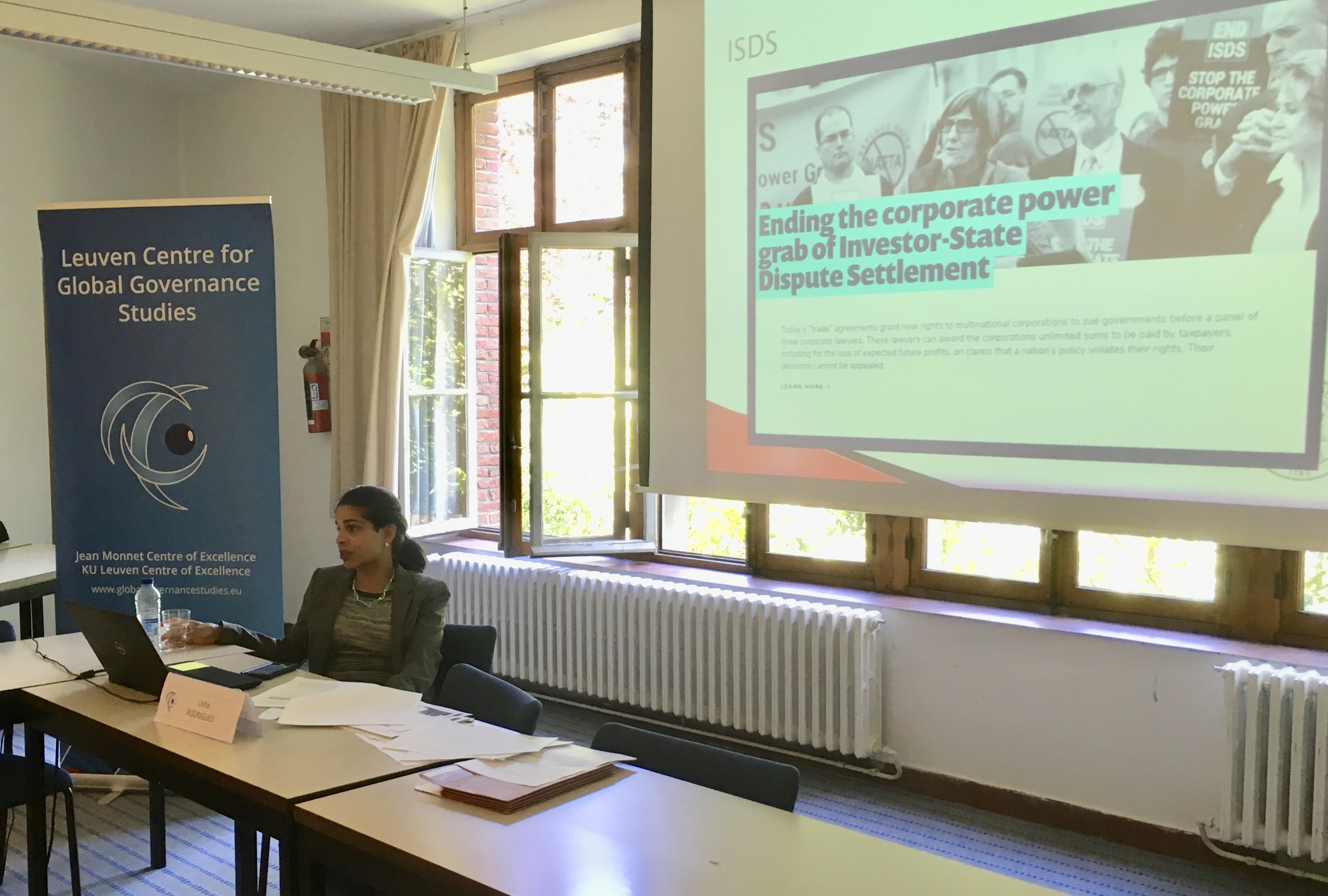
Georgia Law professor Usha Rodrigues (right), provided the final two lectures of the day. A corporate governance scholar, she first provided an overview of international economic law and trade, and covered topics such as finance, international monetary policy, investment, tax, and transnational business transactions. She closed the afternoon with an exploration of comparative corporate governance, including how rules have developed across states, and how conflicts between management and shareholders or between majority and minority shareholders are resolved in different contexts.

Tomorrow, students will participate in an international conference on democracy and the rule of law in the European Union, as part of the RECONNECT project. In the meantime, they’ll spend the evening celebrating the 4th of July as expats in Belgium.

Georgia Law trio pens Daily Report commentary on ECJ arbitration ruling

Peter B. “Bo” Rutledge, Dean and Herman E. Talmadge Chair of Law here at the University of Georgia School of Law, has co-authored, with 3L Katherine M. Larsen and Amanda W. Newton (JD’19), a commentary on a recent decision related to international arbitration.

Entitled “European Decision Could Have Killed Investment Treaties, Affecting Arbitration and Investments,” the commentary appeared at The Daily Report on June 28.

It discusses the content and the implications of Achmea v. Slovakia, a May 2018 decision in which the European Court of Justice ruled a clause in a bilateral investment treaty to be incompatible with European law. Both that decisions and subsequent interpretation of it in European and US courts, the authors state, leaves “more questions than answers at this point.” (Also see prior post.)