Georgia Law Professor Desirée LeClercq leads experiential learning opportunity for students in Atlanta

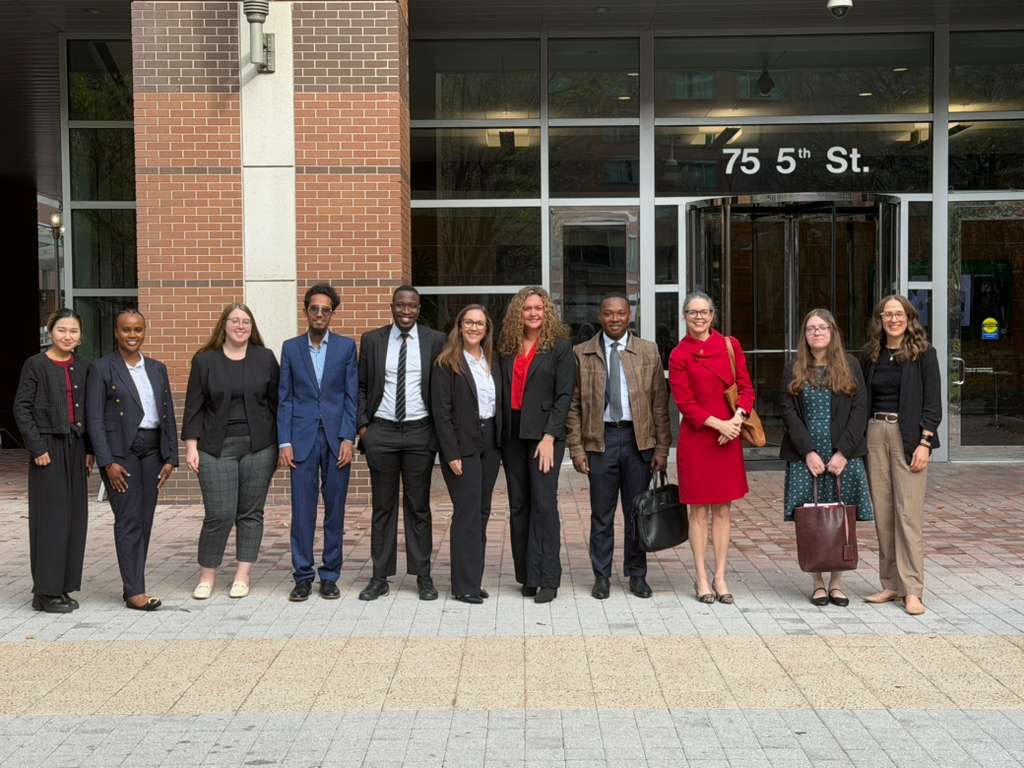
In November, University of Georgia School of Law Professor Desirée LeClercq traveled to Atlanta with a group of students as the culmination of their semester-long exploration of international trade.

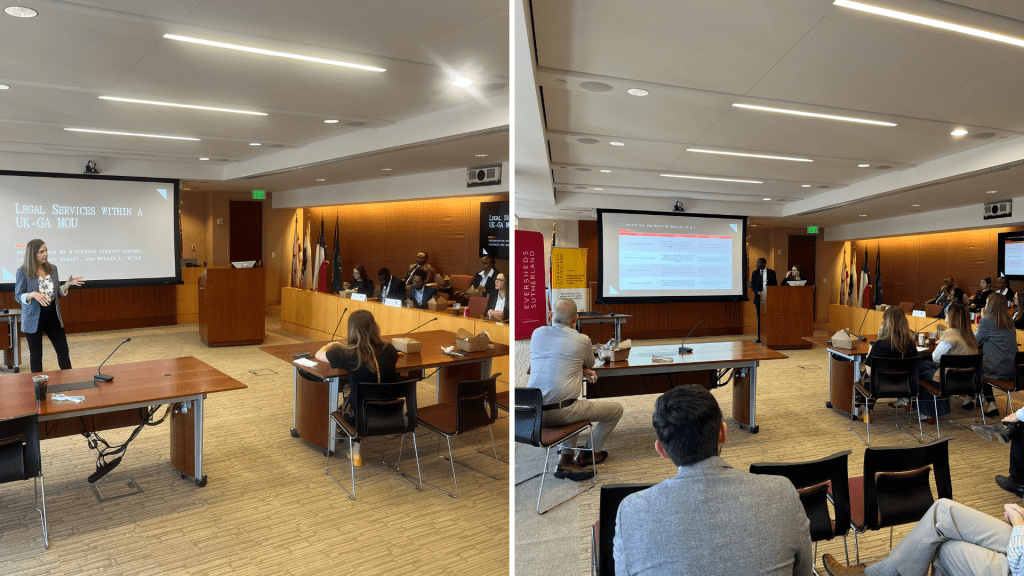
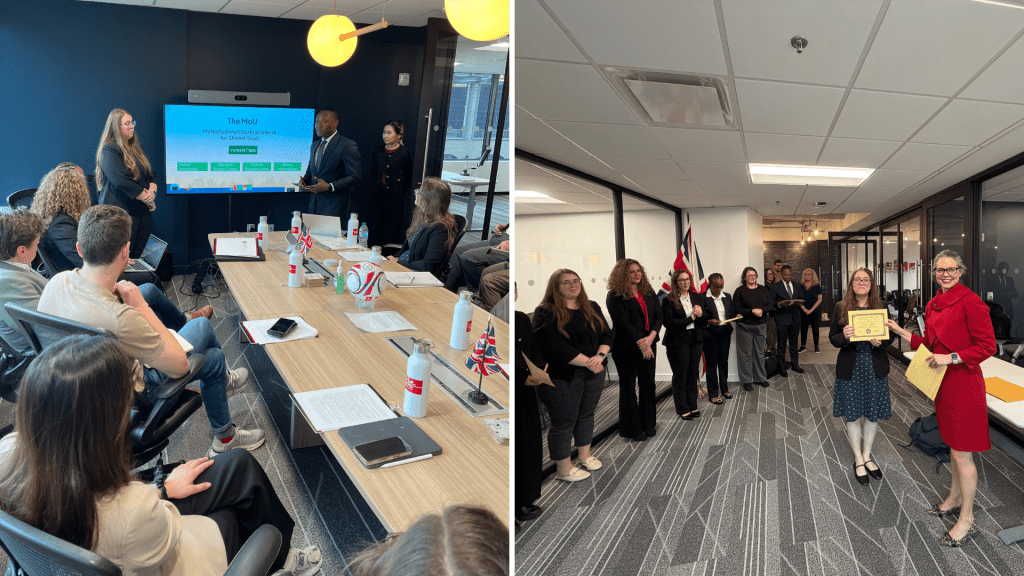
15 students, including J.D., LL.M., and Graduate Certificate in International Law students, spent the semester examining potential trade and investment opportunities between the State of Georgia and the United Kingdom from an interdisciplinary perspective. They researched and wrote a paper examining key export and import sectors in Georgia and the United Kingdom, and then prepared a hypothetical Memorandum of Understanding (MoU) between the two. The students spent the day in Atlanta presenting to, and fielding technical questions from, three different audiences: representatives from the state of Georgia, transactional and international lawyers from Eversheds Sutherland, and foreign diplomats from the U.K. consulate.

Georgia Department of Economic Development

The group’s first stop of the day was hosted by the Georgia Department of Economic Development (GDEcD), the state’s sales and marketing arm, and had in attendance other state representatives.

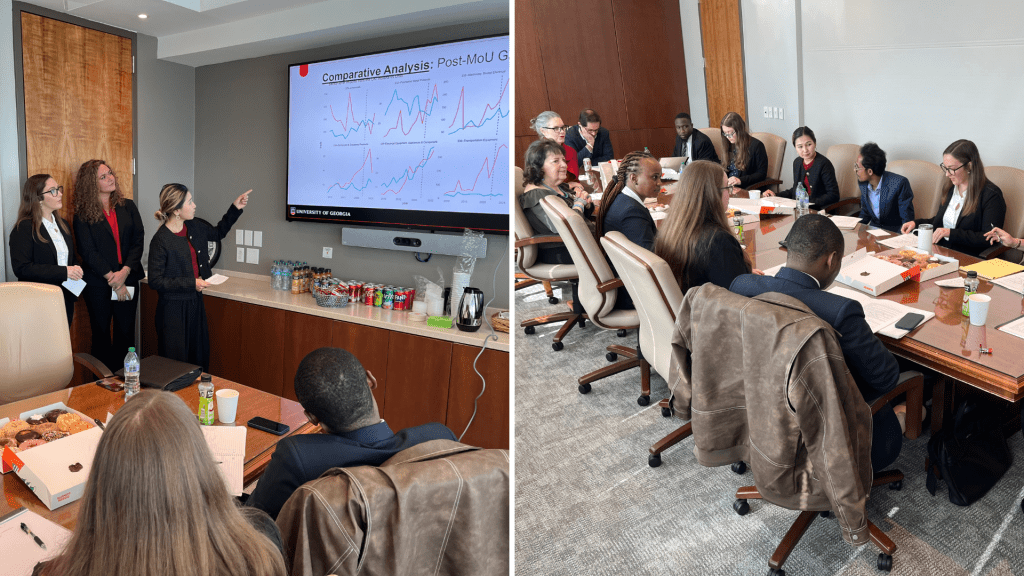
At the GDEcD, Madina Bekisheva (GCIL student), Sutton Eady (J.D. ’27), Md. Asaduzzaman Jabin (GCIL student), and Jalyn Ross (J.D. ’27) worked together to present their portion of the hypothetical legal instrument. In their presentation, the group argued for greater collaboration and synergies between the state and the United Kingdom to attract, facilitate, and potentially grow trade. Their arguments centered on export and import data from similarly situated states and novel predictive models they had built demonstrating how enhanced collaborations with the United Kingdom could increase trade and job opportunities in Georgia. The students used the model to identify specific sectors in industry, renewable energy, commerce, and agriculture, among others, where Georgia’s economy and workers could benefit.
Eversheds Sutherland

The group’s second stop of the day was the Atlanta office of Eversheds Sutherland, a global law firm specializing in corporate, energy, litigation, tax, and real estate. This firm has a meaningful relationship with the UK, as it is where the Eversheds law firm originated prior to their 1988 merger with Sutherland. The firm’s global headquarters is located in London, and its historic ties to the country are evident in their presence throughout the British legal market. Students Leighlee Mahony (J.D. ’26) and N’Guessan “Clement” Kouame (LL.M. ’24, J.D. ’26) presented. Both students argued that enhanced trade and investment collaboration between Georgia and the United Kingdom could offer reciprocity in sectors, including legal services.

The students were hosted by Jenny Lambert, Partner, and attended by several practicing attorneys in transactional and international work. The students benefitted both from the lunch that Eversheds Sutherland generously provided, as well as in-depth and vigorous questioning by the firm’s attorneys.
British Consulate General Atlanta

The group’s third and final stop of the day was the British Consulate General Atlanta. Students Maya Roper (J.D. ’27), Victor Azure (LL.M. ’26), Wambui Kamau (LL.M. ’26), and Madina Bekisheva (GCIL student) presented the group’s data and modeling to U.K. diplomats and officials. The group again walked the audience through specific trade and industry sectors, with a special focus on battery production for electric vehicles, the Georgia aerospace industry’s advantage, and veterinary medicine.
Student Reflections

“Coming from a non-law background in Computer Science, I learned that successful trade and partnerships do not thrive on innovation alone. They must be shaped by policy and political realities, economic conditions, population needs, national interests, and stakeholder relationships. The Atlanta trip made this clear by showing how quickly trade negotiations can shift based on context, not on the brilliance of the technology or business itself.” – Md. Asaduzzaman Jabin (GCIL student)

“This course was a great blend of theory and practice, requiring intensive and insightful legal research to understand and gather the materials, as well as concise, precise, and clear drafting of the MoU. The most significant site visit for me was the visit to the Georgia Department of Economic Development. It was a great experience to compare our findings with the department’s work and its vision for improvement. It was also interesting to know that people at the GDDE were doubtful about the use of models for the prediction of growth or value from MoUs. It shows how sometimes new technology may face skepticism for its implementation and convince people to advance or improve their old methods.” – N’Guessan “Clement” Kouame (LL.M. ’24, J.D. ’26)

Georgia Law alumnus Tom Harrold (J.D. ’69) featured in Global Atlanta interview about Atlanta as a hub for global business

University of Georgia School of Law alumnus Tom Harrold (J.D. ’69) recently spoke with Global Atlanta about Atlanta’s development as a center for international business in an article titled “Miller and Martin’s Tom Harrold Reflects on Atlanta’s Rise as a Global Business Powerhouse“. Harrold, a senior partner at Miller & Martin PLLC, serves on the Dean Rusk International Law Center’s advisory council.

Harrold, one of the founders of the World Law Group, describes milestones in Atlanta’s international growth dating back to Governor George Busbee’s initiatives in the 1970s to the development of Hartsfield-Jackson International Airport, Delta Airline’s international connectivity, and local leaders thinking globally, including Coca-Cola’s Robert Woodruff and civil rights leaders.

The interview concludes with Harrold’s belief in the importance of nurturing a future generation of globally-minded citizens:

As he looks ahead, Mr. Harrold remains confident that Atlanta and Georgia’s competitive advantages—combined with a welcoming business environment—will continue to attract foreign investment for years to come. 

“At the end of the day, we need people that can communicate with workers in the workforce, and then great incentives that the state and local governments provide to new industries coming in,” Mr. Harrold said.  

“We need our young people to look out and see there’s a whole other world out there. They need to travel and go see these other countries, so they can have a real appreciation for an international career—and then come back to Georgia.” 

A 1969 graduate of the law school, Harrold leads Miller & Martin’s International/World Law Group practice. He has for many years worked with European and Asian companies investing in the Southeastern United States and with American companies that have been expanding around the globe. He previously served as the deputy commissioner of the Georgia Department of Revenue, and he has been instrumental in navigating significant pro-economic legislation through the Georgia General Assembly. He is a founder of the World Law Group, an international legal network with over 6o member firms with offices in 92 countries. In 2009, he was awarded the Cross of Merit of Germany by President Horst Köhler. He is presently a member of the law school’s Board of Visitors.

Georgia Law students Olha Kaliuzhna (J.D. ‘25) and Vladyslav Rudzinskyi (J.D. ‘25) win AtlAS Pre-Moot Invitational

University of Georgia School of Law students Olha “Olia” Kaliuzhna (J.D. ‘25) and Vladyslav “Vlad” Rudzinskyi (J.D. ‘25) won the Atlanta International Arbitration Society Pre-Moot Invitational, which took place in March. Rudzinskyi was also named the competition’s best advocate.

Law schools primarily from the Southeastern United States competed in this “warm up” tournament for the Willem C. Vis International Commercial Arbitration Moot to be held in Vienna, Austria, during April. 

Georgia Law students attend Atlanta International Arbitration Society annual conference

Last month, a group of eight University of Georgia School of Law students attended the 13th Annual Conference of the Atlanta International Arbitration Society (AtlAS).

Attendees included 3L Jacob Wood and Master of Laws (LL.M.) students Sara Dorbahani, Michael Faleye, Paria Keramatkhah, Neethu James, Fatemeh Khouei, Samuel Kuo, and Zulma Perez. Five of these students (Wood, Dorbahani, Faleye, Keramatkhah, and Khouei) received Louis B. Sohn Professional Development Fellowships to support their attendance of this conference. Awarded by the law school’s Dean Rusk International Law Center, Sohn Fellowships enable students to attend professional development opportunities related to international law.

Conference attendees attended a number of talks and events designed for practitioners and students involved in international arbitration, including the ICC Young Arbitration & ADR Forum, the AtlAS Young Practitioners Group, networking lunches, and panel discussions. Georgia Law Dean Peter B. “Bo” Rutledge led a fireside chat with alumnus and current President of AtlAS, Christof Siefarth (LL.M. ’86).

Reflecting on the variety of panels and speakers in attendance, Keramatkhah said:

My favorite [discussion] was the panel on the “Top 10 Developments in Arbitration” and Dean Rutledge’s speech. This panel covered key trends in international arbitration, such as the rise of the Borneo Arbitration Center, and UNCITRAL procedural amendments. It also highlighted the growing importance of the new IBA Rules of Disclosure and updates to the 1996 English Arbitration Act. Differences between US and European arbitration were discussed, particularly in witness handling, cross-examination, and the judge’s role. I found this panel very interesting as it was very helpful in understanding the current and future challenges of arbitration. As it regards Dean Rutledge’s speech, since I was involved in [the] research of his speech, I appreciated that it provided deep insights into dispute resolution.

In describing the ways in which this experience benefitted him professionally, Wood said:

Attending the AtlAS conference reaffirmed my desire to practice in the field of international arbitration and aided in my pursuit of this goal. I was able to meet and converse with a variety of practitioners and arbitrators from across the globe.

When asked about her favorite moment from the conference, Dorbahani explained:

One of the standout sessions delved into the art of writing for a multicultural audience. As international arbitration becomes more diverse, mastering the nuances of cross-cultural legal advocacy is vital. It emphasizes how language can either clarify or complicate arbitration across borders. Coming from a Civil Law background, I found this especially relevant, as it highlighted the delicate balance needed to communicate effectively in a global legal landscape.

To read prior posts about Georgia Law students using Sohn Fellowships to attend professional development opportunities, please click here and here.

Ninth Annual AtlAS Lecture speaker, Emory Professor Stacie Strong, considers use of artificial intelligence in international arbitration proceedings

A member of the Dean Rusk International Law Center’s staff, Global Practice Preparation Assistant Catrina Martin, attended this year’s ninth annual Atlanta International Arbitration Society (AtlAS) lecture, “Rage Against the Machine: Governing the Use of AI in International Arbitration.” AtlAS is one of the Center’s institutional partners, and Georgia Law alumnus Dr. Christof Siefarth (LL.M., ’88) is the newly-elected president. Below are some of Martin’s reflections of the event.

Earlier this month, the Atlanta International Arbitration Society co-hosted its 9th annual lecture with the Charlotte International Arbitration Society, held at Wyche Law Firm in downtown Greenville, South Carolina. Stacie Strong, Acting Professor of Law at Emory University Law, presented “Rage Against the Machine: Governing the Use of AI in International Arbitration,” to a hybrid crowd of practitioners, students, and academics.

Her lecture discussed the potential copyright concerns in using AI, such as who owns the created data, as well as privacy concerns given that AI generators have the ability to move past firewalls and other security measures. Discussion included a critique of how the increasing use of AI in arbitration, and across the broader legal field, is training students and young lawyers for the profession, and developing the building block skills of research, writing, and cite checking.

Strong advised that in arbitration, both parties agree during preliminary discussions on the use of AI, and that arbitrators proactively raise the issue with their clients.

Martin reflected on the value of this topic for law students in particular:

“[Strong’s] perspective is helpful for students who are interested in best practices in arbitration, and especially those ‘digital natives,’ for whom AI usage feels like a natural extension of technology already ingrained in their legal education, such as LexisNexis case searches. For students who are interested in international arbitration, generative AI use may offer cost and time savings on the front end, but the pitfalls, especially when arbitrating across common- and civil-law countries, outweigh this potential.”

Strong has taught at law schools around the world and has acted as a dual-qualified (England-US) practitioner with major international law firms in the UK and the US. She has also written over 130 books, articles, and other works and has acted as an expert consultant to a variety of governmental, non-governmental and intergovernmental organizations. A full biography can be found on Emory University’s website.

Georgia Law hosts Hendrix Lecture by arbitration expert, Geneva Professor Gabrielle Kaufmann-Kohler

The University of Georgia School of Law Dean Rusk International Law Center is honored to host the second annual Hendrix Lecture of the Atlanta International Arbitration Society at 6 p.m. Monday, March 27, 2017, at its Atlanta campus, 3475 Lenox Road N.E.

Delivering the lecture will be Gabrielle Kaufmann-Kohler (left), a Professor of Law at the Geneva University Law School in Switzerland. Known worldwide for her expertise in international arbitration, she has:

► Acted in over 200 international arbitrations, mainly as an arbitrator; and

► Appeared on numerous institutional arbitration panels, including those of the International Chamber of Commerce, International Centre for Settlement of Investment Disputes, American Arbitration Association, London Court of International Arbitration, Singapore International Arbitration Centre, and the China International Economic and Trade Arbitration Commission.

A partner at the Geneva law firm Lévy Kaufmann-Kohler, she formerly practiced law at Schellenberg Wittmer and Baker & McKenzie. She is a member of the Bars of Geneva and New York and of the American Arbitration Association, and  is the Honorary President of the Swiss Arbitration Association.

The Hendrix Lecture is named for Glenn P. Hendrix (right), a partner in the Atlanta office of Arnall Golden Gregory LLP and a founder of the Atlanta International Arbitration Society, also known as AtlAS. Georgia Law is among the founding member organizations of the Society, a non-profit organization that seeks to grow the international arbitration community in the southeastern United States.

This year’s Hendrix Lecture is jointly presented by AtlAS and the Dean Rusk International Law Center, and is part of the law school’s Georgia Women in Law Lead (Georgia WILL) initiative. It is cosponsored by Georgia Law’s Women Law Students Association and its International Law Society. Cooperating entities include the Atlanta Center for International Arbitration and Mediation, the Washington, D.C.-based American Society of International Law, JAMS, the Vienna International Arbitration Centre in Austria, and the International Institute for Conflict Prevention and Resolution in New York City.

Registration, snacks, and drinks will begin at 6:00 p.m., and the lecture will begin at 6:30. There will be a reception to follow. A few seats still remain; please register and join us!

Third-party funding a focus of Atlanta international arbitration conference

meganIt’s our pleasure today to publish this post by Megan Alpert, a member of Georgia Law’s J.D. Class of 2018. Along with 2 other students who posted yesterday, Megan recently took part in the 5th annual conference of AtlAS, the Atlanta International Arbitration Society. She served as a rapporteur for a roundtable on “The Rise of Third-Party Funding: Flattening the Playing Field between Haves and Have-Nots?,” featuring attorneys Carlos Forbes (Center for Arbitration and Mediation of the Chamber of Commerce Brazil-Canada and Mundie Advogados, São Paulo, Brazil), Andrea Menaker (White & Case), Eloise Obadia (Derains & Gharavi), Lawrence S. Schaner (Jenner & Block), and Tim Scrantom (JD’83) (Scrantom Dulles International), and moderated by John Watkins (JD’82) (Thompson Hine). Reflecting on this panel, Megan (above left) writes:
atlantamapAtlanta’s infrastructure and legal framework have made it a major seat for international dispute resolution. To secure that position and foster its continued growth, the Atlanta International Arbitration Society (AtlAS) facilitates a conference where representatives of the international legal community discuss various topics relating to international arbitration. I had the privilege of attending the 5th annual AtlAS conference, “International Arbitration in a Not So ‘Flat’ World: Practical Considerations for Counsel and Their Clients.” Here are some things I learned from the panel for which I served as student rapporteur:

► This particular panel focused on the role of third-party funding in cases of international arbitration. Third-party funding, or more simply “TPF”, is a process by which a claim-holder, either on its own behalf or by means of an attorney, approaches and asks a third-party funder to take an interest in the case by agreeing to provide the funds necessary to carry the case forward. The need for TPF typically stems from the so-called “David versus Goliath” cases, in which claim-holders are practically barred from bringing or defending a case because of a lack of funding.

► TPF agreements involve large investments of capital and large amounts of risk, so it’s no surprise that the “reward” sought by third-party funders is also quite substantial. The typical matrix for the funder is a contingency fee split between a fixed and variable return. Often, the funder not only wants to see its capital returned, but also wants to receive a multiple of that investment dispensed on a preferential basis. The fixed return is typically phrased as “investment plus 200%” or “three times capital invested.” The variable return, on the other hand, is roughly 10%-15% of the final award. This arrangement is, in some respect, a means of obviating the risk of not getting paid, but also insuring that some of the risk remains with the firm so they maintain an interest in the case.

► Challenges with TPF present themselves mostly on the battlefield of professional ethics. Panelists alluded to specific challenges for attorneys and their firms, such as:

  • The potential for a conflict of interest or violation of American Bar Association Model Rule 1.8.
  • Issues of disclosure and finder’s fee implications.
  • Practical concerns of jurisdiction and transparency.

It ultimately depends on the characteristics of the specific tribunal but, in general, these hurdles are not insurmountable; rather, they are areas for exercising caution. They require parties to cross every ‘T’ and dot every ‘I’.

► From the point of view of a third-party funder, the biggest issue seems to be in understanding the legal jargon and its minutiae. The difference in “privilege” and “work product” seems to be especially troubling. Third-party funders operate outside the bounds of the attorney-client relationship, and may themselves seek opinions or advice from outside counsel. It’s extremely important that all parties pay close attention to the transfer of documents as well as communications in this web of relationships. To properly operate with these challenges, an attorney will most likely require a confidentiality agreement involving the third-party funder and assurances of protection from any outside counsel having knowledge of the matter. This agreement seeks to make sure none of the parties improperly turns over protected work-product and that there isn’t any leakage of confidential or privileged information once it passes beyond the bounds of general attorney-client privilege.

atlas-logoPanelists broke down the issues into understandable bite-sized pieces, yet still managed to tackle the tough and more technical issues. They brought to light common issues and misconceptions of the use of third-party funding in hopes of correcting any misunderstandings and encouraging those who may have previously been on-the-fence to not shy away from this avenue for funding. Because of their diverse backgrounds, panelists were also able to provide different perspectives on the issues, including the international application of third-party funding for non-US tribunals. All in all, this panel was incredibly informative – especially considering I had absolutely no idea what TPF was prior to my arrival.

Atlanta international arbitration panel surveys recent developments

johann_cropIt’s our pleasure today to publish this post by 2 Georgia Law students,  Johann Ebongom, an LL.M. candidate, and Brian Griffin, a member of the J.D. Class of 2019 and a Dean Rusk International Law Center Student Ambassador. Johann and Brian recently took part in the 5th annual conference of AtlAS, the Atlanta International Arbitration brian2Society. Along with another student whose post will appear tomorrow, they served as rapporteurs for a roundtable on “Recent Developments in International Arbitration,” featuring attorneys Edward A. Marshall (JD’02) (Arnall Golden), Eric D. Johnson (CARE), Kirk W. Watkins (JD’75) (Womble Carlyle), and moderated by Randall F. Hafer (Kilpatrick Townsend). Reflecting on this panel, Johann (top left) and Brian (lower left) write:

Atlanta, Georgia, is fast becoming a preferred seat for international dispute resolution. This is in part due to the efforts of the Atlanta International Arbitration Society (AtlAS), whose primary goal is to promote Atlanta as a venue for the resolution of international commercial and investment disputes. AtlAS hosts an annual conference in pursuit of this goal, and so provides a forum where practitioners, experts, and others interested in international arbitration can network and exchange ideas related to this rapidly evolving field.

atlantamapWe had the privilege to represent the University of Georgia School of Law as student rapporteurs at the 5th annual AtlAS conference, “International Arbitration in a Not So ‘Flat’ World: Practical Considerations for Counsel and Their Clients.” The particular panel we attended focused on the use of arbitration as a dispute resolution mechanism in the payments-processing, international nonprofit, intellectual property, and construction industries. Here are a few things that we learned from the panelists’ presentations:

Arbitration is a binding dispute settlement mechanism whose basic concept is that it is beneficial for somebody with a deep understanding of the context of a dispute to decide the outcome of that dispute. The practice of arbitration first came about when merchants decided that they wanted fellow merchants to settle their disputes instead of judges, who often lacked knowledge necessary to fairly settle a dispute in a particular commercial context. These merchants they believed that because other merchants were the people with the best understanding of their particular industry, they were more likely to fairly settle their disputes than anyone else. The practice of arbitration has continued through the ages, but arbitrators in this day and age are almost always lawyers with expertise in a particular field. However, non-lawyer industry experts still play a vital role by providing information that helps the arbitrators decide the case.

► The payments-processing industry facilitates use of credit and debit cards. When someone uses a credit or debit card, the payment must first pass through a processor to get from the bank to the receiving business. Most disputes in this industry are currently resolved through litigation, but experts in the field see value in moving clients to arbitration. Litigation is often cost prohibitive and the public forum is an inhospitable place to settle disputes in the payments processing industry in general. The confidentiality of arbitration would be a great benefit, as it would allow companies to better protect consumer data.

► In relation to international nonprofit organizations, disputes generally arise between the charity and private companies, governments, or employees. However, formal disputes are not common in the non-profit industry, and when they do arise charities tend to favor courtrooms over arbitration. This is because charities are often seen as sympathetic parties, which can increases their chances of winning a judgment in court as opposed to arbitration. However, international charities often find it hard to get a balanced approach in foreign courts, as they are often subject to local bias and trust issues while litigating in foreign legal systems. Arbitration might be the solution for international organizations looking for a fair resolution to disputes arising in foreign countries.

►There are many opportunities for arbitration to be utilized in the intellectual property industry. As the cost of litigation rises, more businesses are electing to pursue cost-effective means of dispute resolution, like arbitration, in lieu of protecting their rights in court. That said, generally three categories of disputes arise in the IP industry:

  1. In the first, the two parties are unknown to each other before the dispute arises. In this situation, one party is usually alleging that the other party has infringed upon their patent rights, and they go to court to settle their dispute.
  2. In the second, parties have a contractual relationship. This can be between licensor-licensee, manufacturer-distributor, or supplier-purchaser. Because of the prevalence of arbitration clauses in contracts, these disputes are often settled through arbitration.
  3. In the final category, companies lack agreements between themselves, but work in the same industry. Typically these companies are not likely to arbitrate; however, given that litigation is very expensive, some companies do arbitrate in order to keep their legal costs down.

► The construction industry is worth many trillions of dollars worldwide. International construction projects often produce massive and complex disputes that usually cost more than is necessary and take longer than they should. The construction industry has traditionally looked for alternative ways to settle disputes. Arbitration is quicker and cheaper than going to court, and still provides an enforceable resolution to the dispute, making it preferable to other more traditional methods of dispute resolution like litigation. Arbitration is also valuable in that it provides the ability to have a dispute decided by others working in the same industry, as most construction clients would prefer that arbitrators knowledgeable about the construction industry decide their case instead of a judge or a jury with no knowledge of the industry.

atlas-logoAttending this year’s AtlAS Conference was an enriching experience. We learned about the use of arbitration as a dispute settlement mechanism in the context of four different industries and we took full advantage of the opportunity to meet and network with practitioners and experts in this rapidly growing field, many of whom were willing to share their experiences and impart helpful advice in regards to our academic journey at the University of Georgia School of Law. In doing so, we forged important professional relationships that we hope will last for many years to come. Finally, we thank Georgia Law for this wonderful opportunity to represent our law school at this important and highly educational event.

Global Atlanta, our new partner in diplomacy news

downloadThe Dean Rusk International Law Center at the University of Georgia School of Law is honored to partner with Global Atlanta in presenting coverage of diplomatic news in Atlanta.2658403_23502

This new collaboration builds on long traditions of engagement history with the diplomatic community.

Georgia Law’s Center is named after Dean Rusk (below right), Secretary of State to Presidents John F. Kennedy and Lyndon Baines Johnson. The second-longest-serving Secretary of State in U.S. history, Rusk was a Georgia Law professor for decades after leaving the federal government.

outerspace

In 1967, flanked at left by Arthur Goldberg, US Ambassador to the United Nations, and at right by President Johnson, Secretary of State Dean Rusks signs the Outer Space Treaty on behalf of the United States. (credit)

Since 1977, the Dean Rusk International Law Center has served as a nucleus for research, education, and service in international, comparative, transnational, and foreign affairs law and policy. In addition to preparing Georgia Law students for today’s global marketplace and administering the law school’s Master of Laws (LL.M.) curriculum for foreign-educated lawyers, the Center hosts high-level conferences, closed-door experts’ workshops, and international trainings.

The Center’s new partner, Global Atlanta, has for more than twenty years been the only Atlanta publication devoted to tracking the city’s rise as a center of international business, education, and culture. Through its monthly Diplomacy e-newsletter and online archive, Global Atlanta helps officials in consulates and trade missions, as well as other readers, to stay informed about the activities of the local diplomatic corps.

“This partnership is an excellent opportunity for our Dean Rusk International Law Center to engage with Atlanta’s global community and to provide new opportunities for our students,”

said Diane Marie Amann, Georgia Law’s Associate Dean for International Programs & Strategic Initiatives and the Emily & Ernest Woodruff Chair in International Law. Phil Bolton, President of Agio Press and Publisher of Global Atlanta, agreed:

“The monthly Diplomacy newsletter, where we also cover speeches by visiting dignitaries, the arrival of new consuls general stationed in Atlanta and global policy developments affecting international business, has quickly become one of the most heavily engaged areas of our website. We are delighted that the Dean Rusk International Law Center shares our deep interest and appreciation for these important representatives and their work.”

To receive the Diplomacy e-newsletter, subscribe online.