Georgia Law’s Dean Rusk International Law Center hosts online sessions of working group convened to include recruitment and use of children as standalone offense in proposed U.N. crimes against humanity treaty

We at the University of Georgia School of Law Dean Rusk International Law Center were honored to host a recent two-part workshop intended to advance consideration of harms against children in a future crimes against humanity treaty.

U.N. member states took a first step toward negotiating this treaty with the January 19-30, 2026, meeting of the Preparatory Committee for the United Nations Diplomatic Conference of Plenipotentiaries on Prevention and Punishment of Crimes against Humanity. Subsequent PrepComm sessions are expected to develop the text of the treaty, based both on the 2019 International Law Commission Draft Articles on Prevention and Punishment of Crimes Against Humanity and on proposals to amend that draft.

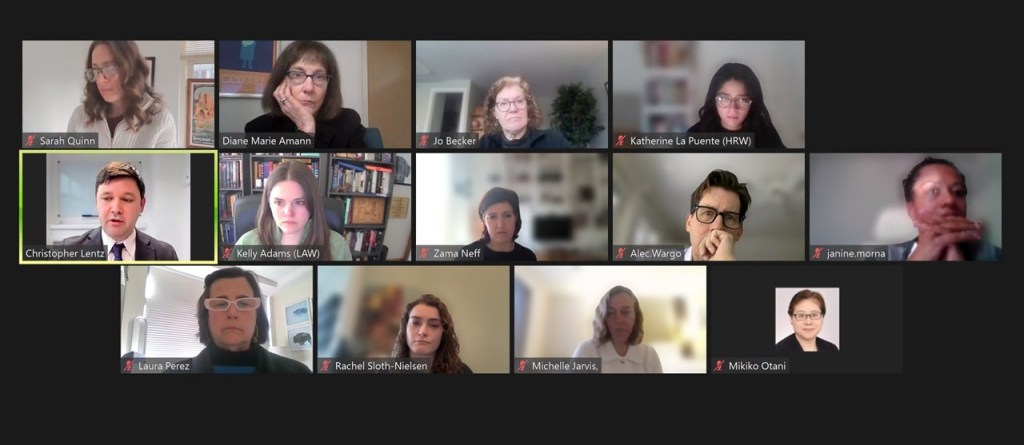
Expanding that draft to include children’s concerns – specifically, by enumerating the recruitment and use of children as a standalone crime against humanity – was the aim of the Working Group on a Standalone Crime of Recruitment & Use of Children under the Crimes Against Humanity Treaty which our Center hosted. As explained by a briefing paper circulated before the first workshop:

Estimates indicate that a staggering 473 million children (or 18.9% of the global child population) live in conflict-affected areas and are at heightened risk of being recruited by State and non-State actors alike. The physical and developmental harms resulting from child recruitment and use can be severe and often long-lasting. Children may suffer death, physical injuries, or permanent disabilities because of combat, and many experience serious psychological trauma from being forced to commit or witness acts of violence. Even those not directly involved in combat are also at risk of attack due to their perceived association with armed actors. Recruited girls and boys are also frequently subjected to rape, sexual slavery, forced marriage, and other forms of sexual violence. For most children, recruitment also interrupts or ends their schooling, limiting future opportunities for sustainable livelihoods and civic participation. The harms experienced by recruited children are comparable in nature and gravity to other crimes against humanity enumerated in the Draft Articles.

Diane Marie Amann, who is Regents Professor Emerita, Emily & Ernest Woodruff Chair in International Law, and a former Center Faculty Co-Director at Georgia Law, was a co-convenor of the Working Group, along with Zama Neff, Executive Director of the Children’s Rights Division of Human Rights Watch, Laura Perez, Adjunct Professor at the Columbia University School of International & Public Affairs, and Janine Morna, Researcher on Children at the Amnesty International Crisis Response Programme.

Other experts in the Working Group included: Kelly Adams, Legal Action Worldwide; Cécile Aptel and Miles Hastie; Jo Becker and Katherine La Puente, Human Rights Watch; Alec Wargo and Claire Bertouille, Office of the Special Representative to the Secretary-General for Children in Armed Conflict; Michelle Jarvis, International, Impartial and Independent Mechanism; Christopher Lentz, University of Chicago; Mikiko Otani, Child Rights Connect; and Rachel Sloth-Nielsen, University of Oxford. (Affiliations for identifying purposes only.)

Once published, the proposed text for the crime of recruitment and use will join other proposals related to children and the crimes against humanity treaty. These include two to which various Working Group members also contributed: “Justice for Children in the Future Convention on the Prevention and Punishment of Crimes Against Humanity,” launched at a May 2025 conference at Columbia University; and “Children,” published in January 2026 by the American Branch of the International Law Association Study Group on Crimes Against Humanity.
Georgia Law Professor Amann joins panel on paths to accountability in conference cosponsored by law schools at Notre Dame and Ukrainian Catholic universities

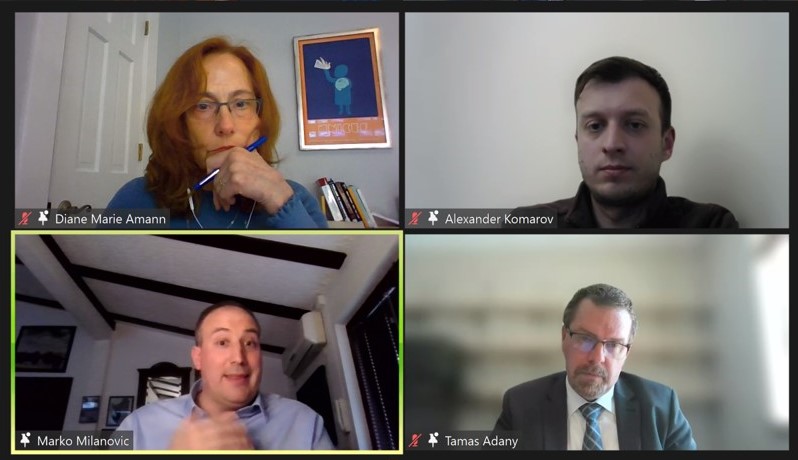
Diane Marie Amann, who is Regents’ Professor of International Law, Emily & Ernest Woodruff Chair in International Law, and Faculty Co-Director of the Dean Rusk International Law Center here at the University of Georgia School of Law, spoke yesterday at “Legal Challenges Posed by the Large-Scale Russian Invasion of Ukraine,” a conference cosponsored by the University of Notre Dame Law School and the Ukrainian Catholic University Law School.

The latter university is located in Lviv, Ukraine – also the birthplace of the late Louis B. Sohn, who was the inaugural holder of Georgia Law’s Woodruff Chair in International Law.

Professor Amann took part in a panel entitled “Prosecution,” along with Marko Milanovic, Professor of Public International Law at the University of Nottingham School of Law in the United Kingdom and Oleksandr Komarov of the Ukrainian Catholic University Law School. Moderating was Tamás Ádány, Fulbright Visiting Professor at Notre Dame Law this semester, and also Head of the Department of International Law at Pázmány Péter Catholic University in Budapest, Hungary.

Discussed in their panel were legal frameworks and forums that hold potential for providing measures of accountability for violations of international law reported since Russia’s February 24, 2022, invasion of Ukraine. These include the illegal resort to armed force – that is, the crime of aggression – as well as atrocity crimes committed once the armed conflict had begun. (Related prior posts here, here, here, and here.)

Participants in the online conference’s two other panels examined additional aspects of the Ukraine-Russia conflict; namely, challenges to the collective security structure, and the use of economic sanctions by states and international organizations.

Georgia Law Professor Amann takes part in launch of NGO report documenting crimes against children in Syria

Professor Diane Marie Amann, the Emily & Ernest Woodruff Chair in International Law and Faculty Co-Director of the Dean Rusk International Law Center here at the University of Georgia School of Law, took part last Friday in the launch of a report on crimes against and affecting children in Syria.

“Children of Syria – The Lost Hope,” was hosted by the Syrian Network for Human Rights, a nongovernmental organization that monitors, documents, and maintains a database of human rights violations in Syria, the site of a nearly ten-year-old conflict. The organization issued its Ninth Annual Report on Violations against Children in Syria (above left) on World’s Children Day, the day in November that marks the anniversary the adoptions by the UN General Assembly of the 1959 Declaration of the Rights of the Child and the 1989 Convention on the Rights of the Child.

Participants in last week’s event discussed the Ninth Report, which stated that the Syrian conflict had claimed nearly 30,000 children between March 2011 and January 2021 – nearly 200 of them as a result of torture. Additional harms, many of which may constitute war crimes or crimes against humanity, documented include arrest and detention of children, forcible disappearance, attacks on schools and deprivation of education, and recruitment and use by armed forces.

Professor Amann, an expert in international criminal law and child rights, joined a panel discussing these findings, their impact on children and society at large, and avenues for redress and accountability. Amann said that the Ninth Report described conduct

“that constitutes both systematic violations of human rights in many different sectors as well as international crimes as articulated in the statutes of multiple tribunals and recognized as customary international law.”

She further outlined treaties and forums through which such conduct might be addressed.

Also speaking at the event, which is archived and available for viewing here, were: Fadel Abdul Ghany, Chairman of the Syrian Network for Human Rights; Martin Leeser, a member of the Syria team at the German Embassy in Beirut, Lebanon; Dr. Troels Gauslå Engell, Senior Stabilisation Advisor on Syria to the Danish Ministry of Foreign Affairs; Paula Sastrowijoto, Deputy Syria Envoy at the Netherlands Ministry of Foreign Affairs; Lina Biscaia, Senior Legal Officer, Sexual and Gender-Based Crimes and Crimes against Children Unit of the UN Investigative Team for Accountability of Da’esh/ISIL; Javier Perez Salmeron of the Justice Rapid Response Child Rights Expert Roster; and Valentina Falco, Team Leader-Child Protection, UN Department of Peace Operations.

Georgia Law Professor Diane Marie Amann on her article, in International Review of the Red Cross, on ICC OTP Policy on Children, accountability for conflict-related crimes against children

In this post Professor Diane Marie Amann, the Emily & Ernest Woodruff Chair in International Law and Faculty Co-Director of our Dean Rusk International Law Center here at the University of Georgia School of Law, discusses her most recent article related to the effects on children of armed conflict and similar extreme violence.

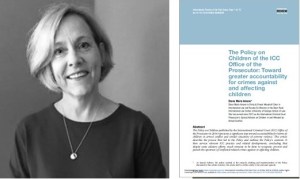
Very pleased to announce the publication of my new article, “The Policy on Children of the ICC Office of the Prosecutor: Toward greater accountability for crimes against and affecting children.”

As indicated in the just-before-publication version that I’ve posted at SSRN, the International Review of the Red Cross placed this article online last month, on February 21. Currently, that published version is available to Cambridge Core subscribers at a First View page; once it appears in print, in a special issue on “Children and War,” it will be freely accessible at the Review‘s website.

Here’s the abstract:

The Policy on Children published by the International Criminal Court Office of the Prosecutor in 2016 represents a significant step toward accountability for harms to children in armed conflict and similar extreme violence. This article describes the process that led to the Policy and outlines the Policy’s contents. It then surveys relevant ICC practice and related developments, concluding that despite some salutary efforts, much remains to be done to recognize, prevent and punish the spectrum of conflicted-related crimes against or affecting children.

This article represents my latest effort to assist in raising awareness and developing strategies respecting children and conflict (prior posts). It’s an effort in which I’ve been deeply involved since my 2012 appointment as the International Criminal Court Prosecutor’s Special Adviser on Children in and affected by Armed Conflict.

Central to this effort was the multiyear process of researching and drafting, along with an Office of the Prosecutor working group and in consultation with others, of the document published in 5 languages and launched in November 2016 as the Policy on Children. Other aspects have included:

Happy to provide further details. And as always, comments welcome.

(Cross-posted from Diane Marie Amann blog)

ICC Prosecutor’s Policy on Children, an international criminal justice capstone

Children have become the unwilling emblems of armed conflict and extreme violence.

Searing images have surfaced in news stories, aid workers’ alerts, and rights groups’ dispatches: a 5 year old pulled from Aleppo rubble, orphans at a Goma children’s center, a young Colombian woman struggling to readjust after years as a child soldier, and, face down on a Turkish beach, a drowned 3-year-old refugee. Images of this nature were shown yesterday at the International Criminal Court, during the opening statement in Ongwen, with Prosecutor Fatou Bensouda herself warning “that some of these images are extremely disturbing.”

There is no better time than now to press for strategies both to combat such harms and to bring the persons responsible to justice. Presenting an important step toward those goals is the Policy on Children of the International Criminal Court Office of the Prosecutor.

fatou

Prosecutor Bensouda launched the Policy on Children at an event during last month’s meeting of the ICC Assembly of States Parties. Bensouda quoted from the U.N. expert Graça Machel’s pathbreaking 1996 report on children and armed conflict, then commented:

“[I]t is indeed unconscionable that we so clearly and consistently see children’s rights attacked and that we fail to defend them.
“It is unforgivable that children are assaulted, violated, murdered and yet our conscience is not revolted nor our sense of dignity challenged. This represents a fundamental crisis of our civilisation and a failure of our humanity.
“By adopting the Policy on Children, which we launch today, we at the Office of the Prosecutor seek to ensure that children suffering the gravest injustices are not ignored. That through the vector of the law, we do what we can to protect and advance the rights of children within the framework of the Rome Statute.”

Leading the event was journalist Zeinab Badawi. Among the many others who offered live or video interventions were: Mamadou Ismaël Konaté, Mali’s Minister of Justice and Human Rights of the Republic of Mali; Zeid Ra’ad Al Hussein, U.N. High Commissioner for Human Rights; Leila Zerrougui, Special Representative of the U.N. Secretary-General for Children and Armed Conflict; Angelina Jolie, Special Envoy of the U.N. High Commissioner for Refugees; Nobel Peace Prizewinner Leymah Gbowee; Lieutenant General Roméo-Dallaire, Founder of the Roméo Dallaire Child Soldiers Initiative (see also IntLawGrrls post by Kirsten Stefanik); Marc Dullaert, Founder of KidsRights and the Netherlands’ former Children’s Ombudsman; and Coumba Gawlo, U.N. Development Programme Goodwill Ambassador and National Goodwill Ambassador for the U.N. High Commissioner for Refugees.

screen2I am honored also to have offered brief remarks – and am especially honored to have assisted in the preparation of this Policy in my capacity as the Prosecutor’s Special Adviser on Children in & affected by Armed Conflict, working alongside a dedicated Office of the Prosecutor team led by Shamila Batohi, Gloria Atiba Davies, and Yayoi Yamaguchi. Preparation included experts’ gatherings at the University of Georgia School of Law Dean Rusk International Law Center, at Leiden Law School, and at the ICC itself, as well as consultations around the globe with young persons who had endured armed conflict. (Legal research produced by my students, in seminars on Children & International Law and through the work of the Georgia Law Project on Armed Conflict & Children, also was invaluable.)

The result is a Policy on Children spanning 47 pages, published simultaneously in Arabic, English, French, Spanish, and Swahili. Identifying children as persons under eighteen (paragraph 16), it covers a gamut of issues related to children and the work of the Prosecutor; for example, general policy, regulatory framework, and engagement with children at all stages of the proceedings. Among many other landmarks, the Policy:

► Embraces a child-sensitive approach grounded in the 1989 Convention on the Rights of the Child, a treaty ratified by every U.N. member state save one: the United States, which is also an ICC nonparty state. (My remarks happily noted that my other state of citizenship, the Republic of Ireland, is a state party to both the Child Rights Convention and the ICC’s Rome Statute.) Paragraph 22 of the Policy on Children thus states:

“In light of the foregoing, the Office will adopt a child-sensitive approach in all aspects of its work involving children. This approach appreciates the child as an individual person and recognises that, in a given context, a child may be vulnerable, capable, or both. The child-sensitive approach requires staff to take into account these vulnerabilities and capabilities. This approach is based on respect for children’s rights and is guided by the general principles of the 1989 Convention on the Rights of the Child: non-discrimination; the best interests of the child; the right to life, survival and development; and the right to express one’s views and have them considered.”

► Views children, like all human beings, as multi-faceted individuals and, simultaneously, as members of multi-generational communities. (See, for example, paragraph 100.) Paragraph 25 states:

“Children, by the very fact of their youth, are frequently more vulnerable than other persons; at certain ages and in certain circumstances, they are dependent on others. Notwithstanding any vulnerability and dependence, children possess and are continuously developing their own capacities – capacities to act, to choose and to participate in activities and decisions that affect them. The Office will remain mindful, in all aspects of its work, of the evolving capacities of the child.”

► Acknowledges in paragraph 17 “that most crimes under the Statute affect children in various ways, and that at times they are specifically targeted” – and then pledges that “the Office will, in order to capture the full extent of the harm suffered, seek to highlight the multi-faceted impact on children, at all stages of its work.” The regulatory framework thus enumerates a range of crimes against and affecting children:

  • recruitment and use by armed forces and armed groups of children under fifteen as war crimes (paragraphs 39-43);
  • forcible transfer of children and prevention of birth as acts of genocide (paragraphs 44-46);
  • trafficking of children as a form of enslavement constituting a crime against humanity (paragraphs 47-48);
  • attacks on buildings dedicated to education and health care as war crimes (paragraph 49);
  • torture and related war crimes and crimes against humanity (paragraph 50);
  • persecution as a crime against humanity (paragraph 50); and
  • sexual and gender-based violence as war crimes and crimes against humanity (paragraph 52).

► Details the Office’s plan for applying the child-sensitive approach, with respect both to all stages of proceedings, including preliminary examinations, investigations, and prosecutions, and to cooperation and external relations, institutional development, and implementation.

Even as cases involving crimes against and affecting children, like Ongwen, go forward, the Office is working on implementation of its new Policy on Children. The implementation phase will include developing versions of the Policy accessible to children. I’m looking forward to the opportunity to contribute this phase – and to hearing others’ views on the Policy.

(Cross-posted from Diane Marie Amann)