Georgia Law Professor Lori A. Ringhand presents at Emory University’s International Law Review Symposium

Earlier this month, University of Georgia School of Law Professor Lori A. Ringhand presented “First Amendment Restrictions on Non-citizens’ Engagement in Campaign Spending” at the Emory International Law Review symposium “Migration, Law, and Justice: The Evolving Role of International and U.S. Policies.” The event was held at the Emory University School of Law.

This year’s symposium focused on critical issues in immigration law and policy as they relate to international law. They explored the following three topics:

  • The Role of International Law in U.S. Immigration Decisions
  • Human Rights Obligations and the Treatment of Migrants
  • Legal Pathways to Citizenship: Challenges and Opportunities

Ringhand teaches courses on constitutional law and election law. She is a nationally known Supreme Court scholar and the author of two books about the Supreme Court confirmation process: Supreme Court Confirmation Hearings and Constitutional Change (with Paul M. Collins) published by Cambridge University Press; and Supreme Bias: Gender and Race in U.S. Supreme Court Confirmation Hearings, (with Christina L. Boyd and Paul M. Collins), forthcoming Fall 2023 with Stanford University Press. She also is the co-author of Constitutional Law: A Context and Practices Casebook, which is part of a series of casebooks dedicated to incorporating active teaching and learning methods into traditional law school casebooks. Ringhand also publishes extensively on election law related issues, and was awarded a Fulbright Distinguished Chair Award at the University of Aberdeen in Scotland to explore  the different approaches to campaign finance regulation taken by the United States and the United Kingdom.

Georgia Law Dean Usha R. Rodrigues selected as European Corporate Governance Institute (ECGI) research member

University of Georgia School of Law Dean Usha R. Rodrigues was recently selected as a research member of the European Corporate Governance Institute, an international non-profit established to “improve corporate governance through fostering independent scientific research and related activities.” Rodrigues is one of 74 new members appointed in February.

Founded in 2002, the ECGI provides a platform for debate and dialogue among academics, policymakers, and business leaders, with a focus on major corporate governance, ESG, and stewardship issues. ECGI Research Members, drawn from Europe, the UK, North America, and Asia, are eligible to publish their academic work on corporate governance and stewardship in the ECGI Working Paper Series (Law and Finance), a highly regarded collection of work known for its reliability, breadth, and impact on policymaking and practice.

Rodrigues became dean of the School of Law on January 1st, 2025. Before becoming dean, she joined the School of Law’s faculty in 2005, with her teaching and research focus on corporate law, business ethics, corporations, and securities regulation. She was named the holder of the M.E. Kilpatrick Chair of Corporate Finance and Securities Law in 2014, and her other university honors and roles include service as the law school’s associate dean for faculty development, the University Council’s parliamentarian, and UGA’s interim vice provost for academic affairs.

Georgia Law alumna Victoria Agbakwuru (LL.M. ’24) publishes article on ESG reporting in Nigeria and other African countries

University of Georgia School of Law alumna Victoria Agbakwuru (LL.M. ’24) published an article earlier this month in the Penn State Journal of Law and International Affairs. The article, titled “A Comparative Analysis of ESG Reporting in Nigeria and Other African Countries,” reflects research conducted by Agbakwuru under the supervision of Georgia Law Professor Christopher M. Bruner during her time as a student.

From the article’s introduction:

This paper provides an in-depth insight into Environmental, Social, and Governance (ESG) reporting in Nigeria, Africa’s largest economy. The Adoption Readiness Working Group’s proposed implementation of the Sustainability Reporting in Nigeria would mandate ESG reporting. This paper also contrasts Nigeria’s reporting standards and regulations with those of other African nations, including Ghana, South Africa, and Egypt. It aims to provide a better understanding of ESG reporting in Africa, which would help investors and partners intending to invest in Africa.

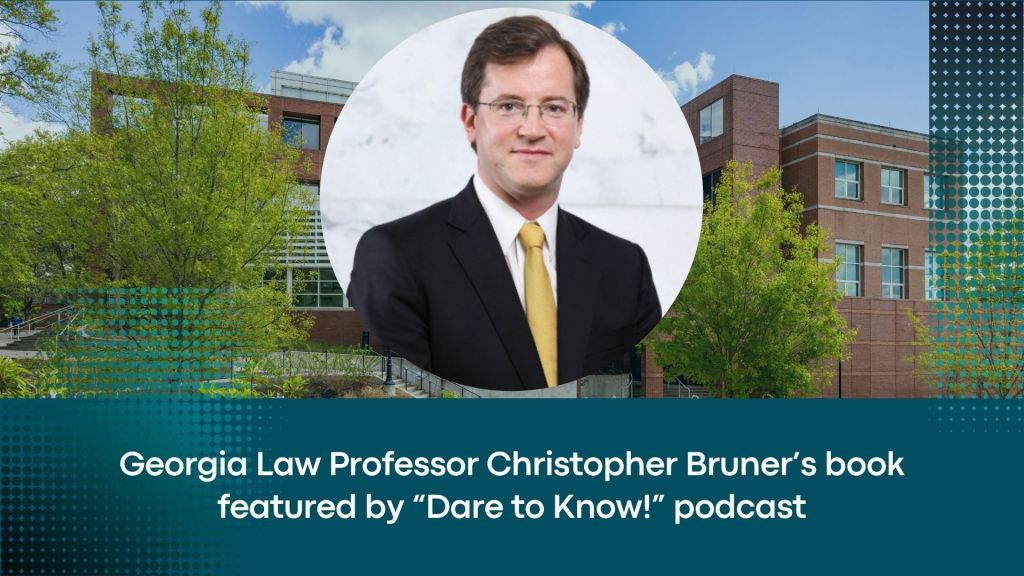
Georgia Law Professor Christopher Bruner publishes article in Transnational Legal Theory

University of Georgia School of Law Professor Christopher M. Bruner published “Corporate Personhood, Corporate Rights, and the Contingency of Corporate Law” in the peer-reviewed journal Transnational Legal Theory (2025). The article was initially presented as a working paper at a conference titled “Decoding the Rights of Companies in the Technocene” at Lund University in Sweden.

Below is an abstract of the article:

Corporate personhood and corporate rights are co-constitutive in nature, meaning that they are mutually constructed – there is no singular, one-way causal path between a conception of corporate personhood and a conception of corporate rights. Consequently, modes of reasoning that purport to deduce the substance and extent of corporate rights from the mere fact of corporate personhood are logically circular. Although the relationship between corporate personhood and corporate rights is real and significant, this relationship cannot, in and of itself, comprehensively specify the content of corporate rights; their substance can only be specified by reference to external normative criteria. The upshot is that corporate law inevitably remains a socially and politically contingent field. Those advancing particular conceptions of corporate personhood and corporate rights should acknowledge the contingency of corporate law and present their preferred visions by reference to external normative criteria that they are prepared to acknowledge, describe, and defend.

Bruner is the Stembler Family Distinguished Professor in Business Law at the University of Georgia School of Law and serves as a faculty co-director of the Dean Rusk International Law Center. His scholarship focuses on corporate law, corporate governance, comparative law and sustainability.

American Branch of the International Law Association shares reflections of Georgia Law student Madison Graham (J.D. ’25)

University of Georgia School of Law student Madison Graham (J.D. ’25) was recently featured in the American Branch of the International Law Association‘s blog. Graham, who served as one of ABILA’s Student Ambassadors for their 2024 International Law Weekend (ILW), writes about the panel discussion, “Empowering International Law to Address Rising Tensions in Outer Space: The Woomera Manual on the International Law of Military Space Activities and Operations.”

Jack Beard, Professor and Director of the Space, Cyber & National Security Law Program at the University of Nebraska College of Law, and member of Committee on the Use of Force for the American Branch of the International Law Association (“ABILA”), served as the panel’s moderator. Panelists included Laura Grego, Senior Scientist and Research Director for the Global Security Program of the Union of Concerned Scientists; Heather Harrison Dinniss, Senior Lecturer for the Department of International and Operational Law at the Swedish Defence University; David A. Koplow, Scott K. Ginsburg Professor of Law for the Georgetown University Law Center; and Dale Stephens, Professor and Director of the Research Unit on Military Law and Ethics at the University of Adelaide, Australia.

Graham was one of five ambassadors selected nationwide to assist with the work of ABILA in the preparation of the International Law Weekend 2024 conference. She attended ABILA’s ILW along with 7 other Georgia Law students through the support of Louis B. Sohn Professional Development stipends, detailed in a prior post (here). Graham’s full blog post can be accessed here

Georgia Law’s Environmental Law Association hosts Fernanda Hopenhaym, member of the UN Working Group on Business and Human Rights

Earlier this month, the University of Georgia School of Law’s Environmental Law Association hosted Fernanda Hopenhaym, member of the UN Working Group on Business and Human Rights, for a virtual event entitled “Corporate Environmental Responsibility: International Legal Frameworks and US Performance.” Georgia Law Professor Christopher M. Bruner, Stembler Family Distinguished Professor in Business Law & Faculty Co-Director of the Dean Rusk International Law Center, moderated the conversation.

Hopenhaym and Bruner discussed the connection between environmental sustainability and human rights, exploring key dynamics, including how communities can suffer when their rights to food, clean water, and fair working conditions are compromised and how corporations are voluntarily improving their practices, but the complexity of their structures—spanning subsidiaries and global supply chains—makes full due diligence difficult. They also talked about where the U.S. stands on corporate compliance and the challenges in providing remedies for affected communities. They concluded the event by discussing the future of corporate accountability, particularly in the context of the ongoing UN Treaty on Business and Human Rights (BHR) process.

Hopenhaym is Co-Executive Director at Project on Organizing, Development, Education and Research (PODER), an organization in Latin America dedicated to corporate accountability. For twenty years, Ms. Hopenhaym has worked on economic, social and gender justice. Since 2006 Ms. Hopenhaym has been working on issues related to human rights and financial institutions and in the last ten years, she has focused specifically on business and human rights, working to advance corporate accountability and strengthen respect for human rights vis-a-vis private and public investments or development projects, and private sector operations. She has been involved in processes related to the implementation of the UN Guiding Principles, as well as in other processes regarding relevant instruments, such as the Binding Treaty negotiations and due diligence laws. She has conducted research on cases related to corporate impact on human rights and the environment and worked with and accompanied local communities affected by public/private projects in their pursuit of justice and remedy. She has conducted advocacy in the LAC region and globally to advance corporate accountability and human rights as well as leading training and capacity building on business and human rights related issues. From January 2019 to December 2021, Ms. Hopenhaym was Chair of the Board of ESCRNet, the international network for economic, social and cultural rights; she has been a board member of EarthRights International since early 2021 and an adviser to the Business and Human Rights Award Foundation since early 2020.

Georgia Law’s Environmental Law Association “seek[s] to further the development and advancement of environmental law through activities designed to increase environmental awareness among members of the community at large and the student bodies of the University of Georgia and the Georgia School of Law.” This year’s ELA President, Kellianne Elliott (J.D. ’26), and Carolina Ruiz (LL.M. ’26) organized this event.

Georgia Law wins Jessup international law moot court regional

Pictured above are: (l. to r.) Dustin Batchelor, Marion Kronauge, Morgan Pfohl, Grace Johnson and Ellis Schmitt. 

Congratulations to University of Georgia School of Law students Dustin M. Batchelor (J.D. ’26), Grace K. Johnson (J.D. ’26), Marion Kronauge (J.D. ’26), Morgan Pfohl (J.D. ’26), and Ellis Schmitt (J.D. ’26) for winning the East Coast regional of the Philip C. Jessup International Law Moot Court Competition.

During the tournament, they beat teams from Harvard University and American University and will now advance to the international tier of the competition later this month. Georgia Law students Joseph “Joe” Colley (J.D. ’25) and Brennan Rose (J.D. ’25) served as student coaches, while J. Caleb Grant (J.D. ’23) served as the alumni coach.

The Jessup competition is the world’s largest moot court tournament that typically fields teams from roughly 700 law schools in 100 countries and jurisdictions around the globe. Georgia Law’s past performances in Jessup competitions can be found here.

Georgia Law Professor Diane Marie Amann speaks at Oxford Union on international law and head of state immunities

From left, Israr Khan, Professor Diane Marie Amann, and Professor Linos-Alexandre Sicilianos

University of Georgia School of Law Professor Diane Marie Amann spoke last Friday in the United Kingdom, on an Oxford Union panel entitled “Crimes of the Powerful: Should Head of State Immunity Be Abolished under International Law?”

Her co-panelist was Linos-Alexandre Sicilianos, who is Professor of Law at the University of Athens, Greece, and the former President of the European Court of Human Rights. Moderating was Israr Khan, President of the Oxford Union, a 200-year-old debating society which draws much of its membership from the University of Oxford.

Amann is Regents’ Professor of International Law, Emily & Ernest Woodruff Chair in International Law, and a Faculty Co-Director of our Dean Rusk International Law Center here at Georgia Law.

Temple Law professor J. Benton Heath presents working paper at Georgia Law’s International Law Colloquium

The University of Georgia School of Law’s spring 2025 International Law Colloquium welcomed Temple University, Beasley School of Law Professor J. Benton Heath, who presented his working paper, “Sanctions and Sanctuary: Refuge, Violence, and the Legal Ordering of (Economic) Warfare.” Laura Phillips-Sawyer, Jane W. Wilson Associate Professor in Business Law at Georgia Law, served as Heath’s faculty discussant.

Heath’s primary research interests include international trade, investment law, dispute resolution, global health, administrative law, public international law, and the national security dimensions of trade and investment. He teaches Civil Procedure and International Arbitration.

Heath previously practiced international law and arbitration at the U.S. State Department, and at Curtis, Mallet-Prevost, Colt & Mosle. He has represented governments and state-owned enterprises before the International Court of Justice, the Iran-United States Claims Tribunal, other international arbitral tribunals, and the federal courts. His work at the State Department also included bilateral claims negotiations with the Republic of Cuba, matters relating to embargoes and economic sanctions, and U.S. court cases brought against foreign governments by victims of terrorism. He also served as a clerk to Judge Robert D. Sack of the U.S. Court of Appeals for the Second Circuit.

Below is the introduction to the working paper Heath presented:

This project is about the relationship of concepts of sanctuary and violence to economic warfare. I am interested in what I think of as “spaces of sanctuary” (or refuge) that provide a break from conflict and place spatial boundaries on the exercise of violence and coercion. My argument, for now, is that the concept of sanctuary is a critical tool for structuring a legal regime of controlled violence, and that this applies also to economic warfare. A key point of departure here is that sanctuary is not simply the negation of violence. Rather, sanctuary spaces control the flow of violence, displacing it where it “doesn’t belong” and channeling violence to spaces where the use of force or coercion is naturalized or even deemed legitimate. By setting the criteria for who can access sanctuary and under what conditions, the law further establishes a normative and spatial order for the continuation of violence at a level, and in a direction, that the law deems tolerable. Sanctuary is thus intertwined with, rather than apart from, violence. Nevertheless, if we are interested in fundamentally reconsidering who has access to safety and security and under what conditions, we should want to think carefully about how to reconstruct spaces of sanctuary—either real or virtual—to resist the totalizing world of economic warfare in which we currently find ourselves.

This year, Georgia Law Professor Desirée LeClercq is overseeing the international law colloquium, which is designed to introduce students to features of international economic law through engagement with scholars in the international legal field. To view the full list of International Law Colloquium speakers, visit our website.

Haidy Ahmed, Diplomat with the Egyptian Ministry of Foreign Affairs, speaks at Georgia Law

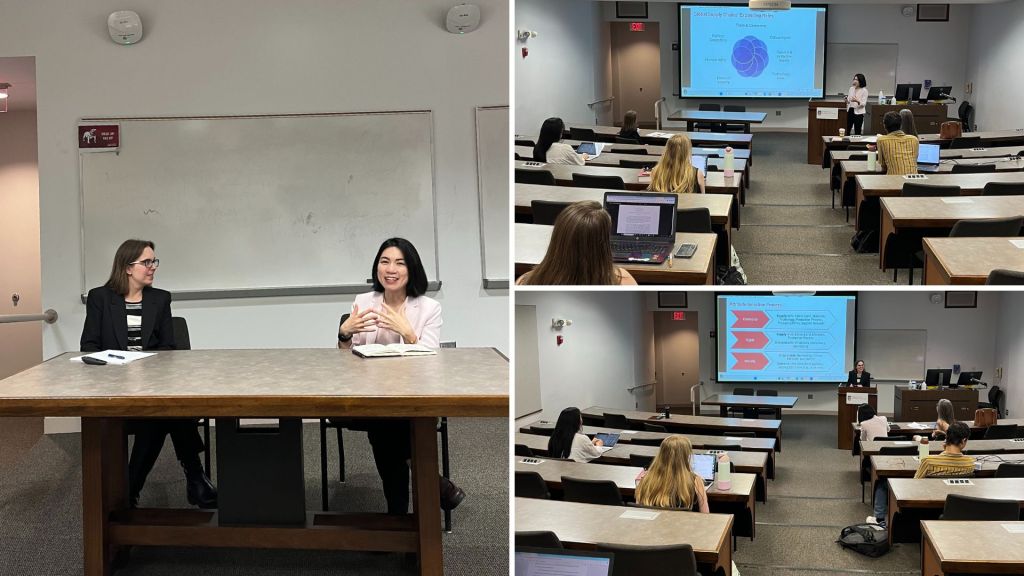
Haidy Ahmed, Diplomat with the Permanent Mission of the Arab Republic of Egypt to the African Union in Addis Ababa, Ethiopia, delivered a talk in February at the University of Georgia School of Law entitled: “Careers in International Law and Diplomacy.”

Ahmed discussed her role as part of Egypt’s legal team before the International Court of Justice in the advisory opinions related to climate change, law of the sea, and other international issues. She answered questions from students about her educational and professional background and provided insight regarding the pursuit of careers in public international law and diplomacy.

In her current position, Ahmed has been in charge of thematic issues such as women, peace, and security at the Peace & Security Council of the African Union. She is an alternate member of the Committee to facilitate implementation and promote compliance under the Paris Agreement (PAICC). She served as Egypt’s representative at the fifth resumed session of the Intergovernmental Conference on an international legally binding instrument under the United Nations Convention on the Law of the Sea on the conservation and sustainable use of marine biological diversity of areas beyond national jurisdiction (the BBNJ). Before joining Egypt’s foreign service, Ahmed worked as a Trainee at Simmons & Simmons in Paris and a Junior Associate at Shalakany in Cairo, Egypt. She received her LL.B. from Cairo University in Egypt and her Master of Laws from Paris I Panthéon Sorbonne University, Paris, France.

This event was part of the Dean Rusk International Law Center’s ongoing Consular Series, which presents students, staff, and faculty with global perspectives on international trade, cooperation, development, and policy.