During his time in Florence, Kadri will expand his ongoing research pertaining to the legal and technical regulation of AI-generated “deepfakes” and focus on the European regulatory approaches to this topic. In 2024, Kadri authored his third book, Dilemmas in Digital Abuse, which discusses related topics including harmful technological advancements and the corresponding regulatory responses.
Kadri is an Assistant Professor of Law at Georgia Law Law, and his research focuses on torts and criminal law, with an emphasis on how technology, law, and social norms enable and affect privacy, speech, and abuse. His scholarship appears in journals including the Harvard Law Review Forum, UCLA Law Review, Texas Law Review, Utah Law Review, Maryland Law Review, and Journal of Free Speech Law and he has published shorter pieces in The New York Times and Slate. His course offerings include Torts, Cybercrime, and Regulating Digital Abuse.
As Graduate Editors, each LL.M. student conducts citation checks and writes a Comment or Book Review on the legal topic of their choice. The Graduate Editors further facilitate the Journal’s commitment to “including a diversity of perspectives, experiences, and backgrounds within [its] membership,” according to the Editor in Chief, Jasmine Furin (J.D. ’25).
The Georgia Journal of International and Comparative Law is a preeminent forum for academic discussion on current international subjects. From its inception in 1971 as a student initiative supported by former U.S. Secretary of State and Georgia Law Professor Dean Rusk, the Journal features work by legal scholars and practitioners and student notes written by Journal members.
This study examines whether the RRM empowers workers’ voices in the Mexican auto sector. To this end, between January and March 2024, we interviewed 130 workers across seven supplier facilities (auto plants facilities and logistics facilities) and five assembly plants, for a total of 12 facilities. Three of the facilities were not unionized; nine facilities were unionized. Three of the twelve plants had used the RRM (“RRM facilities”), addressing various violations of labor rights, voting processes to approve or reject collective contracts, voting processes to elect independent unions, and dismissals and intimidation of workers in union activism. All three RRM cases were remediated through plans requiring the facility to hold a new legitimization vote and union election and offer worker-level trainings. Our preliminary results problematize some assumptions that drove RRM implementation. The Biden administration and members of the United States Congress have promoted the RRM as a way to strengthen the Mexican government’s efforts to implement Mexican labor law reform, empower workers in productive export sectors, and give them a voice over their labor conditions. Our results suggest that, four years after the implementation of the USMCA and the reforms of Mexico’s labor legislation, a little more than half of the workers are aware of the labor law reform, and opinions are divided on whether it is strengthening labor rights. Some workers thought the reforms were going well, while many thought the reform process was going poorly or did not know how it was going. The majority of workers we interviewed revealed that they did not understand the new democratic procedures to legitimize their collective bargaining agreements, nor that they could access the RRM platform to express their complaints. Nevertheless, the workers we interviewed at RRM facilities tended to be more knowledgeable of the labor law reforms and its attendant rights and processes than those at facilities that have not undergone RRM investigation and remediation, and they tended to view their bargaining representative and conditions of work more favorably. Our study suggests that when workers are given the opportunity to participate in democratic elections under international supervision, after receiving training on the shop floor about their rights and election procedures, they gain knowledge and ownership over their working conditions.
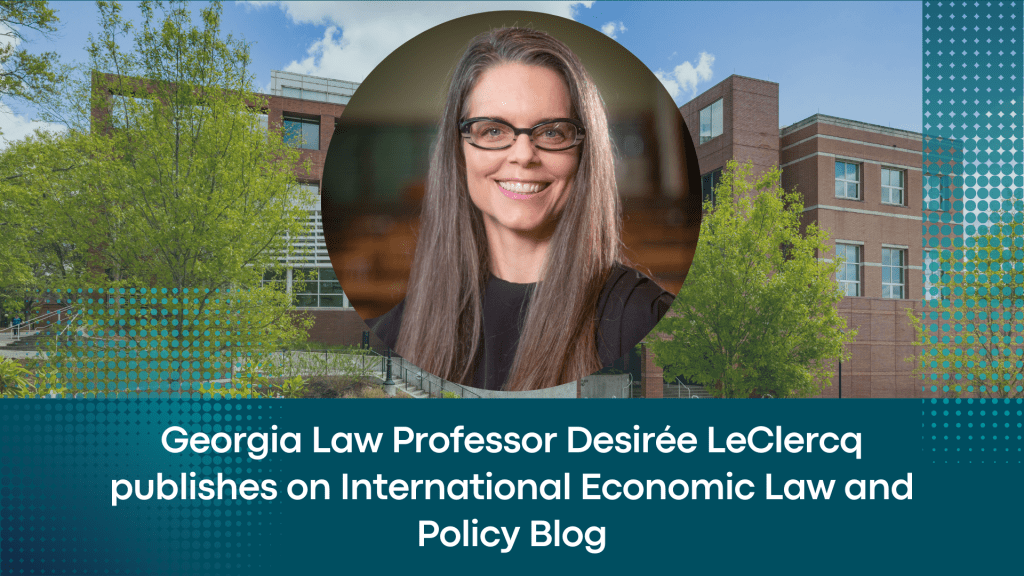
LeClercq joined the University of Georgia School of Law in 2024 as an assistant professor. She teaches International Trade and Workers Rights, International Labor Law, International Law and U.S. Labor Law, as well as the International Law Colloquium. She also serves as a faculty co-director of the Dean Rusk International Law Center and as the faculty adviser for the Georgia Journal of International and Comparative Law.
Amann is Regents’ Professor of International Law, Emily & Ernest Woodruff Chair in International Law, and a Faculty Co-Director of our Dean Rusk International Law Center here at Georgia Law. She has pursued a research-intensive semester this autumn, primarily as a Research Visitor at the Oxford Faculty of Law Bonavero Institute of Human Rights and Visiting Fellow at Exeter College Oxford.
“The Biden administration changed U.S. trade policy significantly when it adopted a “worker-centered” trade policy that justified entering into “frameworks” and not trade agreements. That policy didn’t win many accolades from the trade crowd. Many critics felt that it forewent critical opportunities by refusing to discuss market access in new trade contexts. Without getting into that debate, this post discusses whether the Biden administration’s worker-centered trade policy – and notably, use of that policy under the United States-Mexico-Canada Agreement (USMCA) Facility-Specific Rapid-Response Labor Mechanism (RRM) – will outlive the administration.
I think it will, but it will look different. And some, including labor rights advocates like myself, might prefer the Trump administration’s approach.”
LeClercq joined the University of Georgia School of Law in 2024 as an assistant professor. She teaches International Trade and Workers Rights, International Labor Law, International Law, U.S. Labor Law and the International Law Colloquium. She also serves as a faculty co-director of the Dean Rusk International Law Center and as the faculty adviser for the Georgia Journal of International and Comparative Law.
University of Georgia School of Law Professor Assaf Harpaz presented his draft paper “Global Tax Wars in the Digital Era” at the University of Alabama School of Law as part of the Junior/Senior SEC Workshop.
Below is an abstract of the paper:
Current debates in international taxation often center on how to fairly allocate taxing rights among different jurisdictions. When an enterprise earns income abroad, the country of residence (where the taxpayer resides) and the country of source (where income is generated) have legitimate, competing claims to tax that income. The question is further complicated in a digital economy where profit shifting practices are abundant and businesses no longer require a physical presence in the location of their online consumers.
The international tax system has traditionally favored residence-based taxation. Now, international taxation is at a crossroads with intergovernmental organizations battling to redefine the principles of cross-border taxation. The regime has been dominated by the Global North through the Organisation for Economic Co-operation and Development (OECD), which has drawn backlash due to its undemocratic procedure and unfavorable outputs for developing countries. The United Nations has held a relatively peripheral role in global tax governance, which is poised to change with an upcoming UN Framework Convention on International Tax Cooperation – an initiative overwhelmingly supported by developing countries.
This article explores the “tax wars” surrounding the leadership for global tax governance, contrasting the taxing powers and interests of the OECD-led Global North with those of the UN-backed Global South. It highlights the distortive outcomes created by outdated international tax principles and argues for a shift toward source-based taxation. To do so, it proposes revisiting the permanent establishment standard in model treaty language, creating an opportunity for broader taxation of business profits in the source country. This transition will address longstanding disparities and is increasingly warranted in a digital economy that does not rely on physical presence.
Assaf Harpaz joined University of Georgia School of Law as an assistant professor in summer 2024 and teaches classes in federal income tax and business taxation. Harpaz’s scholarly focus lies in international taxation, with an emphasis on the intersection of taxation and digitalization. He explores the tax challenges of the digital economy and the ways to adapt 20th-century tax laws to modern business practices.
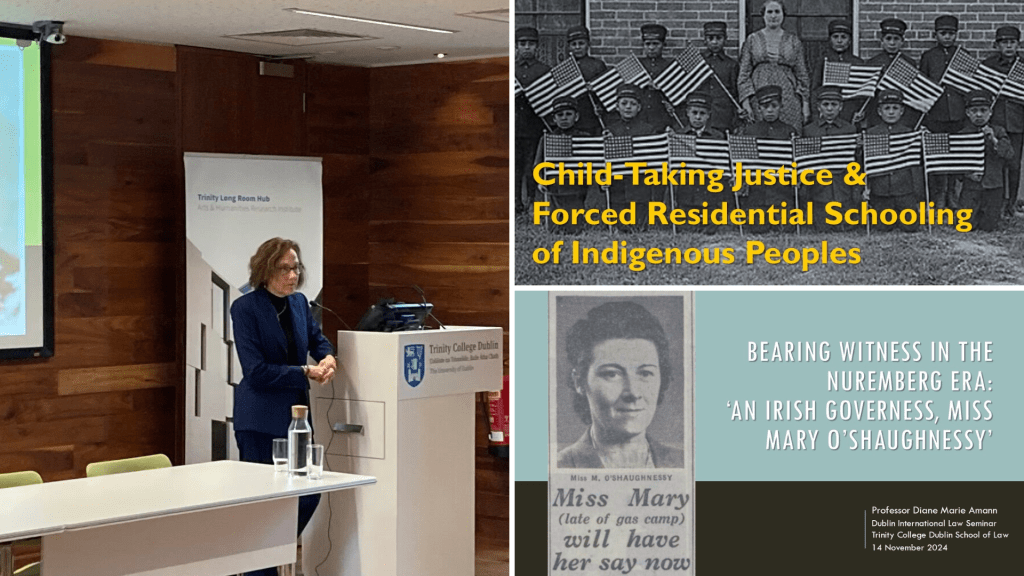
University of Georgia School of Law Professor Diane Marie Amann recently gave a public lecture entitled “Child-Taking: Unlawful Transfer plus Identity Alteration, in Ukraine and Beyond,” at the University of Reading School of Law in Reading, United Kingdom, as part of that law school’s Global Law at Reading (GLAR) lecture series.
Her presentation drew upon her just-published article, “Child-Taking,” 45 Michigan Journal of International Law 305 (2024).
Amann is Regents’ Professor of International Law, Emily & Ernest Woodruff Chair in International Law, and a Faculty Co-Director of our Dean Rusk International Law Center here at Georgia Law. This fall, she is spending a research-intensive semester in the United Kingdom, where she is a Research Visitor at the Oxford Faculty of Law Bonavero Institute of Human Rights and Visiting Fellow at Exeter College Oxford.
Attendees included 3Ls Gloria Maria Correa, Madison Graham, and Tiffany Torchia, and Masters of Laws (LL.M.) students Dzmitry Liasovich, Zulma Perez, Christian Schneider, and Fabienne Taller. Graham was one of 5 students selected to serve as a Student Ambassador for the event. All seven students received a Louis B. Sohn Professional Development Fellowship to support their attendance of this conference. Awarded by the law school’s Dean Rusk International Law Center, Sohn Fellowships enable students to attend professional development opportunities related to international law.
International law faces an existential threat as history unfolds at unprecedented speed worldwide. Indeed, international law and international institutions at times appear incapable of protecting vulnerable persons against war, disease, hunger, exploitation, climate change, and other human and natural catastrophes. Some people–both individually and collectively–are openly eschewing legal values and frameworks in order to pursue results through other means, including dangerous and destabilizing ones. Is international law, in fact, powerless or does it remain a source of power that vulnerable persons can utilize to protect and advance their rights and interests? This year’s ILW is focused on engaged, interactive, and inclusive discussions about how international law can transcend perceptions and misperceptions of its powerlessness and fulfill its aspirations of balancing power through principles of justice, equality, and dignity.
Reflecting on the overall takeaways from the conference, Graham said:
As a student, this conference re-instilled the importance of the research process to me…I was reminded of how important it is to immerse yourself in the big ideas that other people are considering, learning about their work. Even in topics we may already be familiar with, there will always be someone who knows more – or, at the very least, is considering new angles. Put another way, I think conferences like this are integral to ensuring we are continuing to push the mental boundaries we inadvertently place on ourselves when we get into routines and habits of regular school and work lives. Conferences like these help us stay curious, and accordingly, help us re-examine what the law is capable of moving forward.
In describing the ways in which this experience benefitted her professionally, Perez said:
ABILA ILW 2024 was an extraordinary experience on many levels. Personally, I had the opportunity to connect with other professionals and leaders in the legal industry, reinforcing the valuable education I am receiving at Georgia Law by sharing insights with other attendees. Academically and professionally, it sparked my interest about some subjects that I hadn’t previously explored, and I am eager to explore further and apply this knowledge in my career. I now have a clearer understanding of how public and private sectors interact in a various issue, and I can see the professional opportunities that arise from this collaboration.
When asked about her favorite panel from the conference, Correa explained:
My favorite panel discussion was “Arbitrating with International Organizations” because the topic was completely novel to me. The panel discussed some relevant provisions on the International Law Commission’s work on “settlement of disputes to which international organizations are parties,” the practice of arbitral institutions like the Permanent Court of Arbitration, and how arbitration could be a useful tool to overcome barriers like immunity in disputes with international organizations.
To read prior posts about Georgia Law students using Sohn Fellowships to attend professional development opportunities, please click here and here.
University of Georgia School of Law Professor Diane Marie Amann participated last week in “How to Write Feminist Histories of International Law,” the first in a seven-session online seminar series entitled “Thinking Gender, History & International Law” hosted by the University of Warwick School of Law in Coventry, England.
Also joining in the conversation were: Professor Maria Drakopoulou, University of Kent Law School; Professor Gina Heathcote, Newcastle University Law School; Professor Aoife O’Donoghue, Queen’s University Belfast School of Law; and the seminar’s organizers, Dr. Paola Zichi and Dr. Aisel Omarova, both at Warwick Law.
Topics discussed included: what it means to apply feminist approaches to the history of international law; whether and how feminist viewpoints may enhance the writing of history; and what are the relations among feminist values, historical research, and theory or philosophy. (Register for future seminar sessions here.)
Amann, who has several publications broaching such issues, is Regents’ Professor of International Law, Emily & Ernest Woodruff Chair in International Law, and a Faculty Co-Director of our Dean Rusk International Law Center here at Georgia Law. This fall, she is spending a research-intensive semester in the United Kingdom, where she is a Research Visitor at the Oxford Faculty of Law Bonavero Institute of Human Rights and Visiting Fellow at Exeter College Oxford.
During the week of November 18, the University of Georgia School of Law will host events during the lunch hour to highlight International Education Week (IEW) 2024. IEW is a joint initiative between the U.S. Department of State and the U.S. Department of Education that promotes programs that prepare Americans for a global environment and attract future leaders from abroad to study, learn, and exchange experiences.
All events will take place from 12-1pm, unless noted below. Exact locations can be found in the event hyperlinks. The events for the week are as follows:
This event will allow 1Ls and 2Ls to have one-on-one discussions with their peers who have completed both summer and semester-long Global Externships Overseas (GEO). GEOs are work placements around the world that offer law students the opportunity to gain practical knowledge and legal experience in an international setting. Students present will include:
Georgia Law alumnus and adjunct professor Dr. Kannan Rajarathinam will discuss his recently published book, The DMK Years: Ascent, Descent, Survival (India Viking, 2024). The DMK Years tells the story of how India’s democracy has accommodated the cultural nationalist aspirations of the Tamils. The conversation will be co-facilitated by Professor Laura Phillips-Sawyer of Georgia Law and Dr. Laura Zimmermann of the School of Public and International Affairs.
Tuesday, November 19: Unlocking Your Global Legal Career: Discover the Dean Rusk International Law Center at UGA Law
Join the University of Georgia School of Law’s Admissions team for an informative webinar on the Dean Rusk International Law Center. Learn about the center’s unique offerings, including global externships, study abroad programs, and student experiences. Hear directly from Sarah Quinn, Director of the Dean Rusk International Law Center, Assistant Director of Admissions and Student Experience Diana DeJesus, and current law students Tiffany Torchia (J.D. 2025) and Benjamin Privitera (J.D. 2026). This webinar will provide valuable insights into the application process and how to pursue a global legal career.
Join the International Law Society for a brown bag lunch with Desirée LeClercq. LeClercq joined the University of Georgia School of Law in 2024 as an assistant professor. She teaches International Trade and Workers Rights, International Labor Law, International Law and U.S. Labor Law. She also serves as a faculty co-director of the Dean Rusk International Law Center and as the faculty adviser for the Georgia Journal of International and Comparative Law.
This event will offer perspectives on the importance of international experience on a law student’s resume and how to market that during the interview process. Featuring a panel of current students, recent grads, and career development professionals, this event will prepare you for taking part in one of the law school’s international opportunities.
Join current Master of Laws (LL.M.) students from Iran for a panel discussion about their experiences as women lawyers. The panel will include Sara Dorbahani and Paria Keramatkhah and will be moderated by Dr. Laura Kagel, Director of International Professional Education.







 exchange of notes