The University of Georgia School of Law’s spring 2025 International Law Colloquium welcomed Professor Diane Marie Amann, who presented her working paper, “Child-Taking Justice and Forced Residential Schooling of Indigenous Americans.”
Amann is Regents’ Professor of International Law, Emily & Ernest Woodruff Chair in International Law, and a Faculty Co-Director of our Dean Rusk International Law Center here at Georgia Law. Amann served as International Criminal Court Prosecutor Fatou Bensouda’s Special Adviser on Children in & affected by Armed Conflict and is a member of the Bring Kids Back UA Task Force.
Her presentation drew upon her recently-published article, “Child-Taking,” 45 Michigan Journal of International Law 305 (2024). Esra Mirze Santesso, Professor in the Department of English at the University of Georgia, as Amann’s faculty discussant.
This year, Professor Desirée LeClercq is overseeing the colloquium, which is designed to introduce students to features of international economic law through engagement with scholars in the international legal field. To view the full list of International Law Colloquium speakers, visit our website.
This program is made possible through the Kirbo Trust Endowed Faculty Enhancement Fund and the Talmadge Law Faculty Fund
Taher S. Benany joined the University of Georgia School of Law’s Dean Rusk International Law Center as associate director in January 2025.
In this role, he oversees global international training programs, including the Global Externships Overseas (GEO) initiative. He also collaborates with Center faculty and staff to plan and implement international law research initiatives, events and conferences, including the annual Georgia Journal of International and Comparative Law conference.
Benany came to Georgia Law from the Shalakany Law Office in Cairo, Egypt, where he was a partner focusing on public international law, global disputes and government affairs for four years. In an earlier stint with the firm from 2014 to 2019, he was a senior associate focusing on public law, international litigation, compliance and government affairs. He also served as a public international law lecturer at the British University in Egypt and served as a public international law expert for the European Union Agency for Criminal Justice Cooperation.
As a legal fellow for the United Nations Human Rights Council for an African state and an international organization, he drafted resolutions and interventions while preparing universal periodic reviews and legal opinions on international human rights instruments.
He earned his Bachelor of Laws from Cairo University in 2017, then continued his legal studies as a Fulbright Scholar at the University of Michigan in Ann Arbor. He also holds a Bachelor of Science in Oral and Dental Medicine and Surgery from Misr International University in 2010, graduating as the valedictorian of his class and serving as a maxillofacial surgeon at the Munira Public Hospital for one year.
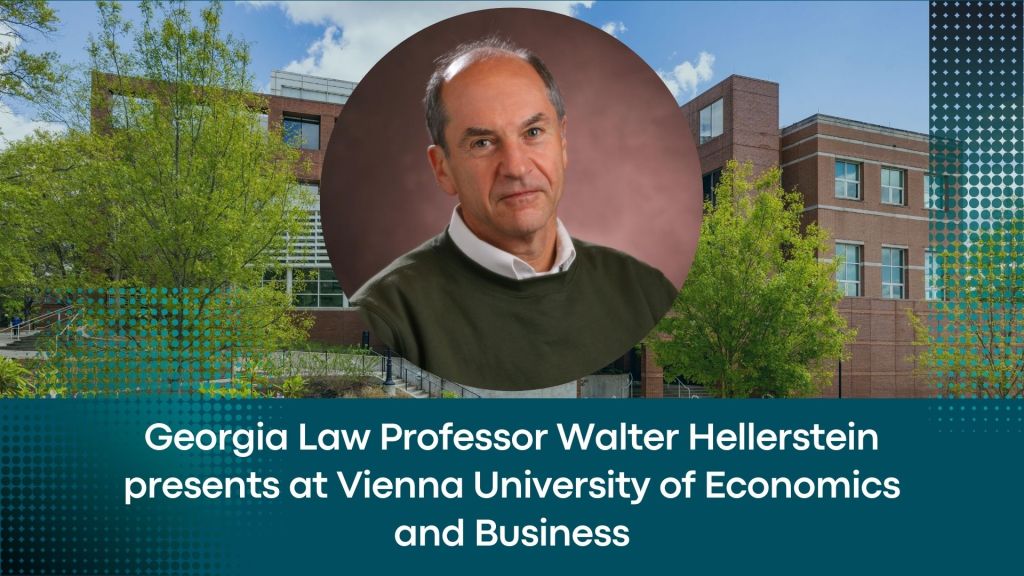
Distinguished Research Professor & Shackelford Distinguished Professor in Taxation Law Emeritus Walter Hellerstein presented as part of a panel on taxable persons and related issues in VAT law at the Court of Justice of the European Union Conference held at the Vienna University of Economics and Business in Austria during January.
A description of the conference can be found below:
This conference will focus on the recent case law of the Court of Justice in the area of indirect taxation. The judgment rendered from September 2018 onwards and important previous judgments will be analyzed by panels consisting of leading academics, judges, government representatives and business representatives.
Hellerstein joined the University of Georgia School of Law faculty in 1978 and was named the Francis Shackelford Distinguished Professor in Taxation Law during 1999 and a UGA Distinguished Research Professor in 2011. He taught in the areas of state and local taxation, international taxation and federal income taxation until he retired from teaching at the School of Law in 2015. He is currently a Visiting Professor at the Vienna University of Economics and Business, and he remains actively involved in his scholarship, consulting and, in particular, his work as an academic advisor to the Organisation for Economic Cooperation and Development (OECD).
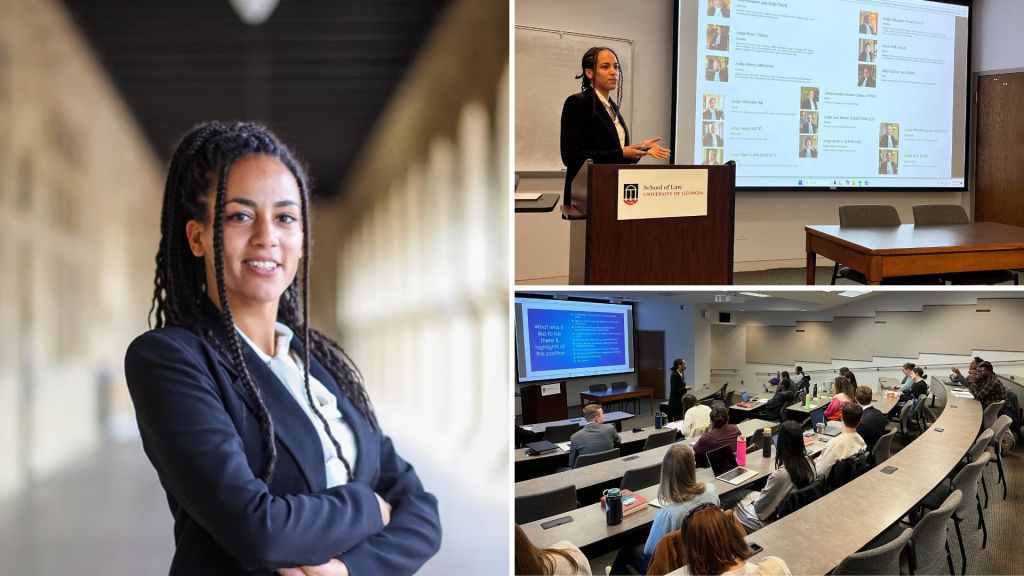
The University of Georgia School of Law welcomed international lawyer Eva Keïta to campus this week to discuss her experience at the International Court of Justice (ICJ) with students in Professor Diane Marie Amann‘s Public International Law course.
Keïta provided students with an overview of the ICJ, where she was an Associate Legal officer and a Judicial Fellow assisting a judge on various public international law matters. She spoke about the makeup of the ICJ, the role of members on each of the Judges’ teams, and how students can make themselves more competitive for open positions. Keïta then took questions from students, detailing her own professional journey as an international dispute settlement lawyer and providing advice for those interested in pursuing international legal careers.
Before her time at the ICJ, Keïta honed her expertise in international arbitration and litigation and handled complex international disputes at two international law firms in Paris. Keïta also has significant experience handling pro bono and international human rights matters. She provided legal representation to an inmate serving a life sentence under California’s Three Strikes Law in post-conviction proceedings, assisted human trafficking victims in compensation proceedings in front of French courts, and volunteered for four months in Togo, providing legal assistance to inmates through a local NGO.
Prior to her legal career, Keïta pursued a bachelor’s and master’s degree in political science, specializing in international relations, from the Sorbonne. In addition, Keïta holds a LL.M. in international economic law, business & policy from Stanford Law School and her first law degree from Sciences Po in Paris.
The University of Georgia School of Law’s spring 2025 International Law Colloquium began last week with Professor Harlan Cohen of Fordham University School of Law. For more than a decade, the International Law Colloquium Series has brought leading scholars to Georgia Law, where they have presented works in progress and invited discussion and comments from students as well as faculty discussants.
This year, Professor Desirée LeClercq is overseeing the colloquium, which is designed to introduce students to features of international economic law through engagement with scholars in the international legal field. The course broadly defines “international economic law,” to include traditional approaches (trade and investment agreements) as well as non-traditional, emerging approaches (examining the effects of international economic law on marginalized communities and considering re-distributional policies).
Cohen presented his working paper titled, “The International Order, International Law, and the Definition of Security.” Cohen, who previously served as the Gabriel M. Wilner/UGA Foundation Professor in International Law at the University of Georgia School of Law and Faculty co-Director of the Dean Rusk International Law Center, specializes in international trade, international law, international legal theory, global governance, and U.S. foreign relations law.
As economic security has seemingly moved to the center of American and European foreign policy, both the United States and the European Union have broadened their interpretation of international law rules governing security, coercion, and intervention. These broadened interpretations have supported a bevy of new sanctions, trade restrictions, investment controls, and industrial policies that have turned the global economy into an increasingly weaponized space. But these interpretations are not exactly new, echoing developing state interpretations of international law that developed states had long ago seemingly rejected. How are these once moribund interpretations of security, force, and coercion being brought back to life?
This essay argues that these interpretative shifts highlight the role of the international order as an interpretative mechanism within international law. Borrowing from the work of Robert Cover, it explains the ways that the international order acts as a jurispathic agent within the system, judging which interpretations live on and which are cast aside. As global power shifts, the international order shifts with it, potentially reopening interpretative fights over international law. Today’s fights over the meaning of security, force, and coercion thus reflect both the realities of a changing order and the battle to shape the one to come.
To view the full list of International Law Colloquium speakers, visit our website.
This program is made possible through the Kirbo Trust Endowed Faculty Enhancement Fund and the Talmadge Law Faculty Fund.
Amann is Regents’ Professor of International Law, Emily & Ernest Woodruff Chair in International Law, and a Faculty Co-Director of our Dean Rusk International Law Center here at Georgia Law.
The “What Figures” article is her contribution to the journal’s symposium issue based on a book about the Chagos Islands and the International Court of Justice advisory opinion, written by University College London Law Professor Philippe Sands, who was a barrister in those proceedings.
The issue also includes a foreword by Sands and a co-authored dialogue between Diane F. Orentlicher and Morton H. Halperin, as well as articles by Dan Bodansky, Christopher J. Borgen, Jorge Contesse, Peter G. Danchin, Jeffrey Dunoff, Margaret M. deGuzman, Mark A. Drumbl, Jean Galbraith, Rachel López, Jonathan H. Marks, Elizabeth Nwarueze, Obiora Chinedu Okafor, Ayodeji Kamau Perrin, and Sebastian von Massow.
Here’s the abstract for Amann’s article, which is available here:
“One person’s life forms the core around which Philippe Sands’ The Last Colony explores the events leading up to the advisory opinion on the Legal Consequences of Chagos Archipelago from Mauritius in 1965. That person is Liseby Bertrand Elysé, who was born in 1953 in Chagos, then forcibly removed to Mauritius in 1973. Her efforts to return home eventually brought her to a 2018 hearing at The Hague, where she spoke to the International Court of Justice bench by means of a subtitled video. This essay, which appears in a symposium issue on Sands’ book, investigates the ethics, the effectiveness, and the emancipatory potential of the author’s telling of the story of the Chagossian woman he most often calls ‘Madame Elysé.’”
Amann is Regents’ Professor of International Law, Emily & Ernest Woodruff Chair in International Law, and a Faculty Co-Director of our Dean Rusk International Law Center here at Georgia Law.
Her article, which draws upon her ongoing research into lawyers and other women professionals played at post-World War II trials, forms part of the journal’s special review series marking the centenary of the Hague Academy of International Law.
Available here, the article focuses on the life of one “Nuremberg woman,” Dr. Aline Chalufour, who attended the Academy in 1937 and again in 1957. Her experiences both shed light on how marginalized groups fared in the Academy’s first 100 years, and also call upon the Academy, and the field it promotes, to do better in the next 100 years.
International tax debates often center on how to fairly allocate taxing rights on the profits of multinational enterprises, carrying significant global economic implications. When a business earns income abroad, the country of residence (where the taxpayer resides) and the country of source (where income is generated) both have legitimate, competing claims to tax that income. The international tax system favors residence-based taxation. The source country has the right to tax business profits only if the enterprise carries on a permanent establishment in its borders, which typically requires physical presence. The permanent establishment standard becomes flawed in a digital economy where profit shifting practices are abundant and businesses no longer require a physical presence in the location of their online consumers.
These enduring norms are poised to change with an upcoming United Nations (UN) Framework Convention on International Tax Cooperation – an initiative overwhelmingly supported by Global South economies. The Global North has historically dominated the international tax regime through the Organisation for Economic Co-operation and Development (OECD), informally known as the “World Tax Organization”. A UN framework convention could introduce new standards to address the tax challenges of digitalization, though it would need to bridge the underlying North-South divide.
This article explores the “tax wars” surrounding the leadership for global tax governance, contrasting the taxing powers and interests of the OECD-led Global North with those of the UN-backed Global South. It argues for a shift toward source-based taxation by revisiting the permanent establishment standard. This transition will address longstanding inequities and is increasingly warranted in a digital economy that does not rely on physical presence.
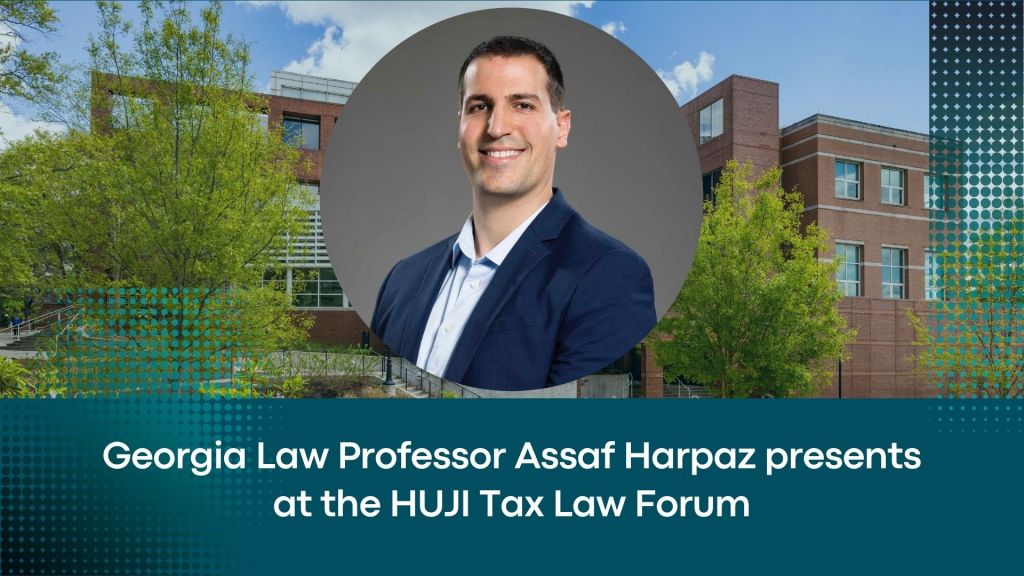
Assaf Harpaz joined University of Georgia School of Law as an assistant professor in summer 2024 and teaches classes in federal income tax and business taxation. Harpaz’s scholarly focus lies in international taxation, with an emphasis on the intersection of taxation and digitalization. He explores the tax challenges of the digital economy and the ways to adapt 20th-century tax laws to modern business practices.
Kobi Korankye: Ph.D. student in Philosophy, Franklin College of Arts and Sciences
Beatrice Robson: Ph.D. student in Agricultural and Applied Economics, College of Agricultural and Environmental Sciences
Uyiosa (“Uyi”) Ugiagbe: Ph.D. student in Mathematics Education, Mary Frances Early College of Education
All information about the Graduate Certificate in International Law, including upcoming application cycles and virtual information sessions, can be found here.
The International Law Colloquium, a time-honored tradition here at the University of Georgia School of Law, returns this spring semester with another great lineup of global legal experts.
In Spring 2025, this for-credit course is designed to introduce students to features of international economic law, broadly defined, through engagement with scholars in the international legal field. The course broadly defines “international economic law” to include traditional approaches (trade and investment agreements) as well as non-traditional, emerging approaches (examining the effects of IEL on marginalized communities and considering re-distributional policies). This course consists of presentations of substantial works-in-progress on a variety of international law topics by prominent scholars from other law schools. In keeping with a tradition established when the series began in 2006, students will write reaction papers on the scholars’ manuscripts, and then discuss the papers with the authors in class. Leading the class will be Desirée LeClercq, Assistant Professor of Law & Faculty Co-Director of the Dean Rusk International Law Center. Other Georgia Law faculty, including Diane Marie Amann and Christopher Bruner, will join in the dialogues.
Further supporting the colloquium are staff at our Center; in particular, the Center’s Global Practice Preparation team, which includes Catrina Martin and student workers Casey Smith (J.D. ’26) and Aubry Tedford (J.D. ’25). The colloquium further benefits from generous support from the Kirbo Trust Endowed Faculty Enhancement Fund and the Talmadge Law Faculty Fund.
Presenting at the Spring 2025 Colloquium (pictured above, clockwise from top left):
January 17: Harlan Cohen, Fordham University School of Law “The International Order, International Law, and the Definition of Security”
January 24: Luwam Dirar, Western New England University School of Law “Emancipation, Decolonization, and Gender in the Context of African Integration”
January 31: Diane Marie Amann, University of Georgia School of Law “Economies of Injustice and the Forced Residential-Schooling of Indigenous Americans”
February 7: Christopher Bruner, University of Georgia School of Law “Sustainable Corporate Governance and Prospects for a US Value Chain Due Diligence Law”
February 14: Katrin Kuhlman, Georgetown University School of Law “Micro International Law”
February 21: Olabisi D. Akinkugbe, Schulich School of Law “Trade and Development in an Era of Geopolitics: A Third World View”
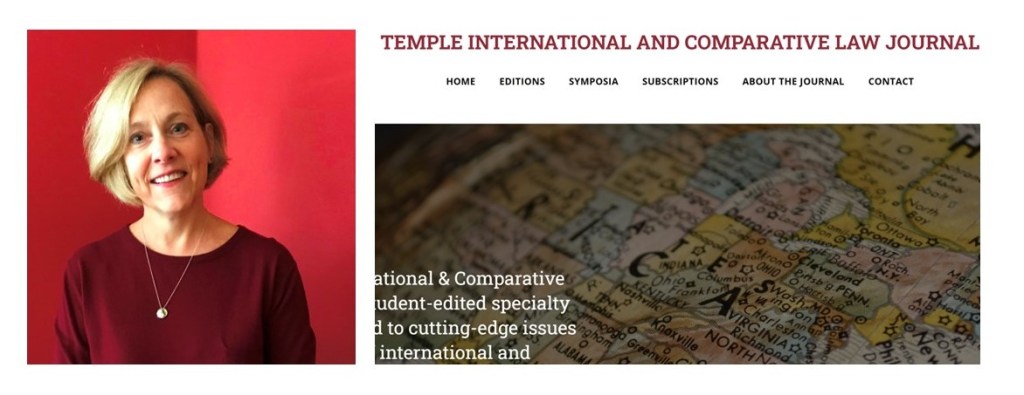
February 28: Ben Heath, Temple University School of Law “Sanctions and Sanctuary: Refuge, Violence, and the Legal Ordering of (Economic) Warfare”
March 14: Weijia Rao, Boston University School of Law “Signaling through National Security Lawmaking”
March 21: Julian Arato, Michigan University School of Law “The Institutions of Exceptions”
April 4: Trang (Mae) Nguyen, Temple University School of Law “Goods’ Citizenship”
April 11: Rachel Brewster, Duke University School of Law “Global settlements in the Foreign Corrupt Practices Act”
April 18: Sarah Dadush, Rutgers Law School “Shared Responsibility in American Contract Law”