
Luwam Dirar of Western New England University speaks at Georgia Law’s International Law Colloquium

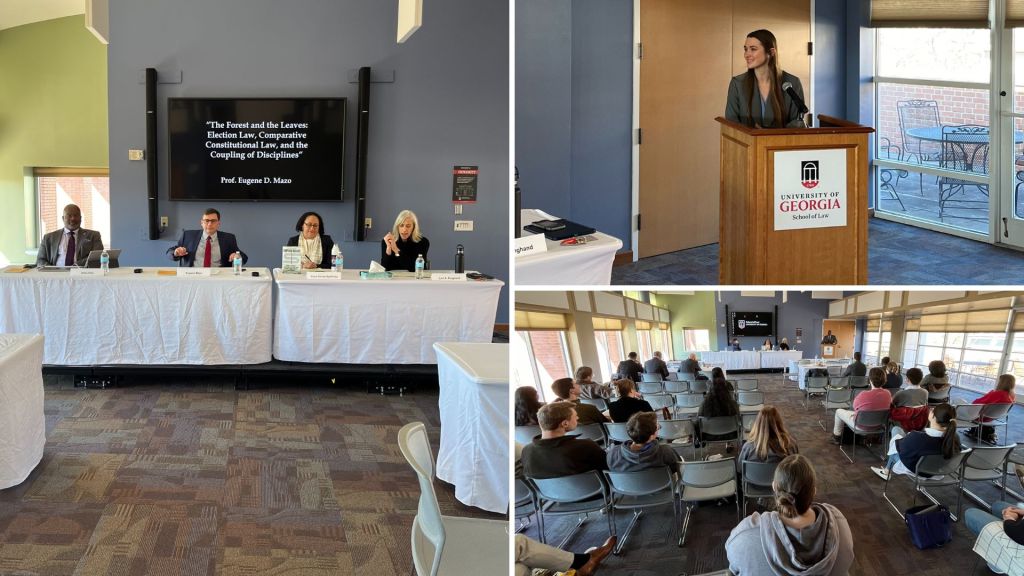
The University of Georgia School of Law’s spring 2025 International Law Colloquium welcomed Professor Luwam Dirar of Western New England University School of Law as its second speaker last week.

Dirar presented her working paper titled, “Emancipation, Decolonization, and Gender in the Context of African Integration.” Dirar’s research and scholarly focus centers on international human rights law and the intersection of international economics and international relations. Dirar has also served as a consultant to several African governments and international organizations regarding migration and law.

Associate Director of the Dean Rusk International Law Center, Taher Benany, served as Dirar’s faculty discussant. Professor Desirée LeClercq is overseeing the colloquium, which is designed to introduce students to features of international economic law through engagement with scholars in the international legal field.

Below is an abstract of Dirar’s working paper:

The 1960s institutionalization and formalization of Africa’s continental integration was a manifestation of the ontological fragility of the concept of emancipation in the African context. As a concept, continental emancipation excluded concerns of women and formalized the divorce between decolonization and racial domination on the one hand and social emancipatory movements on the other. This divorce was contrary to the expectation of women who sought the end of colonial subjugation as a turning point for women’s emancipation from not only colonial and racial domination but also from social oppression. This article argues that the continental emancipation project betrayed the hopes of women who sought decolonization or the end of white racial domination as central to the end of gendered and gendering social subjugation. This article will have four parts. The first part will be a general introduction and will explore women’s emancipation in the context of regional integration studies. The second part will explore the internal contradictions of the concept of emancipation. The third part will explore the marketization of regional integration in Africa and the debates surrounding gender in trade agreements. The fourth part will be the conclusion and way forward.

To view the full list of International Law Colloquium speakers, visit our website. A summary of the previous week’s talk with Professor Harlan Cohen can be found here.

This program is made possible through the Kirbo Trust Endowed Faculty Enhancement Fund and the Talmadge Law Faculty Fund.
Georgia Law’s International Law Colloquium hosts Harlan Cohen, Fordham Law, as first speaker

The University of Georgia School of Law’s spring 2025 International Law Colloquium began last week with Professor Harlan Cohen of Fordham University School of Law. For more than a decade, the International Law Colloquium Series has brought leading scholars to Georgia Law, where they have presented works in progress and invited discussion and comments from students as well as faculty discussants.

This year, Professor Desirée LeClercq is overseeing the colloquium, which is designed to introduce students to features of international economic law through engagement with scholars in the international legal field. The course broadly defines “international economic law,” to include traditional approaches (trade and investment agreements) as well as non-traditional, emerging approaches (examining the effects of international economic law on marginalized communities and considering re-distributional policies).

Cohen presented his working paper titled, “The International Order, International Law, and the Definition of Security.” Cohen, who previously served as the Gabriel M. Wilner/UGA Foundation Professor in International Law at the University of Georgia School of Law and Faculty co-Director of the Dean Rusk International Law Center, specializes in international trade, international law, international legal theory, global governance, and U.S. foreign relations law.

Dean Usha Rodrigues opened the colloquium (recording of opening remarks available here). Professor Diane Marie Amann served as Cohen’s faculty discussant. 

Below is an abstract of Cohen’s working paper:

As economic security has seemingly moved to the center of American and European foreign policy, both the United States and the European Union have broadened their interpretation of international law rules governing security, coercion, and intervention.  These broadened interpretations have supported a bevy of new sanctions, trade restrictions, investment controls, and industrial policies that have turned the global economy into an increasingly weaponized space.  But these interpretations are not exactly new, echoing developing state interpretations of international law that developed states had long ago seemingly rejected.  How are these once moribund interpretations of security, force, and coercion being brought back to life?

This essay argues that these interpretative shifts highlight the role of the international order as an interpretative mechanism within international law.  Borrowing from the work of Robert Cover, it explains the ways that the international order acts as a jurispathic agent within the system, judging which interpretations live on and which are cast aside.  As global power shifts, the international order shifts with it, potentially reopening interpretative fights over international law.  Today’s fights over the meaning of security, force, and coercion thus reflect both the realities of a changing order and the battle to shape the one to come.

To view the full list of International Law Colloquium speakers, visit our website.

This program is made possible through the Kirbo Trust Endowed Faculty Enhancement Fund and the Talmadge Law Faculty Fund.

International Law Colloquium returns to Georgia Law in Spring 2025 semester

The International Law Colloquium, a time-honored tradition here at the University of Georgia School of Law, returns this spring semester with another great lineup of global legal experts.

In Spring 2025, this for-credit course is designed to introduce students to features of international economic law, broadly defined, through engagement with scholars in the international legal field.  The course broadly defines “international economic law” to include traditional approaches (trade and investment agreements) as well as non-traditional, emerging approaches (examining the effects of IEL on marginalized communities and considering re-distributional policies). This course consists of presentations of substantial works-in-progress on a variety of international law topics by prominent scholars from other law schools. In keeping with a tradition established when the series began in 2006, students will write reaction papers on the scholars’ manuscripts, and then discuss the papers with the authors in class. Leading the class will be Desirée LeClercq, Assistant Professor of Law & Faculty Co-Director of the Dean Rusk International Law Center. Other Georgia Law faculty, including Diane Marie Amann and Christopher Bruner, will join in the dialogues.

Further supporting the colloquium are staff at our Center; in particular, the Center’s Global Practice Preparation team, which includes Catrina Martin and student workers Casey Smith (J.D. ’26) and Aubry Tedford (J.D. ’25). The colloquium further benefits from generous support from the Kirbo Trust Endowed Faculty Enhancement Fund and the Talmadge Law Faculty Fund.

Presenting at the Spring 2025 Colloquium (pictured above, clockwise from top left):

January 17: Harlan Cohen, Fordham University School of Law
“The International Order, International Law, and the Definition of Security”     

January 24: Luwam Dirar, Western New England University School of Law
“Emancipation, Decolonization, and Gender in the Context of African Integration”

January 31: Diane Marie Amann, University of Georgia School of Law 
“Economies of Injustice and the Forced Residential-Schooling of Indigenous Americans”

February 7: Christopher Bruner, University of Georgia School of Law
“Sustainable Corporate Governance and Prospects for a US Value Chain Due Diligence Law”

February 14: Katrin Kuhlman, Georgetown University School of Law
“Micro International Law”

February 21: Olabisi D. Akinkugbe, Schulich School of Law
“Trade and Development in an Era of Geopolitics: A Third  World  View”

February 28: Ben Heath, Temple University School of Law
“Sanctions and Sanctuary: Refuge, Violence, and the Legal Ordering of (Economic) Warfare

March 14: Weijia Rao, Boston University School of Law 
“Signaling through National Security Lawmaking”

March 21: Julian Arato, Michigan University School of Law
“The Institutions of Exceptions”

April 4: Trang (Mae) Nguyen, Temple University School of Law
“Goods’ Citizenship”

April 11: Rachel Brewster, Duke University School of Law
“Global settlements in the Foreign Corrupt Practices Act”

April 18: Sarah Dadush, Rutgers Law School
“Shared Responsibility in American Contract Law”

Georgia Law Professor Desirée LeClercq featured in Inside US Trade article 

University of Georgia School of Law Professor Desirée LeClercq was recently featured in Inside US Trade regarding the U.S.-Mexico-Canada Agreement’s Rapid Response Mechanism (RRM) and how it may be used by the upcoming Trump administration.

The December 5 article entitled “Under Trump, hope — and recommendations — for the stronger use of RRM” was written by Margaret Spiegelman. It references a report LeClercq co-authored with Mexican researchers on the views of workers in the Mexican auto sector on their labor rights under the USMCA’s RRM, as well as her November 10 post for the International Economic Law and Policy Blog entitled “Whither the Worker-Centered Trade Policy?”

From the article:

University of Georgia School of Law Assistant Professor Desirée LeClercq…says a recent study she conducted with El Colegio de Sonora professor Alex Covarrubias-V and Cirila Quintero Ramirez, a research professor at El Colegio de Frontera Norte, Unidad Matamoros, suggests that the mechanism has disproportionately served a relatively narrow group of workers with ties to major U.S. unions and non-governmental organizations, without raising labor standards overall.

LeClercq, who was USTR’s director of labor affairs during President Trump’s first term, said she believes a second Trump administration, less beholden to such groups, might be incentivized to use the tool more broadly to try to improve labor standards that give Mexico an unfair competitive edge.

LeClercq joined the University of Georgia School of Law in 2024 as an assistant professor. She teaches International Trade and Workers Rights, International Labor Law, International Law and U.S. Labor Law, as well as the International Law Colloquium. She also serves as a faculty co-director of the Dean Rusk International Law Center and as the faculty adviser for the Georgia Journal of International and Comparative Law.

Georgia Law Professor Desirée LeClercq cited in Financial Times 

University of Georgia School of Law Professor Desirée LeClercq‘s report “Enforcement of the United States-Mexico-Canada Agreement (“USMCA”) Rapid Response Mechanism: Views from Mexican Auto Sector Workers” was cited in the article “How the Democrats Worker-Centred Trade Policy Failed” in the Financial Times.

Below is the article’s abstract:

This study examines whether the RRM empowers workers’ voices in the Mexican auto sector. To this end, between January and March 2024, we interviewed 130 workers across seven supplier facilities (auto plants facilities and logistics facilities) and five assembly plants, for a total of 12 facilities. Three of the facilities were not unionized; nine facilities were unionized. Three of the twelve plants had used the RRM (“RRM facilities”), addressing various violations of labor rights, voting processes to approve or reject collective contracts, voting processes to elect independent unions, and dismissals and intimidation of workers in union activism. All three RRM cases were remediated through plans requiring the facility to hold a new legitimization vote and union election and offer worker-level trainings. Our preliminary results problematize some assumptions that drove RRM implementation. The Biden administration and members of the United States Congress have promoted the RRM as a way to strengthen the Mexican government’s efforts to implement Mexican labor law reform, empower workers in productive export sectors, and give them a voice over their labor conditions. Our results suggest that, four years after the implementation of the USMCA and the reforms of Mexico’s labor legislation, a little more than half of the workers are aware of the labor law reform, and opinions are divided on whether it is strengthening labor rights. Some workers thought the reforms were going well, while many thought the reform process was going poorly or did not know how it was going. The majority of workers we interviewed revealed that they did not understand the new democratic procedures to legitimize their collective bargaining agreements, nor that they could access the RRM platform to express their complaints. Nevertheless, the workers we interviewed at RRM facilities tended to be more knowledgeable of the labor law reforms and its attendant rights and processes than those at facilities that have not undergone RRM investigation and remediation, and they tended to view their bargaining representative and conditions of work more favorably. Our study suggests that when workers are given the opportunity to participate in democratic elections under international supervision, after receiving training on the shop floor about their rights and election procedures, they gain knowledge and ownership over their working conditions.

LeClercq joined the University of Georgia School of Law in 2024 as an assistant professor. She teaches International Trade and Workers Rights, International Labor Law, International Law and U.S. Labor Law, as well as the International Law Colloquium. She also serves as a faculty co-director of the Dean Rusk International Law Center and as the faculty adviser for the Georgia Journal of International and Comparative Law.

Georgia Law Professor Desirée LeClercq publishes on International Economic Law and Policy Blog

University of Georgia School of Law Professor Desirée LeClercq published an article titled “Whither the Worker-Centered Trade Policy?” for the International Economic Law and Policy Blog. This article presents LeClercq’s views on the Trump administration’s trade agenda.

Below is an excerpt from the article:

“The Biden administration changed U.S. trade policy significantly when it adopted a “worker-centered” trade policy that justified entering into “frameworks” and not trade agreements. That policy didn’t win many accolades from the trade crowd. Many critics felt that it forewent critical opportunities by refusing to discuss market access in new trade contexts. Without getting into that debate, this post discusses whether the Biden administration’s worker-centered trade policy – and notably, use of that policy under the United States-Mexico-Canada Agreement (USMCA) Facility-Specific Rapid-Response Labor Mechanism (RRM) – will outlive the administration.

I think it will, but it will look different. And some, including labor rights advocates like myself, might prefer the Trump administration’s approach.”

LeClercq joined the University of Georgia School of Law in 2024 as an assistant professor. She teaches International Trade and Workers Rights, International Labor Law, International Law, U.S. Labor Law and the International Law Colloquium. She also serves as a faculty co-director of the Dean Rusk International Law Center and as the faculty adviser for the Georgia Journal of International and Comparative Law.

Georgia Law Professor Desirée LeClercq publishes article in World Trade Review

University of Georgia School of Law Professor Desirée LeClercq published her article “Tonia Novitz, Trade, Labour, and Sustainable Development: Leaving No One in the World of Work Behind Edward Elgar Publishing, 2024 – Kevin J. Middlebrook, The International Defense of Workers: Labor Rights, US Trade Agreements, and State Sovereignty Columbia University Press, 2024” in the World Trade Review.

LeClercq’s article reviews two books that examine trade and labor rights, the development of the United States-Mexico-Canada Agreement (USMCA) and the Rapid Response Mechanism.

Below is an excerpt from the article:

Over the past decade, trade lawyers and legal researchers have had to take a crash course in international labor law and the so-called ‘sustainable development’ framework. Trade bans across the Atlantic punish governments and corporations for engaging in forced labor. The European Union (EU) recently revised its trade agenda to ensure that commitments to trade agreements with sustainable development provisions are enforceable through sanctions. The United States adopted a ‘worker-centered’ trade policy foregrounding international labor law, the International Labor Organization (ILO), and conceptions of workplace democracy, choice, and voice. The trade and labor linkage, long the source of dispute, is apparently with us to stay, with its attendant implications for trade, political relationships, and international economic law. Namely, who establishes the rules? Governments? International organizations? Civil society? And who decides whether and how those rules are violated?

LeClercq joined the University of Georgia School of Law in 2024 as an assistant professor. She teaches International Trade and Workers Rights, International Labor Law, International Law and U.S. Labor Law. She also serves as a faculty co-director of the Dean Rusk International Law Center and as the faculty adviser for the Georgia Journal of International and Comparative Law.

Georgia Law Professor Desirée LeClercq testifies before the U.S. International Trade Commission in Washington, DC

University of Georgia School of Law Professor Desirée LeClercq testified before the United States International Trade Commission hearing on the United States Mexico Agreement (USMCA) Automotive Rules of Origin: Economic Impact and Operation, 2025 Report earlier this month.

During this hearing, LeClercq presented her empirical study examining the effects of the USMCA Rapid Response Mechanism on workers in the Mexican auto sector. Current 3L Gloria Maria Correa assisted LeClercq in researching for this report. The abstract from the pre-hearing brief is as follows:

This pre-hearing brief is a submission to the U.S. International Trade Commission in relation to its investigation on the USMCA Automotive Rules of Origin: Economic Impact and Operation, 2025 Report. This investigation is a useful exercise and an opportunity to provide information about a recent study, entitled “Enforcement of the United States-Mexico-Canada Agreement (“USMCA”) Rapid Response Mechanism: Views from Mexican Auto Sector Workers,” conducted at Cornell University to help inform the Commission’s assessment. This study explores whether efforts under the United States-Mexico-Canada Agreement (USMCA) Facility-Specific Labor Rapid Response Mechanism (RRM) are leveling the playing field between U.S. and Mexican auto facilities by strengthening the labor rights of workers in the Mexican auto sector.

Desirée LeClercq joined the University of Georgia School of Law in 2024 as an assistant professor. She teaches International Trade and Workers Rights, International Labor Law, International Law and U.S. Labor Law. She also serves as a faculty co-director of the Dean Rusk International Law Center and as the faculty adviser for the Georgia Journal of International and Comparative Law.

Georgia Law Professor Desirée LeClercq presents at 2nd annual Trade and Public Policy Network Conference in Oxford

University of Georgia Assistant Professor of Law & Faculty Co-Director of the Dean Rusk International Law Center, Desirée LeClercq, presented at the 2nd annual Trade and Public Policy Network Conference in Oxford, England. LeClercq’s work was entitled: “Enforcement of the United States-Mexico-Canada Agreement Rapid Response Mechanism.”

Desirée LeClercq joined the University of Georgia School of Law as an assistant professor in summer 2024 and currently teaches International Trade and Workers Rights, International Labor Law, International Law, and U.S. Labor Law. She serves as a faculty co-director of the Dean Rusk International Law Center and as the faculty adviser for the Georgia Journal of International and Comparative Law.

Georgia Professor Desirée LeClercq to present at WTO’s Annual Public Forum in Switzerland

Assistant Professor Desirée LeClercq will present at the World Trade Organization’s (WTO) 2024 Public Forum. The theme for this year’s forum is Re-globalization: Better Trade for a Better World, described below:

Since the WTO’s inception in 1995, global trade has rapidly expanded and become increasingly interconnected. The international trading system has helped lift 1.5 billion people out of absolute poverty and unlocked new opportunities for businesses, workers and consumers. At the same time, the gains from trade have not always been shared equally. This needs to change.

As the WTO celebrates its 30th anniversary, the 2024 Public Forum will look to the future, exploring how re-globalization can help make trade more inclusive and ensuring that its benefits reach more people.

LeClercq will present research under the United States-Mexico-Canada agreement’s dispute settlement provisions and their effects on vulnerable workers in Mexico.

The WTO 2024 Public Forum also discussed the TradeExperettes’ report: Ten “Quick Wins” for Re-globalization and Resilience in Trade. LeClercq authored “Quick Win No. 3: Empower all workers to ensure a fair, equitable and sustainable trade policy,” which urges greater inclusion of non-union workers at the trade bargaining table.

Desirée LeClercq joined the University of Georgia School of Law as an assistant professor in summer 2024 and currently teaches International Trade and Workers Rights, International Labor Law, International Law, and U.S. Labor Law. LeClercq’s scholarly focus lies in international and labor law. She also serves as a faculty co-director of the Dean Rusk International Law Center and as the faculty adviser for the Georgia Journal of International and Comparative Law.