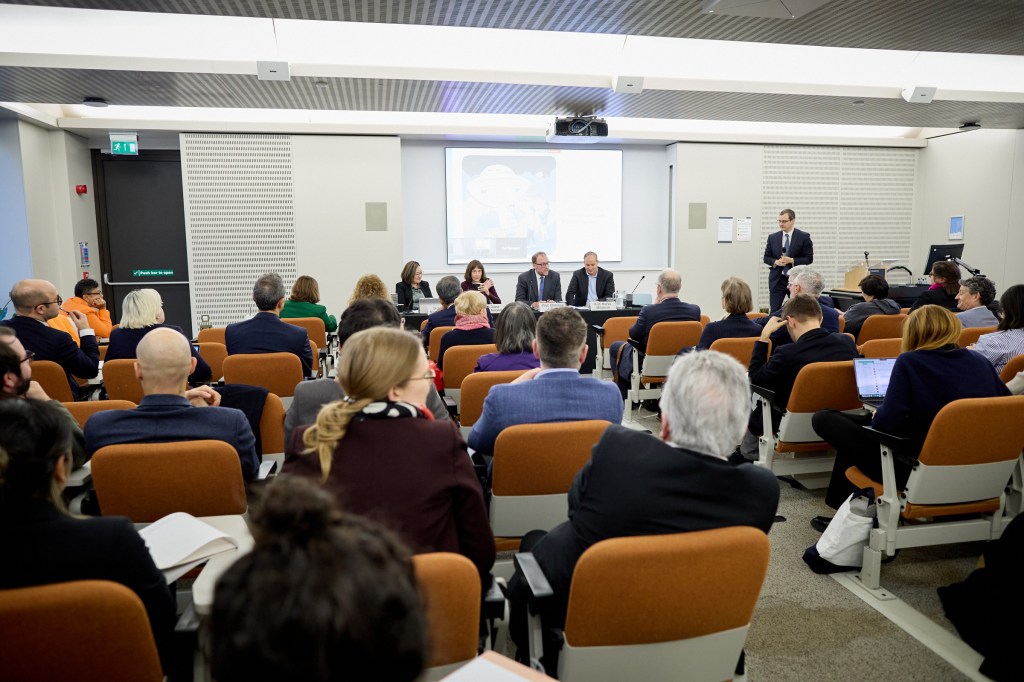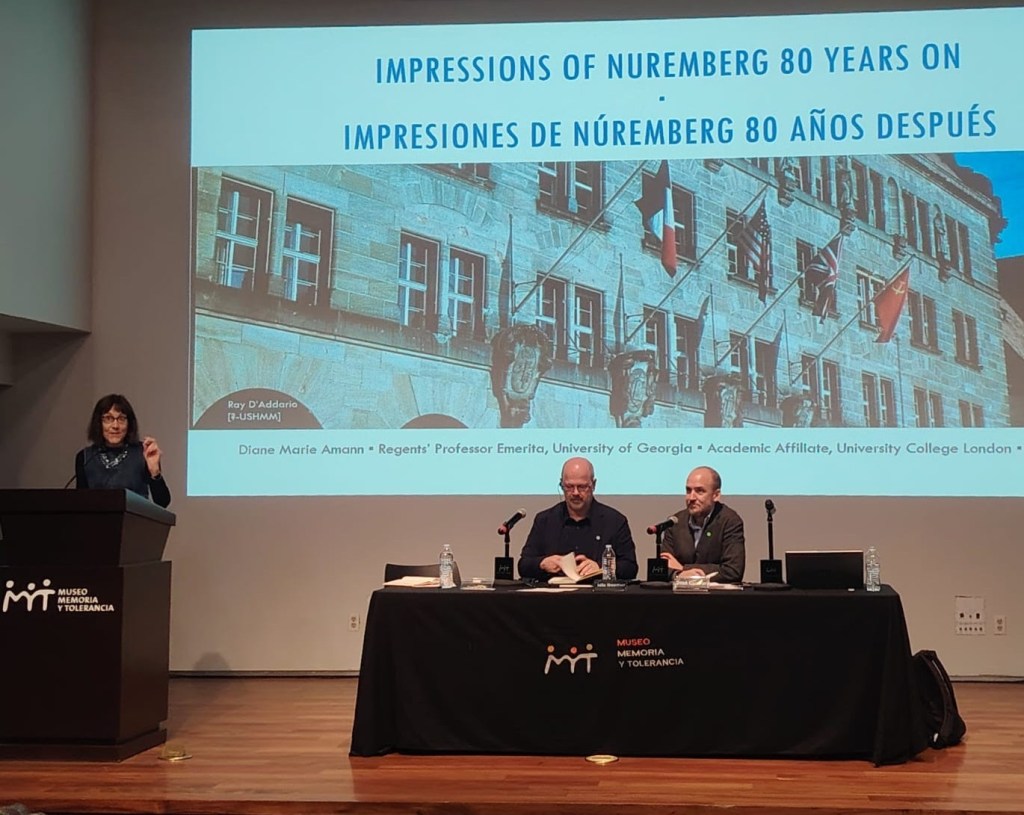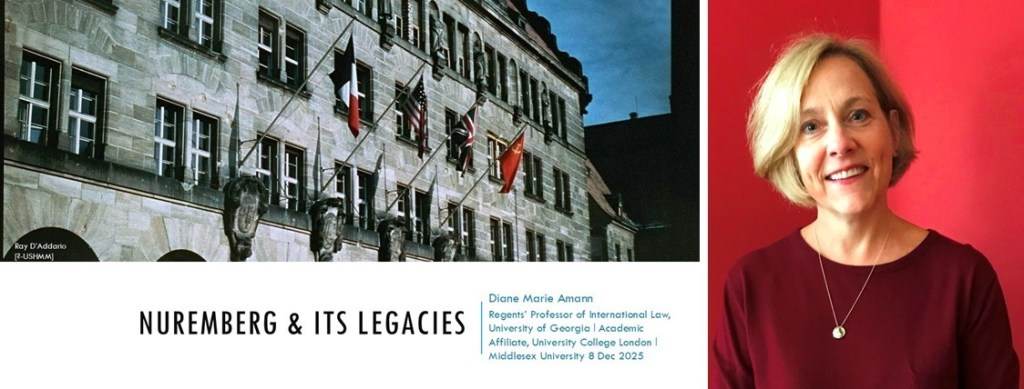
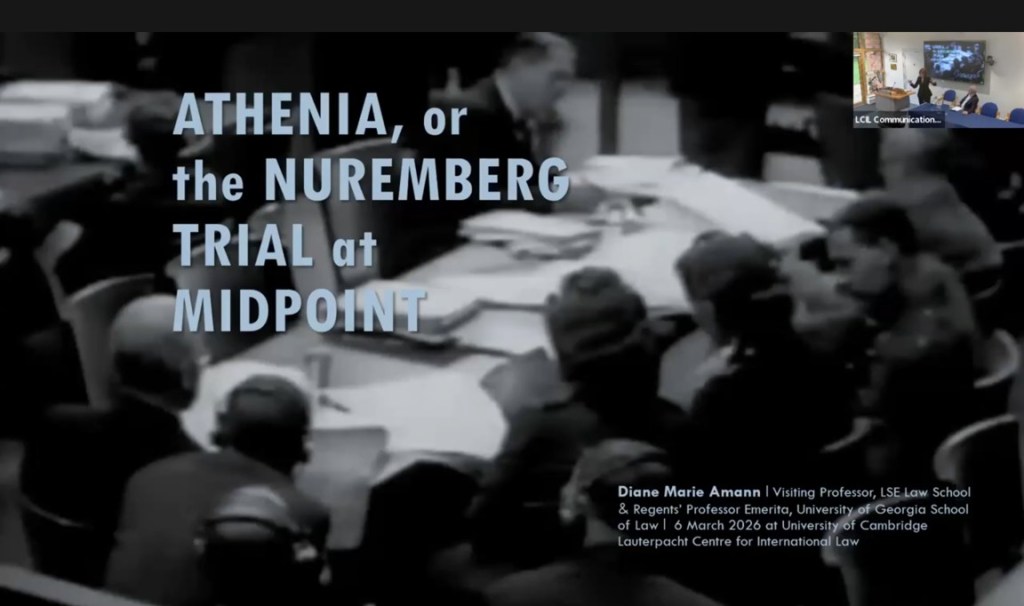
Amann provided an overview of the year-long post-World War II war crimes trial held in Nuremberg, Germany, before an International Military Tribunal established by Britain, France, the Soviet Union, and the United States. After discussing how the 1945-1946 trial unfolded, she considered the continued impact of the trial with regard to issues like the death penalty, the abolition of government leaders’ immunity from prosecution, and the international law duty to refuse to obey illegal orders.
Amann is Regents’ Professor of International Law, Emily & Ernest Woodruff Chair in International Law, and a Faculty Co-Director of our Dean Rusk International Law Center here at Georgia Law. During her current research-intensive semester, she is an Affiliate Academic at University College London Faculty of Laws. She has published several essays on the Nuremberg era and is writing a book on lawyers and other women professionals at that first trial.
University of Georgia School of Law Professor Diane Marie Amann discussed her research on child-taking at a side event occurring during the 24th annual Assembly of States Parties of the International Criminal Court, held in early December at The Hague in The Netherlands.
In addition to Professor Amann, additional panelists included: Hala Turjman, Independent Institution on Missing Persons in the Syrian Arab Republic: Alla Perfetska, Voices of Children; and Ikhlass Ahmed Altaher Eisa, Strategic Initiatives for Women in the Horn of Africa. Ukraine’s Ambassador to The Netherlands, Andriy Kostin, provided opening and closing remarks, and Wayne Jordash KC, president of the Global Rights Compliance Foundation, moderated the panel.
Amann is Regents’ Professor of International Law, Emily & Ernest Woodruff Chair in International Law, and a Faculty Co-Director of our Dean Rusk International Law Center here at Georgia Law. During her current research-intensive semester, she is an Affiliate Academic at University College London Faculty of Laws.
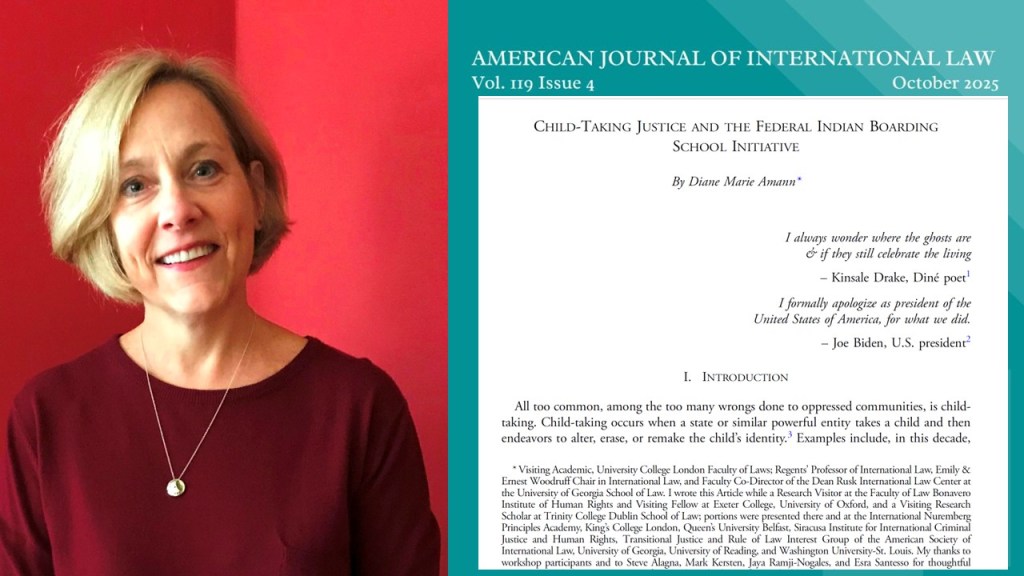
From 2012 to 2021 Amann served as International Criminal Court Prosecutor Fatou Bensouda’s Special Adviser on Children in & affected by Armed Conflict. Her many publications on international child law include two that analyze the long-standing criminal phenomenon by which a state (or other powerful entity) takes a child and then endeavors to alter, erase or remake the child’s identity. These two articles are “Child-Taking Justice and the Federal Indian Boarding School Initiative,” 119 American Journal of International Law 629 (2025), and “Child-Taking,” 45 Michigan Journal of International Law 305 (2024).
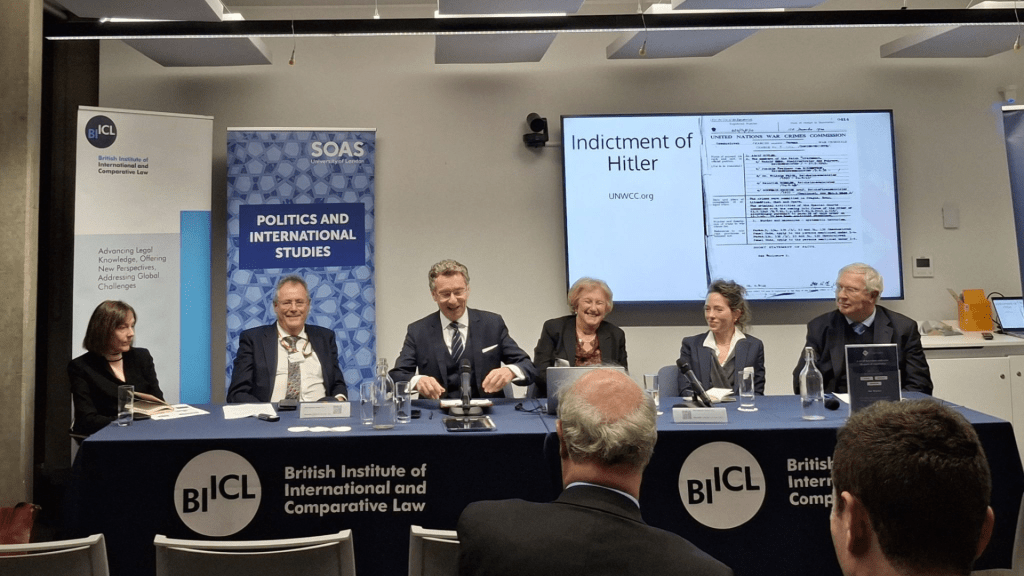
Her talk opened “80 Years On: The Legacy of the Nuremberg Trials for Accountability,” a panel of experts convened to analyze the midtwentieth-century trials project. The panel also looked to contemporary developments in international relations and international criminal justice – not least, to the Nuremberg precedent which permitted international criminal prosecutions of heads of state and other governmental leaders. A full video of the panel can be found here.
Besides Professor Amann (pictured above left), panelists included (l to r): Dan Plesch, Professor of Diplomacy & Strategy at SOAS University of London; Christoph Safferling, Director of the International Nuremberg Principles Academy and Professor of Law at the Friedrich-Alexander-Universität Erlangen-Nürnberg; as moderator, International Criminal Court Judge Joanna Korner CMG KC; Kirsty Sutherland, international barrister at 9BR Chambers, London; and Sir Howard Morrison KCMG CBE KC, former Judge on the International Criminal Court. (LinkedIn photo credit)
Amann is Regents’ Professor of International Law, Emily & Ernest Woodruff Chair in International Law, and a Faculty Co-Director of our Dean Rusk International Law Center here at Georgia Law. During her current research-intensive semester, she is an Affiliate Academic at University College London Faculty of Laws. She has published several essays on the Nuremberg era and is writing a book on lawyers and other women professionals at that first trial.
Amann is Regents’ Professor of International Law, Emily & Ernest Woodruff Chair in International Law, and a Faculty Co-Director of our Dean Rusk International Law Center here at Georgia Law. During her current research-intensive semester, she is a Visiting Academic at University College London Faculty of Laws.
This new publication continues scholarly research that Amann first explored in her article “Child-Taking,” 45 Michigan Journal of International Law 305 (2024), and that she has presented at many universities and other learned societies in the United States, Ireland, and the United Kingdom.
The focus of this article is the 2022–2024 Federal Indian Boarding School Initiative undertaken the U.S. Executive Branch. The article chronicles this three-year process, which included sessions with survivors and their descendants, and which resulted in a two-volume report, in an apology by President Joe Biden, and in designation of a national memorial at one of the most notorious school sites. This article examines the initiative as an example of “child-taking justice”; that is, as a process of what is called “transitional justice”, done in an effort to redress the takings of children from their community, followed by efforts to alter, erase, or remake the children’s identities. The initiative shed glaring light on the past history and present effects of a centuries-old practice by which the United States took Indigenous children from their families and forced them to attend residential schools where they were compelled to submit to Westernized and Christianized notions of “civilization.”
Unfolding within the internal constitutional framework of the United States, the U.S. initiative benefited from meaningful engagement with affected communities. This article nonetheless argues for a framing that also addresses external frameworks; to be specific, one that engages fully with applicable international law and lessons learned elsewhere. The argument runs counter to the United States’ longstanding practice of holding international human rights law at arm’s length, while pressing other countries to conform to that law’s strictures. Efforts of a U.S. human-rights-at-home movement have not reversed that trend. Thus the U.S. initiative made only a hesitant overture to international issues and to three countries, Canada, Australia, and New Zealand, with which it claimed kinship. The 2025 inauguration of a President hostile to rights-based justice pointed to limitations of this approach.
Amann is Regents’ Professor of International Law, Emily & Ernest Woodruff Chair in International Law, and a Faculty Co-Director of our Dean Rusk International Law Center here at Georgia Law. During her current research-intensive semester, she is an Affiliate Academic at University College London Faculty of Laws.
Her chapter appears in The Oxford Handbook on Women and International Law, co-edited by Professors J. Jarpa Dawuni (Howard University), Nienke Grossman (University of Baltimore), Jaya Ramji-Nogales (Temple University), and Hélène Ruiz Fabri (Université Paris 1 Panthéon-Sorbonne). The thirty-five-chapter volume spans many topics – topics that its four dozen authors explore through a variety of methods, including substantive legal analysis, legal history, and global critical race feminism.
Amann’s chapter draws from research that she had presented online as part of “In/ex-clusiveness of the Legal Construction of Justice,” a panel of the 17th Annual Conference of the European Society of International Law, held in 2022 at Utrecht University in The Netherlands.
Women seldom surface in conventional accounts of the many war crimes trials that took place after World War II. Yet as this chapter shows, hundreds of women lawyers and other professionals were present, thus helping to lay the foundations of an international criminal justice project that continues to this day. Combining methodologies of narrative with theories sounding in global legal history and feminist scholarship and discussing what it reveals as dances of absence-presence, visible-invisible, and inclusion-exclusion, this chapter first examines how and why women were absented and then surfaces their contributions. It concludes with a look at contemporary international legal practice.
Amann, who is Regents’ Professor of International Law, Emily & Ernest Woodruff Chair in International Law, and a Faculty Co-Director of our Dean Rusk International Law Center here at Georgia Law, is a Visiting Academic this semester at University College London Faculty of Laws.
Her commentary on Prosecutor v. Bemba, a 2018 judgment of acquittal by the ICC Appeals Chamber, first appeared as “In Bemba, Command Responsibility Doctrine Ordered to Stand Down.” It then was included in this 2025 Brill Publishers collection, edited by UCLA Law Professor Richard H. Steinberg. Also contributing to the book’s section on the Bemba judgment were attorney Nadia Carine Fornel Poutou and law professors Miles Jackson (Oxford), Michael Newton (Vanderbilt), and Leila Nadya Sadat (Washington University).
“The acceptance of commander’s responsibility is, in effect, acceptance of authority over persons permitted to kill. With that acceptance comes a heavy burden, grown out of practical and moral concerns and reflected in longstanding legal doctrine. At odds with this burden was the judgment of acquittal that the International Criminal Court Appeals Chamber entered in Bemba in 2018. Originally appearing in an online forum, this commentary argues for a statutory construction that better would serve the purposes of the ICC and the command responsibility doctrine.”
University of Georgia School of Law Professor Diane Marie Amann recently gave an online lecture entitled “Justice for Child-Taking and Other Crimes against and affecting Children” as part of “International Criminal Law, Conflict Resolution and Transitional Justice,” the week-long 24th Specialization Course in International Criminal Law for Young Penalists, held in Sicily, at the Siracusa International Institute for Criminal Justice and Human Rights, Italy.
Amann is Regents’ Professor of International Law, Emily & Ernest Woodruff Chair in International Law, and a Faculty Co-Director of our Dean Rusk International Law Center here at Georgia Law. Her Siracusa lecture drew upon her expertise on children, violence, conflict, and justice. Her most recent publication in this field is “Child-Taking,” 45 Michigan Journal of International Law 305 (2024); all her related publications are available here.
Amann is Regents’ Professor of International Law, Emily & Ernest Woodruff Chair in International Law, and a Faculty Co-Director of our Dean Rusk International Law Center here at Georgia Law.
Here’s the abstract for Professor Amann’s article:
“Conventional narratives tend to represent the post-World War II international criminal proceedings as a men’s project, thus obscuring the many women who participated, as lawyers, journalists, analysts, interpreters, witnesses, and defendants. Indeed, two women stood trial before Nuremberg Military Tribunals. This article examines the case of the only woman found not-guilty: Inge Viermetz, who had been an administrator at Lebensborn, the Nazi SS adoption and placement agency. The article outlines the prosecution’s child-taking case against Viermetz, as well as her successful gendered self-portrayal as a conventionally feminine caregiver. With references to Professor Megan A. Fairlie, at whose memorial symposium it was presented, the article concludes by considering contemporary implications of this acquittal at Nuremberg.”
University of Georgia School of Law Professor Diane Marie Amann recently took part in a New York conference that launched the Children and Crimes Against Humanity Coalition, formed to ensure that child justice is embedded in a treaty to be negotiated at the United Nations.
Professor Amann, who chaired a conference panel entitled “Increasing Visibility of Crimes Affecting Children and New Crimes Against Children,” commented on drafts and is an individual endorser of the Coalition white paper. Here at Georgia Law, she is Regents’ Professor of International Law, Emily & Ernest Woodruff Chair in International Law, and a Faculty Co-Director of our Dean Rusk International Law Center. She was Special Adviser to International Criminal Court Prosecutor Fatou Bensouda on Children in & affected by Armed Conflict from 2012 to 2021, and has served since 2023 on the Bring Back Kids UA Task Force. Her recent publications in this field include “Child-Taking,” 45 Michigan Journal of International Law 305 (2024), and “International Child Law and the Settlement of Ukraine‑Russia and Other Conflicts,” 99 International Law Studies 559 (2022).
By U.N. General Assembly resolution, states will conclude the Crimes Against Humanity Treaty – known formally as the Convention on the Prevention and Punishment of Crimes Against Humanity – following diplomatic plenipotentiary conferences in 2028 and 2029. Preparatory meetings will take place in the interim, beginning next January.
The treaty’s text will derive from draft articles adopted in 2019 by the International Law Commission, and from amendments to those articles which U.N. member states may propose during the negotiation process.
Through efforts like the Columbia conference and the just-released white paper, the Children and Crimes Against Humanity Coalition will endeavor to promote states’ proposals to include in child-related provisions in the final treaty text. Its white paper proposes, inter alia: that every person under 18 be defined as a child; that the crime of persecution expressly include age as a prohibited ground; and the enumeration of acts that may constitute crimes against humanity explicitly include recruitment and use of children by armed groups and armed forces, as well as forced marriage. Further provisions relate to national justice and reparations proceedings; among these is the proposal that any child suspected of having committed a crime against humanity will be treated in a country’s child justice system, and not via an adult criminal prosecution.
The white paper’s authors are Véronique Aubert (Save the Children), Zoé Bertrand (Global Survivors Fund), Janine Morna (Amnesty International), and Zama Neff (Human Rights Watch). Those nongovernmental organizations co-sponsored the May 5 conference, along with various units of Columbia University and the U.N. permanent missions of Andorra, Brazil, Malta, Mexico, and the United Kingdom.
Her co-panelist was Linos-Alexandre Sicilianos, who is Professor of Law at the University of Athens, Greece, and the former President of the European Court of Human Rights. Moderating was Israr Khan, President of the Oxford Union, a 200-year-old debating society which draws much of its membership from the University of Oxford.
Amann is Regents’ Professor of International Law, Emily & Ernest Woodruff Chair in International Law, and a Faculty Co-Director of our Dean Rusk International Law Center here at Georgia Law.