UGA Professor Ramnath discusses book, “Boats in a Storm: Law, Migration, and Decolonization in South and Southeast Asia, 1942–1962” at law school

Kalyani Ramnath, Assistant Professor in the Department of History at the Franklin College of Arts & Sciences and Assistant Professor (by courtesy) at the University of Georgia School of Law, recently discussed her first book (detailed in previous post here) at an event organized by the Dean Rusk International Law Center. Joining Ramnath in conversation about Boats in a Storm: Law, Migration, and Decolonization in South and Southeast Asia, 1942–1962 (Stanford University Press, 2023) were Diane Marie Amann, Regents’ Professor, Emily & Ernest Woodruff Chair in International Law, and Co-Director of the Dean Rusk International Law Center, and Laura Phillips-Sawyer, Jane W. Wilson Associate Professor in Business Law.

Below is a description of Ramnath’s book:

Drawing on archival materials from India, Sri Lanka, Myanmar, London, and Singapore, Kalyani Ramnath narrates how former migrants battled legal requirements to revive prewar circulations of credit, capital, and labor, in a postwar context of rising ethno-nationalisms that accused migrants of stealing jobs and hoarding land. Ultimately, Ramnath shows how decolonization was marked not only by shipwrecked empires and nation-states assembled and ordered from the debris of imperial collapse, but also by these forgotten stories of wartime displacements, their unintended consequences, and long afterlives.

Ramnath received her Ph.D. in history from Princeton University in 2018, and was a Prize Fellow in Economics, History, and Politics at the Center for History and Economics at Harvard University from 2018 – 2021. She also holds a bachelor’s degree in arts and law (B.A., LL.B. (Hons.) (JD equivalent) from the National Law School of India University (NLSIU) and a master’s degree in law (LL.M.) from the Yale Law School.

Georgia Law Professor Diane Marie Amann presents on Nuremberg woman defendant at conference in memory of FIU Law Professor Megan A. Fairlie

University of Georgia School of Law Professor Diane Marie Amann spoke last week at a conference which paid tribute to Professor Megan A. Fairlie (1971-2022), an international criminal law scholar who had presented her own work at our law school’s Dean Rusk International Law Center.

Most recently, Dr. Fairlie had taken part in a 2019 symposium entitled “International Criminal Court and the Community of Nations,” and she published her presentation, “Defense Issues at the International Criminal Court,” in the Georgia Journal of International and Comparative Law symposium issue.

In recognition of Fairlie’s scholarship on persons accused by international criminal tribunals, Amann chose to present “Inge Viermetz, Woman Acquitted at Nuremberg,” at Friday’s conference.

Entitled “Perspectives on the International Criminal Court and International Criminal Law and Procedure: A Symposium in Memory of Megan Fairlie,” the conference took place at Miami’s Florida International University College of Law. Dr. Fairlie had taught there from 2007 – the same year she earned her Ph.D. in International Human Rights Law from the Irish Centre for Human Rights, National University of Ireland-Galway – until her death in December 2022.

Amann, who is Regents’ Professor of International Law, Emily & Ernest Woodruff Chair in International Law, and Faculty Co-Director of the Dean Rusk International Law Center here at Georgia Law, has published frequently on women professionals during the post-World War II trials at Nuremberg and elsewhere.

Georgetown Law Professor Cliff Sloan discusses “The Court at War” at Georgia Law

Georgetown Law Professor Cliff Sloan recently discussed his new book, The Court at War: FDR, His Justices, and the World They Made, in an event sponsored by the Dean Rusk International Law center here at the University of Georgia School of Law.

Sloan was joined in conversation by two of the law school’s professors: Nathan S. Chapman, Pope F. Brock Professor of Law; and Diane Marie Amann, who is Regents’ Professor of International Law, Emily & Ernest Woodruff Chair in International Law, and the Center’s Faculty Co-Director.

Below is a description of the book:

By the summer of 1941, in the ninth year of his presidency, Franklin Roosevelt had molded his Court. He had appointed seven of the nine justices—the most by any president except George Washington—and handpicked the chief justice.

But the wartime Roosevelt Court had two faces. One was bold and progressive, the other supine and abject, cowed by the charisma of the revered president.

The Court at War explores this pivotal period. It provides a cast of unforgettable characters in the justices—from the mercurial, Vienna-born intellectual Felix Frankfurter to the Alabama populist Hugo Black; from the western prodigy William O. Douglas, FDR’s initial pick to be his running mate in 1944, to Roosevelt’s former attorney general and Nuremberg prosecutor Robert Jackson.

The justices’ shameless capitulation and unwillingness to cross their beloved president highlight the dangers of an unseemly closeness between Supreme Court justices and their political patrons. But the FDR Court’s finest moments also provided a robust defense of individual rights, rights the current Court has put in jeopardy. Sloan’s intimate portrait is a vivid, instructive tale for modern times.

Sloan joined Georgetown – where he teaches constitutional law, criminal justice, and death penalty litigation – following a distinguished legal career, in all three branches of the federal government, at leading law firms, and in-house at the Washington Post.  He is also the author of The Great Decision: Jefferson, Adams, Marshall, and the Battle for the Supreme Court, a 2009 history of the Court’s foundational decision in Marbury v. Madison.

Georgia Law Professor Amann featured in The Wall Street Journal on Gaza ruling by International Court of Justice

University of Georgia School of Law Professor Diane Marie Amann was featured in The Wall Street Journal regarding the recent order of the International Court of Justice in the Genocide Convention case which South Africa has filed against Israel. 

The article titled “World Court Rejects Demands for Gaza Cease-Fire” was written by Jess Bravin and was published on January 26.

After reporting the opinion of Utah Law Professor Amos Guiora , that both parties won something, and that, in the words of the article, “Israel avoided a legal ruling that would force it either to stop military operations or defy the world court,” Bravin then wrote:

Still, the conduct of the Gaza campaign received no pass, said Diane Marie Amann, an international-law professor at the University of Georgia. ‘Israel will need to adjust if it wishes to comply with the court’s order,’ she said.

Amann is Regents’ Professor, Emily & Ernest Woodruff Chair in International Law, and Faculty Co-Director of the Dean Rusk International Law Center here at the University of Georgia School of Law. She teaches and publishes regularly on matters relating to international law.

UGA Law Professor Amann presents “Child-Taking” scholarship at British universities in Cambridge and London

University of Georgia School of Law Professor Diane Marie Amann, whose expertise includes child rights, international criminal law, and global legal history, recently discussed her research on “child-taking” at two universities in the United Kingdom.

At the end of September Amann – who is Regents’ Professor of Law, Emily & Ernest Woodruff Chair in International Law, and Faculty Co-Director of the Dean Rusk International Law Center – presented “Child-Taking and Human Rights Law” at the 2023 European Human Rights Law Conference. Entitled “Human Rights Law: Prospects, Possibilities, Fears & Limitations,” the two-day conference took place at the University of Cambridge Faculty of Law.

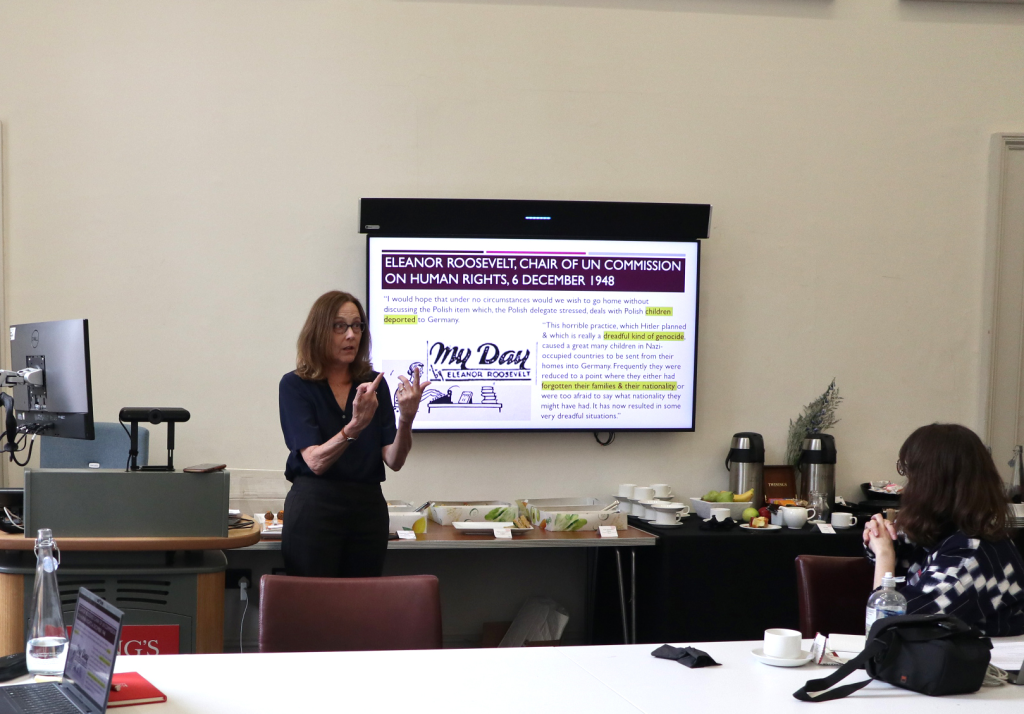
Last week, she gave a public lecture on “Child-Taking in International Criminal Law” at King’s College London Department of War Studies.

Both talks drew from Amann’s forthcoming article, “Child-Taking,” to be published in the Michigan Journal of International Law.

As Amann theorizes it, child-taking occurs when a state or similarly powerful entity abducts children from their community and then endeavors to remake the children in its own image. This conduct lies at the heart of the International Criminal Court warrants pending against President Vladimir Putin and another top Russian official. The article also examines other examples of the phenomenon, including the Nazis’ kidnappings of non-German children during World War II and the forced placement of Indigenous children into boarding schools in North America, Australia, and elsewhere.

UGA Law professor Diane Marie Amann and UCL Professor Martins Paparinskis

UGA Law Professor Amann presents “Child-Taking and the International Criminal Arrest Warrant” at University College London Faculty of Laws

University of Georgia School of Law Professor Diane Marie Amann, an expert on child and human rights, international criminal law, and the laws of war, presented a lecture entitled “Child-Taking and the International Criminal Arrest Warrant” at University College London Faculty of Laws in June.

News that the International Criminal Court is seeking the arrest of Russia’s President, Vladimir Putin, and Child Rights Commissioner, Maria Lvova-Belova, drew attention to the war crimes charged: “unlawful deportation of population (children)” and “unlawful transfer of population (children) from occupied areas.” Professor Amann’s lecture examined these and similar crimes, which she labels “child-taking.” International child-taking trials date to the Nuremberg tribunals, and have continued in modern forums like the ICC. Court records demonstrate that child-taking is no minor crime. Its present gravity and future consequences are heavy; so too, the prosecutorial burdens of securing indictments, conviction, and redress.

This presentation was chaired by UCL Professor of Public International Law, Martins Paparinskis.

Amann is the Regents’ Professor of International Law, the Emily & Ernest Woodruff Chair in International Law, and a Faculty Co-Director of the Dean Rusk International Law Center.