Daniel “Tripp” Vaughn (J.D. ’25) reflects on semester-long Global Externship Overseas in Belgium

Today, we welcome a guest post by Daniel “Tripp” Vaughn, a member of the University of Georgia School of Law class of 2025. Vaughn participated in a semester-long international externship in spring 2025. The semester-long externships overseas initiative is an extension of the Center’s existing Global Externships Overseas and is offered jointly between the Center and the law school’s Clinical and Experiential Program. Vaughn’s post describes his experience as a legal extern with Van Bael & Bellis, a law firm working on EU and national competition law, EU trade and customs law, regulatory law, as well as Belgian business law. Vaughn was based in Brussels, Belgium, where he worked under Georgia Law alumnus Porter Elliott (J.D. ’96). This was Vaughn’s third Global Externship Overseas during his time at Georgia Law. He is now living in Leuven, Belgium, where he is pursuing a Master of Laws (LL.M.) degree at KU Leuven.
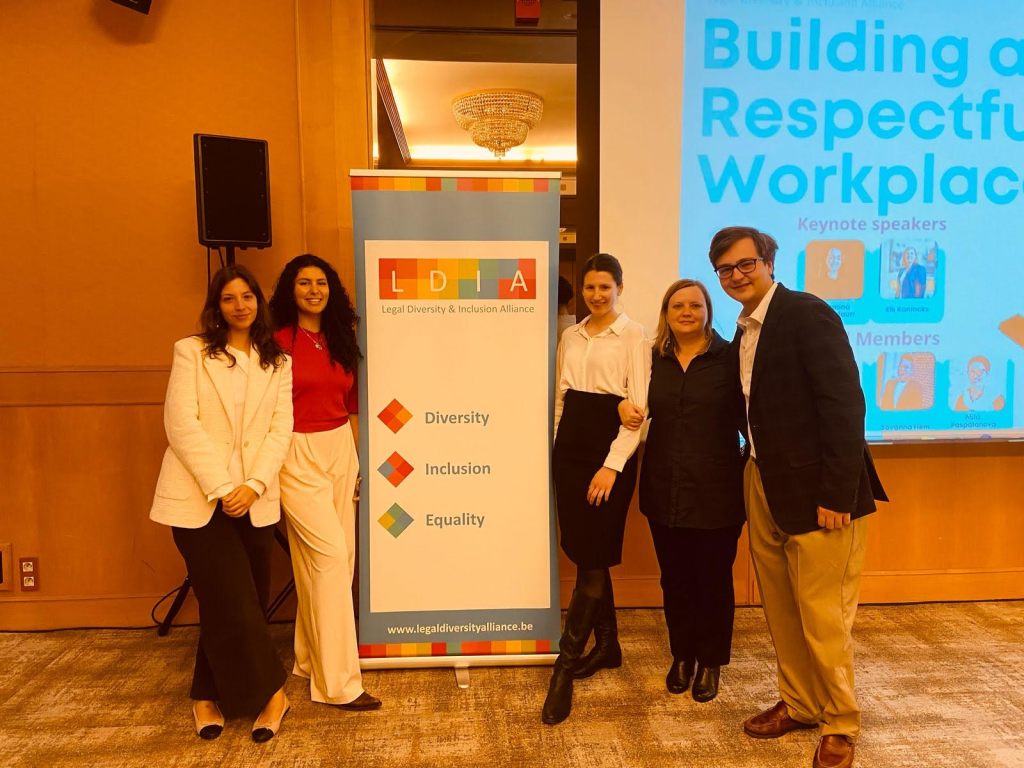
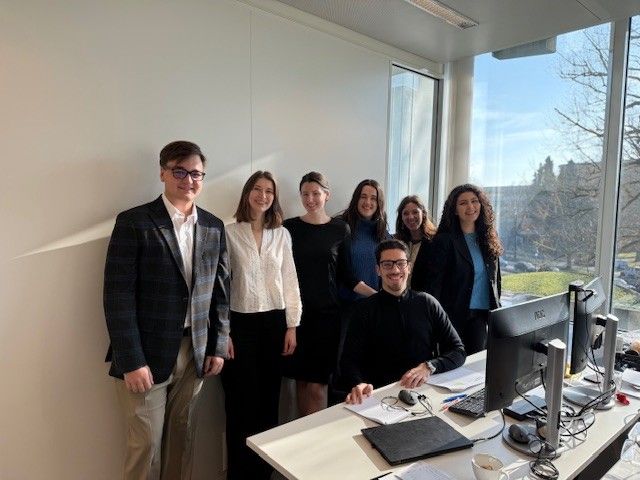
Last spring, I spent my final semester of law school working as a legal extern at Van Bael & Bellis (VBB), a Belgian law firm consisting of three offices in London, Brussels, and Geneva. VBB specializes in European and international legal work across three main categories: trade, antitrust, and corporate regulatory compliance. The firm’s composition truly represents its international focus, employing attorneys from more than 20 different countries. Just my office alone was shared with interns from Belgium, France, Ireland, Italy, Germany, and Spain. 

This international diversity, strongly reminiscent of the city of Brussels itself, created a uniquely open-minded and welcoming atmosphere at the firm. Every day, whether through work projects or casual conversations, I learned more about countries and legal systems all across the world. The sheer breadth of nationalities, experiences, and perspectives held by VBB’s attorneys ensured that everyone in the office was still expanding their understanding of business and law. In this context, it was clear throughout the firm that questions were not only expected but also encouraged. As an extern, this atmosphere afforded me an incredible opportunity to add to my knowledge and experience before graduating law school. 

This open mentality compounded the impact from my involvement in VBB’s extremely varied legal work, spanning from sanctions compliance and antidumping investigations to client alerts on upcoming legislation and updating internal materials on EU antitrust laws. I gained firsthand experience working on US-EU and EU-China trade disputes, including assessing tariffs and determining the correct classifications for products. When the EU proposed new legislation, I researched its impacts and together with expert attorneys wrote alerts for specifically affected clients as well as general takeaways. As part of my externship I also assisted many other tasks as well, including me in projects in over 20 different countries with different legal systems and approaches to corporate law.

However, of these many fascinating projects I had the opportunity to work on during my externship, sanctions compliance proved to be the most impactful and enduring. This work included researching involved parties of proposed transactions to ensure that the actions contemplated would pose minimal compliance risks from a sanctions perspective. While simple in concept, sanctioned parties would often go to great lengths to disguise their presence in transactions through strings of shell companies across the globe and the suppression of any information related to their ownership. Further complications often arose from the differences between UK, US, and EU sanction regimes, including the scope of sanctions, the jurisdiction of corresponding regulatory agencies, and the applicable penalties for noncompliance.

Despite these challenges, I began to increasingly enjoy the research and analysis required. Tracking down the ownership and control of various companies, which is often not openly disclosed information, consisted of sifting through media articles, social media posts, NGO reports, and other publicly accessible data such as ship transponders and locations. This process often felt like solving a particularly difficult puzzle, piecing together various clues to get a clearer picture of the involved parties and sanctions risks. Due to the lack of available information, many times the ownership or control of involved parties could not be definitively determined. However, it was incredibly satisfying when hours or days of research and seemingly unrelated shreds of information finally came together and yielded important conclusions.

I am extremely grateful for the experiences and opportunities given to me by Van Bael & Bellis. My time with the many talented attorneys at the firm opened my eyes to fields and career opportunities in international law that I never would have believed existed. As I am currently returning to Belgium for my Master of Laws (LL.M.) degree at KU Leuven, I am confident that my time with VBB will prove invaluable to me.
***

Applications are open for spring 2026 semester-long Global Externships Overseas (GEOs). All current 2Ls and 3Ls are invited to submit an application by September 15. For more information and the application, please email: ruskintlaw@uga.edu
Georgia Law 2L Erin Nalley shares her Global Externship experience in New Zealand

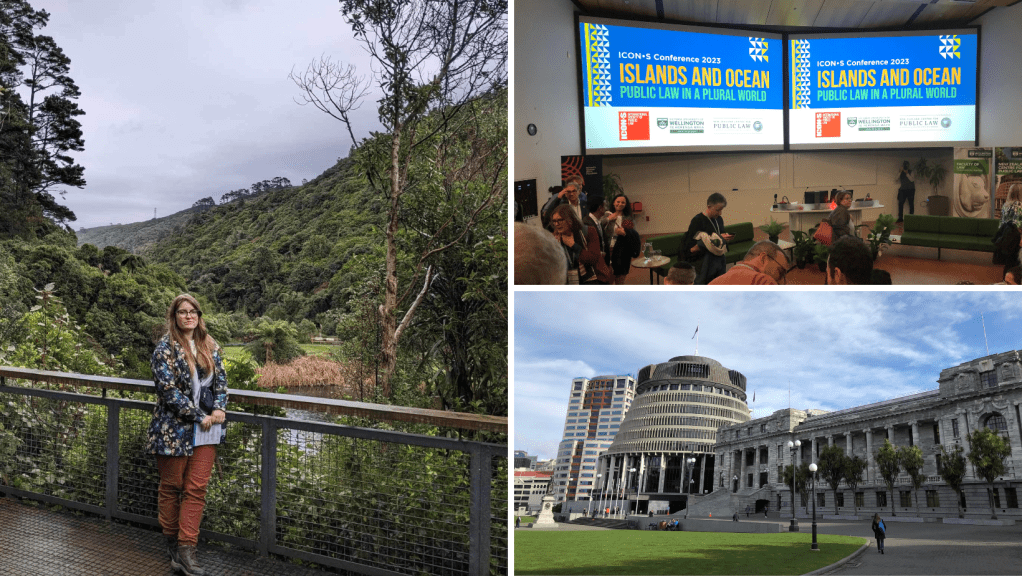
Today, we welcome a guest post by Erin Nalley, a member of the University of Georgia School of Law class of 2025. Through the Global Externships Overseas (GEO) initiative, Erin was able to extern with the Department of Conservation in Wellington, New Zealand in summer 2023.

When I first landed in New Zealand last summer, I was both exhausted and excited for what the next few months would bring me. I had just finished the University of Georgia School of Law’s Global Governance Summer School, and I was worn out from the travel from Amsterdam to Atlanta to Auckland to my final destination of Wellington, New Zealand. Wellington is where I would spend the rest of my summer as a legal extern with the Department of Conservation through the Global Externships Overseas initiative.

My work in New Zealand involved picking apart the World Heritage Convention text. Specifically, I evaluated what language made the text binding and what policy documents and case law were made binding by the text itself. I also worked with case studies involving New Zealand land that was in conservation under the World Heritage Convention. I worked alongside lawyers within my department, lawyers who worked in foreign affairs, and even those who worked directly with the New Zealand Parliament. I designed my research to act as a guide for the international team at the Department of Conservation to assist in keeping New Zealand in compliance with the World Heritage Convention. As part of my externship, I was able to visit the New Zealand Parliament and observe members debating new legislation. I was also given the opportunity to attend the ICON-S Public International Law conference held in Wellington.

Along with my work experience, I had the opportunity to engage in the culture of my host community. I was in New Zealand during Matariki, the Māori New Year. Here, I saw a haka, a ceremonial performance within the Māori culture that is often performed at important events. I visited the Te Papa Tongarewa Museum and learned about the history and culture of the people of New Zealand. I tried yellow kiwi fruit, manuka honey, Wellington chocolate, and New Zealand pies. I also visited Zealandia, where part of the forest is fenced in to keep predators out and to provide the native birds within the sanctuary a place to thrive and recover their populations. Finally, one of my favorite parts of the trip was a drive to Hobbiton, where they filmed The Shire scenes in Lord of the Rings films. It was surreal being able to step inside a hobbit hole and have a drink at the Green Dragon Inn.

My Global Externships Overseas experience was everything I had hoped for and even more than I expected. I walked away from my 1L summer with significant international legal experience, new cultural understandings and appreciation, and even a tattoo of a New Zealand silver fern, an important indigenous plant that serves as a symbol of the country’s national identity.

***

Applications are now open for summer 2024 Global Externships Overseas (GEO). This initiative places University of Georgia School of Law students in four-to-twelve week international placements each summer, where they gain substantive, hands-on experience in diverse areas of legal practice. Over the last fifteen years, more than 200 Georgia Law students have completed a GEO in law firms, government agencies, corporate legal departments, intergovernmental organizations, and nongovernmental organizations around the world. Current 1Ls and 2Ls are encouraged to apply for summer GEOs. All applicants should reference this instructional video for step-by-step information regarding how to create and successfully complete an application for GEOs in UGA’s Study Away Portal by the March 10th deadline. For more information, email: ruskintlaw@uga.edu

Georgia Law 3L Andrew Arrington reflects on significance of his Global Externship in Estonia

Today, we welcome a guest post by Andrew Arrington, a member of the Georgia Law class of 2024. Through the Global Externships Overseas (GEO) initiative, Andrew was able to extern with Sorainen, an international business law firm based in Tallinn, Estonia.

I vividly remember my first day at Sorainen, tidying my hair anxiously in the reflection of the gold elevator. It was not only the first day of my 1L summer job, but it was my first time working abroad, and I did not know what to expect. I was relieved that my apartment was only a five-minute walk from my office, but I still got there so early that I ordered breakfast and coffee in a quiet, ultramodern café next door.

As the elevator counted down to the lobby floor, I mumbled the phrase, “Tere. Mina olen Andrew,” to myself over and over, unsure if my pronunciation was even intelligible. With a ding, I was warmly greeted by the woman at the front desk. I watched my soon-to-be coworkers passing by my conference room, putting up their coats and bags in the cloakroom next door, while I waited for my boss to arrive. My anxiety finally melted when Katriina, who interviewed me months earlier, saw me sitting in the office and burst in to give me a hug. It was then I knew I was in for a special summer.

The Global Externship Overseas initiative was a moonshot for me. What I originally imagined as a substitute for not studying abroad in undergrad turned out to be the best career decision I made during law school because of the depth of legal work and client interaction I had over the span of two short months. Through the tireless work of staff at the Dean Rusk International Law Center, including Sarah Quinn and Catrina Martin, my description of a hypothetical dream placement working on data privacy in Europe, possibly in Estonia, became a reality. This request was the result of being a first-generation law student who had just graduated from Georgia Tech; at this point, I was really only familiar with the field of data privacy law after taking a class with Professor Swire and Dr. Anton at my undergraduate institution. I had my sights set on Estonia because I was familiar with the country’s leadership in technology innovation and entrepreneurship in Europe. 

I was proudly the first American intern in a couple of decades at Sorainen. During my summer there, I gained contracting skills, including with software as a service (SaaS) contracts, data protection agreements, and other standard GDPR privacy agreements. I was also able to research national security implications, genetic material requirements, and the brand new EU sanctions on Russia. I wrote memos on the effects of the then-nascent Digital Services Act and Digital Markets Act. When my time in the office came to a close, I was asked if I would like to work for a client full-time as the designated trainee to a general counsel for Pactum while I worked remotely from my home in the US. This was another great experience of implementing GDPR requirements through vetting vendors and researching the impact of US state privacy laws on a dual US-EU business.

By the end of my summer at Sorainen, I had colleagues who not only translated meetings in English for me, but also translated our nights out at the local museum. These are colleagues I am still in touch with and exchange Christmas cards with two years later.

Because of my decision to pursue a GEO, I fell in love with a place I would have never visited otherwise. I became a local at the bakery around the corner ordering rhubarb pastries in Estonian. I knew I reached local status when a new clerk working asked me a question about change in Estonian. I ate pine needle ice cream on walks by myself after work along cobblestone streets, and I was driven out of the city to Viru Bog by my fellow summer interns to visit one of the most beautiful natural parks I have ever been to. I had coworkers go out of their way to give me visits of their hometown during the weekends, and I also had an unforgettable office outing playing cards on the rooftop under the midnight sun. 

I cannot recommend enough to my fellow students the professional value of not only being able to work in a legal environment abroad but also the memories that Georgia Law and the Center made possible through the GEO program. This opportunity increased my contract drafting and editing abilities tremendously, provided opportunities to interact directly with clients, and exposed me to data privacy and compliance work. Now every time I interview, it is the topic that people most want to talk about, and I not only have a wealth of legal experiences to draw upon but also a reminder of the summer of a lifetime.

***

Applications are now open for summer 2024 Global Externships Overseas (GEO). This initiative places University of Georgia School of Law students in four-to-twelve week international placements each summer, where they gain substantive, hands-on experience in diverse areas of legal practice. Over the last fifteen years, more than 200 Georgia Law students have completed a GEO in law firms, government agencies, corporate legal departments, intergovernmental organizations, and nongovernmental organizations around the world.

Current 1Ls and 2Ls are encouraged to apply for summer GEOs. All applicants should reference this instructional video for step-by-step information regarding how to create and successfully complete an application for GEOs in UGA’s Study Away Portal by the March 1 deadline. For more information, email: ruskintlaw@uga.edu

From classmates to colleagues: LL.M. alumna Rawdha Hidri (LL.M. ’23) and 2L Carolina Mares reflect on summer work experience together

Through the Global Externships Overseas (GEO) initiative administered by the Dean Rusk International Law Center, 2L Carolina Mares spent her summer working in international arbitration at the Houerbi Law Firm in Tunis, Tunisia. In this placement, Ms. Mares worked under the supervision of Rawdha Hidri, a Fulbright recipient who completed her Master of Laws (LL.M.) at UGA Law in May 2023.

While it is not uncommon for our J.D. students to work under our LL.M. alumni/ae in GEO placements, this is the first experience in recent memory when they had the opportunity to meet on-campus and learn together as classmates prior to their experience abroad. Below, Mares and Hidri describe their experiences participating in the GEO from the perspectives of student and supervisor, respectively. Responses have been edited for length and clarity.   

* * * *

Carolina Mares, 2L

What initially interested you about the Global Externships Overseas (GEO) initiative?

With the desire to practice international law in my career moving forward, I knew that the GEO initiative was an incredible opportunity designed to encourage me to explore one potential avenue for my future. I was torn between pursuing summer work in public international law or looking for a firm that would give me some experience in international arbitration. However, when I heard about the possibility of focusing exclusively on international arbitration at Houerbi Law Firm, my mind was set.

What was your GEO experience like?

This summer, I worked at Houerbi Law Firm in Tunis, the capital of Tunisia. The firm specializes in commercial international arbitration and operates between Tunis and Paris with a focus on disputes in Europe, the Middle East, and Africa. My work consisted of reading case dockets, synthesizing parties’ positions, analyzing factual and legal exhibits, drafting an answer to a request for document production, and writing appropriate parts of an award. What I enjoyed most was the novelty of each case I got to work on. The parties in the disputes ranged from state to private parties in the UAE, Italy, Jordan, Iran, Malaysia, Tunisia, Turkey, and Morocco. I also had the chance to learn about all sorts of industries, including oil and gas, gold and fine jewelry manufacturing, and government procurement.

In addition to Rawdha, Mr. Houerbi was a phenomenal mentor to me during my time in Tunisia. With sixteen years of experience as the Arbitration and ADR Director of the ICC for the Mediterranean, the Middle East, and Africa, his positive and direct feedback played an important role in shaping my work and experience at the firm. He often invited me to sit in on team meetings that did not pertain to my particular cases so that I could gain exposure to as many disputes as possible, and he encouraged me to observe all of the virtual hearings that took place this summer.

How do you envision your GEO contributing to your academic and professional goals?

Taking part in the GEO has already impacted my professional trajectory. First, I now know that I enjoy the work involved in international arbitration, and I can picture myself pursuing a career in this practice area. Second, I’m convinced that my participation in a GEO is the reason I landed a 2L summer job fairly quickly, as it was the hot topic in all of my interviews. But more importantly, the GEO gave me a chance to take a deep dive into a niche area of law that is difficult to get into as a novice, especially in the Atlanta area. In addition to delving into international arbitration, the GEO program allowed me to develop my confidence navigating across cultures all while improving my French skills in a captivating work environment.

What was the best part of participating in a GEO?

The highlight of my GEO experience was making deep connections with my colleagues and experiencing day-to-day life in an incredibly rich culture that was brand new to me. Besides taking on the role of mentor, Rawdha was also my cultural guide. She introduced me to the coastal neighborhoods of Tunis, invited me to join her family and friends on the weekend for a shopping expedition in the Medina, pointed out the flocks of flamingos flying by in V-formation as we lounged on the beach, and took me sightseeing in Hammamet where we attended an amateur Opera concert at the Dar Sebastian villa overlooking the Mediterranean. In short, the best part of doing a GEO was getting a feel for the flow of life in Tunis and growing in my cultural competency, all of which I owe in big part to Rawdha’s support as my mentor and host.

* * * *

Rawdha Hidri (LL.M., ’23)

What interested you in serving as a placement supervisor for a GEO?

My time at UGA Law was so formative, I was eager to reciprocate and provide inquisitive American J.D. students with an experience as enriching as the one that I had in Athens. I strongly believe that immersing oneself in new experiences and can be influential on both personal and professional levels. Throughout my journey at UGA Law, I embraced the role of an informal cultural ambassador for my country Tunisia. The GEO initiative emerged as an ideal opportunity for both providing American J.D. students with professional experiences in a distinct legal framework and within a specific geopolitical context and with rich cultural immersion in my home country.

How did hosting a UGA Law student contribute to your firm’s work?

Carolina’s ability to methodically structure and articulate her thoughts has been a valuable addition to our team dynamics. Her innate attention to detail was evident from the outset, as she engaged diligently with the tasks assigned to her. Encouraging her to delve further and uncover nuances within cases became a rewarding challenge, showcasing her dedication to thorough exploration.

How did you approach integrating a UGA Law student into the local community and culture?

In the spirit of fostering a sense of belonging, I took it upon myself to introduce Carolina to the richness of Tunisian culture, ensuring she tried traditional Tunisian cuisine and experienced the crystal-clear waters of the Mediterranean. The entire team enthusiastically engaged in this process, sharing suggestions of places to visit, offering language lessons, and collectively enjoying lunches together outside the office on a weekly basis. This collaborative approach not only enhanced Carolina’s integration but also fostered a supportive and inclusive environment, benefitting both her and the entire team.

What did you enjoy about serving as a supervisor for a GEO?

Serving as a supervisor for a GEO was incredibly rewarding on a personal level. It expanded upon my own Fulbright journey that I started at UGA Law, allowing me to share my perspective and insights with someone eager to learn. The most fulfilling aspect was knowing that the student I hosted would carry their experiences in Tunisia with them, and that perspective would continue to guide them in their professional pursuits. This connection ensures a lasting impact, creating a sense of continuity and mutual understanding that extended beyond the program itself.

* * * *

Global Externships Overseas (GEOs) are four-to-twelve week summer placements in diverse areas of legal practice around the world. Students return to Athens with new colleagues and mentors, legal practice skills, and a deeper appreciation of the global legal profession. Over the last fifteen years, more than 200 UGA Law students have completed a GEO. Students secure placements tailored to their career goals with the aid of the Dean Rusk International Law Center.

For more information about GEOs, visit our website.

Bon voyage to students taking part in Georgia Law global summer initiatives

In the weeks ahead, more than two dozen students will travel to participate in two global practice preparation offerings administered by the University of Georgia School of Law Dean Rusk International Law Center. These are the:

GGSS

This year’s Global Governance Summer School will focus on economic and human rights. It’s set to begin at the end this month, when students will travel to Belgium for a week of lectures led by Georgia Law Professor Zohra Ahmed as well as Leuven professors. The first week of this for-credit course also will include professional development briefings at the European Parliament, the North Atlantic Treaty Organization, and a private law firm.

Then programming shifts to The Hague, Netherlands, where Professor Melissa J. “MJ” Durkee, the Center’s Director, Associate Dean for International Programs, and Allen Post Professor at Georgia Law, will lead briefings at the International Criminal Court, the International Court of Justice, the International Residual Mechanism for Criminal Tribunals, and Leiden University. Casey Graham, Sarah Quinn, and Catrina Martin will provide logistical assistance during the program. (Above, many in the group gather for a predeparture photo.)

Seventeen Georgia Law students will take part: Andrew Arrington, Hao Chen “Bobby” Dong, and Marly “Jansen” Killian, Allison Reid, all rising 3Ls; Mona Abboud, Madison Graham, Megan Jones, Anna “Carolina” Mares, Erin Nalley, Caden Pruitt, Hannah Silvers, Tiffany Torchia, Daniel “Tripp” Vaughn, all rising 2Ls; and Alma Bajramovic, Thomas Kingsley, Angela Mossgrove, Jasmine Underwood, all pursuing Graduate Certificates in International Law.

GEO

Our Center’s Global Externship Overseas initiative places Georgia Law students in externships lasting between four and twelve weeks. It thus offers students the opportunity to gain practical work experience in a variety of legal settings worldwide. Some students opt to combine the GEO opportunity with participation in GGSS.

This summer, fifteen Georgia Law students are set to pursue Global Externships Overseas, in practice areas such as privacy and technology law, international environmental law, intellectual property law, European Union competition and trade law, international arbitration, corporate law, and human rights law.

Private-sector placements among rising 3Ls include: Caroline Bailey, GreenCo S.A., Buenos Aires, Argentina; Hao Chen “Bobby” Dong, Baker Tilly, Hamburg and Frankfurt, Germany; Matthew Philips, PSA Legal, New Delhi, India; Benjamin Siegel, Soreinen, Tallinn, Estonia. Among rising 2Ls, private-sector placements include: Mona Abboud, Alston & Bird, Brussels, Belgium; Madison Graham, Van Bael & Bellis, Brussels, Belgium; Sierra Hamilton, Weickmann & Weickmann, Munich, Germany; Anna “Carolina” Mares, Houerbi Law Firm, Tunis, Tunisia; Matthew McKaig, GÖRG, Berlin, Germany; Caden Pruitt, Bodenheimer, Cologne, Germany; Daniel “Tripp” Vaughn, Deloitte, Baku, Azerbaijan.

Public-sector placements include: rising 3L Allison Reid, Eliberare, Brasov, Romania; and rising 2Ls Jasmine Furin, Office of the Privacy Commissioner, Hamilton, Bermuda; Bryonna Howard, No Peace Without Justice, Brussels, Belgium; and Erin Nalley, New Zealand Department of Conservation, Wellington, New Zealand.

More information on both of these Georgia Law initiatives here.

Scholarly achievements, vibrant initiatives highlighted in newsletter of Dean Rusk International Law Center, University of Georgia School of Law

For a recap of the year’s research and global practice accomplishments, have a look at the newly published newsletter of the Dean Rusk International Law Center at the University of Georgia School of Law. Features include:

Scholarly achievements of our Center Director, Melissa J. Durkee, and our many other globally minded faculty, including Diane Marie Amann and Harlan G. Cohen, our Center’s Faculty Co-Directors, as well as Zohra Ahmed, Christopher Bruner, Jason Cade, Nathan Chapman, Walter Hellerstein, Thomas Kadri, Jonathan Peters, Peter B. “Bo” Rutledge, Tim Samples, and Laura Phillips-Sawyer.

► The exceptional performance of the Georgia Law students who competed in the 2022 Philip C. Jessup International Law Moot Court Competition, placing second in the United States, competing through octofinals internationally, and tying for best overall oralist through the International Advanced Rounds.

► Our International Law Colloquium in Spring 2022, a course featuring works-in-progress conversations with international law scholars based in Latin America and Europe as well as the United States.

► Recent events, including our day-long conference on “The Law of Global Economic Statecraft” cosponsored with the Georgia Journal of International & Comparative Law and other University of Georgia entities, our Consular Series of talks with diplomats, presentations by distinguished lawyers on issues including the Ukraine-Russia war, and participation in panels at meetings of the American Branch of the International Law Association, the American Society of International Law, and other global entities.

► Initiatives aimed at preparing our J.D. and LL.M. students for global legal practice, including our NATO Externship, our Global Externships, and the Global Governance Summer School we host in partnership with the Leuven Centre for Global Governance at Belgium’s University of Leuven (plus additional partnerships with O.P. Jindal University in India and Bar Ilan University in Israel).

The full newsletter is here.

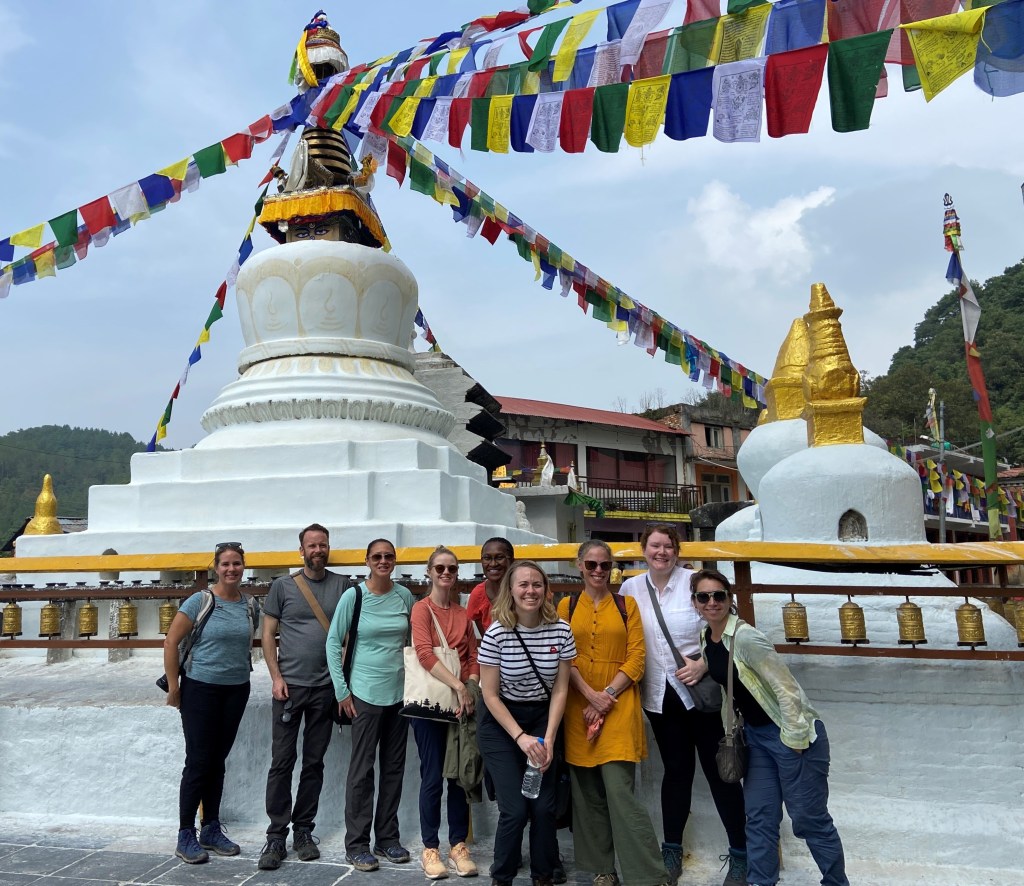
Journeying from Georgia Law to Nepal, Center staff member Catrina Martin participates in study abroad seminar

Catrina Martin, 2d from right, and other seminar participants at Nepal’s Namo Buddha stupa, a Buddhist pilgrimage site located in the Kavrepalanchok District, 40km southeast from Kathmandu.

Catrina Martin, Global Practice Preparation Assistant here at the Dean Rusk International Law Center, University of Georgia School of Law, took part earlier this month in an educational seminar in Nepal.

The seminar was sponsored by SIT Study Abroad, a unit of the Vermont-based School for International Training. It brought together 10 study abroad professionals and faculty members from an array of U.S. colleges and universities.

“We received the warmest of welcomes in Nepal, and every aspect of the seminar was enriching. I learned so much from everyone we interacted with, including my fellow attendees,” said Martin, who assists with administration of the Global Externships Overseas, among other Dean Rusk International Law Center initiatives.

Led by Suman Pant, SIT Academic Director, the attendees were immersed in the Nepali language and culture. They made numerous site visits, including to NGOs. Lectures, meanwhile, covered a variety of pedagogical and cultural topics. A highlight was a discussion with activist Deepti Gurung on statelessness and human rights in Nepal.

Martin summed up her experience:

“An integral part of the programs that Director Pant runs is the intentional removal of students from their comfort zones, and she extended that to us, as well. We didn’t only discuss experiential learning pedagogy, we went through it ourselves. I am so excited to return home and put into practice the lessons we’ve learned.”

Georgia Law students bound for summer Global Externships with law firms, corporations, NGOs across the globe

Eleven Georgia Law students will earn global practice experience this summer through the Global Externship Overseas initiative of the Dean Rusk International Law Center here at the University of Georgia School of Law.

Through the GEO initiative, students enhance their legal studies by working for law firms, in-house legal departments, and nongovernmental organizations. This summer’s placements are based in Asia, Europe, and the Americas. Practice areas include dispute resolution, data privacy, corporate law, refugee law, cultural heritage law, international human rights law, and international criminal law.

This year’s GEO class includes these placements in private-sector legal settings:

These students will work for nongovernmental organizations:

More information here about GEOs and other Dean Rusk International Law Center initiatives. (image credit)

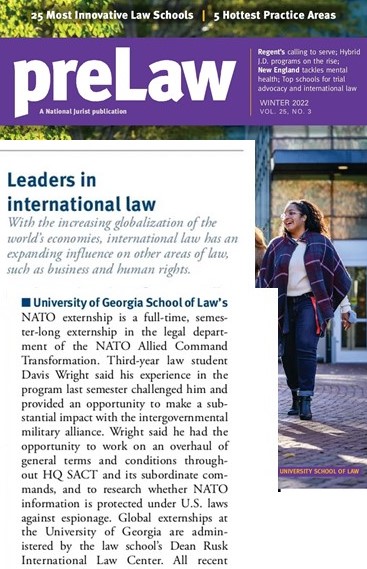
Georgia Law at top in international law, Center-administered NATO externship featured in national preLaw magazine

The just-released issue of preLaw magazine places the University of Georgia School of Law among the United States’ top international law curriculums; in so doing, it features an initiative of our Dean Rusk International Law Center.

In an article entitled “25 Most Innovative Law Schools,” author Michelle Weyenberg reports (page 42) on a valued partnership which Georgia Law entered several years ago with the North Atlantic Treaty Organization. Georgia Law’s “NATO externship,” she writes, “is a full-time, semester-long externship in the legal department of the NATO Allied Command Transformation.” She then describes experiences by our most recent extern, 3L Davis Wright, who worked in-person in Norfolk, Virginia, throughout the Fall 2021 semester (prior post):

“Third-year law student Davis Wright said his experience in the program last semester challenged him and provided an opportunity to make a substantial impact with the intergovernmental military alliance. Wright said he had the opportunity to work on an overhaul of general term and conditions throughout HQ SACT and in its subordinate commands, and to research whether NATO information is protected under U.S. laws against espionage.”

The NATO externship is one of many with international components in Georgia Law’s D.C. Semester in Practice initiative, directed by Georgia Law Professor Jessica Heywood, and also one of our Center’s many Global Externships Overseas and At-Home (GEO/GEA), administered by Sarah Quinn, our Center’s Associate Director for Global Practice Preparation.

Georgia Law 3L Davis Wright on his externship in Virginia: “My time at NATO helped me grow as an aspiring lawyer, law student, and person.”

Pleased today to welcome this post by University of Georgia School of Law student Davis Wright, who describes his just-completed his Fall 2021 externship in Norfolk, Virginia, in the legal department of HQ SACT, a leading unit of the North Atlantic Treaty Organization. This externship is administered by our law school’s Dean Rusk International Law Center in partnership with NATO Allied Command Transformation. Davis arrived at Georgia Law with a background in international relations and politics, having competed in Model United Nations and worked for a member of the Dáil Éireann. His experiences at Georgia Law have included service as a Dean Rusk International Law Center Student Ambassador and J.D.-to-LL.M. liaison. He is due to receive his J.D. degree this May, and then to begin practice as an Associate at the Atlanta office of Jones Day.

Working in the Office of the Legal Advisor at the North Atlantic Treaty Organization (NATO) Headquarters Supreme Allied Commander Transformation (HQ SACT) in Norfolk, Virginia, was an exciting and rewarding experience. In the time I was at HQ SACT I grew substantially, in personal, academic, and professional aspects.

Personal growth

During the time I spent at HQ SACT, I was exposed to a diverse range of ideas and people. While the Chief Legal Advisor at HQ SACT is American, there is a French Legal Advisor, a Dutch Legal Advisor, and a Turkish intern. All of these interactions were valuable to me as I was exposed to cultural and legal perspectives from their home nations. 

My interactions at the office likewise gave me exposure to a diverse set of views on a variety of topics, ranging from the insignificant, such as musical preferences, to the significant, such as views on the war in Afghanistan and NATO’s involvement in it. These new friendships, and sometimes deep discussions, helped me grow as a person and challenged my views and perspective of the world.

Academic growth

As one part of my externship at HQ SACT, I participated in a once-a-week seminar course with Georgia Law Professor Diane Marie Amann, who is a Faculty Co-Director of the Dean Rusk International Law Center. We discussed a variety of topics through weekly readings on different areas of international law. Highlights included the role of the legal advisor in armed conflict, rules of engagement, and immunities of international organizations in domestic courts. Most of these subjects were new to me, and the weekly seminar helped build my knowledge and challenge my perspective on different international legal issues.

I am especially pleased that I was encouraged to lead the discussions in this seminar and to select readings for subjects that I find of interest. This encouragement to be curious and take a leading role also helped me grow academically.

Professional growth

The experience at HQ SACT was completely new for me as I had never before worked in the national security sector or for an international organization. My time in the legal office was largely split into two categories, as follows:

  • Legal assistance: During the mornings I was assigned to legal assistance work. This is essentially all the support elements that the office provides to both civilian and military personnel at HQ SACT. This work varies depending on who walks through the door, but includes a large amount of immigration work.  These experiences provided me an appreciation of the multitude of legal issues that foreign personnel face during their time in the United States. Additionally, these experiences provided me valuable client interaction that will assist my future career.
  • Legal projects: In the afternoons I worked on projects for the legal advisors. These projects varied considerably. For example, I had the opportunity to work on an overhaul to the general terms and conditions throughout HQ SACT and its subordinate commands, and to research whether NATO information is protected under U.S. laws against espionage. These projects all challenged me and provided an opportunity to make a substantial impact during my time at HQ SACT.  

In short, my time at NATO helped me grow as an aspiring lawyer, law student, and person. I am sure I will use the experiences I have gained so far at NATO in my future career.

I am extremely grateful that the Dean Rusk International Law Center and the University of Georgia School of Law allowed me to partake in this unique experience. Specifically, I would like to thank the Center’s Associate Director for Global Practice Preparation, Sarah Quinn, and Professor Amann, for their valuable guidance. I would also like to thank everyone at HQ SACT, especially Theresa Donahue, Kathy Hansen-Nord, Monte DeBoer, Butch Bracknell, Mette Hartov, Vincent Grassin, and Muge Karatas.