Georgia Law Jessup team earns awards

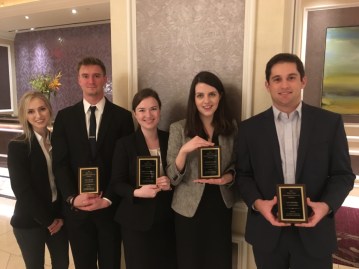
Jessup team 2019Congratulations to our 2019 Philip C. Jessup International Law Moot Court team, which advanced to the quarterfinals and brought home awards at the recent Regional Rounds in New Orleans.

The team – from left, student coach Allison Gowens, along with competitors Andrew Hedin, Lyddy O’Brien, Hanna Karimipour, and Sam Hatcher – were recognized for the 4th Best Brief. Meanwhile, O’Brien earned the Best Oralist award, and Hedin the 6th Best Oralist award.

Great effort, and thanks to faculty, alums, and friends of Georgia Law who helped prepare them for the meet.

Experts to gather March 8 for journal conference, “International Criminal Court and the Community of Nations”

This International Women’s Day, Friday, March 8, 2019, experts will gather here in Athens for a conference entitled “The International Criminal Court and the Community of Nations.”  Featured will be panels on the ICC’s relation to various constituent communities, as well as a video message from the ICC Prosecutor, Fatou Bensouda.

Principal sponsors of this University of Georgia School of Law conference are the Georgia Journal of International & Comparative Law and the Dean Rusk International Law Center, which I am honored to serve as a Faculty Co-Director. I’m pleased to serve as faculty adviser for this conference, given my ongoing role as Special Adviser to Prosecutor Bensouda on Children in & affected by Armed Conflict, and also to be joined at this conference by her Special Adviser on Crimes Against Humanity, Leila Nadya Sadat.

The conference concept note begins with a quote from the Preamble of the 1998 Rome Statute of the International Criminal Court, whose Hague headquarters of which are depicted above. In it, states parties “[r]esolved to guarantee lasting respect for and the enforcement of international justice.” The concept note continues:

“Across the globe, resurgent nationalisms place stress on institutions designed to promote human and collective security through international cooperation. Critiques – even, at times, outright denunciations – compel such institutions to re-examine, in a process that poses challenges yet also portends opportunities for renewal. The dynamic surely affects the International Criminal Court. In the last several months alone, states as varied as Burundi, the Philippines, and the United States have levied harsh criticism against this twenty-year-old justice institution, established in recognition that “children, women and men have been victims of unimaginable atrocities” that “threaten the peace, security and well-being of the world.” In the same time frame, the ICC Prosecutor welcomed a multistate referral of alleged crimes in Venezuela and launched a preliminary examination into alleged forced deportation in Myanmar, and the Court as a whole continued complementary efforts to strengthen national and regional prevention and accountability. It did so within legal, geopolitical, and budgetary constraints imposed by a trio of stakeholder communities.

“Experts from academia and the practice will cast a critical eye on ‘The International Criminal Court and the Community of Nations’; that is, on the place of the ICC vis-à-vis communities of states parties, nonparty states, and nonstate stakeholders, as well as inherited communities. Presentations will be published in the Georgia Journal of International and Comparative Law.”

Here’s the schedule:

8:45-9:00 Welcome

Dean Peter B. “Bo” Rutledge University of Georgia School of Law

9:00-10:30  Community of States Parties

Diane Desierto University of Notre Dame Keogh School of Global Affairs ǀ The Philippines and the International Criminal Court: Withdrawal from the Rome Statute and the War on Drugs

Mark Kersten Wayamo Foundation, University of Toronto Munk School of Global Affairs ǀ On the Road to Compromise? African States and the International Criminal Court

Naomi Roht-Arriaza University of California Hastings College of the Law ǀ The Role of the Court in Latin America

Leila Nadya Sadat Washington University School of Law ǀ States Parties and the Shifting Sands of the Court’s Jurisprudence

David Tolbert Duke University Sanford School of Policy ǀ A Look Back, Learning from the Experiences of the Ad Hoc Tribunals: What Lessons for the ICC?

Moderator ǀ Kathleen A. Doty University of Georgia School of Law

11:00-12:30  Community of Nonstate Stakeholders

Tess Davis Antiquities Coalition ǀ Cultural Heritage as an International Criminal Court Stakeholder

Christopher Engels Commission for International Justice & Accountability ǀ Private Investigations, Public Partnerships—Supporting International Criminal Prosecutions through Nongovernmental Organizations

Megan A. Fairlie Florida International University School of Law ǀ The International Criminal Court and the Community of Nonstate Stakeholders: Defense Issues

Valerie Oosterveld University of Western Ontario Faculty of Law ǀ Victims of Sexual and Gender-Based Violence as Stakeholders in the International Criminal Court: An Assessment

Peter Robinson Defense Counsel before International Criminal Court ǀ How the Defense Can Support the ICC

Moderator ǀ Melissa J. Durkee University of Georgia School of Law 

1:45-2:00  Video Remarks

Fatou Bensouda International Criminal Court Prosecutor

2:00-2:35  Inherited Communities

Diane Marie Amann University of Georgia School of Law ǀ What Would Maître Chalufour Say Today?

Mark A. Drumbl Washington & Lee University School of Law ǀ What Would Justice Pal Say Today?

2:45-3:45  Community of Nonparty States

Chimène Keitner University of California Hastings College of the Law ǀ International Institutions and the “Ideology of Patriotism”

Jane E. Stromseth Georgetown University Law Center ǀ The United States and the ICC: Why John Bolton’s Attack on the ICC Is Not in U.S. Interests

Saira Mohamed University of California Berkeley School of Law ǀ States Parties, Non-States Parties, and the Idea of International Community

Moderator ǀ Harlan G. Cohen University of Georgia School of Law

3:50-4:00  Closing Remarks

Morgan Renee Thomas Editor-in-Chief, Georgia Journal of International and Comparative Law

Registration, for CLE credit, and other details here. Additional cosponsors include the International Law Society, Georgia Law’s chapter of the the International Law Students Association, along with SPIA, the University of Georgia School of Public & International Affairs.
Learn about Georgia Law LL.M. degree at Atlanta info session Tuesday, Feb. 5

llm ad_Persons who have completed legal studies overseas are invited to learn about earning a University of Georgia School of Law Master of Laws (LL.M.) degree at a free information session this month at Atlantic Station in Atlanta.

The session will take place at 6:30 p.m. on Tuesday, February 5, 2019, and hosted at the offices of Arnall Golden Gregory LLP, 171 17th Street NW, Atlanta, GA 30363 (click here for directions).

The LL.M. is a one-year, full-time degree designed for lawyers who trained in countries outside the United States and wish to study at the University of Georgia School of Law, a 160-year-old institution that is consistently ranked among the country’s top law schools.

Georgia Law LL.M. candidates study alongside J.D. candidates. Each LL.M. student pursues a flexible curriculum tailored to his or her career goals, including preparation to be eligible to sit for the Georgia or other U.S. bar examination. Details about this decades-old initiative may be found at our website and in posts at this blog of the Dean Rusk International Law Center, the law school unit that administers the LL.M. degree.

Among those speaking at the information session will be our Center’s Associate Director for International Professional Education, Dr. Laura Kagel, as well as graduates of the LL.M. degree, who will talk about the student experience at the University of Georgia School of Law.

Other topics to be discussed at the information session include:

  • benefits of obtaining an LL.M.
  • putting together a strong application
  • costs and financial aid
  • career options for LL.M. graduates
  • steps toward preparing to take a U.S. bar examination

Interested persons are invited to register at no cost. Light refreshments will be served.

We look forward to seeing you and answering your questions there!

Season’s greetings

Photo Collage_drft2_fnl_crp

Wishing a festive holiday season to all friends of our Dean Rusk International Law Center, University of Georgia School of Law. We look forward to exchanges and collaborations in the coming New Year!

Accountability for harms to children during armed conflict discussed at Center-sponsored ILW panel

NEW YORK – Ways to redress offenses against children during armed conflict formed the core of the panel that our University of Georgia School of Law Dean Rusk International Law Center sponsored last Friday at International Law Weekend, an annual three-day conference presented by the American Branch of the International Law Association and the International Law Students Association. I was honored to take part.

► Opening our panel was Shaheed Fatima QC (top right), a barrister at Blackstone Chambers in London, who led a panel of researchers for the Inquiry on Protecting Children in Conflict, an initiative chaired by Gordon Brown, former United Kingdom Prime Minister and current UN Special Envoy for Global Education.

As Fatima explained, the Inquiry focused on harms that the UN Security Council has identified as “six grave violations” against children in conflict; specifically, killing and maiming; recruitment or use as soldiers; sexual violence; abduction; attacks against schools or hospitals; and denial of humanitarian access. With regard to each, the Inquiry identified legal frameworks in international criminal law, international humanitarian law, and international human rights law. It proposed a new means for redress: promulgation of a “single instrument” that would permit individual communications, for an expressed set of violations, to the Committee on the Rights of the Child, the treaty body that monitors compliance with the Convention on the Rights of the Child and its three optional protocols. These findings and recommendations have just been published as Protecting Children in Armed Conflict (Hart 2018).

► Next, Mara Redlich Revkin (2d from left), a Ph.D. Candidate in Political Science at Yale University and Lead Researcher on Iraq and Syria for the United Nations University Project on Children and Extreme Violence.

She drew from her fieldwork to provide a thick description of children’s experiences in regions controlled by the Islamic State, an armed group devoted to state-building – “rebel governance,” as Revkin termed it. Because the IS sees children as its future, she said, it makes population growth a priority, and exercises its control over schools and other “sites for the weaponization of children.” Children who manage to free themselves from the group encounter new problems on account of states’ responses, responses that Revkin has found often to be at odds with public opinion. These range from the  harsh punishment of every child once associated with IS, without considering the extent of that association, to the rejection of IS-issued birth certificates, thus rendering a child stateless.

► Then came yours truly, Diane Marie Amann (left), Emily & Ernest Woodruff Chair in International Law here at the University of Georgia School of Law and our Center’s Faculty Co-Director. I served as a member of the Inquiry’s Advisory Board.

Discussing my service as the Special Adviser to the Prosecutor of the International Criminal Court on Children in and affected by Armed Conflict, I focused on the preparation and contents of the 2016 ICC OTP Policy on Children, available here in Arabic, English, French, Spanish, and Swahili. The Policy pinpoints the crimes against and affecting children that may be punished pursuant to the Rome Statute of the International Criminal Court, and it further delineates a “child-sensitive approach” to OTP work at all stages, including investigation, charging, prosecution, and witness protection.

► Summing up the conversation was Harold Hongju Koh (2d from right), Sterling Professor of International Law at Yale Law School and former Legal Adviser to the U.S. Department of State, who served as a consultant to the Inquiry.

Together, he said, the presentations comprised “5 I’s: Inquiry, Iraq and Syria, the ICC, and” – evoking the theme of the conference – “international law and why it matters.” Koh lauded the Inquiry’s report as “agenda-setting,” and its proposal for a means to civil redress as a “panda’s thumb” response that bears serious consideration. Koh envisaged that in some future administration the United States – the only country in the world not to have ratified the Convention on the Rights of the Child – might come to ratify the proposed new  protocol, as it has the optional protocols relating to children in armed conflict and the sale of children.

The panel thus trained attention on the harms children experience amid conflict and called for redoubled efforts to secure accountability and compensation for such harms.

(Cross-posted from Diane Marie Amann)

Scholarly achievements, thriving initiatives featured in newsletter of Dean Rusk International Law Center

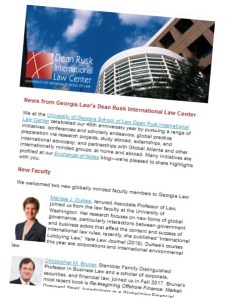
For a recap of the year’s global law-and-practice accomplishments here at the University of Georgia School of Law, have a look at the just-published annual newsletter of the Dean Rusk International Law Center. Features include:

► Welcome to new professors, Melissa J. Durkee and Christopher Bruner, as well as scholarly achievements of our many other globally minded faculty and staff, including Diane Marie Amann, Jason Cade, Nathan S. Chapman, Harlan G. Cohen, Kathleen A. Doty, Matthew I. Hall, Walter Hellerstein, Laura Tate Kagel, Jonathan Peters, Lori Ringhand, Peter B. “Bo” Rutledge, Christian Turner, and Carol Watson.

Events past and future, including day-long conferences cosponsored with the Georgia Journal of International & Comparative Law, public lectures and our Consular Series of lunch talks with Atlanta-based diplomats, and cosponsorship of panels at regional and national international law meetings.

► Initiatives aimed at preparing our J.D. and LL.M. students for global legal practice, including our Global Externships and our Global Governance Summer School, plus support for students’ organizations and international advocacy teams.

The full newsletter is here.


In international law journal, Library Director Carol A. Watson publishes article on “fake news”

Critical reading is the core topic of the article that Carol A. Watson, Director of the Alexander Campbell King Law Library here at the University of Georgia School of Law, has just published in a Cambridge University Press law journal.
Watson’s article, “Information Literacy in a Fake/False News World: An Overview of the Characteristics of Fake News and its Historical Development,” 46 International Journal of Legal Information 93 (2018), stems from her panel presentation at the 2017 Annual Course of the International Association of Law Libraries.

Here’s an extract:

“Prior to designing strategies and information literacy programs to combat the dissemination and proliferation of fake/false news, it is instructive for legal information professionals to understand the characteristics of fake news and the context of its historical development.”

The full article is available here.

International Law Society hosts gathering of globally minded students

1

International Law Society leadership, from left: Hanna Karimipour, President; Sam Hatcher, Treasurer; and Caitlin Felt, Social Chair

The International Law Society, the University of Georgia School of Law chapter of the worldwide International Law Students Association, hosted a mixer at the end of last week to welcome new globally minded students to their community.

3Co-sponsored by the Dean Rusk International Law Center, the mixer took place last Thursday in the law school’s Eversheds Sutherland Courtyard. This much-anticipated event afforded JD, LLM, and MSL students the chance to relax and learn from each other’s interests and experiences.
IMG_5291


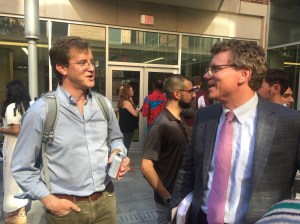
Several faculty members, including Professors Diane Marie Amann, Christopher Bruner (near right), Rob McNiff (far right), and Dan Coenen, dropped by to learn about students’ international ambitions and share their own unique advice and experiences. Staff of the Dean Rusk International Law Center was also on hand to discuss the Center’s international initiatives such as Global Externships Overseas, the Global Governance Summer School, and upcoming events.

The event kicked off with a welcome from Hanna Karimipour, International Law Society President. She gave an overview of the chapter and of opportunities afforded to its members. Kathleen A. Doty, Director of the Dean Rusk International Law Center, then provided information about upcoming events and initiatives at the Center.


A warm thank you to all who were able to attend.

LL.M. academic year kicks off at Georgia Law

LLMbrochureCLR2017It’s an exciting time for the LL.M. degree at Georgia Law: orientation for new students began today at the Dean Rusk International Law Center, as we welcomed sixteen foreign-educated lawyers from around the world to Georgia Law. They will begin classes alongside J.D. students next week.

Soon to open is the application for the LL.M. class of Fall 2019 — on September 1, 2018 — via LSAC. Generous merit scholarships will be awarded to top candidates who apply by January 15, 2019. Graduates of law schools outside the United States who are interested in studying at Georgia Law are encouraged to contact us for more information.

KagelHead

Several University of Georgia staff members have also recently returned from the EducationUSA Forum 2018 in Washington D.C., including Dr. Laura Kagel, our Center’s Associate Director for International Professional Education, Robin Catmur, Director of Immigration Services, and Chenelle Goyen, Associate Director of Admissions and International Admissions for undergraduate students. 1The Forum, hosted by EducationUSA, a U.S. Department of State network of over 425 international student advising centers in more than 175 countries, offered an array of panels focused on international recruiting trends and best practices.

Stay tuned for more information about our incoming LL.M. class; it’s shaping up to be a great year!


Belgium week of our Global Governance Summer School concludes on a (World Cup) celebratory note

LEUVEN – Final sessions of our 2018 Global Governance Summer School‘s Belgium leg came to an end yesterday, even as the country’s national team vaulted into the final four of the World Cup.

Day 5 of the summer school, devoted to Global Security Governance,  began with a lecture by Dr. Nicolas Hachez. He is a Fellow at the Leuven Centre for Global Governance Studies, University of Leuven, with which we at the Dean Rusk International Law Center, University of Georgia School of Law, partner to present the Global Governance Summer School. Hachez’ lecture began with an historical account dating to Aristotle, and ended with a survey of contemporary challenges to rule of law and democracy. (Just below, he listens to a response from Georgia Law student Brooke Carrington.) The presentation provided a valuable recap of many issues raised at the high-level RECONNECT conference our students attended earlier in the week.

Next, yours truly, Georgia Law Professor Diane Marie Amann, Emily & Ernest Woodruff Chair in International Law, one of our Center’s Faculty Co-Directors, and a founding Co-Director of the Global Governance Summer School. I introduced the concept of Global Security Governance, which incorporates within its analysis of human, national, and collective security insights from traditional international law subfields like human rights, the laws of war, and development law.

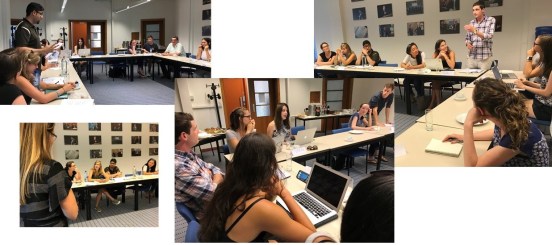
Our Center’s Director, Kathleen A. Doty, offered an overview of legal regimes related to disarmament and weapons control, including the Nuclear Non-Proliferation Treaty and the Chemical Weapons Convention. Then, as pictured at top, she led our summer school students – variously educated at Georgia Law, Leuven, and several other European institutions – in a spirited, simulated, multilateral negotiation for a new treaty to curb an imagined new development in weapons technology.

The week’s classroom component concluded with a lecture on “Global Governance, International Law and Informal Lawmaking in Times of Antiglobalism and Populism” by Leuven Professor Jan Wouters (right), Jean Monnet Chair ad personam EU and Global Governance, Full Professor of International Law and International Organizations, Director of the Leuven Centre for Global Governance Studies, and founding Co-Director of our summer school. Touching on concepts and issues introduced throughout the week, Wouters exposed shortcomings of classic international law. He further urged greater acceptance of the significance of informal lawmaking actors, norms, and processes, which form the core of global governance studies.

Leuven and Georgia Law students, faculty, staff, and friends then enjoyed a conference dinner, plus a live, and lively, screening of the Belgium Red Devils’ 2-1 World Cup victory over Brazil – then headed to Oude Markt to celebrate with other denizens of this lovely city.