Bon voyage to students taking part in Georgia Law global summer 2024 initiatives

In the weeks ahead, more than two dozen students will travel to participate in two global practice preparation offerings administered by the University of Georgia School of Law’s Dean Rusk International Law Center. These are the:

Global Governance Summer School

This year’s Global Governance Summer School will focus on comparative administrative law. It is set to begin this month, when students will travel to Belgium for a week of lectures led by Georgia Law Associate Dean for Academic Affairs & J. Alton Hosch Professor of Law Kent Barnett, as well as professors from partner university KU Leuven. The first week of this for-credit course also will include professional development briefings at the North Atlantic Treaty Organization, the American Chamber of Commerce to the European Union, private law firms, and NGOs.

Then, programming shifts to The Hague, Netherlands, where Barnett will lead briefings at the International Criminal Court, the International Court of Justice, the Permanent Court of Arbitration, the International Residual Mechanism for Criminal Tribunals, and the U.S. Embassy in The Hague. Center director Sarah Quinn and Global Practice Preparation Assistant Catrina Martin will provide logistical assistance during the program.

Thirteen Georgia Law students will take part: Ceilidh Buckley, Elizabeth “Grace” Lane, both rising 3Ls; Elizabeth Burns, Aaron Dasher, Leighlee Mahony, Antavious McCarden, Emily Munger, Benjamin Privitera, Karlie “Kara” Reed, Bailey “Hunt” Renfroe, Casey Smith, all rising 2Ls; and Emilio Suarez Romero and Michael Williams, both pursuing Graduate Certificates in International Law.

Global Externships Overseas

Our Center’s Global Externship Overseas initiative places Georgia Law students in externships lasting between four and twelve weeks. It thus offers students the opportunity to gain practical work experience in a variety of legal settings worldwide. This summer, three students have opted to combine the GEO opportunity with participation in GGSS: Emily Munger, Karlie “Kara” Reed, and Benjamin Privitera.

This summer, sixteen Georgia Law students are set to pursue Global Externships Overseas, in practice areas such as privacy and technology law, intellectual property law, cultural heritage and historic preservation, environmental law, international arbitration, corporate law, and human rights law.

This year’s GEO class includes these private-sector placements:

These students will work for public sector placements:

  • Amelia England (rising 2L) – Cambodian Ministry of Culture’s Department of Antiquities; Phnom Penh, Cambodia
  • Rogers “Carter” Haydon (rising 2L) – Office of the Privacy Commissioner; Hamilton, Bermuda
  • Eman Mistry (rising 3L) – Department of Conservation; Wellington, New Zealand
  • Emily Munger (rising 2L) – The International Institute for Justice and the Rule of Law; Valletta, Malta
  • Chelsey Perry (rising 3L) – Department of Conservation; Wellington, New Zealand
  • Abigail Rimmer (rising 2L) – No Peace Without Justice; Brussels, Belgium
  • Tiffany Torchia (rising 3L) – Office of the Privacy Commissioner; Hamilton, Bermuda

More information on both of these Georgia Law initiatives here.

Georgia Law 2L Madison Graham on her D.C. Semester externship at NATO HQ SACT: “a dream come true”

University of Georgia School of Law 2L Madison Graham recently completed an externship in Norfolk, Virginia, in the legal department of HQ SACT, a leading unit of the North Atlantic Treaty Organization. This externship forms part of Georgia Law’s D.C. Semester in Practice initiative, in partnership with NATO Allied Command Transformation. Graham arrived at Georgia Law after working as a Staff Assistant and Legislative Correspondent in the U.S. Senate. As an undergraduate at the University of Tennessee, Knoxville, Graham interned for the USDA in Washington, D.C. Her law school experiences have included service as an Editorial Board Member of the Georgia Journal of International & Comparative Law, a summer internship at Brussels-based law firm Van Bael & Bellis through the Global Externships Overseas initiative, and President of the International Law Society. Below, Graham reflects on her experiences as an extern with NATO HQ SACT this semester.

I first heard about the opportunity to intern with NATO through the University of Georgia School of Law and the Dean Rusk International Law Center nearly three years ago. At the time, I was only beginning to think about law school and where I might apply. Eventually, however, opportunities like this one are the reason I came to Georgia Law. Getting to spend the spring semester in the Office of the Legal Advisor at NATO’s Headquarters Supreme Allied Command Transformation (HQ SACT) was nothing short of a dream come true.

Fortunately, the mere fact of doing the externship is not where the dream ended. Not only was I working in the midst of an international organization, I was also physically working on a section of the biggest naval base in the world. Because of these two features, I received uniquely multifaceted exposure to both the complexities of working in an international organization, as well as the realities of working in a military environment. As a law student interested in pursuing a career in the national security realm of federal public service, this exposure could not have been more valuable.

The substance of the work was also incredibly rewarding. The Office of the Legal Advisor performs an wide variety of legal roles to support HQ SACT’s mission, and I was fortunate to experience parts of each.

First, the office provides legal assistance to the international military staff of HQ SACT. This is usually in the form of helping them obtain local driver licenses, helping their spouses obtain work permits, assisting with traffic tickets, ensuring their visas are up to date, and preparing powers of attorney for outgoing military personnel. Personally, I found this facet of my work to be an incredibly eye-opening and important reminder of how hard it is to legally transition to life in America. But even further, this work involved communicating with NATO staff from each of the 32+ NATO member countries. This was a test of my ability to communicate clearly, anticipate needs and expectations based on certain peoples’ backgrounds, and generally remind myself of how much peoples’ own cultural perceptions affect their approach to life. As an undergraduate anthropology major, I thought I was prepared for this, but could not have expected how much this work experience even further tested and honed these skills for me.

Second, the Office of the Legal Advisor supports HQ SACT through a variety of more general counsel duties. This might include anything from advising on intellectual property rights, contracting, employment law, operational law, and international law. However, the office prides itself on supporting the endeavors of other sections of HQ SACT – ensuring that their plans and processes are within legal possibility. Because of this, the work of the office is largely dependent on the needs and processes of other offices. In my case, this meant I got to help with contracting guidance for contracting officers in the procurement branch, as well as helping to draft another HQ SACT-wide directive for the permissible use of funding for staff morale and welfare activities. This was a great way to hone the knowledge and skills from previous semesters’ contracting and drafting classes, while also having to adapt to the unique requirements NATO has for such documents.

The highlight of my time, however, may have been the multiple educational and coursework opportunities I was able to participate in. These ranged from online, subject-specific courses – on topics like counterterrorism and gender perspectives in armed conflict – to a week-long Strategic Writing Course, to sitting in on meetings with representatives from the International Committee on the Red Cross. Lastly, the Office of the Legal Advisor hosted a week-long Legal Gathering, with legal advisors from several NATO commands around the world invited to talk about each other’s ongoing work and areas in need of assistance. This as a great opportunity to meet other European lawyers with their own unique backgrounds, as well as learn more about NATO’s structure and the roles of each command. Most importantly, however, my supervisors were incredibly supportive of my participation in all these learning opportunities. It is well-understood that just being in the room, taking in as much information as you can, is so valuable to a young student.

Lastly, I was lucky enough to work with incredible colleagues in HQ SACT during my externship. For example, interns from all over Europe, working in other offices at HQ SACT, welcomed me with open arms and have become close friends. I would, however, like to specifically thank my supervisors and colleagues in the Office of the Legal Advisor: Monte DeBoer, Theresa Donahue, Renata Vaisviliene, Cyrille Pison, Kathy Hansen-Nord, Mette Hartov, Agathe Tregarot, and Galateia Gialitaki. Their kindness, patience, and overall support made an already incredible experience even more special. From bi-weekly staff meetings to monthly staff lunches, to staff birthday celebrations, I felt welcomed as a full member of the team from my first day to my last.

I could not be more thankful for my time at NATO HQ SACT, and was reminded of that each time I was asked: “so how do you get to be here?” Over the course of the semester, I must have watched at least a dozen people marvel at the fact that Georgia Law has this externship opportunity available to students. Its uniqueness cannot be understated; I firmly believe it is an something every student at Georgia Law – regardless of your current interests may be – should at least take a moment to appreciate, if not consider doing themselves.

***

For more information and to apply for the NATO Externship, please visit our website.

UGA Professor Kalyani Ramnath named 2024 ACLS Fellow

Kalyani Ramnath, Assistant Professor in the Department of History at the Franklin College of Arts & Sciences and Assistant Professor (by courtesy) at the University of Georgia School of Law, is a recipient of an American Council of Learned Societies (ACLS) Fellowship for her project, “Adrift in the Indian Ocean: Abandonment, Law, and the Making of Maritime Sovereignty.”

From Ramnath’s abstract:

“‘Adrift in the Indian Ocean’ explores how and why empires and nation-states looked beyond land-based territorial conquests and claimed maritime spaces. It is a history of sovereignty and placemaking set in the Indian Ocean from the 18th century onwards, one where imperial officials and scientists confronted the differing views of space held by maritime and coastal communities. Legal fictions such as the territorial sea’ or ‘historic waters’ emerged from these encounters, showing how oceanic space patrolled for security was eventually enclosed as property. Exploring key sites looking out to the ocean from south Indian coasts, ‘Adrift’ shows how people and places once abandoned are dredged up during present-day legal disputes over maritime boundaries in the Indian Ocean.

This fellowship follows Dr. Ramnath’s publication of her first book, Boats in a Storm: Law, Migration, and Decolonization in South and Southeast Asia, 1942–1962, with Stanford University Press. To read more about this publication, please click here.

Ramnath received her Ph.D. in history from Princeton University in 2018, and was a Prize Fellow in Economics, History, and Politics at the Center for History and Economics at Harvard University from 2018 – 2021. She also holds a bachelor’s degree in arts and law (B.A., LL.B. (Hons.) (JD equivalent) from the National Law School of India University (NLSIU) and a master’s degree in law (LL.M.) from the Yale Law School.

Georgia Law Professor Cade featured in The Atlanta Journal-Constitution

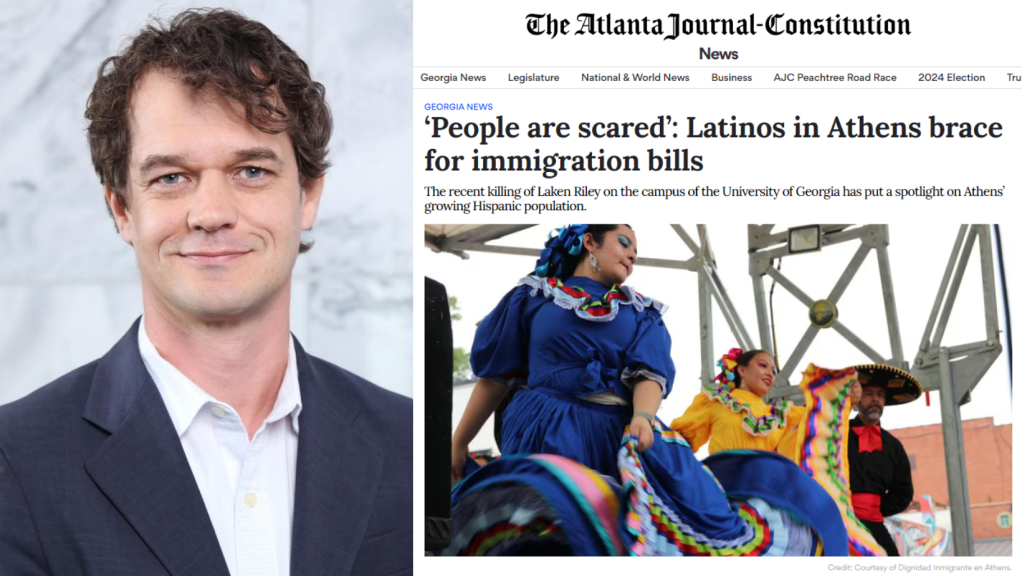
Professor Jason A. Cade was recently featured in The Atlanta Journal-Constitution regarding the University of Georgia School of Law’s Community Health Law Partnership Clinic, (“Community HeLP Clinic”). The article titled “‘People are scared’: Latinos in Athens brace for immigration bills” was written by Lautaro Grinspan and centered around the legislative consequences of the recent loss of Laken Riley on the University of Georgia campus, which put a spotlight on the growth of Athens’ Hispanic population. 

As stated in the article:

“The growth of the community has created significant demand for legal services to help with immigration cases. Those with limited means have only one pro-bono provider to turn to: a legal clinic at the University of Georgia School of Law, run by Professor Jason Cade.”

The Community HeLP Clinic focuses on interdisciplinary advocacy at the intersection of immigration status and health, including humanitarian and family-based immigration benefits, advocacy on behalf of noncitizen workers and detainees, and public education.

In reference to the Clinic within the article, Professor Cade said:

“We have the U.S. citizen children of the families that we serve very much in mind and are trying to do what we can to kind of reduce stress and stigma from their lives.”

Jason A. Cade is Associate Dean for Clinical Programs and Experiential Learning, J. Alton Hosch Professor of Law & Community Health Law Partnership Clinic Director. In addition to overseeing the law school’s 11 in-house clinics and 7 externship programs, Cade teaches immigration law courses and directs the school’s Community Health Law Partnership Clinic (Community HeLP), in which law students undertake an interdisciplinary approach to immigrants’ rights through individual client representation, litigation, and project-based advocacy before administrative agencies and federal courts.

To read the full article, please click here. To learn more about the Clinic, please click here.

International law at University of Georgia, administered by Dean Rusk International Law Center, earns #20 U.S. News ranking

Last week, the U.S. News rankings placed our international law curriculum here at the University of Georgia School of Law at No. 20 in the United States.

For over a decade, our international law initiatives have ranked in the top 20 or so among U.S. law schools. In this year’s rankings, our international law curriculum tied with Northwestern University (Pritzker) Law, University of California (Davis)  Law, and Vanderbilt University for the No. 20 spot. (The University of Georgia School of Law, as a whole, earned a No. 20 ranking this year for the second year in a row, as is posted here.)

Our international law achievement is due in no small part to the enthusiastic support and hard work of everyone affiliated with Georgia Law’s four-decades-old-old Dean Rusk International Law Center. As chronicled at this Exchange of Notes blog and our Center website, these include:

► Superb members of the law faculty, including: Dean Peter B. “Bo” Rutledge, an international arbitration expert; the Center’s Faculty Co-Directors, Professors Diane Marie Amann, an expert in peace-and-security fields including the laws of war, child rights, and international criminal justice, and Christopher M. Bruner, a comparative corporate governance scholar. Among those supporting their efforts are many other Georgia Law faculty and courtesy faculty members, including: Thomas Burch, who leads the Appellate Clinic that has won clients relief under the Convention Against Torture; Anne Burnett, foreign and international law research librarian; Jason Cade and Clare Norins, who recently led a clinical team in securing federal redress for immigration detainees; Nathan S. Chapman, a scholar of due process and extraterritoriality; Jessica L. Heywood, Director of the Washington, D.C. Semester in Practice; Thomas E. Kadri, whose expertise includes cybercrime and global data privacy; Elizabeth Weeks, a health law specialist; Jonathan Peters, a journalism and law professor expert in international media and free speech; Laura Phillips-Sawyer, an expert in antitrust law and policy; Kalyani Ramnath, a global legal historian who focuses on South Asia; Lori A. Ringhand, a scholar of comparative constitutional law and elections law; Tim Samples, whose scholarship includes global digital platforms agreements; Kent Barnett, Sonja West, and Elizabeth Chamblee Burch, who have presented overseas on administrative law, media law, and civil procedure, respectively; Adam D. Orford, an environmental and energy law scholar; Kristen E. Shepherd, who developed and teaches the Legal Spanish curriculum; Walter Hellerstein, a world-renowned tax specialist; and Michael L. Wells, a European Union scholar.

► Talented students pursuing J.D., M.S.L., and LL.M. degrees, as well as Graduate Certificates in International Law. They include: our Center’s Student Researcher and Graduate Assistant; the staffers and editors of the Georgia Journal of International and Comparative Law who produce one of the country’s oldest student journals, and who led our 2023 conference, “ESG and Corporate Sustainability: Global Perspectives on Regulatory Reform”; the advocates on the Philip C. Jessup International Law Moot Court, the LL.M.s’ International Commercial & Investment Arbitration Moot Competition, and the Willem C. Vis International Commercial Arbitration Moot; student clinicians in our Appellate Litigation Clinic who have argued asylum cases before U.S. Courts of Appeals, as well as those in our Community HeLP Clinic, Jane W. Wilson Family Justice Clinic, and First Amendment Clinic who have litigated claims for detainees and other immigration clients; participants in our summer and semester-long Global Externships as well as our full-semester NATO Externship and other D.C. Semester in Practice placements; participants in our Global Governance Summer School and our bilateral exchanges; those who were able to attend professional conferences, including the ABILA International Law Weekend and the ASIL Annual Meeting through the support of Louis B. Sohn professional development scholarships; and the student leaders of our International Law Society.

► Superb Center staff like Sarah Quinn, Laura Tate Kagel, Mandy Dixon, and Catrina Martin, who administer the LL.M. degree and the Graduate Certificate in International Law, international trainings, the Visiting Researcher initiative, bilateral exchanges, Global Governance Summer School, Global Externships Overseas, international events, and more.

► Visiting Scholars and Researchers, including, Mine Turhan, an assistant professor of administrative law in the Faculty of Law at the Izmir University of Economics in Türkiye, and Daesun Kim, an attorney practicing law in Vietnam who specializes in cross-border M&A, foreign investment, and public-private partnerships. 

► Academics, practitioners, and policymakers, from all over the world, who have contributed to our events – conferences, workshops, and lectures, such as our ongoing Consular Series and International Law Colloquium, which this year included the visit of Rachel Galloway, British consul general in Atlanta, and Georgetown Law Professor Cliff Sloan, as well as a new events series highlighting the U.S. Department of State and U.S. Department of Education’s International Education Week.

► Graduates who excel as partners in international commercial law firms, as heads of nongovernmental organizations and international organizations, as in-house counsel at leading multinational enterprises, and as diplomats and public servants – and who give back through participation in our Dean Rusk International Law Center Council, through mentoring, speaking with students (like Kannan Rajarathinam, Eduardo Conghos, Alexander White, Ellen Clarke, and Clete Johnson), and through other support.

► Our valued partnerships, with Georgia Law student organizations; with leading higher education institutions such as the Leuven Centre for Global Governance Studies at KU Leuven in Belgium, our partner in our Global Governance Summer School, as well as O.P. Jindal Global University’s Jindal Global Law School in India and Bar Ilan University’s Faculty of Law in Israel, with which we have student and faculty exchanges; with organizations like the American Branch of the International Law Association, the American Society of International Law, and the European Society of International Law, in which our faculty have held leadership roles, as well as Global Atlanta, the Atlanta International Arbitration Society; and with university units like the School of Public & International Affairs, the Terry College of Business, the Grady School of Journalism, the African Studies Institute, the Center for International Trade and Security, and the Willson Center for Humanities & Arts.

With thanks to all, we look forward to continuing to strengthen our initiatives in international, comparative, transnational, and foreign relations law – not least, in the preparation of Georgia Law students to practice in our globalized legal profession.

Georgia Law LL.M. Students Take Professional Development Trip

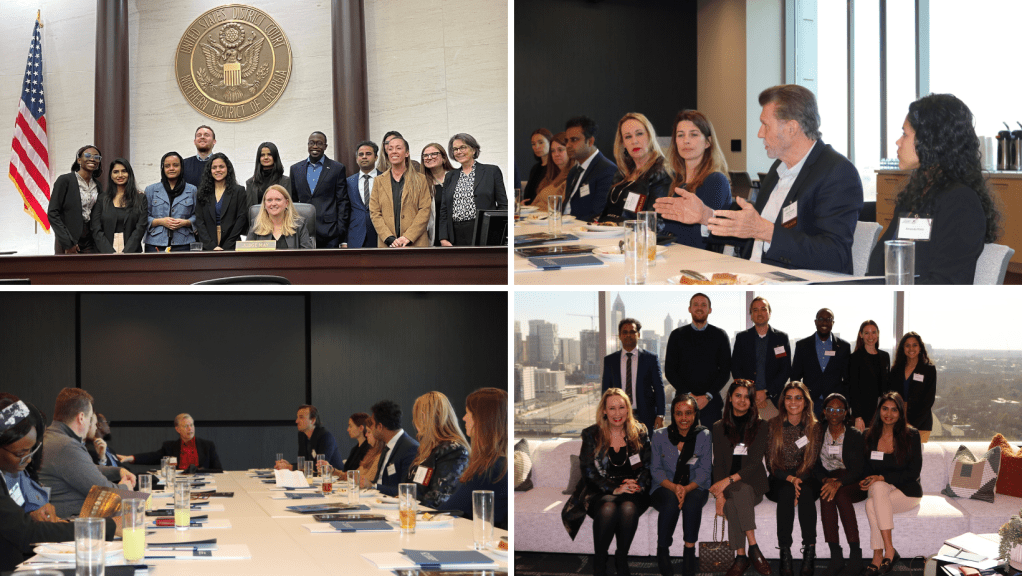
Earlier this month, the University of Georgia School of Law Master of Laws (LL.M.) class of 2025 traveled to Atlanta for a professional development trip organized by the Dean Rusk International Law Center’s director of international professional education, Dr. Laura Tate Kagel, and Mandy Dixon, international professional education manager.

The students began their day by visiting the U.S. District Court for the Northern District of Georgia, where they observed a sentencing hearing. They were hosted by the Honorable Leigh Martin May (J.D., ’98), who answered questions about the hearing, the federal judiciary, and her career path. 

The group of foreign lawyers then visited the law offices of Arnall Golden Gregory, LLP, where over lunch they heard about a variety of practice areas. Teri Simmons (J.D., ’89), a partner and chair of the firm’s International Immigration & Global Mobility practice and an adjunct professor of law at UGA, and her team members Matt Ohm (LL.M., ’14) and Dorothea Hockel, discussed the role of lawyers in helping foreign businesses bring their operations to the U.S. Glenn Hendrix a partner in AGG’s Healthcare Group, familiarized the visiting foreign lawyers with international arbitration practice and related the origins of Atlanta’s arbitration center, AtlAS. Jeffery Y. Lewis (J.D., ’82), discussed his work as a partner in AGG’s Litigation Practice and contrasted it with international arbitration. And Michael Burke, a partner in the Corporate and Finance Practice, shared his thoughts about issues facing lawyers in the international corporate arena.

Professional development trips are among many opportunities offered to Georgia Law LL.M. students to foster career connections and gain insight into potential career paths. 

To read about one of our past professional development trips for LL.M. students, click here (2019). 

To learn more about the LL.M. program, click here.

UGA Law Professor Bruner presents on global value chains at Tilburg Law School in the Netherlands

Christopher M. Bruner, Stembler Family Distinguished Professor in Business Law and Faculty Co-Director of the Dean Rusk International Law Center, presented his working paper, “Prospects for a US Value Chain Due Diligence Law,” at a conference hosted by Tilburg Law School in the Netherlands titled “Connecting Responsible Organizations: Legal Strategies for Sustainability in Global Value Chains.”

Bruner participated in the panel titled “Sustainable corporate governance and tax transparency.” The conference, hosted by Tilburg’s Department of Private, Business & Labour Law, aimed to provide a platform for legal experts to discuss environmental and social sustainability challenges in global value chains.

Prior posts on Bruner’s scholarship can be found here.

UGA Law Professor Hellerstein presents on crypto-assets at OECD

Distinguished Research Professor & Shackelford Distinguished Professor in Taxation Law Emeritus Walter Hellerstein co-presented a paper on the value added taxation of crypto-assets at the Organisation for Economic Co-operation and Development (OECD) Working Party No. 9 on Consumption Taxes in Paris, France, in November.

The Working Party No. 9 on Consumption Taxes is a forum for the discussion of consumption tax policy and administration, working with both Members and non-Members of the OECD to develop appropriate and effective taxation outcomes.

Hellerstein, a recipient of the National Tax Association’s Daniel M. Holland Medal for outstanding lifetime contributions to the study and practice of public finance, is widely regarded as the nation’s leading academician on state and local taxation. He has authored numerous books, textbooks, and law review articles, and has practiced extensively in the field. Hellerstein is currently a Visiting Professor at the Vienna University of Economics and Business, and he remains actively involved in his scholarship, consulting, and, in particular, his work as an academic advisor to the OECD.

South Korean Consul General Suh featured at Global Atlanta Consular Conversation

One of the Dean Rusk International Law Center’s current Visiting Research Scholars, Daesun Kim, Esq., attended last week’s Consular Conversation with Sangpyo Suh, the Consul General of Korea in Atlanta. This event, organized by one of the Center’s institutional partners, Global Atlanta, is part of an ongoing series presented by Miller & Martin PLLC. Below are some of Kim’s reflections of the event.

Consul General of South Korea in Atlanta Sangpyo Suh serves as his country’s top diplomatic in the Southeastern United States. In a wide-ranging conversation with Trevor Williams, Global Atlanta’s managing editor, Suh detailed his diplomatic service before his arrival in Atlanta, including: Korea’s Ambassador to the OECD; Korea’s Ambassador to Gabon; Head of Energy, Climate Change and Environment, United Nations Mission; and, most recently, Korea’s Ambassador to Pakistan.

Suh explained that he first came to Atlanta in the mid-90s to study English as a diplomat at Georgia State University. During that time, the population of Koreans in Georgia was around 10,000. Now, in 2023, the population exceeds 150,000 and is growing. Korean investments in Georgia reflect this trend, with over $12.5 billion allocated towards foreign direct investment projects in Georgia alone as part of the $30 to $40 billion annually invested in the United States. The Hyundai electric vehicle plant project, currently under construction near Savannah, is worth more than $7 billion alone. The number of Korean companies in Georgia has increased dramatically in recent years, and Suh hopes to continue to strengthen the economic ties between the Southeast and Korea.

Suh is aware of more than 250 Korean companies in the Southeast, including 150 in Georgia. Outside of automotive investment, there has been trade and investment activity in response to the IRA/ CHIPS Act, with collaborations focusing on semiconductors, EVs, and batteries. He believes that the region serves as an important regional base for these key industries of the future.

This year marks the 70th anniversary of the U.S.-ROK alliance. While the economic partnership between the U.S. and Korea has grown, so have the countries’ cultural ties. Suh talked about how the number of students in the U.S. studying the Korean language is exploding. He credits this in no small part to the soft power of what is known as K-culture, including Korean “K-pop” music, Korean cinema, and television. Suh views part of his role as Consul General to promote these cultural ties and find ways to further develop them.