Halle Foundation grant recipient Eleanor Cox (J.D. ’26) reflects on semester-long Global Externship Overseas in Germany

Today, we welcome a guest post by Eleanor Cox, a member of the University of Georgia School of Law class of 2026. Cox is the eleventh Georgia Law student to participate in a semester-long international externship and the third recipient of a grant from the Halle Foundation to support her externship in GermanyThe semester-long externships overseas initiative is an extension of the Center’s existing Global Externships Overseas and is offered jointly between the Center and the law school’s Clinical and Experiential Program. Cox’s post describes her experience as a legal extern with Bodenheimer, a German law firm specializing in international arbitration. Cox was based in Bodenheimer’s Berlin office, where she worked under Georgia Law alumnus Dr. Christof Siefarth (LL.M., ’86). Dr. Siefarth, who is also a member of the Dean Rusk International Law Center’s Advisory Council, is a Partner at Bodenheimer.
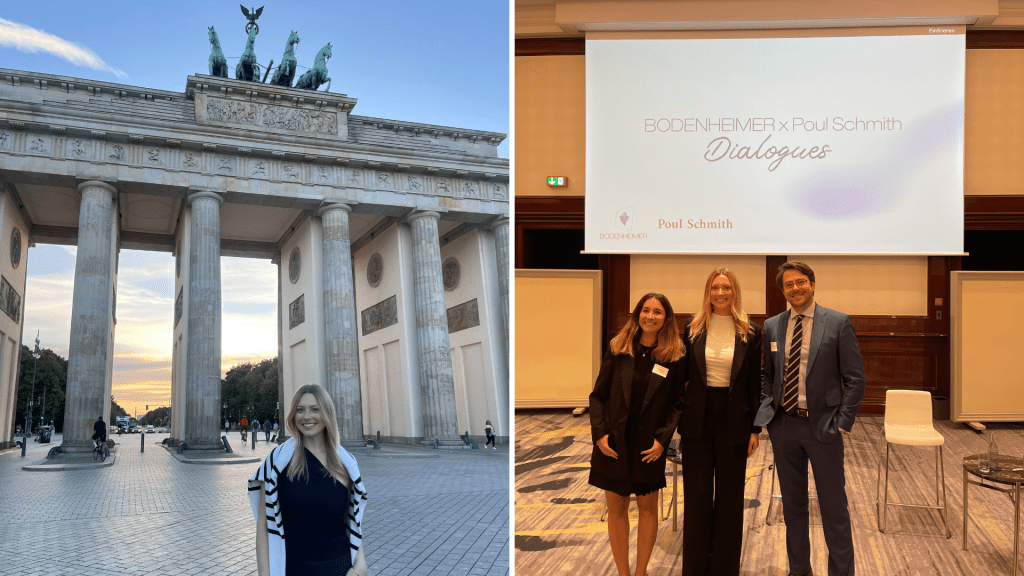
“Do it afraid.” That simple reminder became my mantra during my semester abroad. It is an acknowledgement that discovery rarely feels comfortable at the start. Stepping into a new country, a new legal system, and a new professional culture required me to move forward even when I felt unsteady. But the very discomfort I feared became the gateway to the most meaningful growth I have experienced. During the fall 2025 semester, I externed at BODENHEIMER Law Firm in Berlin—a firm specializing in international dispute resolution with offices also in Cologne, and, soon, the UAE.

Living in Berlin

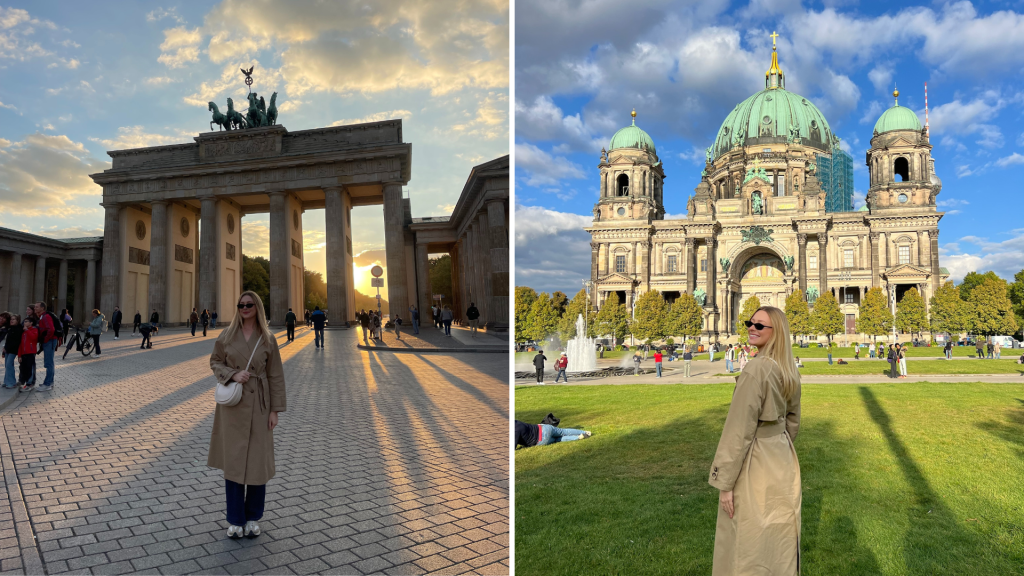
    Berlin is a place that refuses to simplify itself. Its history is felt in every neighborhood, yet its present is defined by internationalism and constant reinvention. I met a woman who was nine years old when the wall fell, and she learned that the world had changed only when her family from the East knocked on her family’s front door for the first time. I also met a Syrian student working to adjust to the new language, culture, and that in-between feeling of starting over. Encounters like these reminded me that, as the most populated city in the European Union, Berlin cannot be described as one thing. It is one place that is also all places.

    What I will miss most is the sense of community Berliners create without even trying: my morning conversations with a bakery owner on the way to the S-Bahn station, watching the city rush outside the second the sun appears, my favorite neighborhood dog Leo religiously greeting me at a local coffee shop, and never knowing whether a parade would materialize around the corner. It is both unpredictable and deeply human. One of my favorite things about Berlin is living in a city that constantly asks you to discover yourself and expand. It stretches you in small ways, like in the languages you hear, the people you meet, and the art tucked in quiet corners of the city.

    Substantive Work and Office Culture

      At BODENHEIMER, I worked on cross-border legal matters ranging from construction to inheritance. The international nature of the work required me to expand both my legal thinking and cultural awareness. I worked on matters involving different jurisdictions, which meant relying on machine-translated documents and learning the procedural rules of various arbitral institutions. Unsure of how much work would be available due to my limited German-language skills, I was surprised by how much opportunity being a native English speaker provided. I was able to assist in the drafting of statements of claim, attend case management conferences, and research cross-border enforcement.

      With colleagues from four different continents, some of the most valuable learning happened outside of my actual assignments. Long lunches turned into lively conversations about world politics, personal histories, cultural differences, and the small absurdities that make international work so rich. These moments helped me understand the human side of international practice and reminded me how central curiosity is to this area.

      Lessons to Carry Forward

        The most challenging part of the placement was the constant unfamiliarity. But that challenge became the most rewarding part, too. Every day, I proved to myself, in small ways, that I could adapt and grow through trial and error. I learned to celebrate being unfamiliar rather than feel embarrassed by it. That shift in mindset is something I will carry with me.

        Looking back, my semester in Berlin helped me see myself differently, personally and professionally. I became more confident, more flexible, and more willing to step into the unknown. What first felt foreign and intimidating slowly became more familiar. Living and working abroad showed me that the moments that feel uncomfortable are often the ones that push us forward the most. And for me, that made this experience not just educational, but truly transformative.
        Melanie Moltmann, German Consul General in Atlanta, speaks at Georgia Law

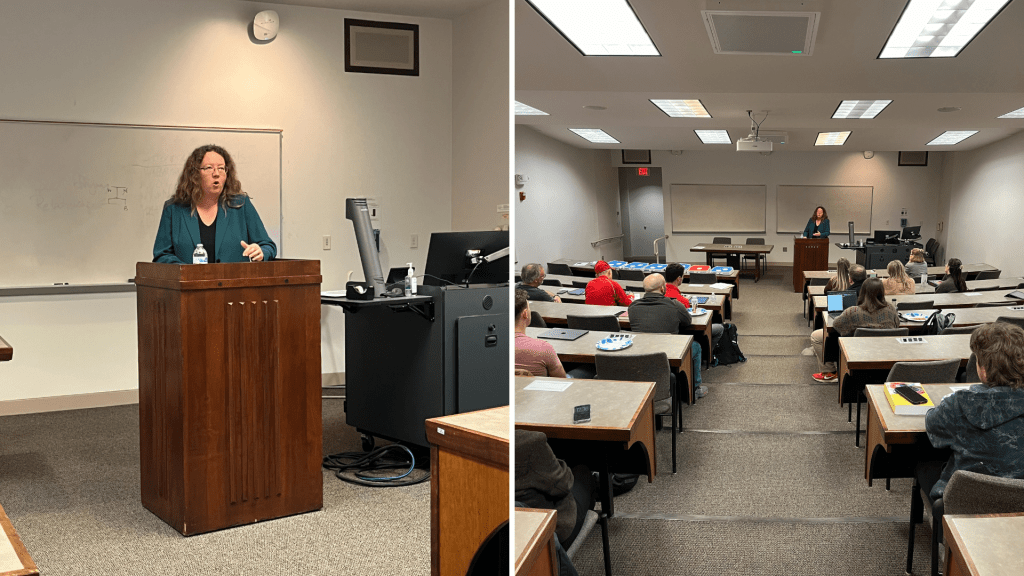
        This week, the German Consul General in Atlanta, Melanie Moltmann, delivered a lecture at the University of Georgia School of Law entitled: “Germany’s Bilateral Relations with Georgia and the United States.” This event was the most recent installment of the Center’s ongoing Consular Series, which presents students, staff, and faculty with global perspectives on international trade, cooperation, development, and policy.

        Moltmann spoke with students about her diplomatic career, including her previous roles in Germany, Uzbekistan, and Armenia. She discussed the historic economic and cultural ties between the United States and Germany, as well as those between the state of Georgia and Germany. Moltmann assumed her current position in Atlanta in September 2021, overseeing a consular district that includes Alabama, Georgia, Mississippi, North Carolina, South Carolina, and Tennessee. She was joined by Josephine Hertzberg, who is currently completing a legal internship at the German Consulate General in Atlanta.

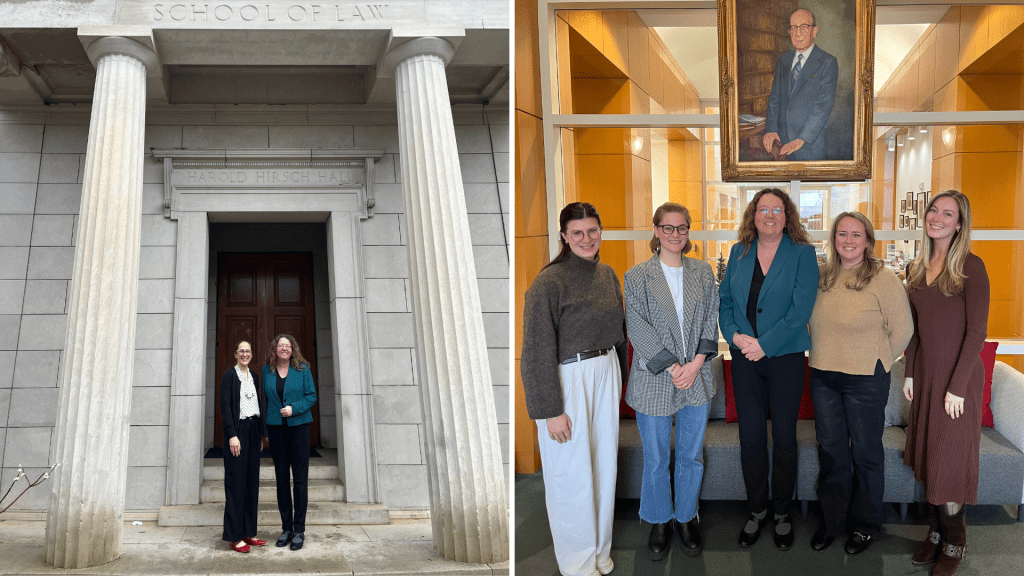
        After her lecture, Moltmann and Hertzberg had a lunch in the Center’s Louis B. Sohn Library with several Georgia Law students who have connections with Germany: Alexis Bartholomew (J.D. ’26), who completed a semester-long Global Externship Overseas (GEO) in fall 2025 in Stuttgart, Germany; Megan Greeley Bradford (J.D. ’26), who completed a summer 2025 GEO in Cologne, Germany; Pace Cassell (J.D. ’26), who completed a semester-long GEO in spring 2025 in Hamburg, Germany with the support of a grant from the Halle Foundation; and Daniel Köhl (LL.M. ’26), a current LL.M. student originally from Germany.

        Georgia Law Professor Diane Marie Amann presents on Nuremberg trial at London’s Middlesex University

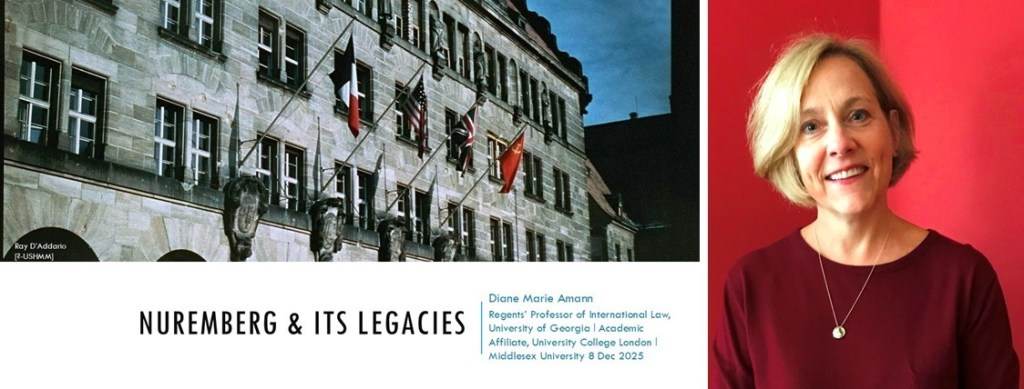
        University of Georgia School of Law Professor Diane Marie Amann recently presented “Nuremberg and Its Legacies” as part of a doctoral students’ seminar at Middlesex University School of Law in London.

        Amann provided an overview of the year-long post-World War II war crimes trial held in Nuremberg, Germany, before an International Military Tribunal established by Britain, France, the Soviet Union, and the United States. After discussing how the 1945-1946 trial unfolded, she considered the continued impact of the trial with regard to issues like the death penalty, the abolition of government leaders’ immunity from prosecution, and the international law duty to refuse to obey illegal orders.

        Leading the two-day seminar were Middlesex Law professors William A. Schabas and Giulia Pecorella.

        Amann is Regents’ Professor of International Law, Emily & Ernest Woodruff Chair in International Law, and a Faculty Co-Director of our Dean Rusk International Law Center here at Georgia Law. During her current research-intensive semester, she is an Affiliate Academic at University College London Faculty of Laws. She has published several essays on the Nuremberg era and is writing a book on lawyers and other women professionals at that first trial.

        Dean Rusk International Law Center participates in event at the Halle Foundation in Atlanta

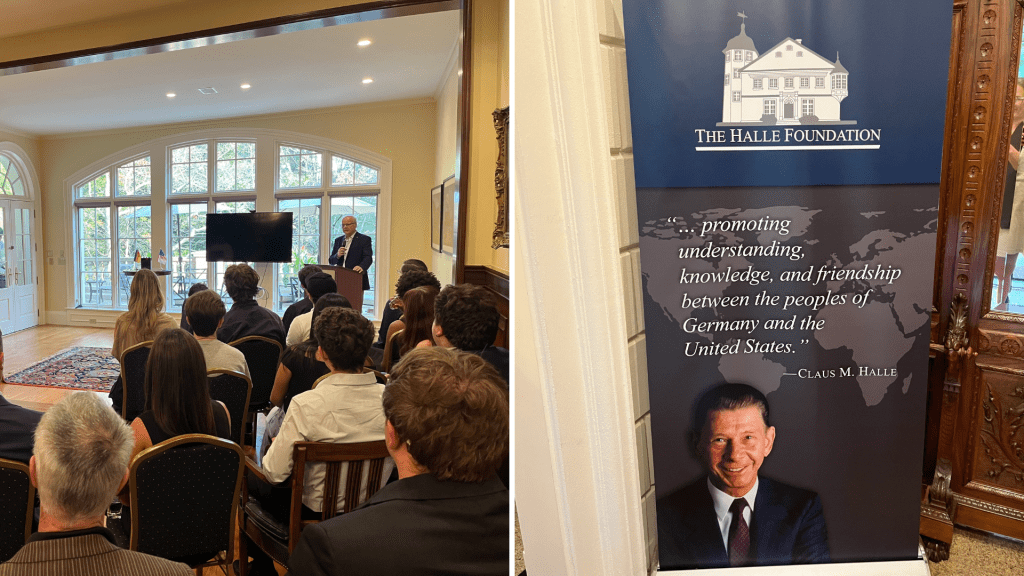
        Last week, the University of Georgia School of Law’s Dean Rusk International Law Center participated in a dinner reception celebrating global education and the philanthropic generosity of the Halle Foundation, supporting American-German educational exchange. This event was jointly sponsored by the University of Georgia’s Department of Germanic and Slavic Studies and the Office of Global Engagement.

        The mission of The Halle Foundation is to promote understanding, knowledge, and friendship between the people of Germany, as seen in its European context, and those of the United States. In furtherance of this mission, the Foundation supports, primarily through grantmaking, initiatives and activities with a preference to organizations and institutions operating within, or with some discernable connection to, the state of Georgia. UGA has several international mobility initiatives, including Georgia Law’s semester-long Global Externships Overseas (GEO) initiative, that are beneficiaries of the Halle Foundation.

        The evening program began with welcoming remarks by Dr. Eike Jordan, Chairman of the Board of Trustees of the Halle Foundation and Dr. Martin Kagel, Associate Provost for Global Engagement, UGA Office of Global Engagement. Then, faculty and administrators at UGA who oversee initiatives benefitting from the Halle Foundation’s support spoke about the impact that their grants have on students. Speakers included: Dr. Jan Uelzmann, Co-Director of Film, Art, and Cultural History in Berlin program; Dr. Heide Crawford, Co-Coordinator of ENGR-GRMN Dual Degree Program, Director of the Freiburg Study Abroad program; and Sarah Quinn, Director of the Dean Rusk International Law Center.

        Then, UGA students shared reflections about what their time abroad in Germany meant to them academically, professionally, and personally. Georgia Law student Pace Cassell (J.D. ’26) spoke about her experience as a legal extern at Baker Tilly in Hamburg, Germany during the spring 2025 semester through the semester-long GEO initiative, jointly administered by the Center and the DC Semester in Practice. Cassell is the recipient of a grant from the Halle Foundation, awarded to the law school in summer 2024 to support six students over three years participate in semester-long externships in Germany.

        ***

        Applications are open for fall 2027 semester-long Global Externships Overseas (GEOs). All current 1Ls and 2Ls are invited to submit an application by February 15. For more information and the application, please email: ruskintlaw@uga.edu

        Elizabeth Ferguson (J.D. ’25) reflects on semester-long Global Externship Overseas in Germany

        Today, we welcome a guest post by Elizabeth Ferguson, a member of the University of Georgia School of Law class of 2025. Ferguson participated in a semester-long international externship in spring 2025. The semester-long externships overseas initiative is an extension of the Center’s existing Global Externships Overseas and is offered jointly between the Center and the law school’s Clinical and Experiential Program. Ferguson’s post describes her experience as a legal extern with Bodenheimer, a law firm that handles disputes across jurisdictions, including cases in litigation, arbitration, and mediation and other ADR proceedings. Ferguson was based in Berlin, Germany, where she worked under Georgia Law alumnus Dr. Christof Siefarth (LL.M., ’86).

        When I decided to participate in my semester-long Global Externship at Bodenheimer in Berlin, Germany I was looking for a new way to challenge myself academically. I concluded that taking myself far beyond the law school classroom I had spent two and a half years becoming familiar with would be the perfect opportunity. Although I was ready for a challenge, I didn’t anticipate how the lessons I learned in international arbitration would expand beyond its subject matter and into my professional life forever.

        Bodenheimer is an international arbitration firm with a truly global scope. As a result, during my four months there, I researched many issues spanning multiple jurisdictions: I immersed myself in Chinese product quality standards, untangled questions of Indian law, and more.

        When I received my first assignment, concerning a legal issue relying on law in an Asian country, the reality set in that I did not have the basic building blocks I needed to begin. When I received assignments on an unfamiliar issue while working at American law firms, I had a certain base knowledge to assist me because law school taught me the basics of the American civil and criminal systems and how to research them. However, in this situation, I quickly realized, I had none of those research tools or knowledge ready to go.

        Although I conquered each task with the help of my colleagues, law school staff, and by familiarizing myself with the tools and knowledge used in international arbitration, I relived this fearful realization many times. Each time I received an assignment based in a jurisdiction I had not yet faced, I felt as though I was back at square one: navigating a new legal universe, where I didn’t speak the language, didn’t know the rules, and did not know where to begin. In American law firms, I had the comfort of a familiar legal system, a base knowledge to lean on, and research tools I used frequently. However, in Berlin, I often found myself staring at an assignment wondering, “Where do I even start?”

        As a result, I began to struggle with something I’d never felt before: imposter syndrome. Imposter syndrome is a phenomenon where professionals experience feelings of inadequacy, despite evidence of their competence and achievements. I knew that I was given this opportunity for a reason, but nevertheless I could not shake this feeling of self-doubt and compare myself to my very impressive colleagues. Most of the attorneys in my office were fluent in at least three languages and were qualified attorneys in several countries! As someone who only spoke English and had not yet even graduated law school, I couldn’t help but compare myself to them and worry that I was simply not up to the task. As a result, my imposter syndrome began to eat away at my confidence.

        But here’s the thing about throwing yourself into the deep end: you must learn to swim.

        Over time, as I completed challenging assignments and learned from my helpful and knowledgeable colleagues, I developed strategies to identify, build, and promote my value as a young attorney in this unfamiliar environment which helped me combat my imposter syndrome. For example, one attorney frequently asked me to edit English language documents and made the observation that I was the only native English speaker in the office. At this moment, I realized that I was too busy comparing myself to my colleagues, who could all speak three to five languages, to recognize that my native English skills were a unique asset in my office when my colleagues needed someone to edit or translate documents into English. By the end of the semester, I was able to recognize my value in many ways and recognize the meaningful contributions I made through my work product.

        Working at Bodenheimer taught me more than just the inner workings of international arbitration: it taught me how to quiet the inner critic, embrace uncertainty, and how to identify and promote my value, rather than focus on perceived shortcomings.

        Berlin will always hold a special place in my heart, not just for its beautiful cathedral, the delicious Franzbrötchen, and the amazing colleagues I met, but for the reminder that growth often comes disguised as discomfort.

        As I head into my next professional chapter, I’ll carry with me the lesson that the doubts you feel today will become issues you will conquer tomorrow.

        ***

        Applications are open for spring 2026 semester-long Global Externships Overseas (GEOs). All current 2Ls and 3Ls are invited to submit an application by September 15. For more information and the application, please email: ruskintlaw@uga.edu

        Georgia Law Professor Christopher Bruner presents at Bucerius Law School in Hamburg, Germany

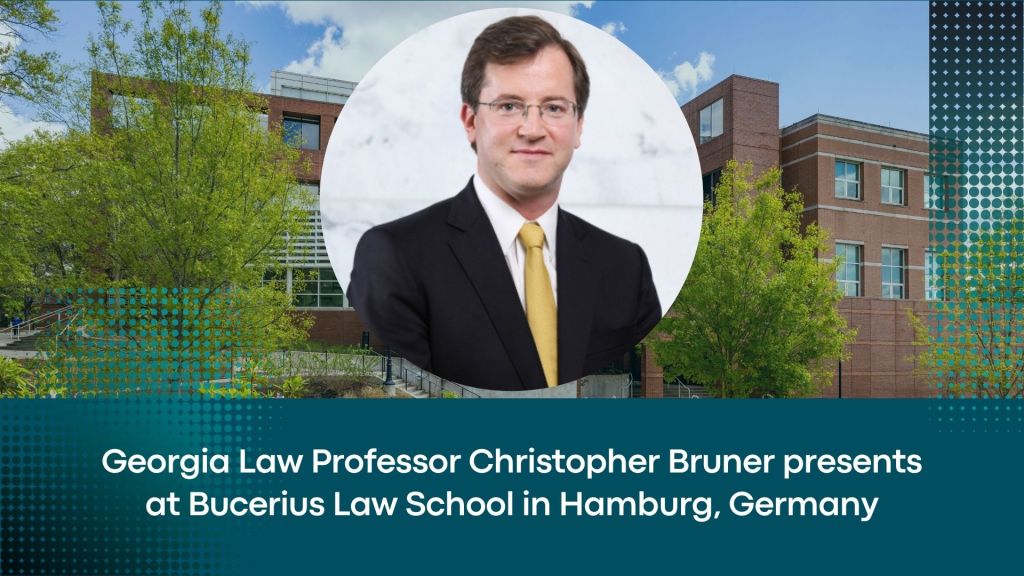
        University of Georgia School of Law professor Christopher M. Bruner delivered his presentation “A Political Economy of Corporate Sustainability Reform in the United States” at the Sustainability in Corporate Law Conference at Bucerius Law School in Hamburg, Germany.

        Bruner is the Stembler Family Distinguished Professor in Business Law at the University of Georgia School of Law and serves as a faculty co-director of the Dean Rusk International Law Center. He holds a courtesy appointment at the UGA Terry College of Business. Bruner teaches a range of corporate and transactional subjects, and he has received the School of Law’s C. Ronald Ellington Award for Excellence in Teaching.

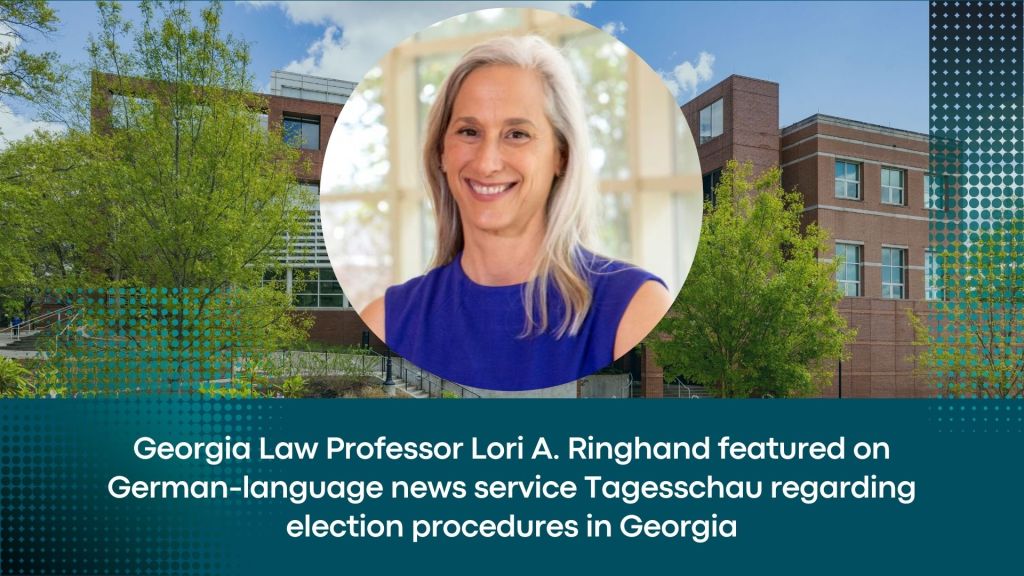
        Georgia Law Professor Lori A. Ringhand featured on German-language news service Tagesschau regarding election procedures in Georgia

        University of Georgia School of Law Professor Lori A. Ringhand was featured on the German-language news service Tagesschau regarding election procedures in Georgia. The article titled “Wahlhelfer mit ‘Panik-Knöpfen’” was reported by Ralf Borchard and published October 31, 2024.

        Ringhand teaches courses on constitutional law and election law. She has been a member of the University of Georgia School of Law faculty since 2008 and was named a Hosch Professor in 2012 and awarded a Josiah Meigs Distinguished Professorship, UGA’s highest teaching honor, in 2021. She is a nationally known Supreme Court scholar and the author of two books about the Supreme Court confirmation process: Supreme Court Confirmation Hearings and Constitutional Change (with Paul M. Collins) published by Cambridge University Press; and Supreme Bias: Gender and Race in U.S. Supreme Court Confirmation Hearings, (with Christina L. Boyd and Paul M. Collins), published by Stanford University Press. She also is the co-author of Constitutional Law: A Context and Practices Casebook, which is part of a series of casebooks dedicated to incorporating active teaching and learning methods into traditional law school casebooks. Ringhand also publishes extensively on election law related issues, and was awarded a Fulbright Distinguished Chair Award at the University of Aberdeen in Scotland to explore the different approaches to campaign finance regulation taken by the United States and the United Kingdom.

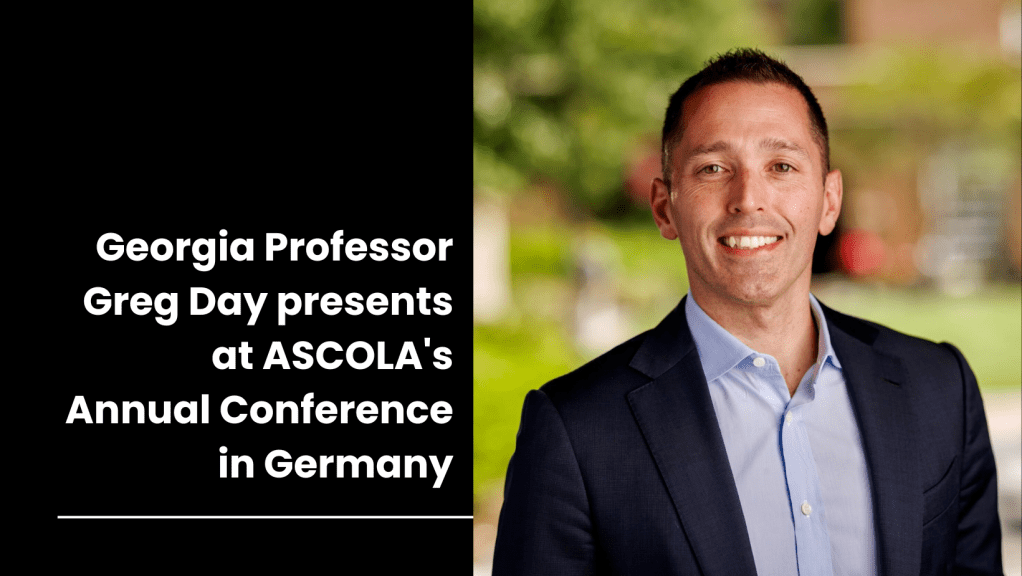
        Georgia Professor Greg Day presents at ASCOLA’s Annual Conference in Germany

        University of Georgia Associate Professor of Legal Studies Greg Day recently presented research at the 19th American Society for Competition Law (ASCOLA) Annual Conference in Würzburg, Germany. The conference brings together about 120 scholars doing research in competition law, economics or policy from all over the world. 

        Greg Day is an Associate Professor of Legal Studies at the Terry College of Business and holds a courtesy appointment in the School of Law. He is also an Affiliated Fellow at Yale Law School’s Information Society Project as well as the University of North Carolina’s Center for Information, Technology, and Public Life. His research has primarily focused on the intersection of competition, technology, innovation, and privacy as well as the disparate impact of anticompetitive conduct.

        Dean Rusk International Law Center receives grant from The Halle Foundation

        The University of Georgia School of Law’s Dean Rusk International Law Center has received a grant from The Halle Foundation to support six law students in semester-long externships in Germany over the next three years.

        “Germany is a country where our students are showing increasing interest,” according to Dean Rusk International Law Center Director Sarah Quinn. “Since 2022, three UGA Law students have participated in for-credit, semester-long externships with German law firms. This new partnership with The Halle Foundation will enable more students to immerse themselves in the heart of Europe and grow their international and legal skill sets, giving them the tools to succeed in the globalized practice of law” she said.

        Reflecting on her externship with the German law firm Bodenheimer in fall 2022, alumna Emily Crowell (J.D. ’23) stated:

        My externship…absolutely enhanced my legal education. I gained a much more holistic perspective on international arbitration, was exposed to laws from many different European countries, and worked alongside lawyers from different backgrounds and countries. Further, the attorneys at Bodenheimer allowed me to join teams involved in ongoing arbitrations and gave me substantive projects. The practical experience I gained at Bodenheimer was one of my most useful and enjoyable experiences of law school.

        Alumna Meredith Williams (J.D. ’24), who externed with the German firm Weickmann in fall 2023, had a similarly transformative experience during her time abroad:

        The opportunity to network and meet attorneys who work abroad is invaluable. I learned a lot about German and EU trademark law as well as had the opportunity to provide insight into the American system. Learning how to interact with international attorneys and international law in this way is certainly not something I would be able to do if I remained in Athens. Finally, Dr. Udo Herberth (LL.M. ’96) is not only an excellent mentor who has plentiful exciting work but is a great person to know.

        More about Williams’ experience with Weickmann can be found here.

        Based in Atlanta, The Halle Foundation seeks to promote understanding, knowledge and friendship between the people of Germany and the United States.

        For more information or to set up an advising appointment, please email: ruskintlaw@uga.edu

        Georgia Law alumnus elected as president of the Atlanta International Arbitration Society

        The Atlanta International Arbitration Society (“AtlAS”) recently elected University of Georgia School of Law alumnus and Rusk Council member Dr. Christof Siefarth (LL.M., ‘86) as President.

        Siefarth is currently a partner at the German law firm Bodenheimer. He took office as President after AtlAS’s plenary meeting at Smith, Gambrell & Russell in March. Siefarth has been active in AtlAS throughout its 14-year history.

        Siefarth has significant experience in arbitration throughout Europe, Asia, and the United States. He has participated on many AtlAS conference panels over the years, and he also has led discussions at AtlAS’s plenary meetings, including in December 2022, where the topic was “U.S. Experience with DIS Arbitration.” Siefarth is licensed to practice law in Germany and New York.

        AtlAS’ mission is to promote and enhance Atlanta as a place to resolve the world’s business disputes using international arbitration and mediation. The University of Georgia School of Law is a founding organization and hosts its annual lecture every three years. Both Dean & Talmadge Chair of Law Peter B. “Bo” Rutledge and director of the Dean Rusk International Law Center Sarah Quinn serve on the organization’s Board of Directors.