UGA Law Professor Kadri presents on “Cyberflashing” and other projects at gatherings in Germany

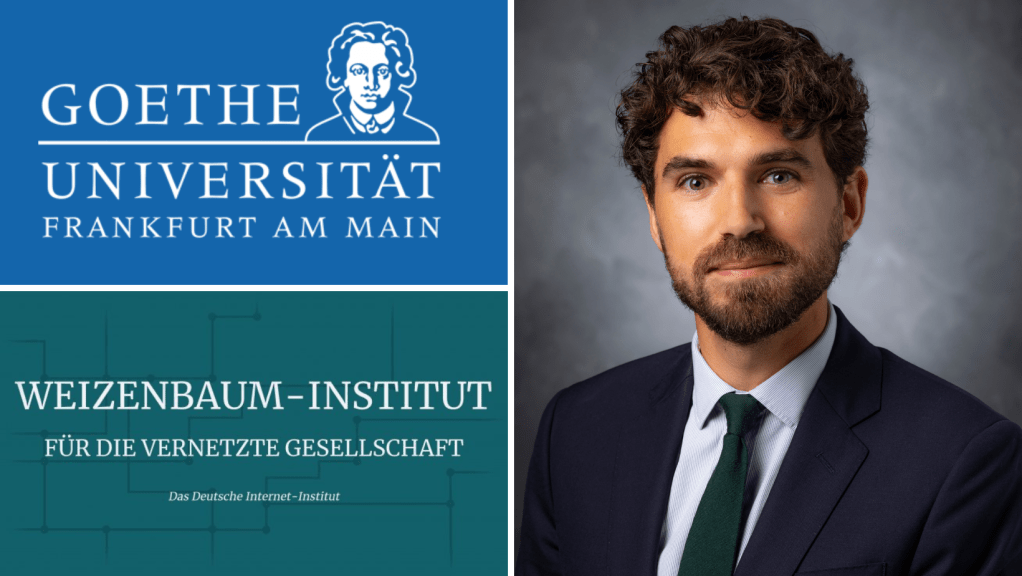
University of Georgia School of Law Professor Thomas E. Kadri presented his article “Cyberflashing,” co-authored with Harvard Law School SJD candidate Brenda Dvoskin, at a workshop hosted by Goethe University’s Center for Critical Computational Studies in Frankfurt, Germany. He also discussed several current works-in-progress during a visit to the Weizenbaum Institute for the Networked Society in Berlin, Germany. 

At these gatherings, Kadri discussed several of his current projects, including his work investigating how large technology companies have adopted particular strands of feminism to gain, exercise, and justify their power to regulate sexual speech and imagery. He also presented a related project that explores a recent legislative trend to regulate “cyberflashing,” which is the act of sending a nude image to a person without receiving prior consent. Lastly, Kadri discussed a piece proposing a regulatory response to how data brokers are enabling and exacerbating interpersonal abuse like stalking and harassment. 

The Weizenbaum Institute aims to investigate “the ethical, legal, economic and political aspects of digital change” to create an empirical basis for “responsible digitalisation.” Kadri explains how his current research fits within this framework:

“With each new innovation in the digital age, it can be tempting to assume that our capacity to use technology in a certain way means that we should use it in that way. My work, in part, seeks to resist this kind of technological determinism. Digitalization has offered huge benefits for humanity, but that doesn’t mean humanity should abdicate responsibility for judging — including through law — how we should use technology. Though it’s not for me to say, my hunch is that this kind of critical approach to technology (and law) would align with the Weizenbaum Institute’s aims to create a foundation for “responsible digitalisation.”

Kadri is an Assistant Professor of Law at UGA Law, and his research focuses on torts and criminal law, with an emphasis on how technology, law, and social norms enable and affect privacy, speech, and abuse. His scholarship appears in journals including the Harvard Law Review Forum, UCLA Law Review, Texas Law Review, Utah Law Review, Maryland Law Review, and Journal of Free Speech Law and he has published shorter pieces in The New York Times and Slate. His course offerings include Torts, Cybercrime, and Regulating Digital Abuse. 

Prior posts on Kadri’s scholarship can be found here

UGA Law 3L Meredith Williams reflects on participation in the Bavarian International Trademark Association (“BITMA”) convention in Munich, Germany

Today we welcome a guest post by Meredith Williams, a member of the University of Georgia School of Law Class of 2024. Meredith is one of several UGA Law students to participate in a semester-long international externship, a pilot extension of our existing Global Externships Overseas initiative. This pilot is a joint initiative between the Dean Rusk International Law Center and the law school’s Clinical and Experiential Program. Meredith’s post describes her experience attending an international convention as part of her externship.

I am spending the fall semester of my 3L year working as a legal extern with Weickmann, an intellectual property law firm located in Munich, Germany. I work under Dr. Udo W. Herberth (LL.M., ’96), who heads the firm’s brands and designs group.

A highlight of my global externship thus far has been attending the second annual Bavarian International Trademark Association (“BITMA”) convention, which Dr. Herberth founded. The conference took place over two days, during which I met trademark and patent attorneys from fourteen different countries. On the first day, attorneys from each country presented on the topics of 1) use and 2) jurisdiction.

My externship and this conference in particular have crystalized for me how intellectual property is an increasingly international area of law. Many clients and companies wish to register, maintain, and prevent infringement of their trademarks in more than one country; yet, there are nuanced and important distinctions between different jurisdictions’ requirements and timelines. In a field of law where adding value to a brand is crucial, it is important to be aware of these differences and stay on top of deadlines.

I enjoyed learning from the diverse group of individuals at the BITMA conference. For example, a topic I found compelling was the question of translation of trademark languages. In Canada, the Quebec charter regarding French language has been amended. Attorneys at the conference suggested this will have an impact on trademarks because the French portion of the mark must be twice the size, yet the entire trademark need not be translated. For example, in Quebec, an Apple store could display a large “Le Magasin” before “Apple,” and not have to translate “Apple” into “Pomme.” Further, in Japan, there are four different scripts, which create even more nuance to registering a word mark. These evaluations go into much more detail than we had time to cover during the conference, but it has piqued my interest as something I had never thought about living in the English-dominant US.

Another aspect of the BITMA conference that I enjoyed was the balance between personal and professional. The group of 25 of us shared many meals, watched the traditional Bavarian parade for the opening weekend of Oktoberfest, and eventually made our way to the festivities. While the substantive knowledge I acquired from this group is important, I also learned a lot from interacting with everyone on a personal level. Dr. Herberth fostered a warm and supportive atmosphere throughout the convention. This type of collegial experience served as a reminder that there is value in getting to know colleagues as people outside of work. The BITMA group treated me as an equal and were interested in my path and life. It reminded me that I want to lend a helping hand to law students and those in the early stages of their careers as I progress through mine.

I look forward to the second half of my semester working at Weickmann. I thank UGA Law for leaving such a lasting, positive impression on Dr. Herberth; it is for this reason that he was incentivized to provide educational experiences for UGA Law students like myself, and it is also why I know that I, too, want to provide this type of experience to a UGA Law student one day.

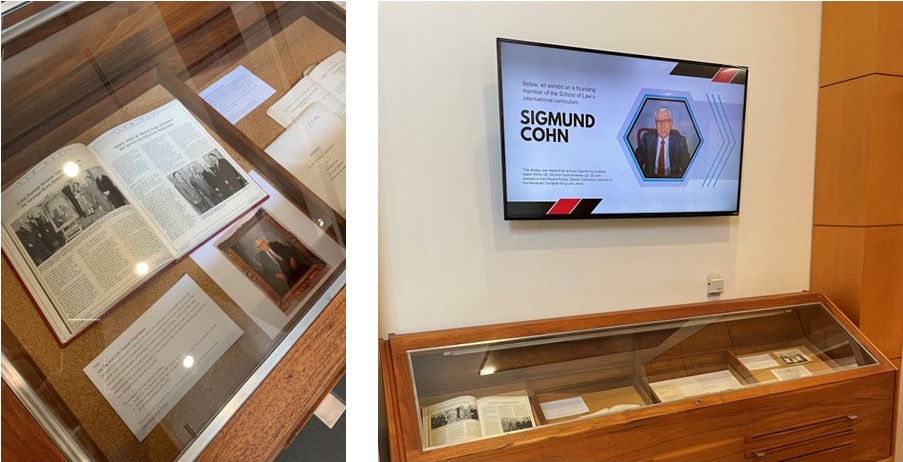
Georgia Law’s first international law professor, Sigmund A. Cohn, featured in Dean Rusk International Law Center exhibit

An ongoing exhibit here at the Dean Rusk International Law Center, University of Georgia School of Law, celebrates the distinguished life and career of Professor Sigmund A. Cohn, who taught the law school’s first international law class, in 1940.

Cohn’s courses, in international law and in comparative law, blazed a trail. Others would follow Cohn’s path; among them, past Georgia Law Professors Dean Rusk, Louis B. Sohn, and Gabriel Wilner.

The exhibit was researched and curated by two of the Center’s Student Ambassadors, 3L Isabel White and 2L Carolina Mares, along with Rachel Evans, Metadata Services & Special Collections Librarian at the law school’s Alexander Campbell King Law Library. It features a collection of archival items about Cohn’s life and work.

Cohn was born in 1898 in Breslau, Germany (now Wrocław, Poland) to a Jewish family. He became a lawyer and then a judge in Germany’s Weimar Republic. But in 1934, Nazi Germany’s antisemitic laws forced him out of his judicial position. Cohn immigrated to Italy for a few years, but then was forced to immigrate once again, to the United States.

He was hired by Georgia Law, and became its first professor of Jewish ancestry, at a time when state laws barred the paying of foreign citizens. His hiring thus was supported financially by Harold Hirsch – then general counsel at the Coca-Cola Co., and the lawyer for whom Georgia Law’s Hirsch Hall is named.

A portrait of Professor Cohn greets visitors to the Dean Rusk International Law Center.

Cohn’s legacy likewise continues in the form of Georgia Law’s highly ranked curriculum (here and here), in global practice preparation and international professional education, benefiting candidates for Juris Doctor, Master of Laws (LL.M.), and Master in the Study of Law (M.S.L.) degrees as well as Graduate Certificate in International Law students.

Georgia Law Professor Usha Rodrigues in Frankfurter Allgemeine Zeitung article on special purpose acquisition companies

Usha Rodrigues, University Professor and M.E. Kilpatrick Chair of Corporate Finance & Securities Law and the University of Georgia School of Law, serving currently as the University of Georgia Interim Vice Provost for Academic Affairs, recently was featured the German daily newspaper Frankfurter Allgemeine Zeitung.

The article by reporter Von Roland Linder was entitled “Für hunderte Spacs tickt die Uhr,” or “The clock is ticking for hundreds of spacs” – the last term an acronym for “special purpose acquisition companies,” a corporate law phenomenon about which Rodrigues has written and frequently is quoted.

Georgia Law Professor Nathan Chapman gives scholarly presentations at Oxford and Heidelberg universities

Nathan Chapman, Pope F. Brock Associate Professor of Professional Responsibility here at the University of Georgia School of Law, is just back after giving scholarly presentations at Oxford University in the United Kingdom and the University of Heidelberg in Germany.

The Oxford Programme for the Foundations of Law and Constitutional Governance hosted Professor Chapman’s visit last month to the Oxford University Faculty of Law, where he gave two presentations:

  • “Judicial Review in the US As a Tradition of Moral Reasoning.” Commenting were Professor Richard Ekins (St. John’s, Oxford) and Professor Fernando Simon Yarza (Oxford/Navarre).
  • “The Doctrine of Qualified Immunity,” which summarized his argument in “The Fair Notice Rationale for Qualified Immunity,” forthcoming in the Florida Law Review. Professor Timothy Endicott (All Soul’s, Oxford) commented.

In Germany, Chapman presented as part of the Internationales Wissenschaftsforum, or International Academic Forum, at the University of Heidelberg. Entitled “Government Conditions on Religious School Funding,” the chapter will appear in an interdisciplinary book on The Impact of Political Economy on Character Formation. Workshop participants were the other authors and editors of the book. They included scholars in social theory, theology, philosophy, economics, and law from the Universities of Chicago, Heidelberg, Bonn, Queensland, and Stellenbosch, located, respectively, in the United States, Germany, Australia, and South Africa.

Georgia Law Professor Cohen on WTO precedent at ESIL IG workshop

Harlan Cohen, the Gabriel M. Wilner/UGA Foundation Professor in International Law and Faculty Co-Director of the Dean Rusk International Law Center here at the University of Georgia School of Law, presented on “The Sociology of WTO Precedent” last month as part of a 2-day Behavioural Approaches in International Law Workshop.

It was sponsored online by the at Hamburg University, and organized by Hamburg Professor Eva van der Zee, Leiden Professor Daniel Peat, and Copenhagen Professor Veronika Fikfak. It was the first event of the new European Society of International Law Interest Group on Social Sciences and International Law.

Georgia Law Professor Kent Barnett on comparative study in “Chevron Abroad,” Notre Dame Law Review article co-authored with Georgia Law 3L student Lindsey Vinson

Pleased today to welcome a contribution from Kent Barnett (near right), J. Alton Hosch Associate Professor of Law here at the University of Georgia School of Law. He reprises his recent Yale Journal on Regulation blog post; it summarizes the forthcoming article, Chevron Abroad, which he co-authored with Georgia Law 3L Lindsey Vinson (above right). An expert on administrative law and related areas—at times using comparative approaches—Professor Barnett’s previous Exchange of Notes contribution is here.

The Kids Will Be Alright—How comparative study can inform U.S. judicial review of agency statutory interpretation

Chevron deference—the U.S. doctrine that calls for courts to defer to reasonable agency statutory interpretations—is under siege. A majority of current U.S. Supreme Court Justices have, at one time or another, expressed concern over its domain, operation, or very existence. Two state courts in the U.S. have overruled their state-law equivalents. Some welcome Chevron’s demise as an antidote to an ever-encroaching administrative state that chafes at statutory limits to authority. Others view Chevron’s internment as nothing but a judicial power grab in the face of ideological hostility to an effective administrative state. For my part, my past research co-authored with Dr. Christy Boyd and Professor Chris Walker suggests that—whatever its downsides—Chevron deference has the benefit of muting ideological judicial behavior. This muting can further national uniformity in lower court decisions concerning agency statutory interpretation.

But is the angst surrounding Chevron worth it? Do we really need to worry that administrative agencies will eventually consume all our liberty if Chevron continues or that the American bureaucracy will become an ineffective wasteland if Chevron ends? Moreover, even those not taken to hyperbolic worry have argued, to varying degrees, that Chevron deference is inevitable—whatever its drawbacks.

To evaluate whether Chevron or something like it exists or is absent in other stable democracies, my co-author, Lindsey Vinson, and I considered judicial review of agency statutory interpretation in five other countries in Chevron Abroad, our forthcoming article in the Notre Dame Law Review. Although we would have liked to see how countries with a presidential system like that of the United States behave, that system is rare, especially among mature legal systems. Instead, we looked at 5 parliamentary systems. These included countries with separation of powers guaranteed in written constitutions, with civil-law legal systems, and with federal systems. Among the countries studied were Germany, Italy, the United Kingdom, Canada, and Australia.

Based on our study, we cannot say that Chevron or something like it is inevitable. Only one of the countries that we studied had a doctrine similar, if not more expansive than, Chevron. One has rejected deference altogether, and one has rejected Chevron specifically in dicta. The others, at best, had some small space for deferring to agency interpretations. This variation among these major legal systems also suggests that the existence or absence of something like Chevron does not mean the end of either democracy or an effective bureaucracy. After all, citizens in both Canada—with a strong form of deference—and Germany—without one—have strong confidence in their governments. Of course, we cannot say that any of these systems are operating optimally, but we can say that Chevron existence or absence alone does not appear as significant as the U.S. administrative law cognoscenti often suggests.

In brief, here’s the variation that we found in our study:

Germany. Influenced by its conscious concern over the relationship between judicial abdication and its Nazi past, Germany has its own 2-step deference doctrine that has a much more limited domain than Chevron. Deference in Germany is significantly limited to certain technical, scientific, or economic matters that the legislature has delegated to the agency.

Italy. Italy has had tumultuous doctrinal shifts in the past few decades. As it stands, it has rejected judicial deference altogether when reviewing agency statutory interpretations. But it sends contradictory signals occasionally.

United Kingdom. For decades, the UK has rejected judicial deference to agency statutory interpretation, after having a doctrine similar to Chevron. Although it defers in some instances for “special” matters decided by entities that U.S. law would characterize as agencies, its limited deference arises under its law on charities.

Canada. Canadian judicial review comes the closest to Chevron, with a highly functional, contextual inquiry into whether deference is appropriate for statutory provisions that can support more than one reasonable interpretation. Canada has applied deference even to questions that implicated constitutional or common-law matters.

Australia. Finally, Australia’s High Court expressly rejected Chevron in dicta. Nonetheless, Australia continues to have a very limited, rarely applied doctrine somewhat similar to Chevron when statutes expressly give agencies exclusive jurisdiction and limit judicial review.

Our study also provides insight on how U.S. courts—whether or not they prefer Chevron—could go about improving Chevron in a way that is more consistent with its theoretical grounding.

For instance, Chevron, like other countries’ deference doctrines, is grounded primarily on notions of legislative delegation and expertise. Chevron relies primarily upon ambiguity in a statute that the agency administers to signal legislative delegation. But the presence of statutory ambiguity somewhere in a statute is not the most direct way of assessing either actual delegation or agency expertise on the matter at issue. Germany focus on expertise. German courts permit deference only in limited circumstances—for certain scientific, economic, or technical matters—as a way of ensuring that deference adheres only to matters in which the agency has likely epistemological advantage over courts. Australia has its limited Hickman deference doctrine that requires that the legislature signal its intent with two statutory clauses that it wants agencies (or inferior courts) to have interpretive primacy over the matter at issue. By doing so, Hickman requires a more direct, although not express, signal of legislative delegation than Chevron. These approaches in other countries suggest how Chevron could better ground itself on its theoretical foundations.

We hope that our article will lead more American scholars to consider how other countries approach administrative law matters. Doing so not only provides examples of possible improvements to the American administrative state, but it also helps lower the temperature of academics and judges who worry over the current or future state of Chevron deference.

Foreign media quote Georgia Law Professor Elizabeth Burch on mass tort suits against Bayer herbicide Roundup

University of Georgia School of Law Professor Elizabeth Chamblee Burch, an expert on mass torts and complex litigation, recently was quoted in overseas news media regarding ongoing lawsuits against Bayer AG, the Germany-based multinational corporation.

The reporting centered on negotiations to end U.S. litigation in which tens of thousands of plaintiffs have alleged that glyphosate, an ingredient in the Bayer herbicide Roundup, is a carcinogen that causes non-Hodgkin’s lymphoma.

In an article entitled “Bayer vor Glyphosat-Einigung – So sieht der teure Plan aus” (“Bayer before the Glyphosate Agreement – This Is What the Expensive Plan Looks Like”), reporters Bert Fröndhoff and Katharina Kort wrote:

“Legal expert Elizabeth Chamblee Burch, professor at the University of Georgia, thinks it makes sense in principle to withdraw the product from the market beyond agricultural use. ‘But even that doesn’t solve the problem of complaints that can come from those who have already used the product,’ warns the lawyer.”

(Translated from the original German.) The article appeared in Handelsblatt, a business newspaper headquartered in Düsseldorf.

A separate article on the same subject, “Q&A – What Are the Obstacles to Bayer Settling Roundup Lawsuits,” appeared in Israel’s Haaretz. It this article, Reuters reporter Tina Bellon wrote:

“Non-Hodgkin’s lymphoma on average can take up to 10 years to emerge, increasing the likelihood of claims being filed after the litigation has settled. Product liability settlements generally include a cut-off date for future claimants and need to be properly funded for a court to approve the agreement.

“As long as the product continues to be sold without changes to the label, plaintiffs may continue to file lawsuits, said Elizabeth Burch, a law professor at the University of Georgia.”

Professor Burch, holder of the Fuller E. Callaway Chair of Law here at the University of Georgia School of Law,  is the author of Mass Tort Deals: Backroom Bargaining in Multidistrict Litigation (Cambridge University Press 2019). In 2017, she presented at an international conference held by Tel Aviv University.

Center’s Laura Kagel to meet with prospective LLMs in Austria, Croatia, and Germany

LLM cover pageLaw students in Austria, Croatia, and Germany will soon have the opportunity to talk with a Dean Rusk International Law Center staffer about pursuing a degree at here at the University of Georgia School of Law.

Later this month yours truly, Laura Tate Kagel, the Center’s Associate Director of International Professional Education, will give a presentation for students at Johannes Gutenberg University in Mainz, Germany, and take part in LL.M. fairs in Vienna, Austria, and Zagreb, Croatia. Sponsor of the fairs is EducationUSA, an arm of the U.S. Department of State.

I’ll be on hand personally to discuss the career benefits and special advantages of earning the Master of Law, or LL.M., degree at Georgia Law. (See prior posts about our current LL.M. students, as well as our hundreds of LL.M. alums, here.)

If you’d like to schedule to meet with me, please email LLM@uga.edu, and you can register for the fairs via the links below.

Monday, November 12, Mainz: 18:00-20:00, Johannes Gutenberg University, Department of Law and Economics. Email LLM@uga.edu for more details.

Wedne1sday, November 14, Vienna: 16:00 – 18:00, University of Vienna, Juridicum Dachgeschoss, 10-16 Schottenbastei, 1010. Register to attend online.

Friday, November 16, Zagreb: 18:00-20:00 at the Sheraton Hotel, Ul. kneza Borne 2, 10000. Register to attend online.

Hope to see you there!

Georgia Law Professor Amann presents “A New History of the Nuremberg Trials” at Oxford University’s Bonavero Institute of Human Rights

We’re pleased today to cross-post this report from Professor Diane Marie Amann, Emily & Ernest Woodruff Chair in International Law and Faculty Co-Director here at the Dean Rusk International Law Center, University of Georgia School of Law, who undertook research-intensive semester this spring:

OXFORD – A capstone of my Hilary-Trinity Term visit here took place yesterday, when I presented “A New History of the Nuremberg Trials: Figuring Women and Others into the Narrative” to law students and faculty who gathered at the Bonavero Institute of Human Rights, located at Oxford University’s Mansfield College. The Oxford Transitional Justice Research network cosponsored.

Professor Kate O’Regan, director of the institute and a former judge on the Constitutional Court of South Africa, opened my Research Visitor Seminar. Then came my  presentation of my research on the roles women played at Nuremberg – not only the Trial of the Major War Criminals before the International Military Tribunal, but also the 12 subsequent American trials before what are known as the Nuremberg Military Tribunals. Next, Dapo Akande, Professor of Public International Law at Oxford’s Blavatnik School of Government, offered discussant’s remarks before opening the floor for a stimulating round of Q&A.

I’m grateful to all at the Institute for this event and the hospitality I’ve enjoyed during my stay at a Bonavero Research Visitor and Mansfield College Visiting Fellow. Grateful, too, for the opportunities I’ve had to present this work elsewhere in Europe, at the Irish Centre for Human Rights at the National University of Ireland Galway, University of Stockholm, University of Göttingen, and Max Planck Institute Luxembourg.