Taher S. Benany joined the University of Georgia School of Law’s Dean Rusk International Law Center as associate director in January 2025.
In this role, he oversees global international training programs, including the Global Externships Overseas (GEO) initiative. He also collaborates with Center faculty and staff to plan and implement international law research initiatives, events and conferences, including the annual Georgia Journal of International and Comparative Law conference.
Benany came to Georgia Law from the Shalakany Law Office in Cairo, Egypt, where he was a partner focusing on public international law, global disputes and government affairs for four years. In an earlier stint with the firm from 2014 to 2019, he was a senior associate focusing on public law, international litigation, compliance and government affairs. He also served as a public international law lecturer at the British University in Egypt and served as a public international law expert for the European Union Agency for Criminal Justice Cooperation.
As a legal fellow for the United Nations Human Rights Council for an African state and an international organization, he drafted resolutions and interventions while preparing universal periodic reviews and legal opinions on international human rights instruments.
He earned his Bachelor of Laws from Cairo University in 2017, then continued his legal studies as a Fulbright Scholar at the University of Michigan in Ann Arbor. He also holds a Bachelor of Science in Oral and Dental Medicine and Surgery from Misr International University in 2010, graduating as the valedictorian of his class and serving as a maxillofacial surgeon at the Munira Public Hospital for one year.
Today, we welcome a guest post by John “Jack” Buckelew, a member of the University of Georgia School of Law class of 2025. Jack is the fifth Georgia Law student to participate in a semester-long international externship and the first recipient of a grant from the Halle Foundation to support his externship in Germany. The semester-long externships overseas initiative is an extension of the Center’s existing Global Externships Overseas and is offered jointly between the Center and the law school’s Clinical and Experiential Program. Jack’s post describes his experience as a legal extern with Weickmann, an intellectual property firm in Munich, Germany, where he works under Georgia Law alumnus Dr. Udo W. Herberth (LL.M., ’96). Dr. Herberth heads the firm’s Trademark and Design group.
Working in Munich for the past two months has been a deeply transformative experience, shifting my professional outlook in surprising ways. I began this experience feeling a little burned out. The first two years of law school are notoriously challenging, and somewhere along that arduous road I lost sight of the many reasons that I decided to go to law school. At the end of my 2L summer, I had many doubts in my mind about whether life in a law firm after graduation would reinvigorate my previously held excitement towards being an attorney. But these past two months abroad have shown me the unique freedoms and possibilities that come with a career in law, and my view towards the future is now much more optimistic.
BITMA
Three weeks into my stay in Munich, my office hosted one of its biggest events of the year– the annual Bavarian International Trademark Association Conference (BITMA). The annual conference is a relatively new idea created by my supervisor at Weickmann, Dr. Udo Herberth. He developed the idea at the height of the COVID pandemic as an opportunity for colleagues to connect in-person. Now, attorneys travel from around the world– this year from 20 different countries– to participate in this conference.
Because the IP practice is so international, these attorneys have a vested interest in (1) establishing business relationships with attorneys around the world and (2) learning about the substantive differences of the IP practice in different countries. BITMA was only a two-day event, but those two 48 hours were packed with activities. BITMA kicked off with a day full of instructional presentations where attorneys spoke about novel issues of trademark law in their home countries. Then, participants enjoyed a long meal at a traditional Bavarian restaurant in downtown Munich. The next day, we resumed presentations and then headed back into town to join the rest of the city in celebrating the first weekend of Oktoberfest.
I personally had the chance to talk to over 20 different attorneys about their career paths, their current practice, and what they enjoyed most about their lives as attorneys. The experience was not only extremely informative but also very fun, and I was able to expand my professional network. I honestly feel like the connections I made in that environment will go a lot farther than any meeting in a formal setting ever could. An attorney from France gave me her personal phone number and told me to text her for restaurant recommendations if I’m ever in Paris; another attorney from Cologne told me I could stay on his couch if I ever wanted to visit him; and an attorney from Beijing broke into tears as he shared the importance of finding a good mentor at the start of a career. All of this happened as we danced and sang in our traditional Bavarian clothing. Attending BITMA was an experience to remember.
Substantive Work and Life in Munich
BITMA may have been the highlight of my externship so far, but my day-to-day work has also been extremely engaging. One feature of the job that I have particularly enjoyed is the vast range of substantive issues I am able to work on at Weickmann. On my first day, I worked on a design patent for a grill tray; later, a position trademark for bike sprocket; then, the naming rights for a brand of hiking shoes; and now, I am working on the design for coffee mug sleeve that prevents users from burning their hands. Each of these clients comes from an entirely different industry, all bringing their own creative innovations to the market and seeking protection from our firm. My work is limited to trademarks and designs, but I often have lunch with other attorneys in the firm who work on patents, and the range of products there is arguably even greater. They also work to protect innovation, but at a more technical level. It can be really educational to talk with these patent attorneys just because they are such experts in their given fields. Whether that be physics, chemistry, mechanical engineering, or something else, it is fascinating to hear them break complex technical processes into simple explanations that a non-expert like me can understand.
I have also been enjoying life in Munich outside of work. For example, I am able ride my bike to the office every day, despite living on the opposite side of town from my firm. Aside from my daily commute, I can often walk to get where I need to go, whether that be a friend’s apartment, a nearby plaza, or a neighborhood grocery store. Being able to move around the city this way has been extremely enjoyable and improves my daily satisfaction in a way that is hard to overstate.
One of the most important revelations I’ve had concerning life in Munich is that this city is a real option for me to live in someday. I think I was always aware of the possibility of working internationally as an attorney, but I never considered it as a concrete option in the way I do now. In the past two months I have worked with attorneys in our office who are from all over the world, including Romania, South Korea, Italy, Brazil, China, France, and Ukraine. Seeing people from around the world work together in this office has moved the prospect of working abroad to the front of my mind.
This experience has been rich and rewarding each step of the way. When I arrived in Munich two months ago, I was feeling burned out with law school. Now, I feel like I have the world ahead of me. The world feels bigger; the potential life and career paths ahead feel more numerous. Above all, my time here in Munich has reinvigorated the excitement of finding a career path and a place to live in life. I wholeheartedly recommend the experience to any prospective student looking for a chance to see what life as an attorney looks like in another part of the world.
Global Externships Overseas (GEO), 4-12 week placements for rising second- and third-year law students in private-sector and public-sector law placements around the world.
Global Governance Summer School
This year’s Global Governance Summer School will focus on comparative administrative law. It is set to begin this month, when students will travel to Belgium for a week of lectures led by Georgia Law Associate Dean for Academic Affairs & J. Alton Hosch Professor of Law Kent Barnett, as well as professors from partner university KU Leuven. The first week of this for-credit course also will include professional development briefings at the North Atlantic Treaty Organization, the American Chamber of Commerce to the European Union, private law firms, and NGOs.
Then, programming shifts to The Hague, Netherlands, where Barnett will lead briefings at the International Criminal Court, the International Court of Justice, the Permanent Court of Arbitration, the International Residual Mechanism for Criminal Tribunals, and the U.S. Embassy in The Hague. Center director Sarah Quinn and Global Practice Preparation Assistant Catrina Martin will provide logistical assistance during the program.
Our Center’s Global Externship Overseas initiative places Georgia Law students in externships lasting between four and twelve weeks. It thus offers students the opportunity to gain practical work experience in a variety of legal settings worldwide. This summer, three students have opted to combine the GEO opportunity with participation in GGSS: Emily Munger, Karlie “Kara” Reed, and Benjamin Privitera.
This summer, sixteen Georgia Law students are set to pursue Global Externships Overseas, in practice areas such as privacy and technology law, intellectual property law, cultural heritage and historic preservation, environmental law, international arbitration, corporate law, and human rights law.
This year’s GEO class includes these private-sector placements:
Andrew Miller (rising 3L) – Weickmann & Weickmann; Munich, Germany
In the article, Quinn discusses the Center’s focus on providing Georgia Law students with opportunities to globalize their legal education. She highlights the Center’s student-facing programming, including Global Governance Summer School, Global Externships Overseas, the NATO Externship, and semester-long exchanges with institutional partner O.P. Jindal Global University’s Jindal Global Law School. Explaining how the Center encourages all J.D. students to consider participating in these programs, Quinn states:
“We underscore to our students just how globalized the practice of law is— even [students] aspiring to work domestically can benefit from taking an international law course or gaining work experience abroad.”
Quinn provides information about the Center’s initiatives for foreign-educated law students and professionals, ranging from the 10-month Master of Laws (LL.M.) degree to the Visiting Researcher initiative. She notes that the Center’s events throughout the academic year, including the annual Georgia Journal of International and Comparative Law conference, offer opportunities for participation, particularly from alumni/ae and from interested professionals.
The article can be accessed in its entirety here. Global Atlanta is one of the Center’s institutional partners.
Quinn was named the permanent director of the Dean Rusk International Law Center after leading the unit for seven months on an interim basis. Quinn, who joined the School of Law in 2019, previously served as the associate director for global practice preparation. She was instrumental in developing the school’s partnership with India’s Jindal Global University, establishing the Graduate Certificate in International Law and transitioning the Global Governance Summer School into a credit-bearing program. Prior to joining the law school, Quinn worked with the UGA Office of Global Engagement and the U.S. Peace Corps in addition to serving as a director for the American School Language Institute in Morocco. She earned her B.A., B.F.A. and M.I.P. from UGA and her ED.M. from Harvard University.
University of Georgia School of Law 2L Madison L. Graham was featured in National Juristregarding her experience studying abroad. During her 1L summer in 2023, Graham participated in both the Global Governance Summer School and the Global Externships Overseas initiative, administered by the Dean Rusk International Law Center. She reflects on her experiences in the National Jurist article titled “Studying Abroad Can Be Life Changing” written by Trevor Mason and published in the magazine’s Winter 2024 edition.
Graham discusses the impact of participating in international opportunities as a law student. Graham began her summer with the Global Governance Summer School, a 10-day study abroad presented through a partnership between Georgia Law and KU Leuven’s Centre for Global Governance Studies through which students study in Belgium and the Netherlands:
“As someone already interested in international law, it was really special to see other people who didn’t think that they were interested in it start to challenge their own perspectives, start to realize how ‘international’ law pervades domestic practice, and the scope of international opportunities that exist in the American legal context.
Also, I think it is really important for American law students to recognize and remember that there is an entire world out there handling the same legal challenges we are, and often in a different way.
To have the opportunity to learn from specialists in the field, and step into the courts and government offices of the legal systems we spend semesters learning about, was an incredible opportunity. Getting to do all of that and make new friends along the way was an experience I could not be more thankful for.
The opportunities it provides from an educational and professional perspective are unlike ones I have seen at any other law school, and something every student should consider doing.”
Upon completion of Global Governance Summer School, Graham started a legal externship placement at Van Bael & Bellis through the Global Externships Overseas initiative. Georgia Law alumni David Hull (J.D., ’83) and Porter Elliott (J.D., ’96) facilitate placements and supervise law students at this Brussels-based firm. Van Bael & Bellis specializes in domestic Belgian law matters, mergers and acquisitions, and focuses heavily on EU competition law, EU data privacy, and international trade law. Graham’s summer work focused on the latter three categories, assisting senior associates and partners prepare client memos, regulatory updates, research new EU and US legislation, and proofreading legal documents as a native-English speaker.
“Being challenged to understand a new law-making process helped me not only adapt my research skills to be able to learn what I need to about a ‘foreign’ legal framework, but also better understand effects on US legislative process and domestic policy, generally. Further, I was fortunate to be in a firm with lawyers from 20 different countries, so I was constantly being exposed to different ideas, cultural norms, problem-solving approaches, and even legal backgrounds (given those people that were coming from Civil Law-based countries).
My GEO helped me solidify and reaffirm my aspirations about possibly working abroad if I get the opportunity, and hopefully working in a public sector position. Further, though, it helped me improve my skills researching laws and regulations from other countries and legislative systems, which will benefit me no matter what international-law-focused position I could possibly end up in.
This experience also built my confidence in being able to move to a new place, make new friends, and succeed in a new professional environment. That is a big step for a lot of people post-grad, so having a trial period in an exceptionally new environment is a great trial experience and confidence booster. I also think that anytime you can work around people with that many different personal, cultural, and educational experiences will humble you in the very best way, by forcing you to challenge your preconceived notions about the world. I have always appreciated that challenge, but it’s so easy to forget. This summer was a great reminder and time of reflection for me, and one I think every law student needs.”
***
To learn more about international opportunities at the University of Georgia School of Law, visit our website here.
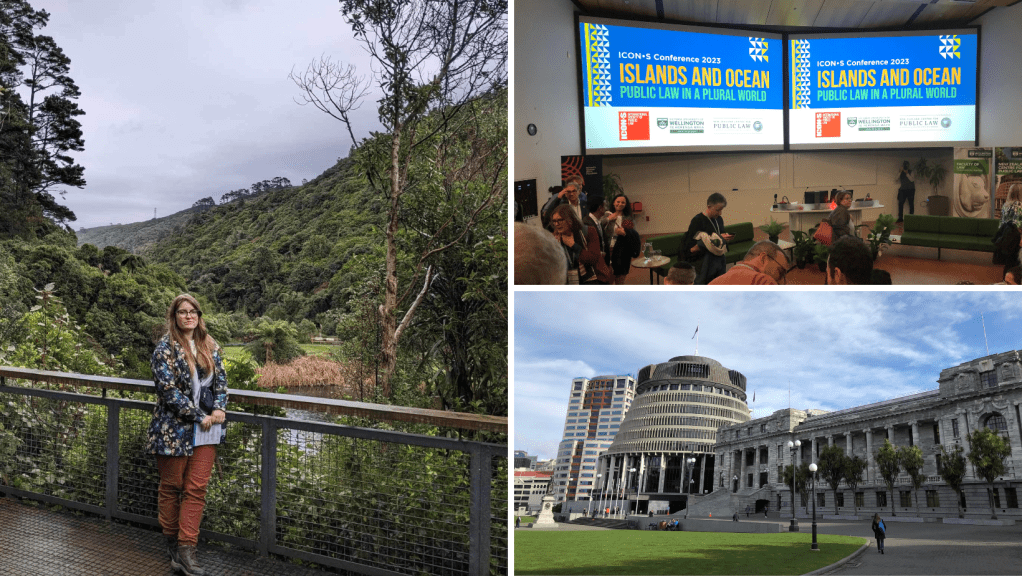
When I first landed in New Zealand last summer, I was both exhausted and excited for what the next few months would bring me. I had just finished the University of Georgia School of Law’s Global Governance Summer School, and I was worn out from the travel from Amsterdam to Atlanta to Auckland to my final destination of Wellington, New Zealand. Wellington is where I would spend the rest of my summer as a legal extern with the Department of Conservation through the Global Externships Overseas initiative.
My work in New Zealand involved picking apart the World Heritage Convention text. Specifically, I evaluated what language made the text binding and what policy documents and case law were made binding by the text itself. I also worked with case studies involving New Zealand land that was in conservation under the World Heritage Convention. I worked alongside lawyers within my department, lawyers who worked in foreign affairs, and even those who worked directly with the New Zealand Parliament. I designed my research to act as a guide for the international team at the Department of Conservation to assist in keeping New Zealand in compliance with the World Heritage Convention. As part of my externship, I was able to visit the New Zealand Parliament and observe members debating new legislation. I was also given the opportunity to attend the ICON-S Public International Law conference held in Wellington.
Along with my work experience, I had the opportunity to engage in the culture of my host community. I was in New Zealand during Matariki, the Māori New Year. Here, I saw a haka, a ceremonial performance within the Māori culture that is often performed at important events. I visited the Te Papa Tongarewa Museum and learned about the history and culture of the people of New Zealand. I tried yellow kiwi fruit, manuka honey, Wellington chocolate, and New Zealand pies. I also visited Zealandia, where part of the forest is fenced in to keep predators out and to provide the native birds within the sanctuary a place to thrive and recover their populations. Finally, one of my favorite parts of the trip was a drive to Hobbiton, where they filmed The Shire scenes in Lord of the Rings films. It was surreal being able to step inside a hobbit hole and have a drink at the Green Dragon Inn.
My Global Externships Overseas experience was everything I had hoped for and even more than I expected. I walked away from my 1L summer with significant international legal experience, new cultural understandings and appreciation, and even a tattoo of a New Zealand silver fern, an important indigenous plant that serves as a symbol of the country’s national identity.
***
Applications are now open for summer 2024 Global Externships Overseas (GEO). This initiative places University of Georgia School of Law students in four-to-twelve week international placements each summer, where they gain substantive, hands-on experience in diverse areas of legal practice. Over the last fifteen years, more than 200 Georgia Law students have completed a GEO in law firms, government agencies, corporate legal departments, intergovernmental organizations, and nongovernmental organizations around the world. Current 1Ls and 2Ls are encouraged to apply for summer GEOs. All applicants should reference this instructional video for step-by-step information regarding how to create and successfully complete an application for GEOs in UGA’s Study Away Portal by the March 10th deadline. For more information, email: ruskintlaw@uga.edu
Today, we welcome a guest post by Andrew Arrington, a member of the Georgia Law class of 2024. Through the Global Externships Overseas (GEO) initiative, Andrew was able to extern with Sorainen, an international business law firm based in Tallinn, Estonia.
I vividly remember my first day at Sorainen, tidying my hair anxiously in the reflection of the gold elevator. It was not only the first day of my 1L summer job, but it was my first time working abroad, and I did not know what to expect. I was relieved that my apartment was only a five-minute walk from my office, but I still got there so early that I ordered breakfast and coffee in a quiet, ultramodern café next door.
As the elevator counted down to the lobby floor, I mumbled the phrase, “Tere. Mina olen Andrew,” to myself over and over, unsure if my pronunciation was even intelligible. With a ding, I was warmly greeted by the woman at the front desk. I watched my soon-to-be coworkers passing by my conference room, putting up their coats and bags in the cloakroom next door, while I waited for my boss to arrive. My anxiety finally melted when Katriina, who interviewed me months earlier, saw me sitting in the office and burst in to give me a hug. It was then I knew I was in for a special summer.
The Global Externship Overseas initiative was a moonshot for me. What I originally imagined as a substitute for not studying abroad in undergrad turned out to be the best career decision I made during law school because of the depth of legal work and client interaction I had over the span of two short months. Through the tireless work of staff at the Dean Rusk International Law Center, including Sarah Quinn and Catrina Martin, my description of a hypothetical dream placement working on data privacy in Europe, possibly in Estonia, became a reality. This request was the result of being a first-generation law student who had just graduated from Georgia Tech; at this point, I was really only familiar with the field of data privacy law after taking a class with Professor Swire and Dr. Anton at my undergraduate institution. I had my sights set on Estonia because I was familiar with the country’s leadership in technology innovation and entrepreneurship in Europe.
I was proudly the first American intern in a couple of decades at Sorainen. During my summer there, I gained contracting skills, including with software as a service (SaaS) contracts, data protection agreements, and other standard GDPR privacy agreements. I was also able to research national security implications, genetic material requirements, and the brand new EU sanctions on Russia. I wrote memos on the effects of the then-nascent Digital Services Act and Digital Markets Act. When my time in the office came to a close, I was asked if I would like to work for a client full-time as the designated trainee to a general counsel for Pactum while I worked remotely from my home in the US. This was another great experience of implementing GDPR requirements through vetting vendors and researching the impact of US state privacy laws on a dual US-EU business.
By the end of my summer at Sorainen, I had colleagues who not only translated meetings in English for me, but also translated our nights out at the local museum. These are colleagues I am still in touch with and exchange Christmas cards with two years later.
Because of my decision to pursue a GEO, I fell in love with a place I would have never visited otherwise. I became a local at the bakery around the corner ordering rhubarb pastries in Estonian. I knew I reached local status when a new clerk working asked me a question about change in Estonian. I ate pine needle ice cream on walks by myself after work along cobblestone streets, and I was driven out of the city to Viru Bog by my fellow summer interns to visit one of the most beautiful natural parks I have ever been to. I had coworkers go out of their way to give me visits of their hometown during the weekends, and I also had an unforgettable office outing playing cards on the rooftop under the midnight sun.
I cannot recommend enough to my fellow students the professional value of not only being able to work in a legal environment abroad but also the memories that Georgia Law and the Center made possible through the GEO program. This opportunity increased my contract drafting and editing abilities tremendously, provided opportunities to interact directly with clients, and exposed me to data privacy and compliance work. Now every time I interview, it is the topic that people most want to talk about, and I not only have a wealth of legal experiences to draw upon but also a reminder of the summer of a lifetime.
***
Applications are now open for summer 2024 Global Externships Overseas (GEO). This initiative places University of Georgia School of Law students in four-to-twelve week international placements each summer, where they gain substantive, hands-on experience in diverse areas of legal practice. Over the last fifteen years, more than 200 Georgia Law students have completed a GEO in law firms, government agencies, corporate legal departments, intergovernmental organizations, and nongovernmental organizations around the world.
Current 1Ls and 2Ls are encouraged to apply for summer GEOs. All applicants should reference this instructional video for step-by-step information regarding how to create and successfully complete an application for GEOs in UGA’s Study Away Portal by the March 1 deadline. For more information, email: ruskintlaw@uga.edu
Today we welcome a guest post by Meredith Williams, a member of the University of Georgia School of Law Class of 2024. Meredith is one of several UGA Law students to participate in a semester-long international externship, a pilot extension of our existing Global Externships Overseas initiative. This pilot is a joint initiative between the Dean Rusk International Law Center and the law school’s Clinical and Experiential Program. Meredith’s post describes her experience attending an international convention as part of her externship.
I am spending the fall semester of my 3L year working as a legal extern with Weickmann, an intellectual property law firm located in Munich, Germany. I work under Dr. Udo W. Herberth (LL.M., ’96), who heads the firm’s brands and designs group.
A highlight of my global externship thus far has been attending the second annual Bavarian International Trademark Association (“BITMA”) convention, which Dr. Herberth founded. The conference took place over two days, during which I met trademark and patent attorneys from fourteen different countries. On the first day, attorneys from each country presented on the topics of 1) use and 2) jurisdiction.
My externship and this conference in particular have crystalized for me how intellectual property is an increasingly international area of law. Many clients and companies wish to register, maintain, and prevent infringement of their trademarks in more than one country; yet, there are nuanced and important distinctions between different jurisdictions’ requirements and timelines. In a field of law where adding value to a brand is crucial, it is important to be aware of these differences and stay on top of deadlines.
I enjoyed learning from the diverse group of individuals at the BITMA conference. For example, a topic I found compelling was the question of translation of trademark languages. In Canada, the Quebec charter regarding French language has been amended. Attorneys at the conference suggested this will have an impact on trademarks because the French portion of the mark must be twice the size, yet the entire trademark need not be translated. For example, in Quebec, an Apple store could display a large “Le Magasin” before “Apple,” and not have to translate “Apple” into “Pomme.” Further, in Japan, there are four different scripts, which create even more nuance to registering a word mark. These evaluations go into much more detail than we had time to cover during the conference, but it has piqued my interest as something I had never thought about living in the English-dominant US.
Another aspect of the BITMA conference that I enjoyed was the balance between personal and professional. The group of 25 of us shared many meals, watched the traditional Bavarian parade for the opening weekend of Oktoberfest, and eventually made our way to the festivities. While the substantive knowledge I acquired from this group is important, I also learned a lot from interacting with everyone on a personal level. Dr. Herberth fostered a warm and supportive atmosphere throughout the convention. This type of collegial experience served as a reminder that there is value in getting to know colleagues as people outside of work. The BITMA group treated me as an equal and were interested in my path and life. It reminded me that I want to lend a helping hand to law students and those in the early stages of their careers as I progress through mine.
I look forward to the second half of my semester working at Weickmann. I thank UGA Law for leaving such a lasting, positive impression on Dr. Herberth; it is for this reason that he was incentivized to provide educational experiences for UGA Law students like myself, and it is also why I know that I, too, want to provide this type of experience to a UGA Law student one day.