
Georgia Professor Greg Day presents at Japan’s Fair Trade Commission Symposium

University of Georgia Professor Greg Day was recently invited to present “The Evolving Landscape of Dark Patterns in the United States” at Japan’s Fair Trade Commission symposium titled Dark Patterns: The Role of Competition Policy on Deceptive Web Designs. Day’s presentation centered around antitrust, consumer protection laws, and dark patterns.

Below is a description of the symposium:

There are a variety of acts known as “dark patterns,” such as forcing consumers to register as members when browsing or purchasing products, or obscuring important information for consumers. These acts of dark patterns not only disadvantage consumers and other users, but there are also concerns that they may harm fair and free competition between businesses that use dark patterns and those that do not use such means. It is necessary to consider how to address the issue of dark patterns from the perspective of Antimonopoly Act and competition policy.

This symposium will include speeches and a panel discussion regarding current situation of dark patterns, their regulatory trends and future issues in Japan and abroad, and the way competition policy should approach dark patterns.

Day is an Associate Professor of Legal Studies at the Terry College of Business and holds a courtesy appointment in the School of Law. He is also an Affiliated Fellow at Yale Law School’s Information Society Project as well as the University of North Carolina’s Center for Information, Technology, and Public Life. His research has primarily focused on the intersection of competition, technology, innovation, and privacy as well as the disparate impact of anticompetitive conduct.


Georgetown Law professor Katrin Kuhlmann presents working paper at International Law Colloquium

The University of Georgia School of Law’s spring 2025 International Law Colloquium welcomed Professor Katrin Kuhlmann, who presented her working paper, “Micro International Law.” Greg Day, Associate Professor in the Terry College of Business at the University of Georgia, served as Kuhlmann’s faculty discussant.

Kuhlmann is the Faculty Director and Co-founder of the Center on Inclusive Trade and Development at Georgetown Law. Her scholarly focus lies in international law, development, inclusive and sustainable international trade law, regional trade agreements, agricultural law and food security, comparative economic law, African trade and development law and corridors, and the interdisciplinary connections between law and development.

Below is an abstract of Kuhlmann’s working paper:

International law has long been viewed as the domain of countries and capitals, not fields or factories, but this overly top-down perspective misses a critical and under-studied part of the picture. Underneath the macro level of standardized legal norms, international law is much more nuanced, with multiple sites of influence, production, design, adoption, and decision-making that scholars have largely neglected but which need to be better understood. Models stemming from legal systems in less powerful states, smaller-scale stakeholder interests, and local solutions are often treated as one-off anecdotes or isolated case studies without broader implications.

Capturing these lessons, cataloging them, and building a methodology around them could be transformational at a time when international law needs a refresh to make it more responsive to a new set of global challenges ranging from inequality to food insecurity to climate change.

This paper presents a conceptual and methodological framework for “micro international law” as a sub-field of international law. Adding a micro dimension to international law would bring it in line with other disciplines that recognize the importance of studying smaller-scale, more granular interventions. It would also make a significant contribution to the international legal field by integrating theoretical and empirical approaches to focus on the impact innovations within domestic legal systems and the interests of individuals have on international law (and the impact of international law on these systems and stakeholders), ultimately providing a framework for designing international law differently to equitably address more specialized needs and positively impact the lives of those international law aims to serve and benefit.

This year, Professor Desirée LeClercq is overseeing the colloquium, which is designed to introduce students to features of international economic law through engagement with scholars in the international legal field. To view the full list of International Law Colloquium speakers, visit our website.

This program is made possible through the Kirbo Trust Endowed Faculty Enhancement Fund and the Talmadge Law Faculty Fund.

Georgia Professor Greg Day presents at ASCOLA’s Annual Conference in Germany

University of Georgia Associate Professor of Legal Studies Greg Day recently presented research at the 19th American Society for Competition Law (ASCOLA) Annual Conference in Würzburg, Germany. The conference brings together about 120 scholars doing research in competition law, economics or policy from all over the world. 

Greg Day is an Associate Professor of Legal Studies at the Terry College of Business and holds a courtesy appointment in the School of Law. He is also an Affiliated Fellow at Yale Law School’s Information Society Project as well as the University of North Carolina’s Center for Information, Technology, and Public Life. His research has primarily focused on the intersection of competition, technology, innovation, and privacy as well as the disparate impact of anticompetitive conduct.
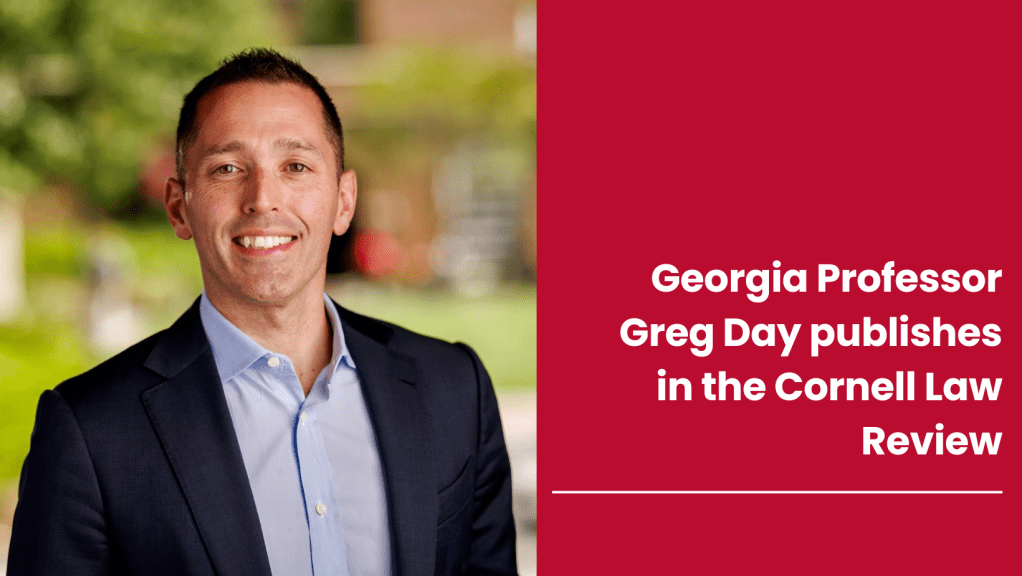
Georgia Professor Greg Day publishes in the Cornell Law Review

Greg Day, Associate Professor of Legal Studies at the Terry College of Business and professor (by courtesy) at the University of Georgia School of Law, published “Antitrust for Immigrants” in the Cornell Law Review.

Below is an abstract from the draft paper:

Immigrants and undocumented people have often encountered discrimination because they compete against “native” businesses and workers, resulting in protests, boycotts, and even violence intended to exclude immigrants from markets. Key to this story is government’s ability to discriminate as well: it is indeed common for state and federal actors to enact protectionist laws and regulations meant to prevent immigrants from braiding hair, manicuring nails, operating food trucks, or otherwise competing. But antitrust courts have seldom mentioned a person’s immigration status, much less offered a remedy.

This Article shows that antitrust’s “consumer welfare” standard has curiously ignored the plight of immigrants. Part of the reason is that antitrust law is characterized as a “colorblind” regime benefitting consumers collectively, meaning that it isn’t supposed to prioritize insular groups such as immigrants. Courts and scholars have also described matters of inequality and discrimination as “social harms” existing beyond antitrust’s scope. In fact, antitrust lawsuits have successfully sought to drive immigrants out of markets, alleging that competitors gained an “unfair” advantage from employing undocumented workers. Under this view of antitrust law, the exclusion of immigrants is an appropriate way of promoting competition.

This Article argues that anti-immigrant discrimination creates the exact types of harms that antitrust was meant to remedy. Since excluding immigrants can misallocate resources on citizenship or racial lines as opposed to their most productive usages, certain acts of discrimination should entail “conduct without a legitimate business purpose,” even when based solely on racial animus. A hidden type of market power is revealed in that foreign-born people are less able to employ self-help remedies to correct market failures. In addition to analyzing antitrust’s purpose and economic foundation, this Article delves into antitrust’s history to show that an original function of competition law was to protect foreigners. By demonstrating how incumbents can inflict greater levels of harm on immigrants while wielding less market power, this Article reimagines the consumer welfare standard and its colorblind approach as well as reveals how marginalized communities defy antitrust’s assumptions of self-help remedies.

Greg Day is an Associate Professor of Legal Studies at the Terry College of Business and holds a courtesy appointment in the School of Law. He is also an Affiliated Fellow at Yale Law School’s Information Society Project as well as the University of North Carolina’s Center for Information, Technology, and Public Life. His research has primarily focused on the intersection of competition, technology, innovation, and privacy as well as the disparate impact of anticompetitive conduct.