We at the University of Georgia School of Law Dean Rusk International Law Center are delighted to congratulate our longtime colleague Harlan G. Cohen, whom the American Journal of International Law has just elected an Editor-in-Chief, along with Professor Neha Jain of Northwestern’s Pritzker School of Law. The new editors’ tenure will start in April 2026.
Having joined the Georgia Law faculty in 2007, Professor Cohen was appointed its inaugural Gabriel M. Wilner/UGA Foundation Professor in International Law in 2016. That same year he also was appointed a Faculty Co-Director of the Dean Rusk International Law Center, serving in that role with Georgia Law Professor Diane Marie Amann. Cohen held both positions until his move at the end of 2023 to New York’s Fordham School of Law, where he is a Professor of Law.
While at Georgia Law, Cohen taught and published in fields including Public International Law, International Trade, Foreign Affairs & National Security Law, and Global Governance. He also served as the Faculty Advisor for the Georgia Journal of International & Comparative Lawand as an advisor to the Jessup International Law Moot Court team.
Cohen’s election followed his many years of service as a member of the editorial board of AJIL, a leading, century-old, peer-reviewed quarterly of the American Society of International Law (of which Cohen is a Vice President).AJIL features articles, essays, editorial comments, current developments, and book reviews by pre-eminent scholars and practitioners from around the world addressing developments in public and private international law and foreign relations law. Along with the online publication AJIL Unbound, AJIL is indispensable for all professionals in international law, economics, trade, and foreign affairs.
The University of Georgia School of Law’s spring 2025 International Law Colloquium began last week with Professor Harlan Cohen of Fordham University School of Law. For more than a decade, the International Law Colloquium Series has brought leading scholars to Georgia Law, where they have presented works in progress and invited discussion and comments from students as well as faculty discussants.
This year, Professor Desirée LeClercq is overseeing the colloquium, which is designed to introduce students to features of international economic law through engagement with scholars in the international legal field. The course broadly defines “international economic law,” to include traditional approaches (trade and investment agreements) as well as non-traditional, emerging approaches (examining the effects of international economic law on marginalized communities and considering re-distributional policies).
Cohen presented his working paper titled, “The International Order, International Law, and the Definition of Security.” Cohen, who previously served as the Gabriel M. Wilner/UGA Foundation Professor in International Law at the University of Georgia School of Law and Faculty co-Director of the Dean Rusk International Law Center, specializes in international trade, international law, international legal theory, global governance, and U.S. foreign relations law.
As economic security has seemingly moved to the center of American and European foreign policy, both the United States and the European Union have broadened their interpretation of international law rules governing security, coercion, and intervention. These broadened interpretations have supported a bevy of new sanctions, trade restrictions, investment controls, and industrial policies that have turned the global economy into an increasingly weaponized space. But these interpretations are not exactly new, echoing developing state interpretations of international law that developed states had long ago seemingly rejected. How are these once moribund interpretations of security, force, and coercion being brought back to life?
This essay argues that these interpretative shifts highlight the role of the international order as an interpretative mechanism within international law. Borrowing from the work of Robert Cover, it explains the ways that the international order acts as a jurispathic agent within the system, judging which interpretations live on and which are cast aside. As global power shifts, the international order shifts with it, potentially reopening interpretative fights over international law. Today’s fights over the meaning of security, force, and coercion thus reflect both the realities of a changing order and the battle to shape the one to come.
To view the full list of International Law Colloquium speakers, visit our website.
This program is made possible through the Kirbo Trust Endowed Faculty Enhancement Fund and the Talmadge Law Faculty Fund.
Gabriel M. Wilner/UGA Foundation Professor in International Law & Faculty Co-Director of the Dean Rusk International Law Center Harlan Grant Cohen spoke to International Law Society (ILS) members in late September as part of an ongoing brown bag lunch series with international law faculty at UGA Law.
Cohen provided the students in attendance with an introduction to his current research. He then outlined his path into academia and offered students insight into the spectrum of professional opportunities within the field of international law, noting fast-growing sectors like export controls, CFIUS issues, and space law. He also offered some reflections on the changing nature of the field, including the recent trend of withdrawal from international organizations and treaties; the emergence of new centers of power that challenge norms in international law; and increasing economic competition influencing international law through mechanisms such as trade rules and sanctions. Cohen encouraged student questions to drive the majority of the conversation, providing career and networking advice throughout the discussion. He recommended that students interested in international law enroll in the spring Public International Law course, attend conferences and get involved in international law organizations, and try to learn a second language if possible.
ILS President, 2L Madison Graham, spearheaded this series with the intention of orienting new law students towards the international law faculty. She hopes to expand the student body’s definition of what international law means and to bring their attention to the academic achievements of the international law faculty here at UGA Law.
ILS is the student chapter of the International Law Students Association, a Washington, D.C.-based organization that for decades has provided students with opportunities to study, research, and network in the international law arena through conferences, publications, and administration of the Philip C. Jessup International Law Moot Court Competition. At UGA Law, ILS hosts events and projects designed to stimulate and advance understand of international, comparative, foreign, and transnational law and institutions. ILS’ faculty advisor is Diane Marie Amann, Regents’ Professor of International Law, Emily & Ernest Woodruff Chair in International Law, Faculty Co-Director of the Dean Rusk International Law Center.
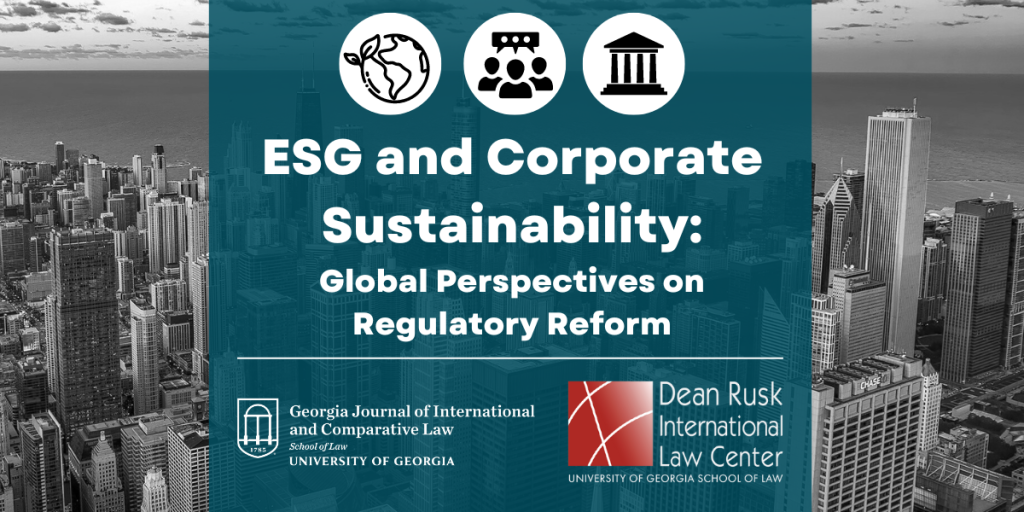
This year’s annual conference of the Georgia Journal of International and Comparative Law will address “ESG and Corporate Sustainability: Global Perspectives on Regulatory Reform.” Featured will be a keynote discussion by Jill E. Fisch, the Saul A. Fox Distinguished Professor of Business Law and Co-Director of the Institute for Law and Economics at the University of Pennsylvania Carey Law School, as well as panels including more than a dozen experts from around the world.
The daylong conference will take place on Monday, October 16, in the Larry Walker Room of Dean Rusk Hall at the University of Georgia School of Law.
Sponsoring along with GJICL, a student-edited journal established more than 50 years ago, is the law school’s Dean Rusk International Law Center. GJICL Editor in Chief, 3L Jack Schlafly, worked with Professor Christopher M. Bruner, who is the Stembler Family Distinguished Professor in Business Law and a newly appointed Faculty Co-Director of the Dean Rusk International Law Center; Center staff Sarah Quinn, Interim Director; Catrina Martin, Global Practice Preparation Assistant; and with the GJICL’s Faculty Advisor, Professor Harlan Grant Cohen, who is Gabriel M. Wilner/UGA Foundation Professor in International Law and one of the Center’s Faculty Co-Directors.
Below is the concept note of the conference:
We live in an era marked by complex and interconnected environmental, social, and economic crises, including climate change and various forms of destabilizing inequalities. Efforts to grapple with these realities are rapidly evolving and taking shape through a host of private and public institutions, both domestically and internationally, and an array of novel reform efforts aim to curb harmful corporate practices that have contributed to such crises.
Global asset managers have increasingly prioritized “environmental, social, and governance” (ESG) factors – emphasizing their relation to investment risk and investment return – and have taken up existing tools available to them through corporate law, securities regulation, and capital market structures to push for change. Meanwhile, various types of domestic regulatory reforms have been adopted, or are under consideration, in jurisdictions around the world to promote “corporate sustainability,” understood to include environmental, social, and economic dimensions. Some reform initiatives focus on disclosure, reflecting confidence that investors, consumers, and other constituencies armed with sufficient information could differentiate between sustainable and unsustainable companies, and that these private actors would effectively reward the former and punish the latter. Other reform initiatives take more direct aim at decision-making incentives of managers and investors alike, through corporate governance structures creating novel – and potentially powerful – liability regimes intended to force both domestic and multinational businesses to internalize costs that would otherwise be externalized to society and the environment. At the same time, a host of international organizations have sought to promote ESG and corporate sustainability through a range of global standard-setting and coordination efforts.
This symposium will grapple with the array of ESG and corporate sustainability initiatives taking shape today, mapping this rapidly evolving global landscape and engaging with the host of complex international and comparative legal challenges they raise. Speakers offering a diverse range of doctrinal, institutional, and jurisdictional perspectives will tackle these issues through presentations and panel discussions focusing on capital market developments, corporate governance reform initiatives, and efforts to constrain multinational businesses.
The day’s events are as follows:
9:00-9:15am | Welcome Messages
Peter B. “Bo” Rutledge, Dean and Talmadge Chair of Law, University of Georgia School of Law
Sarah Quinn, Interim Director, Dean Rusk International Law Center
9:15-10:30am | Panel 1: ESG and Sustainable Finance
George S. Georgiev, Associate Professor of Law, Emory University School of Law
Virginia Harper Ho, Professor of Law, City University of Hong Kong (Zoom)
Stephen Park, Associate Professor of Business Law and Satell Fellow in Corporate Social Responsibility, University of Connecticut School of Business
Anne Tucker, Professor of Law, Georgia State University College of Law
Moderator: Usha Rodrigues, University Professor and M.E. Kilpatrick Chair of Corporate Finance and Securities Law, University of Georgia School of Law
10:30-10:45am | Break
10:45-12:00pm | Panel 2: Corporate Law, Corporate Governance and Sustainability
Matthew T. Bodie, Robins Kaplan Professor of Law, University of Minnesota Law School
Andrew Johnston, Professor of Company Law and Corporate Governance, University of Warwick School of Law (UK) (Zoom)
Lindsay Sain Jones, Assistant Professor, University of Georgia Terry College of Business
Omari Scott Simmons, Professor of Law, George Washington University Law School
Moderator: Christopher M. Bruner, Stembler Family Distinguished Professor in Business Law and Faculty Co-Director of the Dean Rusk International Law Center, University of Georgia School of Law
12:00-1:00pm | Lunch
1:00-2:15pm | Panel 3: Multinational Corporations and Global Value Chains
Sarah Dadush, Professor of Law, Rutgers Law School (Zoom)
David Hess, Professor of Business Law and Business Ethics, University of Michigan Stephen M. Ross School of Business
Kish Parella, Class of 1960 Professor of Ethics and Law, Washington and Lee University School of Law (Zoom)
Jaakko Salminen, Associate Senior Lecturer, Department of Law, Lund University (Sweden) (Zoom)
Moderator: Harlan G. Cohen, Gabriel M. Wilner/UGA Foundation Professor in International Law and Faculty Co-Director of the Dean Rusk International Law Center, University of Georgia School of Law
2:15-2:30pm | Break
2:30-2:35pm | Keynote Introduction
Christopher M. Bruner, Stembler Family Distinguished Professor in Business Law and Faculty Co-Director of the Dean Rusk International Law Center, University of Georgia School of Law
2:35-3:15pm | Keynote Address
Jill E. Fisch, Saul A. Fox Distinguished Professor of Business Law and Co-Director of the Institute for Law and Economics, University of Pennsylvania Carey Law School
3:15 | Closing Remarks
Jack Schlafly, Editor in Chief, Georgia Journal of International and Comparative Law


 exchange of notes