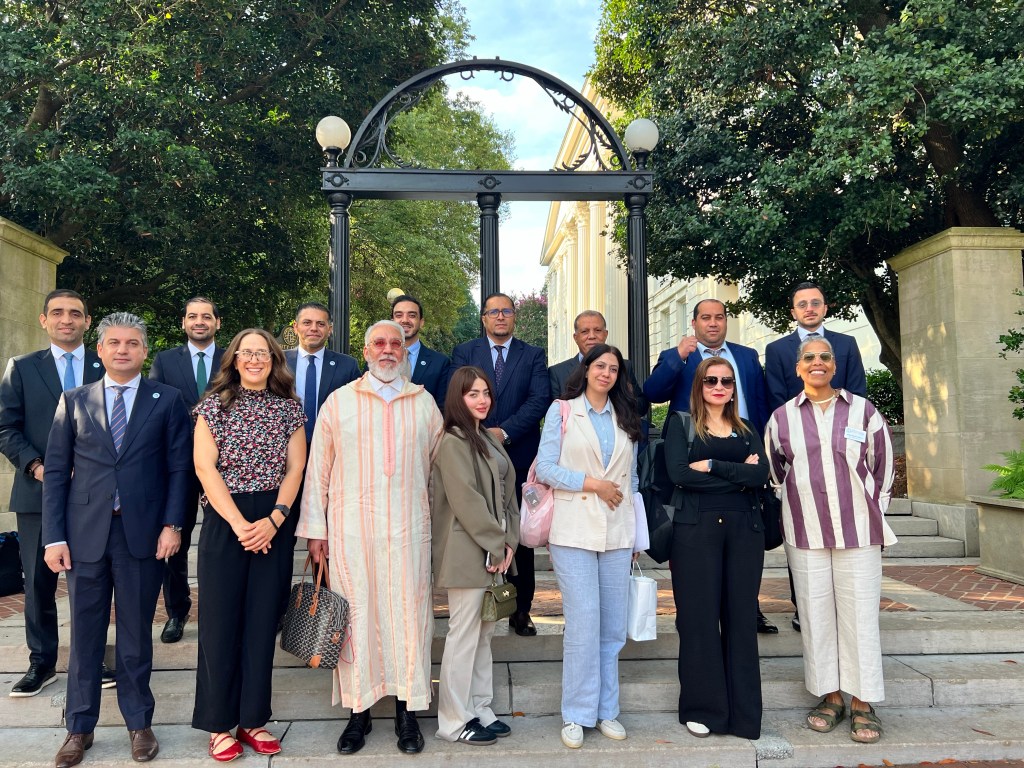
Last month, the University of Georgia School of Law hosted a delegation of lawyers and judges from North African and Middle Eastern countries through the U.S. Department of State’s International Visitor Leadership Program (IVLP). The half-day visit to Athens was part of a three-week regional project entitled “The U.S. Judicial System.” Thirteen individuals representing eight countries participated and learned about principles of the U.S. judicial and legal systems while deepening their understanding of federal and state judicial systems during their time in the U.S.
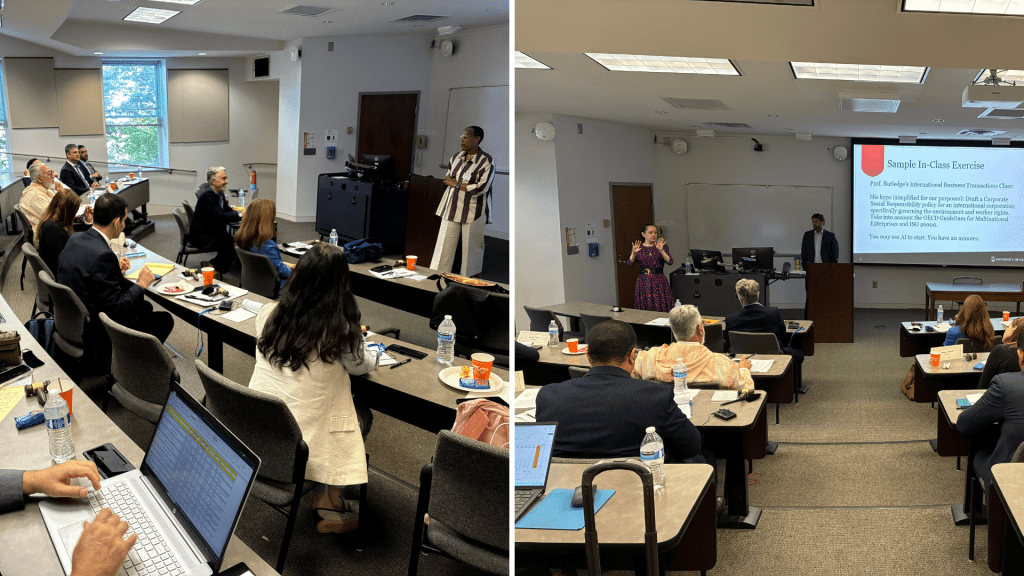
While at Georgia Law, the delegation met first with Lynne Moore Nelson, Executive Director of the Institute of Continuing Judicial Education (“ICJE”). Nelson described the role of the ICJE, its partnership model, and how it serves the state’s judicial branch. She provided examples of their training components for judges and court personnel, the goals of their work, and different opportunities for growth.
Professor Thomas “TJ” Striepe, Director of the Law Library, and Professor Brandy Ellis, Research Services Librarian, presented afterwards on practical applications of generative Artificial Intelligence (“genAI”) in U.S. legal education and in the legal system. They gave an overview of the law school’s approach to genAI instruction and use, as well as examples of how genAI has been used in courts and law firms in the U.S. recently. They concluded with a discussion of professional responsibility as it pertains to genAI usage in both law school and in the larger legal system.
Director of Georgia Law’s Dean Rusk International Law Center, Sarah Quinn, and Center Associate Director, Taher Benany, co-facilitated a synthesis discussion for the delegation, providing participants to reflect on transferrable judicial practices they observed, how they could build trust in their courts and legal communities, and other ways to implement lessons learned during their experience in the U.S. in their home countries.
Launched in 1940, the IVLP deepens ties between the United States and other nations through carefully designed professional visits to the United States based on U.S. foreign policy goals for current and emerging foreign leaders. Each year, approximately 4,000 IVLP participants from around the world are selected by U.S. embassies to engage professional counterparts across the United States. Through these encounters, they develop a deeper understanding of the political, economic, and cultural influences within U.S. society. IVLP participants also gain a firsthand experience of the United States, its people, and its culture. Current and emerging leaders represent government, politics, the media, education, nongovernmental organizations, the arts, public health, international security, business and trade, and other fields. Over 500 current and former heads of government and state, 1,600 cabinet officials, 1,000 Members of Parliament, 12 Nobel Laureates, and many other distinguished world leaders in the public and private sectors have participated in the International Visitor Leadership Program.
Special thanks to Hannah Kim, Program Coordinator – Georgia Council for International Visitors (GCIV), and Lindsay Weinmann, Administrative Specialist to the Dean Rusk International Law Center, for their logistical support of this visit.


 We are deeply honored to announce that one of our distinguished international law alumnae,
  She returned to Georgia Law’s Athens campus last month to receive our alum association’s
  Law students in Austria, Croatia, and nearby regions will soon have the opportunity for talk with a Dean Rusk International Law Center staffer about pursuing a degree at here at the
  sday, November 9, Vienna: 16:00 – 18:00, Amerika Haus, Friedrich-Schmidt-Platz 2, 1010 Vienna. Registration:
  Reap, a

 Ambassador Rivkin spoke about the
  At first blush, today’s security challenges may seem familiar. Yet they are new – emerging, in U.S. State Department parlance – because of the novel ways in which those challenges present themselves.
 Visitors to Tillar House, the Washington, D.C., headquarters of the American Society of International Law, were treated yesterday to a superb
  One was the
