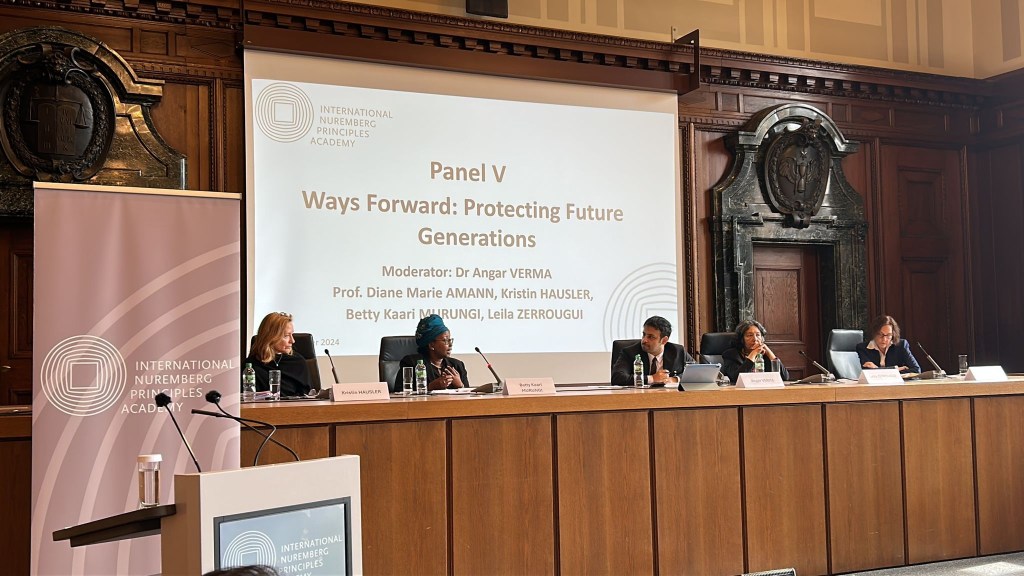
University of Georgia School of Law Professor Diane Marie Amann spoke at last week’s Nuremberg Forum 2024, the annual three-day meeting of the International Nuremberg Principles Academy. It was held in the Nuremberg, Germany, courtroom where hundreds of Nazi defendants were tried in the wake of World War II.
The theme of this year’s Forum was “For Every Child: Protecting Children’s Rights in Armed Conflict.” Amann spoke on the closing panel, “Ways Forward: Protecting Future Generations,” pictured above. She is pictured at right along with, l to r: Kristin Hausler; Betty Kaari Murungi; moderator Angar Verma; and Leila Zerrougui.
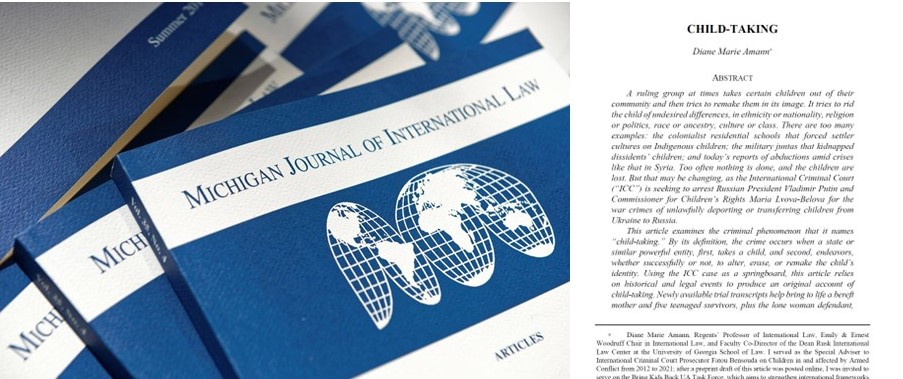
Amann gave an overview of her new article “Child-Taking,” 45 Michigan Journal of International Law 305 (2024), with focus on forced residential schooling of Indigenous children. As theorized in the article available here, child-taking occurs when a state or similar powerful entity takes a child and then endeavors to alter, erase, or remake the child’s identity. Though a criminal phenomenon, it may be redressed not only in criminal justice systems, but also through transitional justice mechanisms.
Amann is Regents’ Professor of International Law, Emily & Ernest Woodruff Chair in International Law, and a Faculty Co-Director of our Dean Rusk International Law Center here at Georgia Law. She served from 2012 to 2021 as International Criminal Court Prosecutor Fatou Bensouda’s Special Adviser on Children in & affected by Armed Conflict. This fall, she is spending a research-intensive semester in the United Kingdom, where she is a Research Visitor at the Oxford Faculty of Law Bonavero Institute of Human Rights.
As theorized in the article, “child-taking” occurs when a state or similar powerful entity takes a child and then endeavors to alter, erase, or remake the child’s identity. It is a criminal phenomenon that has been repeated across decades and centuries. On rare occasion, criminal prosecutions have occurred, as with the Situation in Ukraine before the International Criminal Court. More often redress, if any, must take place in other forums. The article thus considers these other types of transitional justice, with particular attention to the legacies of forced residential schooling imposed upon Indigenous children in the United States, Canada, and elsewhere.
Amann is Regents’ Professor of International Law, Emily & Ernest Woodruff Chair in International Law, and a Faculty Co-Director of our Dean Rusk International Law Center here at Georgia Law. She served from 2012 to 2021 as International Criminal Court Prosecutor Fatou Bensouda’s Special Adviser on Children in & affected by Armed Conflict.
Here’s the abstract of the “Child-Taking” article, the print version of which is available here:
A ruling group at times takes certain children out of their community and then tries to remake them in its image. It tries to rid the child of undesired differences, in ethnicity or nationality, religion or politics, race or ancestry, culture or class. There are too many examples: the colonialist residential schools that forced settler cultures on Indigenous children; the military juntas that kidnapped dissidents’ children; and today’s reports of abductions amid crises like that in Syria. Too often nothing is done, and the children are lost. But that may be changing, as the International Criminal Court (“ICC”) is seeking to arrest Russian President Vladimir Putin and Commissioner for Children’s Rights Maria Lvova-Belova for the war crimes of unlawfully deporting or transferring children from Ukraine to Russia.
“This article examines the criminal phenomenon that it names ‘child-taking.’ By its definition, the crime occurs when a state or similar powerful entity, first, takes a child, and second, endeavors, whether successfully or not, to alter, erase, or remake the child’s identity. Using the ICC case as a springboard, this article relies on historical and legal events to produce an original account of child-taking. Newly available trial transcripts help bring to life a bereft mother and five teenaged survivors, plus the lone woman defendant, who testified at a little-known child-kidnapping trial before a postwar Nuremberg tribunal. Their stories, viewed in the context of the evolution of international child law, inform this article’s definition. These sources further reveal child-taking to be what the law calls a matter of international concern. At its most serious, child-taking may constitute genocide or another crime within the ICC’s jurisdiction. Yet even if circumstances preclude punishment in that permanent criminal court, child-taking remains a grave offense warranting prosecution or other forms of local and global transitional justice. This is as true for the Indigenous children of residential schools in North America, Australia, and elsewhere, and for children in Syria and many other places in the world, as it is for the children of Ukraine.
The faculty sponsor for Amann’s visit is Professor Dapo Akande. Oxford’s Chichele Professor of Public International Law and a member of the U.N. International Law Commission, he has just been nominated as the UK candidate for election to the International Court of Justice.
Amann, who is Regents’ Professor, Emily & Ernest Woodruff Chair in International Law, and Faculty Co-Director of the Dean Rusk International Law Center here at the University of Georgia School of Law, held the same Oxford post during another research-intensive semester, Spring 2018.
She plans to pursue her scholarship related to women professionals who played roles in international criminal trials after World War II and also her work on child rights, especially as they relate to armed conflict and similar violence.
As a Research Visitor, she also will have the opportunity to take part in Bonavero Institute activities, and will benefit from Oxford’s libraries, seminars and lectures, and other offerings.
The Bonavero Institute was founded in 2016 as a unit of the Oxford Faculty of Law, under the direction of Professor Kate O’Regan, a former judge on the Constitutional Court of South Africa.
University of Georgia School of Law student, rising 3L Erin Nalley, recently attended the University of Liverpool School of Law and Social Justice’s second annual Summer School in partnership with the Council of Europe. This year’s Summer School took place in Liverpool, UK from July 8-19 and centered on the theme “Council of Europe at 75: Protecting Human Rights, Democracy, and the Rule of Law in a Rapidly Changing World.“ Below, Nalley reflects on her experience as the first Georgia Law student to attend the Summer School. The University of Georgia and the University of Liverpool are institutional partners.
I have been very fortunate this summer to have the opportunity to represent the University of Georgia School of Law at the University of Liverpool’s second Summer School in the Law of the Council of Europe. This year, the Summer School celebrated the 75th anniversary of the Council of Europe and focused on Protecting Human Rights, Democracy, and the Rule of Law in a Rapidly Changing World. This included focusing on emerging technologies, such as Artificial Intelligence and Neurotechnology, and their interaction with human rights. This is only the second year the University of Liverpool has hosted this Summer School. Still, their unique connection and work with the Council of Europe allows them to provide students and working professionals from around the world with an amazing opportunity to learn not only about the Council of Europe but also about emerging human rights challenges.
As this Summer School focuses on issues that come before the Council of Europe and other European Committees and Tribunals, attendees are mainly from European countries, although not all are European Union countries. I met colleagues from over 20 different countries including Italy, Switzerland, Germany, Ireland, and more. This year there was especially great representation of Balkan states like Bosnia and Herzegovina, Kosovo, North Macedonia, Romania, and Serbia. There were also other participants from countries outside of Europe, including India. This experience was truly diverse and allowed me to make many connections and friendships with those around the world.
For two weeks, I attended lectures on a variety of issues including topics such as AI technology, organ trafficking, the Venice Commission, and counter-terrorism laws. Our lectures were given by practicing lawyers, judges, and academic professionals. There were around 3-4 lectures a day from Monday through Friday. The last day included closing remarks and talks about the future of the Council of Europe and the European Court of Human Rights. All attendees were awarded a certificate for our participation in the Summer School as well.
Although I was the only participant from the United States, I found a lot of common ground with my cohort. I was able to travel around the city and try new restaurants with the same people I could sit with and have a deep and meaningful discussion on human rights issues around the world. My experience was not just academic, but it was also cultural and communal.
Within the city of Liverpool, there are many museums and landmarks. There are many connections to American history, Irish culture, and of course, the Beatles throughout the city. Liverpool is also a great location for trying new foods and drinks. Because of their proximity to Ireland, Irish culture and food is very prominent in Liverpool which means you can experience both English and Irish cuisine in one town. Because of its location on the western coast of England, Liverpool also situated visitors well for additional travel. I was able to take a day trip over one of my weekends to Dublin, and some of my colleagues traveled to Wales and Scotland in their free time.
The University of Liverpool Summer School has been a wonderful experience. Liverpool’s location is great not only for learning more about European and international law, but for getting to experience other countries and cultures as well. The University of Liverpool works hard to use its connections with the Council of Europe to promote and help build the networks of its Summer School participants. It is a fantastic opportunity to build relationships with legal professionals from all over the world in a short amount of time.
I hope to pursue a career in international law after graduation, and this experience will assist me in reaching that goal in many ways. It has allowed me to network with professionals and learn about human rights issues I may hope to work on after law school.
***
For more information about attending Liverpool Summer School, please email the Center: ruskintlaw@uga.edu
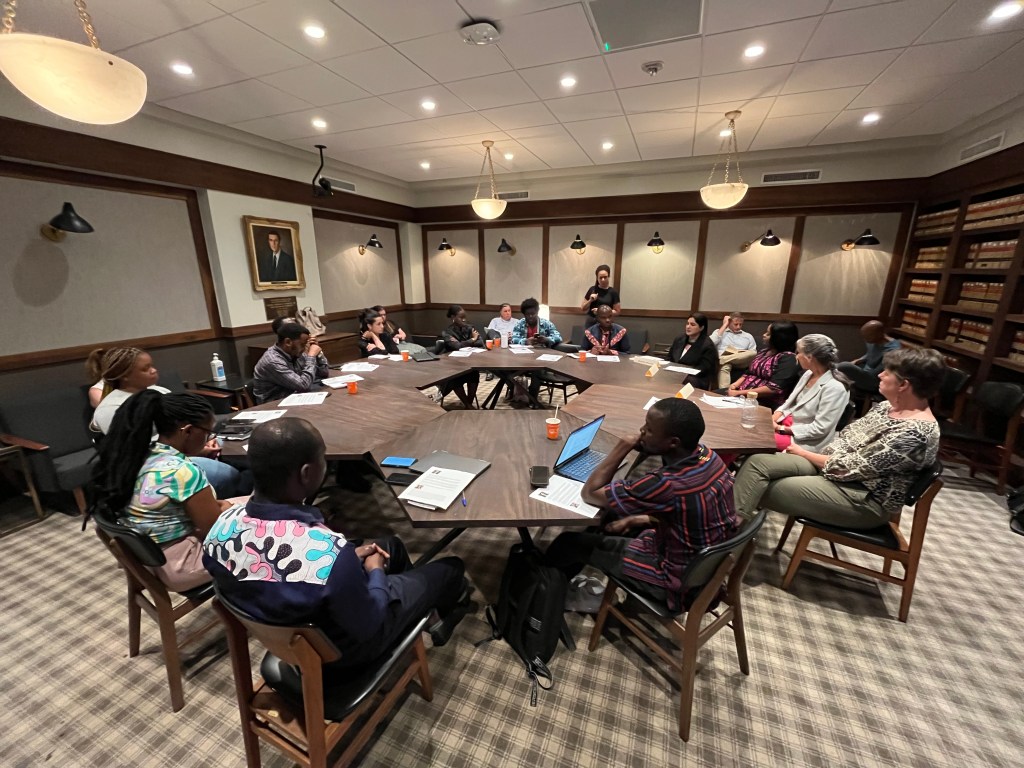
The 10 Fellows in attendance have work experience in anti-human trafficking, advocacy for women and girls, human rights, and refugee and victim assistance, among other topics. A total of 10 countries were represented in this group: The Republic of Congo, Ethiopia, Mali, South Africa, Zambia, Zimbabwe, Kenya, Burkina Faso, Uganda, and the Ivory Coast.
Scartz, Prittie, and Lartey began the roundtable by discussing their respective backgrounds and work, and then answered the Fellows’ questions. This is the second year that the law school has hosted a group of Fellows.
The Mandela Washington Fellowship for Young African Leaders is the flagship program of the U.S. government’s Young African Leaders Initiative (YALI) and sponsored by the U.S. Department of State. Since 2014, nearly 4,200 young leaders from every country in Sub-Saharan Africa have participated in the Fellowship. Mandela Washington Fellows, between the ages of 25 and 35, are accomplished innovators and leaders in their communities and countries.
Professor Diane Marie Amann recently was featured in Expresso, a newspaper based in Lisbon, Portugal, regarding efforts to hold Russian officials accountable for the war in Ukraine.
Reviewing various obstacles to these efforts, Tribuna quoted Amann as follows (in translation):
“One question, obviously, is whether this court will be able to arrest the accused leaders,” acknowledges Diane Marie Amann. Still, she points out, “this is a challenge in all criminal cases, and the magnitude of the challenge should not impede the effort to ensure justice.”
Recalling the March 17, 2023, arrest warrants issued by the International Criminal Court against Russian President Vladimir Putin and his Children’s Rights Commissioner Maria Lvova-Belova (about which Amann has written here), Tribuna wrote:
Although neither has been detained – which highlights the challenge that any legal system faces when trying to guarantee justice while the conflict is ongoing – the decision had effects, considers Amann. “It raised public awareness about the criminal allegations and encouraged states and civil society actors to call for the return of children.”
Amann is Regents’ Professor of International Law, Emily & Ernest Chair in International Law, and Faculty Co-Director of the Dean Rusk International Law Center here at the University of Georgia School of Law. She writes and teaches in areas including transnational and international criminal law, child and human rights, constitutional law, and global legal history.
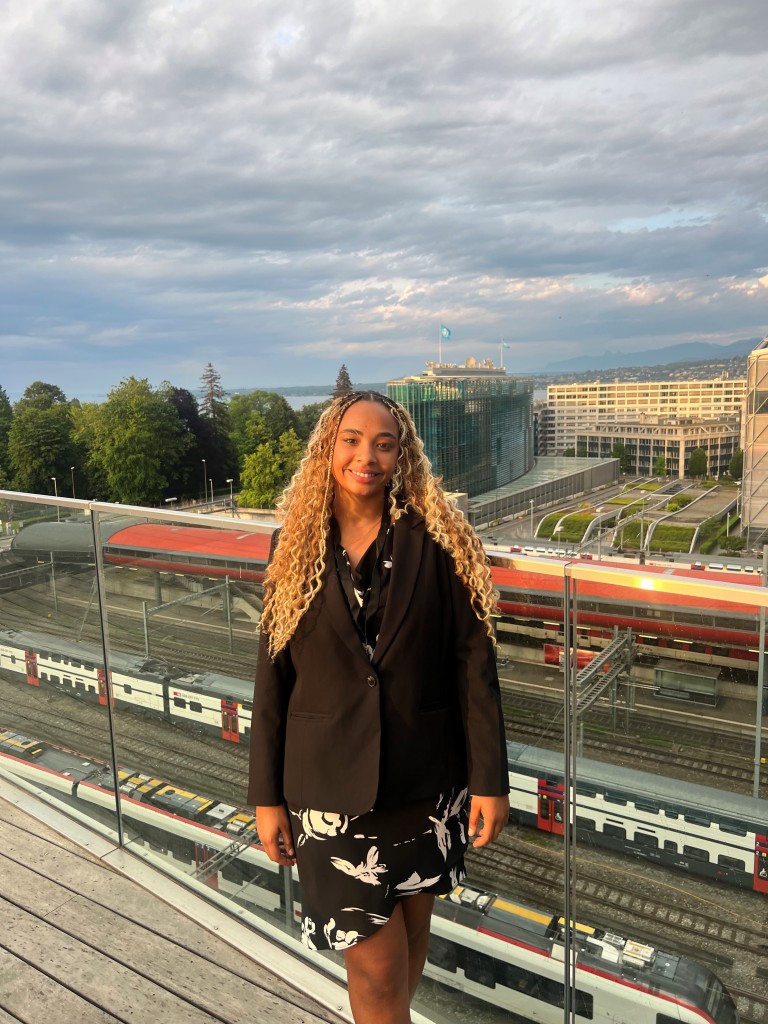
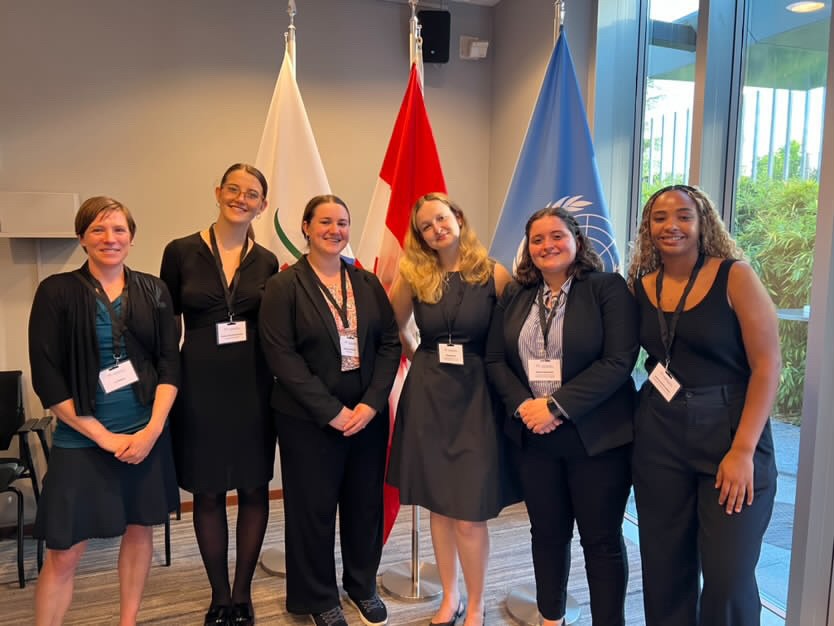
University of Georgia School of Law student, rising 2L Aubrey “Ellie” Wilson-Wade, recently attended the American Society of International Law (ASIL)’s 2024 ASIL Abroad meeting on June 5-6 at the University of Geneva in Geneva, Switzerland. The two-day conference consisted of dual parallel tracks on Human Rights, International Humanitarian Law, International Criminal Law (Track 1) and International Dispute Resolution & International Economic Law (Track 2). Georges Abi-Saab (honorary professor at The Geneva Graduate Institute) delivered a keynote speech, with Laurence Boisson de Chazournes (University of Geneva) as discussant. Below, Wilson-Wade reflects on her experience as an attendee of the conference. Georgia Law is an academic partner of ASIL.
I am so grateful to have had the opportunity to attend the 2024 ASIL Abroad Conference in Geneva, Switzerland. I was able to attend sessions in both track 1 and track 2, as I have an interest in both tracks’ topics. The most memorable sessions that I attended included “Enforcement of Arbitral Awards Rendered Against States” and “Compensation in International Law.” Additionally, I was able to see a mock arbitration related to growing tensions between investment treaties and environmental protection. These panels taught about investment and trade disputes in international law.
My favorite session was titled “Gender, Sexualized Violence, and Conflict: Incorporating the Women, Peace, and Security Agenda into Global Atrocity Prevention Efforts.” The panelists, including Priya Gopalan, Vanessa Murphy, and Dalila Seoane, were able to share their firsthand knowledge and experience working on issues related to gender-based violence.
Overall, the conference was a once-in-a-lifetime learning experience and every panel had an array of diverse perspectives and ideas. Not only was the substantive portion of the conference great, but I also met so many legal professionals and students during my time in Geneva. In just two days, I was able to connect with students attending law school throughout the United States, as well as from schools in England, Brazil, and Geneva. I was also able to network with legal professionals from all over the world.
As a first-year law student, it was a unique opportunity to learn about intricacies of international law outside of the typical classroom setting from professionals in the field. Additionally, it was a great way to make connections with international lawyers and law students. I would highly recommend any student who wishes to globalize their legal perspective and education to attend this conference.
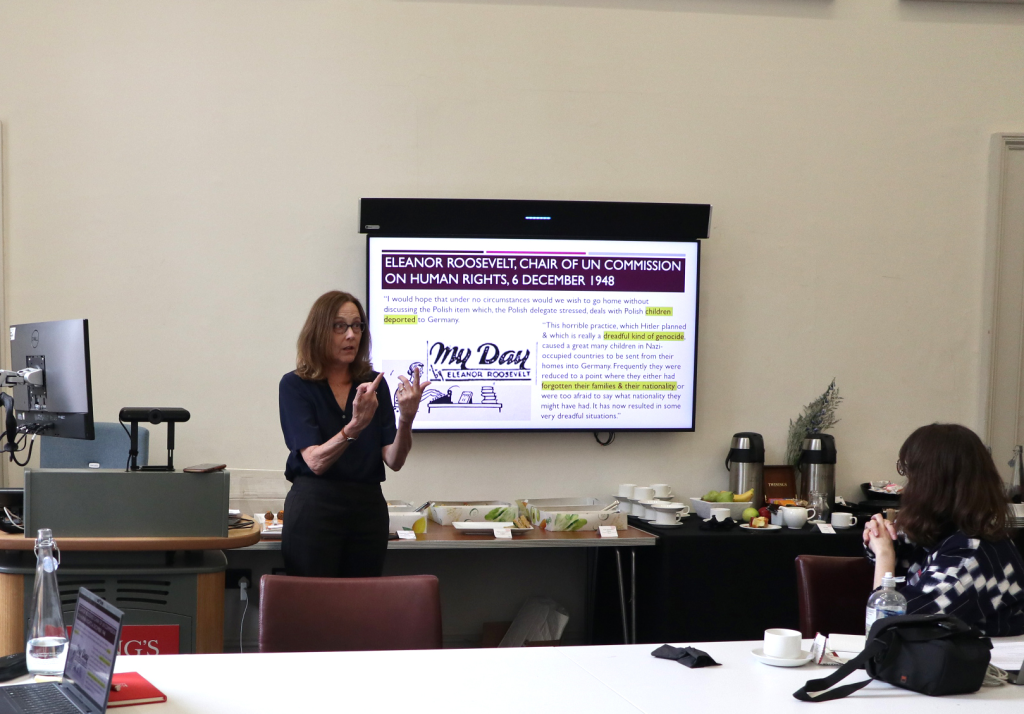
Professor Diane Marie Amann recently presented her research on “Child-Taking” during a Forced Separation Workshop at King’s College London, which cosponsored the event along with Queen’s University Belfast School of Law and the UK Gender, Justice and Security Hub.
Organizers of the workshop – Professor Fionnuala Ni Aolain, Dr. Rebekka Friedman, and Dr. Diana Florez – brought together a global array of participants who engaged in a multidisciplinary exploration of instances and consequences of separating families. Studied were contemporary and historical contexts across the globe. They included: armed conflict and similar violence; security, carceral, and migration detention; coerced schooling; enslavement; and illegal adoptions.
Amann’s talk drew from her article, “Child-Taking,” soon to be published in the Michigan Journal of International Law. (Preprint draft available at SSRN.) As Amann theorizes it, child-taking occurs when a state or similarly powerful entity abducts children from their community and then endeavors to remake the children in its own image. This conduct, involving children taken from Ukraine, lies at the heart of the International Criminal Court warrants pending against President Vladimir Putin and another top Russian official. The article also examines other examples of the phenomenon, including the Nazis’ kidnappings of non-German children during World War II and the forced placement of Indigenous children into boarding schools in North America, Australia, and elsewhere.
Amann is Regents’ Professor of International Law, Emily & Ernest Chair in International Law, and Faculty Co-Director of the Dean Rusk International Law Center here at the University of Georgia School of Law. She writes and teaches in areas including child and human rights, constitutional law, transnational and international criminal law, and global legal history.
Amann situated the crime of human trafficking within efforts to combat illicit flows of myriad goods, ranging from armaments to endangered animal species. She then considered the interplay of multilateral treaties and national statutes by comparing U.S. and British precedents on whether diplomatic immunity applies in cases alleging domestic servitude.
The talk furthered outreach efforts by the American Society of International Law, on whose Judicial Education Committee Amann serves.
Amann is Regents’ Professor of International Law, Emily & Ernest Chair in International Law, and Faculty Co-Director of the Dean Rusk International Law Center here at the University of Georgia School of Law. She writes and teaches in areas including transnational and international criminal law, child and human rights, constitutional law, and global legal history.
University of Georgia School of Law Professor Diane Marie Amann, whose expertise includes child rights, international criminal law, and global legal history, recently discussed her research on “child-taking” at two universities in the United Kingdom.
At the end of September Amann – who is Regents’ Professor of Law, Emily & Ernest Woodruff Chair in International Law, and Faculty Co-Director of the Dean Rusk International Law Center – presented “Child-Taking and Human Rights Law” at the 2023 European Human Rights Law Conference. Entitled “Human Rights Law: Prospects, Possibilities, Fears & Limitations,” the two-day conference took place at the University of Cambridge Faculty of Law.
Both talks drew from Amann’s forthcoming article, “Child-Taking,” to be published in the Michigan Journal of International Law.
As Amann theorizes it, child-taking occurs when a state or similarly powerful entity abducts children from their community and then endeavors to remake the children in its own image. This conduct lies at the heart of the International Criminal Court warrants pending against President Vladimir Putin and another top Russian official. The article also examines other examples of the phenomenon, including the Nazis’ kidnappings of non-German children during World War II and the forced placement of Indigenous children into boarding schools in North America, Australia, and elsewhere.





 exchange of notes