Transitional justice expert David Tolbert to speak on future of human rights

DT_BarcelonaWe at the University of Georgia School of Law Dean Rusk International Law Center will welcome human rights attorney David Tolbert to campus next Tuesday, October 2. His presentation, “Quo Vadis? Where Does the Human Rights Movement Go from Here?” will start at 12 noon in Classroom B, located on the 1st Floor of the law school’s Hirsch Hall. Lunch will be served.

Tolbert is a Visiting Scholar at Duke University’s Sanford School of Public Policy and the immediate past President of the International Center for Transitional Justice, a New York-based nongovernmental organization. He has held multiple positions at international criminal tribunals including as Registrar of the Special Tribunal for Lebanon, as special expert to the UN Secretary-General on the UN Assistance to the Khmer Rouge Trials, and as Deputy Chief Prosecutor of the International Criminal Tribunal for the former Yugoslavia.

Sponsoring his talk with the Dean Rusk International Law Center is the International Law Society, Georgia Law’s chapter of the International Law Students Association.

Details here.

Georgia Law dean, alumnus co-author essay on human rights lawsuits in US

Alien Tort Cases Will Survive Supreme Court Trim,” predicts an essay published Monday in the Daily Report. Co-authoring the essay were Peter B. “Bo” Rutledge, Herman Talmadge Chair and Dean at the University of Georgia School of Law, and Michael Baker (JD’18), a Law Clerk for Superior Court Judge Ron Mullins, Chattahoochee Judicial Circuit. (Among other achievements, Baker served last year as Executive Conference Editor for the Georgia Journal of International & Comparative Law.)

In their essay, Rutledge and Baker noted that in the last several decades federal courts have adjudicated many lawsuits testing the scope of the Alien Tort Statute of 1789, which states:

The district courts shall have original jurisdiction of any civil action by an alien for a tort only, committed in violation of the law of nations or a treaty of the United States.

Most recently, that litigation gave rise to the April 2018 decision in Jesner v. Arab Bank, in which the U.S. Supreme Court held that the statute does not permit suits against foreign corporations.

Taking issue with commentators who have viewed Jesner as “a blow … to the cause of human rights,” the essay outlined, with references to other federal cases, “three anticipated battlegrounds in future ATS litigation.” Specifically, the decision in Jesner leaves open:

  1. Whether the statute precludes suits against all corporate defendants, or just against foreign corporations.
  2. Whether corporate officers remain liable even if lawsuits may not proceed against the corporation with which they are affiliated.
  3. What is the “degree of domestic conduct necessary for the ATS to have effect.”

The authors thus conclude:

“[T]he only certainty is that ATS litigation remains a ripe area for international human rights litigation.”

Their full essay is here.

Belgium week of our Global Governance Summer School concludes on a (World Cup) celebratory note

LEUVEN – Final sessions of our 2018 Global Governance Summer School‘s Belgium leg came to an end yesterday, even as the country’s national team vaulted into the final four of the World Cup.

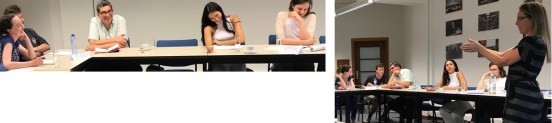
Day 5 of the summer school, devoted to Global Security Governance,  began with a lecture by Dr. Nicolas Hachez. He is a Fellow at the Leuven Centre for Global Governance Studies, University of Leuven, with which we at the Dean Rusk International Law Center, University of Georgia School of Law, partner to present the Global Governance Summer School. Hachez’ lecture began with an historical account dating to Aristotle, and ended with a survey of contemporary challenges to rule of law and democracy. (Just below, he listens to a response from Georgia Law student Brooke Carrington.) The presentation provided a valuable recap of many issues raised at the high-level RECONNECT conference our students attended earlier in the week.

Next, yours truly, Georgia Law Professor Diane Marie Amann, Emily & Ernest Woodruff Chair in International Law, one of our Center’s Faculty Co-Directors, and a founding Co-Director of the Global Governance Summer School. I introduced the concept of Global Security Governance, which incorporates within its analysis of human, national, and collective security insights from traditional international law subfields like human rights, the laws of war, and development law.

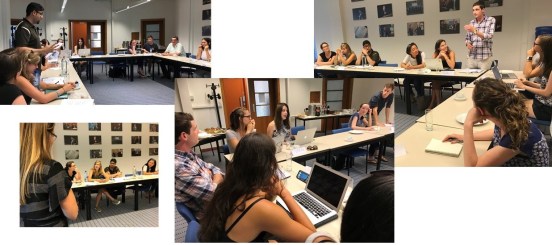
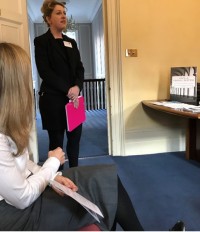
Our Center’s Director, Kathleen A. Doty, offered an overview of legal regimes related to disarmament and weapons control, including the Nuclear Non-Proliferation Treaty and the Chemical Weapons Convention. Then, as pictured at top, she led our summer school students – variously educated at Georgia Law, Leuven, and several other European institutions – in a spirited, simulated, multilateral negotiation for a new treaty to curb an imagined new development in weapons technology.

The week’s classroom component concluded with a lecture on “Global Governance, International Law and Informal Lawmaking in Times of Antiglobalism and Populism” by Leuven Professor Jan Wouters (right), Jean Monnet Chair ad personam EU and Global Governance, Full Professor of International Law and International Organizations, Director of the Leuven Centre for Global Governance Studies, and founding Co-Director of our summer school. Touching on concepts and issues introduced throughout the week, Wouters exposed shortcomings of classic international law. He further urged greater acceptance of the significance of informal lawmaking actors, norms, and processes, which form the core of global governance studies.

Leuven and Georgia Law students, faculty, staff, and friends then enjoyed a conference dinner, plus a live, and lively, screening of the Belgium Red Devils’ 2-1 World Cup victory over Brazil – then headed to Oude Markt to celebrate with other denizens of this lovely city.

Human rights, criminal justice, NATO, business practice, reception with Georgia Law alums: Global Governance Summer School day 3, Brussels

Professor Amann, Ana Sofie Silveira, Lucia Hakala, Eunjun Kim, Bryant Oliver, Professor Doty, NATO Legal Adviser Steven Hill, Hanna Karimipour, Maddie Neel, Julian Skoruppa, Brooke Carrington, Saif Ahmed, Caroline Harvey, Mills Culver, and Frances Plunkett

BRUSSELS – A variety of briefings in this Belgium capital, and home of many European Union institutions, highlighted day 3 of the Global Governance School that our University of Georgia School of Law Dean Rusk International Law Center offers with the Leuven Centre for Global Governance Studies at KU Leuven, one of Europe’s premier research institutions.

Our cohort of students from Georgia Law and multiple European universities first traveled to the Brussels office of No Peace Without Justice (left), a nongovernmental organization founded a quarter-century ago to promote “the protection and promotion of human rights, democracy, the rule of law and international justice.” There Alison A. Smith (left), Legal Counsel and Director of the organization’s International Criminal Justice Program, took part in a dialogue on “International Human Rights Lawyering” with Georgia Law Professor Diane Marie Amann, Emily & Ernest Woodruff Chair in International Law and one of our Center’s Faculty Co-Directors. Then the organization’s Secretary-General, Niccolò A. Figà-Talamanca, described the Rome diplomatic conference that led to adoption in 1998 of the Rome Statute of the International Criminal Court.

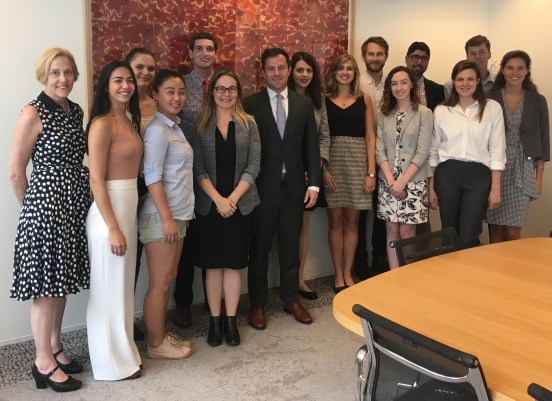
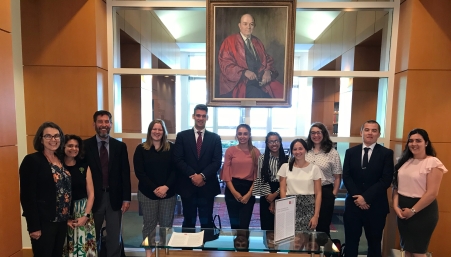
Next, Steven Hill, Legal Adviser and Director of the Office of Legal Affairs at the North Atlantic Treaty Organization, outlined the work of his office, where an 8-lawyer team serves as counsel to NATO Secretary-General Jens Stoltenburg and further liaises with NATO lawyers throughout the world. He then discussed key issues likely to be discussed at next week’s NATO Summit. (Preparations for that meeting of member states’ heads of state and government precluded a visit to the new NATO headquarters; we are grateful to the Brussels law firm Van Bael & Bellis for providing the lovely conference room, pictured above, where our students met with Hill.)

Finally, we made our way to the Brussels office of Sidley Austin LLP. There Stephen Spinks (Georgia Law JD’76), a member of our Dean Rusk International Law Center Council, led a presentation on key areas of global business practice at his office. Spinks is the immediate past managing partner of that office, and a well-known lawyer expert in matters related to EU competition (in effect, antitrust) law and trade law. Assisting in the presentation by Spinks (standing, at left) were 4 additional Sidley lawyers. From left: Dr. Michele Boggiani, who spoke on anti-corruption and life sciences law, Paul Greaves, on data privacy law, Anne Robert, on competition law, and Dr. Bregt Natens, on trade law.

The day concluded with a lively reception that Sidley kindly hosted. Participants included our students, firm attorneys, Center Director Kathleen A. Doty and myself, Sidley attorneys including Wim Nauwelaerts (LLM’94), an alumnus and head of the firm’s data privacy group, plus other Georgia Law graduates. These included: Johan De Bruycker (LLM’90), General Counsel, Ageas, Brussels; Porter Elliott (JD’96), the Van Bael & Bellis partner who helped secure a room for the morning NATO presentation; Daniel J. Felz (JD’09), an associate at Alston & Bird LLP; Professor Erik Franckxx (LLM’83), Professor of Law Director of the Department of International and European Law at Vrije Universiteit Brussel; and Dr. Christof Siefarth (LLM’86), a partner at GÖRG law firm in Cologne, Germany, and member of our Center’s Council.

Our group returns to Brussels tomorrow, to the Royal Flemish Academy of Belgium for Science and the Arts, to take part in Reconnect: Reconciling Europe with its Citizens through Democracy and the Rule of Law, a conference kicking off a 4-year-research project among 18 partners, including our partner institution, the Leuven Centre for Global Governance Studies, KU Leuven.

Law in Practice International Interns from Sheffield Hallam University visit the Dean Rusk International Law Center for training

Group Photo RuskLast week, the Dean Rusk International Law Center was pleased to co-present a training with Sheffield Hallam University on criminal law and human rights for eight law students from the United Kingdom. Organized by Dr. Laura Kagel, Associate Director for International Professional Education at the Dean Rusk International Law Center, and Michael Edwards (J.D. ’93), Senior Lecturer in Law and Criminology at Sheffield Hallam University, the four-day training was designed to prepare the students for summer internships they will undertake in the United States.

Faculty from both universities lectured on relevant topics. These included Georgia Law professors: Anne Burnett on legal research methods; Andrea Dennis on evidence; and Russel Gabriel on criminal procedure. From Sheffield Hallam University Michael Edwards lectured on international human rights and civil rights law, and Christopher Riley presented an introduction to the student internships.

IMG-1797

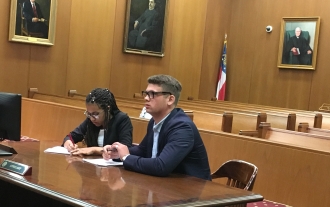
In addition to coursework, while in Athens, the students observed court proceedings and met with local prosecutors and court officials to hear about treatment and accountability courts. Organized by Assistant District Attorney Paige Otwell (J.D. ‘88), this discussion was particularly engaging, as England currently only has one court of this type. Students also spent a day learning more about advocacy and civil rights in Atlanta. The students prepared and presented mock oral arguments at the Supreme Court of Georgia, toured the State Capitol, and visited the Martin Luther King, Jr. National Historical Site. They also visited the Southern Center for Human Rights, where Tiffany Williams Roberts, Community Engagement and Movement Building Counsel, discussed the work of the non-profit law firm.

The Sheffield students are now off to begin their internships; we wish them an enriching summer!

On Holocaust Remembrance Day, thanks to archives preserving histories of post-WWII war crimes trials: Amann


LOS ANGELES – On this International Holocaust Remembrance Day, I am honored to be spending this month at the USC Shoah Foundation, reviewing testimonies of persons who did their part to set right one of history’s terrible wrongs.

Seventy-three years ago today, Soviet troops liberated Auschwitz-Birkenau, the infamous Nazi concentration camp located about 45 miles west of Kraków, Poland. Liberations of other camps by other Allied forces soon followed; among them, the U.S. liberation of Buchenwald on April 11, 1945, and the British liberation of Bergen-Belsen 4 days later.

Sixty years later, a 2005 U.N. General Assembly resolution set this date aside for commemoration of World War II atrocities; to quote the resolution, of

“… the Holocaust, which resulted in the murder of one third of the Jewish people, along with countless members of other minorities …”

The resolution further:

  • honored “the courage and dedication shown by the soldiers who liberated the concentration camps”;
  • rejected “any denial of the Holocaust as an historical event”;
  • envisaged the Holocaust as “a warning to all people of the dangers of hatred, bigotry, racism and prejudice”;
  • denounced “all manifestations of religious intolerance, incitement, harassment or violence against persons or communities based on ethnic origin or religious belief, wherever they occur”; and
  • encouraged initiatives designed to “inculcate future generations with the lessons of the Holocaust in order to help to prevent future acts of genocide.”

Among the many such initiatives are memorial centers and foundations throughout the world – 2 of which have helped me in my own research into the roles that women played during postwar international criminal trials at Nuremberg.

In December, the Holocaust Memorial and Tolerance Center of Nassau County, located in Glen Cove, New York, opened its archives to me. Special thanks to Helen  Turner, archivist and Director of Youth Education, for her assistance.

This month, as the inaugural Breslauer, Rutman and Anderson Research Fellow, I am in residence at the University of Southern California, examining documents in USC Shoah Foundation’s Visual History Archive. It has been a fruitful and moving scholarly experience, and I look forward to sharing my research at a public lecture on campus at 4 p.m. this Tuesday, Jan. 30 (as I was honored to do last week at UCLA Law’s Promise Institute for Human Rights; video here). Special thanks to all at the foundation’s Center for Advanced Research – Wolf Gruner, Martha Stroud, Badema Pitic, Isabella Evalynn Lloyd-Damnjanovic, and Marika Stanford-Moore – and to the donors who endowed the research fellowship. (Fellowship info here.)

As reflected in the 2005 General Assembly resolution, the work of such institutions helps to entrench – and to prevent backsliding from – states’ promises to ensure and respect human rights and dignity norms, set out in instruments like the 1945 Charter of the United Nations, the 1948 Convention on the Prevention and Punishment of Genocide, the 1948 Universal Declaration of Human Rights, and the 1966 International Covenant on Civil and Political Rights. To this list I would add the many documents establishing international criminal fora to prosecute persons charge with violating such norms – from  the Nuremberg-era tribunals through to today’s International Criminal Court.

(Cross-posted from Diane Marie Amann; image credit)

Professor Amann: Honored to contribute to new anthology, “Human Rights and Children”

Honored to be a contributor to Human Rights and Children, an anthology of works in the field edited by Hofstra Law Professor Barbara Stark.

The collection’s just been issued by Edward Elgar Publishing, which writes:

“This volume provides a comprehensive overview of children’s human rights, collecting the works of leading authorities as well as new scholars grappling with emerging ideas of ‘children’ and ‘rights.’ Beginning with the Convention on the Rights of the Child, the most widely ratified human rights treaty in the world, this book explores the theory, doctrine, and implementation of the legal frameworks addressing child labor, child soldiers, and child trafficking, as well as children’s socio-economic rights, including their rights to education.”

My own contribution is listed in this compendium as: “Diane Marie Amann (2013), ‘A Review of Reimagining Child Soldiers in International Law and Policy in Mark A. Drumbl, Oxford University Press’, American Journal of International Law…” On my SSRN page, I describe this book review as follows:

“This essay reviews ‘Reimagining Child Soldiers in International Law and Policy’ (2012), in which author Mark Drumbl examines legal doctrine, global activism, and social science research respecting underaged combatants.”

Additional contributors to this collection, besides Professor Stark and me: Philip Alston, Jo Becker, Maria Bouverne-De Bie, Claire Breen, Geert Cappelaere, Cynthia Price Cohen, Katherine Covell, Mac Darrow, Martha F. Davis, Michael J. Dennis, Janelle M. Diller, Sara A. Dillon, Mark A. Drumbl, Nienke Grossman, Martin Guggenheim, Stuart N. Hart, Kamran Hashemi, R. Brian Howe, David A. Levy, Janet McKnight, Tendai Charity Nhenga-Chakarisa, Paulo Sérgio Pinheiro, Roslyn Powell, Alison Dundes Renteln, Marilia Sardenberg, William A. Schabas, David M. Smolin, Murray A. Straus, Laura Thetaz-Bergman, John Tobin, Jonathan Todres, Geraldine Van Bueren, Wouter Vandenhole, Eugeen Verhellen, and Barbara Bennett Woodhouse.

(Cross-posted from Diane Marie Amann blog)

International lawyer Christine Keller, our Center’s new Associate Director for Global Practice Preparation

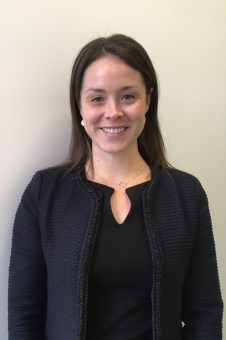
KellerWe’ve just welcomed a new international lawyer to the Dean Rusk International Law Center at the University of Georgia School of Law: Christine Keller, our new Associate Director for Global Practice Preparation.

In that position, she’ll enhance our 40-year-old Center’s mission by developing and administering global practice preparation initiatives,  including: the Global Governance Summer School we host in the Netherlands and Belgium, in partnership with the Leuven Centre for Global Governance Studies, University of Leuven; our Global Externships Overseas and At-Home; academic-year events programming and support; communications; and research initiatives.

It’s a bit of a homecoming for Christine, who was an undergraduate at the University of Georgia – she earned her A.B. in Political Science with honors, and was a member of the university’s NCAA champion women’s swim team. She also holds an LL.M. from Harvard Law School (with a focus on international criminal law), a J.D. from the Santa Clara University School of Law (where she was a member of the Jessup International Moot Court team and a Justice John Paul Stevens Public Interest Fellow), and an M.A. in International Policy Studies from Stanford University.

She comes to us from The Hague in the Netherlands, where for the last decade she has practiced international criminal law. At the United Nations International Criminal Tribunal for the Former Yugoslavia, her positions included: Associate Legal Officer and then a Legal Officer in Chambers, working on the Tolimir and Karadžić cases and leading a team of attorneys on an aspect of the Prlić appeal. Before that, she worked as an Assistant Legal Officer to two successive judges of Pre-Trial Chamber I of the International Criminal Court. She also provided research and drafting assistance in the Office of the Prosecutor, on cases including Al Bashir and issues including victim participation. She also has worked at a San Francisco nongovernmental organization, the Center for Justice and Accountability, on topics such as European universal jurisdiction, human rights violations in Guatemala and Somalia, and the Alien Tort Statute.

Christine has studied abroad in Germany and El Salvador, is proficient in French, and has a working knowledge of Spanish.

We’re delighted to welcome her!

Important essays on myriad international law subfields in OUP book coedited by Professor Amann, “Arcs of Global Justice: Essays in Honour of William A. Schabas”

LONDON – Building on yesterday’s post about the magical London conference launching Arcs of Global Justice: Essays in Honour of William A. Schabas (Margaret M. deGuzman and Diane Marie Amann eds.), today’s post profiles the book itself, which, thanks to excellent assistance from John Louth, Blake Ratcliff, and their staff, has just been published by Oxford University Press. (The hardback may be ordered via OUP or Amazon, and the book’s also available on Kindle.)

Not least because Professor Schabas delivered two talks here at the University of Georgia School of Law in 2013, I’m very pleased to have coedited this volume with my colleague Meg. The concept, in our words:

Martin Luther King, Jr. once said ‘the arc of the moral universe is long, but it bends toward justice.’ Testing the optimism of that claim were the many fits and starts in the struggle for human rights that King helped to catalyze. The same is true of other events in the last half-century, from resistance to apartheid and genocide to equal and fair treatment in domestic criminal justice systems, to the formation of entities to prevent atrocities and to bring their perpetrators to justice. Within this display of myriad arcs may be found the many persons who helped shape this half-century of global justice-and prominent among them is William A. Schabas. His panoramic scholarship includes dozens of books and hundreds of articles, and he also has served as an influential policymaker, advocate, and mentor.

This work honours William A. Schabas and his career with essays by luminary scholars and jurists from Africa, Asia, Europe, and the Americas. The essays examine contemporary, historical, cultural, and theoretical aspects of the many arcs of global justice with which Professor Schabas has engaged, in fields including public international law, human rights, transitional justice, international criminal law, and capital punishment.

In all, the book includes 29 contributions by 35 academics, advocates, and jurists, as detailed in the table of contents below. Providing jacket-cover testimonials were Steven Kay QC, Philippe Sands QC, Professor and former Ambassador David Scheffer, and Judge Christine Van den Wyngaert. We hope that you’ll follow their recommendations and give these important, substantive essays a very good read.

Arcs of Global Justice:
Essays in Honour of William A. Schabas

Foreword by Diane Marie Amann and Margaret M. deGuzman, coeditors
Introduction: William Schabas: Portrait of a Scholar/Activist Extraordinaire by Roger S. Clark, Board of Governors Professor of Law, Rutgers University School of Law

Human Rights
Human Rights and International Criminal Justice in the Twenty First Century: The End of the Post-WWII Phase and the Beginning of an Uncertain New Era by M. Cherif Bassiouni (He died at age 79 in September, just weeks after he completed final changes on this essay; as posted, our conference included a memorial to him. At the time of his death, he was Emeritus Professor of Law, DePaul University College of Law; Honorary President, Siracusa Institute for Criminal Justice and Human Rights; and Honorary President, L’Association internationale de droit pénal.)
William Schabas, the Canadian Charter of Rights and Freedoms and International Human Rights Law by Justice Thomas A. Cromwell, Supreme Court of Canada, and Bruno Gélinas-Faucher, formerly a law clerk on that court and now a Cambridge PhD candidate
The International Convention on the Protection of All Persons from Enforced Disappearance, as a Victim-Oriented Treaty by Emmanuel Decaux, Professor Emeritus, Université Paris 2 (Panthéon-Assas), and former President, Committee on Enforced Disappearances
The Politics of Sectarianism and its Reflection in Questions of International Law & State Formation in The Middle East by Kathleen Cavanaugh, Senior Lecturer at the Irish Centre for Human Rights, National University of Ireland Galway, and  Joshua Castellino, Professor of Law & Dean of the School of Law, as well as the Business School, at Middlesex University, London

Capital Punishment
International Law and the Death Penalty: A Toothless Tiger, or a Meaningful Force for Change? by Sandra L. Babcock, Clinical Professor of Law at Cornell Law School and Faculty Director of the Cornell Center on the Death Penalty Worldwide
The UN Optional Protocol on the Abolition of the Death Penalty by Marc Bossuyt, Fellow at the Stellenbosch Institute for Advanced Study, Emeritus Professor of the University of Antwerp, Emeritus President of the Constitutional Court of Belgium, and former Chairman of the UN Commission on Human Rights
The Right to Life and the Progressive Abolition of the Death Penalty by Christof Heyns, formerly the UN Special Rapporteur on extrajudicial, summary or arbitrary executions from 2010 through 2016, and now a member of the UN Human Rights Committee and Professor of Human Rights Law at the University of Pretoria, Thomas Probert, Research Associate, Centre of Governance & Human Rights, University of Cambridge, and Tess Borden, Aryeh Neier Fellow at Human Rights Watch and the American Civil Liberties Union, and former researcher for the UN Special Rapporteur on extrajudicial, summary or arbitrary execution
Progress and Trend of the Reform of the Death Penalty in China by Zhao Bingzhi, Dean of the College for Criminal Law Science of Beijing Normal University, President of the Criminal Law Research Association of China, Vice-President of the International Association of Penal Law, and President of that association’s Chinese National Group

International Criminal Law
Criminal Law Philosophy in William Schabas’ Scholarship by Margaret M. deGuzman, Professor of Law at Temple University’s Beasley School of Law
Is the ICC Focusing too Much on Non-State Actors? by Frédéric Mégret, Associate Professor and Dawson Scholar, Faculty of Law, McGill University
The Principle of Legality at the Crossroads of Human Rights and International Criminal Law by Shane Darcy, Senior Lecturer at the Irish Centre for Human Rights, National University of Ireland Galway
Revisiting the Sources of Applicable Law Before the ICC by Alain Pellet, Emeritus Professor at the University of Paris Nanterre, former Chairperson of the UN International Law Commission, President of the French Society for International Law, Member of the Institut de droit international, as well as Counsel and Advocate before the International Court of Justice, the International Tribunal for the Law of the Sea, and other forums
The ICC as a Work in Progress, for a World in Process by Mireille Delmas-Marty, Member, Institut de France, and Professor Emerita, Collège de France de Paris
Legacy in International Criminal Justice by Carsten Stahn, Professor of International Criminal Law and Global Justice, Leiden University
Torture by Private Actors and ‘Gold Plating’ the Offence in National Law: An Exchange of Emails in Honour of William Schabas by Andrew Clapham, Professor of Public International Law at the Graduate Institute of International and Development Studies in Geneva, and Paola Gaeta, Professor of International Law and International Criminal Law at the Graduate Institute of International and Development Studies, Geneva

Genocide and Crimes Against Humanity
Secrets and Surprises in the Travaux Préparatoires of the Genocide Convention by Hirad Abtahi, First Legal Adviser, Head of the Legal and Enforcement Unit, at the Presidency of the International Criminal Court, and Philippa Webb, Reader (Associate Professor) in Public International Law at King’s College London and a barrister at 20 Essex Street Chambers
Perspectives on Cultural Genocide: From Criminal Law to Cultural Diversity by Jérémie Gilbert, Professor of International and Comparative Law, University of East London
Crimes Against Humanity: Repairing Title 18’s Blind Spots by Beth Van Schaack, Leah Kaplan Visiting Professor in Human Rights at Stanford Law School and Visiting Scholar at the Center for International Security & Cooperation at Stanford University
A New Global Treaty on Crimes Against Humanity: Future Prospects by Leila Nadya Sadat, James Carr Professor of International Criminal Law and Director of the Whitney R. Harris World Law Institute at Washington University School of Law, Special Adviser to the ICC Prosecutor on Crimes Against Humanity, and Director of the Crimes Against Humanity Initiative

Transitional Justice and Atrocity Prevention
Justice Outside of Criminal Courtrooms and Jailhouses by Mark A. Drumbl, Class of 1975 Alumni Professor of Law and Director, Transnational Law Institute, Washington and Lee University School of Law
Toward Greater Synergy between Courts and Truth Commissions in Post-Conflict Contexts: Lessons from Sierra Leone by Charles Chernor Jalloh, Professor of Law, Florida International University, and a member of the International Law Commission
International Criminal Tribunals and Cooperation with States: Serbia and the provision of evidence for the Slobodan Milosevic Trial at the ICTY by Geoffrey Nice QC, a barrister since 1971, formerly at the International Criminal Tribunal for the Former Yugoslavia, and Nevenka Tromp, Lecturer in East European Studies at the University of Amsterdam and former member of the ICTY Leadership Research Team
The Arc toward Justice and Peace by Mary Ellen O’Connell, the Robert and Marion Short Chair in Law at the University of Notre Dame Law School
The Maintenance of International Peace and Security through Prevention of Atrocity Crimes: The Question of Co-operation between the UN and regional Arrangements by Adama Dieng, UN Under-Secretary-General and Special Adviser on the Prevention of Genocide, as well as former Registrar of the International Criminal Tribunal for Rwanda and former Secretary-General of the International Commission of Jurists

Justice in Culture and Practice
Law and Film: Curating Rights Cinema by Emma Sandon, Senior Lecturer in Film and Television at Birkbeck, University of London, and a Research Fellow to the Chair for Social Change, University of Johannesburg
The Role of Advocates in Developing International Law by Wayne Jordash QC, international human rights and humanitarian lawyer and founding partner of Global Rights Compliance
Bill the Blogger by Diane Marie Amann, Emily and Ernest Woodruff Chair in International Law and Faculty Co-Director of the Dean Rusk International Law Center at the University of Georgia School of Law

(Cross-posted from Diane Marie Amann)
Optimism about “Arcs of Global Justice” at London launch of Professor Amann’s coedited OUP essay collection honouring William A. Schabas

LONDON – “Optimism” was the byword for Friday’s magical conference launching Arcs of Global Justice: Essays in Honour of William A. Schabas, the just-published Oxford University Press collection coedited by Margaret M. deGuzman and myself.

The event took place in a Christmas-tree-lighted conference room at 9 Bedford Row, the London chambers where our honouree, Bill Schabas (above center), is a door tenant.

Professor Schabas is well known at the University of Georgia. During a 2013 visit to the Athens campus, he presented “The Drafting and Significance of the Universal Declaration of Human Rights,” the opening chapter of a then-forthcoming treatise, as part of the International Law Colloquium, a University of Georgia School of Law course. Additionally, Bill gave a public lecture entitled “Human Rights and Culture,” cosponsored by the law school and by the university’s Willson Center for Humanities & Arts.

At Friday’s London launch, Bill and his wife, Penelope Soteriou, were joined by several of the 35 women and men whose 29 contributions comprise the volume, many friends, colleagues, PhD students, and relatives.

Gillian Higgins (left), Head of the International Practice Group at 9 Bedford Row, opened with a warm message of welcome and congratulations. Then followed a celebration that combined lighthearted anecdotes with serious presentations of scholarship. Topics ranged as far and wide as Schabas’ multifaceted career, which includes current appointments as Professor of International Law at Middlesex University, London, Professor of International Criminal Law and Human Rights at Leiden University, and Emeritus Professor of Human Rights Law and Honorary Chairman of the Irish Centre for Human Rights, National University of Ireland Galway; service as a member of the Sierra Leone Truth and Reconciliation Commission and as a consultant on capital punishment for the United Nations Office of Drugs and Crime; and authorship of hundreds of books, chapters, and articles.

A sobering moment came in Birkbeck Lecturer Emma Sandon‘s discussion of Schabas’ role as an organizer of and speaker at human rights film festivals. Sandon (above) concluded with a clip from Judgment at Nuremberg (1961). All fell silent while watching the characters in the video courtroom watch actual footage from the Allied liberations of concentration camps like Buchenwald.

Also moving was the memorial that Northwestern University Law Professor David Scheffer gave on behalf of contributor Cherif Bassiouni, who died at age 79 in September, not long after finishing his chapter, entitled “Human Rights and International Criminal Justice in the Twenty-First Century: The End of the Post-WWII Phase and the Beginning of an Uncertain New Era.” (Bassiouni also penned a dedication for our conference programme, available in PDF here.) Scheffer described the essay in light of his own and Schabas’ writings, and concluded on a optimistic note regarding the future of human rights.

That same note sounded in Schabas’ own interventions throughout the day. On issues ranging from the International Criminal Court to abolition of the death penalty, he assured his audience that even in these times, when the day-to-day “weather” may seem grim, the overall “climate” offers much room for optimism.

Here’s order of the day (full PDF programme here; additional contributors in attendance included Middlesex Law Dean Joshua Castellino and Cambridge PhD candidate Bruno Gélinas-Faucher):

Arcs of Global Justice:
Conference Launching Essay Collection in Honour of William A. Schabas
Friday, 8 December 2017, 9 Bedford Row, London

Opening
“Welcome” by Gillian Higgins, Head of the International Practice Group at 9 Bedford Row
“In Memoriam for Cherif Bassiouni” by David Scheffer, Mayer Brown/Robert A. Helman Professor of Law and Director of the Center for International Human Rights at Northwestern University Pritzker School of Law, Chicago
“Introduction to Arcs of Global Justice” by coeditors Diane Marie Amann and Margaret M. deGuzman

International Law & Criminal Justice
“The Principle of Legality at the Crossroads of Human Rights & International Criminal Law” by Shane Darcy, Senior Lecturer at the Irish Centre for Human Rights, National University of Ireland Galway
“Criminal Law Philosophy in William Schabas’s Scholarship” by Margaret M. deGuzman, Professor of Law at Temple University’s Beasley School of Law
“Perspectives on Cultural Genocide: From Criminal Law to Cultural Diversity” by Jérémie Gilbert, Professor of International and Comparative Law, University of East London
“Toward Greater Synergy between Courts & Truth Commissions in Post-Conflict Context: Lessons from Sierra Leone” by Charles Chernor Jalloh, Professor of Law, Florida International University, and a member of the International Law Commission
Moderator: Kathleen Cavanaugh, Senior Lecturer at the Irish Centre for Human Rights, National University of Ireland Galway

Justice / Scholarship / Culture / Practice
“Bill the Blogger” by Diane Marie Amann, Emily and Ernest Woodruff Chair in International Law and Faculty Co-Director of the Dean Rusk International Law Center at the University of Georgia School of Law
“Advocates, Scholars & Maintaining the International Criminal Law Momentum” by Wayne Jordash QC, international human rights and humanitarian lawyer and founding partner of Global Rights Compliance
“Law & Film: Curating Rights Cinema” by Emma Sandon, Senior Lecturer in Film and Television at Birkbeck, University of London, and a Research Fellow to the Chair for Social Change, University of Johannesburg
Moderator: Michelle Farrell, Senior Lecturer in Law in the School of Law and Social Justice, University of Liverpool

Abolition of the Death Penalty
“International Law & the Death Penalty: A Toothless Tiger, or a Meaningful Force for Change?” by Sandra L. Babcock, Clinical Professor of Law at Cornell Law School and Faculty Director of the Cornell Center on the Death Penalty Worldwide
The Right to Life & the Progressive Abolition of the Death Penalty by Thomas Probert, Research Associate, Centre of Governance & Human Rights, University of Cambridge (on behalf of himself & co-authors Christof Heyns & Tess Borden)
Moderator: Jon Yorke, Professor of Human Rights and Director of the Centre for Human Rights at Birmingham City School of Law

Closing
Introduction by John Louth, Editor-in-Chief of Academic Law at Oxford University Press
Remarks by William A. Schabas OC MRIA

Reception

With thanks to our host, 9 Bedford Row, & cosponsor, Oxford University Press

◊ ◊ ◊

Cross-posted at Diane Marie Amann. Tomorrow’s post: Details on Arcs of Justice: Essays in Honour of William A. Schabas (Margaret M. deGuzman and Diane Marie Amann, eds.) (OUP 2018) (The hardback may be ordered via OUP or Amazon, and the book’s also available on Kindle.)