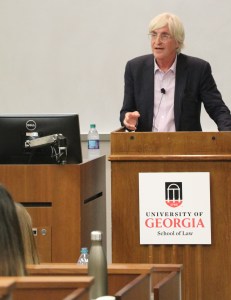
 A speech that noted human rights lawyer David Tolbert delivered here at the University of Georgia School of Law (right) is available in the just-released edition of the Georgia Journal of International & Comparative Law.
The law school’s Dean Rusk International Law Center was honored to host Tolbert last autumn. Currently Ford Fellow/Visiting Scholar at the Duke University Sanford School of Public Policy and immediate past president of the International Center for Transitional Justice, Tolbert has held many leadership positions at international institutions. His survey of the state of human rights, a highlight of our Center’s academic year, has been published as Quo Vadis: Where Does the Human Rights Movement Go from Here?
It is one of many stimulating publications in the newest issue of Volume 47, No. 2 of this nearly half-century-old student-edited journal. Other articles are (hyperlink connects to PDF download):
► Two-Dimensional Hard-Soft Law Theory and the Advancement of Women’s and LGBTQ+ Rights Through Free Trade Agreements, by Raj Bhala, the Leo S. Brenneisen Distinguished Professor at the University of Kansas School of Law, and Cody N. Wood, an associate at Dentons LLP in Kansas City
► Refugee Crisis in Germany and the Right to a Subsistence Minimum: Differences That Ought Not Be, by Dr. Ulrike Davy, Professor of Constitutional and Administrative Law, International and German Social Law, and Comparative Law at Bielefeld University, Germany, and Visiting Researcher, Faculty of Law, University of Johannesburg, South Africa
► Democracy, Rule-of-Law, and Legal Ethics Education: Directing Lawyers to Support Democratization in Myanmar, by Dr. Jonathan Liljeblad, Senior Lecturer at the Australian National University College of Law, Canberra
The issue also includes the following notes, all by members of the just-graduated Georgia Law Class of 2019:
► Off with Their Heads! How China’s Controversial Human Head-Transplant Procedure Exceeds the Parameters of International Ethical Standards in Human Experimentation, by Deena Agamy
► Trading Places: With the United States in Retreat, Who Writes the International Rules for Trade?, by Austin C. Cohen
► What Not to Wear: Religious Dress and Workplace Policies in Europe, by Sarah Lanier Flanders
► Poland: Winds of Change in the Act on Windfarms, by Jacob T. McClendon
The entire issue is available here.
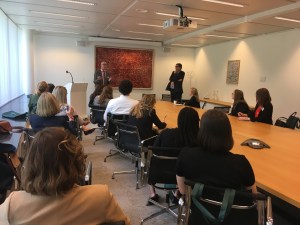
 Students spent the morning meeting with lawyers from the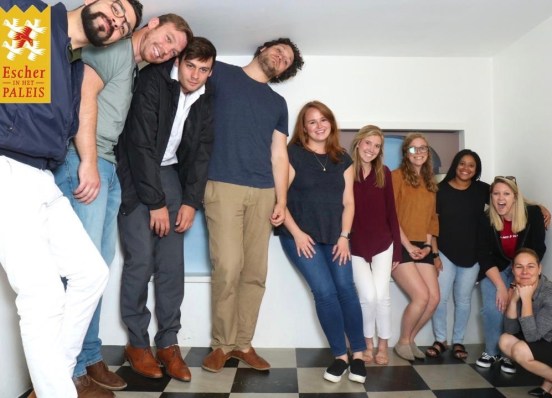
 First,
  Second,
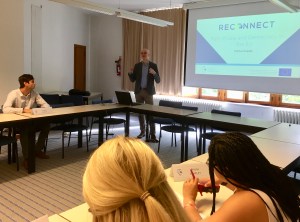 LEUVEN & BRUSSELS – The morning opened with an introduction to the European Union, presented by
 The conference took place in the Brussels’ beautiful Academy Palace, and opened with a welcome by
  The conference featured keynote remarks by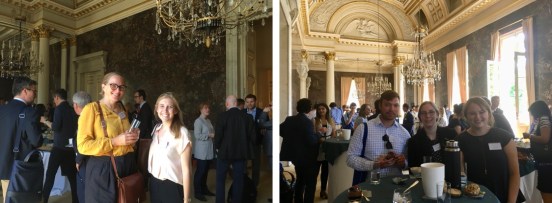



 Scholarship by 2 members of the international law faculty here at the University of Georgia School of Law is featured in the latest edition of the peer-reviewed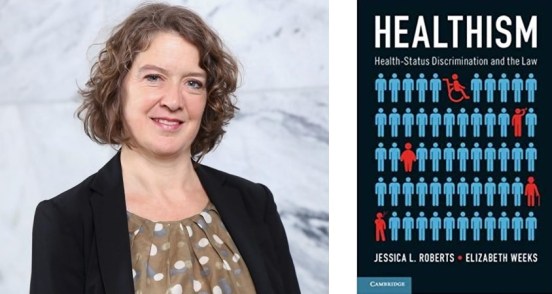
 The Dean Rusk International Law Center at the University of Georgia School of Law welcomes Laura Olson, Director of the Human Rights Program at The Carter Center, to campus next Tuesday, November 6. She will give a lecture, “

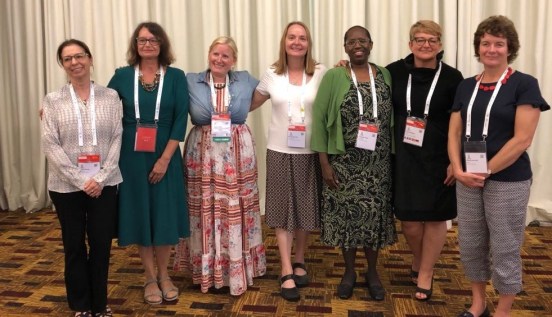

 One of my greatest pleasures in serving as an officer of the Standing Committee is my collaboration with law and government librarians from all corners of the world who share a common goal of providing and preserving access to government and legal information. Our Section Standing Committee meetings this year included members and observers from Africa, Southeast Asia, Australia, China, Canada, Australia and Europe.
 The conference schedule allowed for some sightseeing opportunities. Kuala Lumpur (KL), the capital and largest city of Malaysia, boasts record-setting skyscrapers housing national and international corporations, high-end fashion stores, insane traffic and delicious street food (right). The large convention center, where we met, is in the shadows of the twin towers (top right) of Malay’s Petroleum Company, Petronas, which are the emblematic symbol of the city. But KL’s architecture also reflects Portuguese, Dutch and British colonialism. The population is similarly diverse, with predominately Muslim Malaysians joined by significant Indian and Chinese populations. I was fortunate to take a trip to the outskirts of KL to see the Hindu temple at the
  exchange of notes