Georgia Law Professor Diane Marie Amann publishes “Nuremberg Women” chapter in Oxford Handbook on Women and International Law

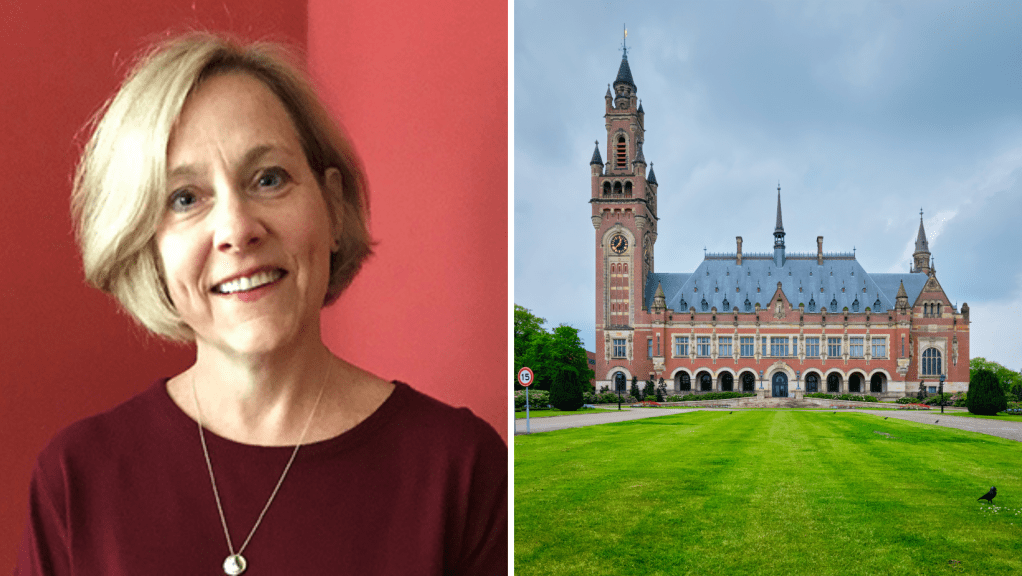
“Absented at the Creation: Nuremberg Women and International Criminal Justice,” a chapter by University of Georgia School of Law Professor Diane Marie Amann, has just been published in a new Oxford University Press essay collection.

Amann is Regents’ Professor of International Law, Emily & Ernest Woodruff Chair in International Law, and a Faculty Co-Director of our Dean Rusk International Law Center here at Georgia Law. During her current research-intensive semester, she is an Affiliate Academic at University College London Faculty of Laws.

Her chapter appears in The Oxford Handbook on Women and International Law, co-edited by Professors J. Jarpa Dawuni (Howard University), Nienke Grossman (University of Baltimore), Jaya Ramji-Nogales (Temple University), and Hélène Ruiz Fabri (Université Paris 1 Panthéon-Sorbonne). The thirty-five-chapter volume spans many topics – topics that its four dozen authors explore through a variety of methods, including substantive legal analysis, legal history, and global critical race feminism.

Amann’s chapter draws from research that she had presented online as part of “In/ex-clusiveness of the Legal Construction of Justice,” a panel of the 17th Annual Conference of the European Society of International Law, held in 2022 at Utrecht University in The Netherlands.

Here’s the abstract for Amann’s chapter:

Women seldom surface in conventional accounts of the many war crimes trials that took place after World War II. Yet as this chapter shows, hundreds of women lawyers and other professionals were present, thus helping to lay the foundations of an international criminal justice project that continues to this day. Combining methodologies of narrative with theories sounding in global legal history and feminist scholarship and discussing what it reveals as dances of absence-presence, visible-invisible, and inclusion-exclusion, this chapter first examines how and why women were absented and then surfaces their contributions. It concludes with a look at contemporary international legal practice.

Eva Keïta speaks with Georgia Law students about experience at the International Court of Justice

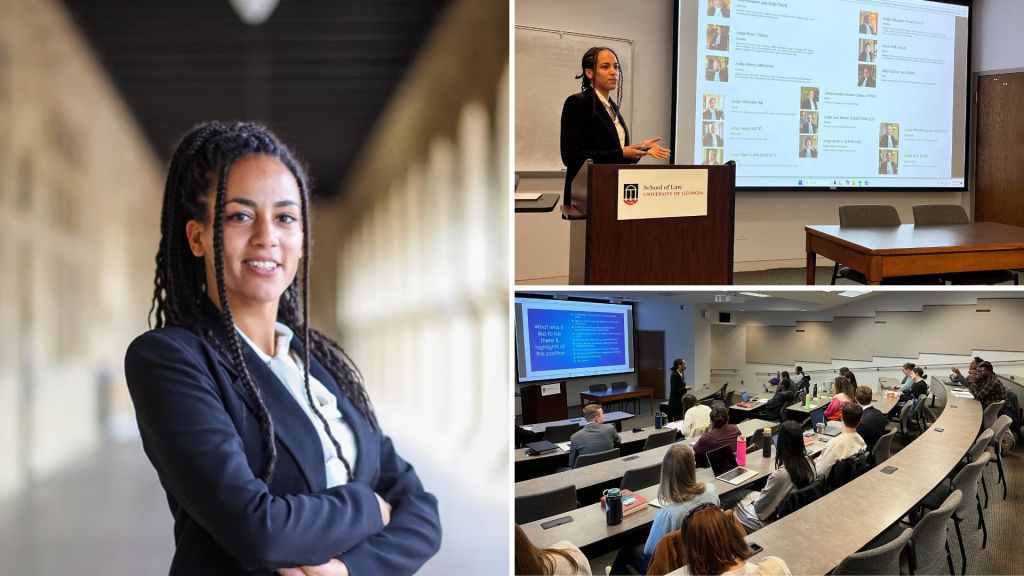
The University of Georgia School of Law welcomed international lawyer Eva Keïta to campus this week to discuss her experience at the International Court of Justice (ICJ) with students in Professor Diane Marie Amann‘s Public International Law course.

Keïta provided students with an overview of the ICJ, where she was an Associate Legal officer and a Judicial Fellow assisting a judge on various public international law matters. She spoke about the makeup of the ICJ, the role of members on each of the Judges’ teams, and how students can make themselves more competitive for open positions. Keïta then took questions from students, detailing her own professional journey as an international dispute settlement lawyer and providing advice for those interested in pursuing international legal careers.

Before her time at the ICJ, Keïta honed her expertise in international arbitration and litigation and handled complex international disputes at two international law firms in Paris. Keïta also has significant experience handling pro bono and international human rights matters. She provided legal representation to an inmate serving a life sentence under California’s Three Strikes Law in post-conviction proceedings, assisted human trafficking victims in compensation proceedings in front of French courts, and volunteered for four months in Togo, providing legal assistance to inmates through a local NGO.

Prior to her legal career, Keïta pursued a bachelor’s and master’s degree in political science, specializing in international relations, from the Sorbonne. In addition, Keïta holds a LL.M. in international economic law, business & policy from Stanford Law School and her first law degree from Sciences Po in Paris.

Georgia Law Professor Amann featured in The Wall Street Journal on Gaza ruling by International Court of Justice

University of Georgia School of Law Professor Diane Marie Amann was featured in The Wall Street Journal regarding the recent order of the International Court of Justice in the Genocide Convention case which South Africa has filed against Israel. 

The article titled “World Court Rejects Demands for Gaza Cease-Fire” was written by Jess Bravin and was published on January 26.

After reporting the opinion of Utah Law Professor Amos Guiora , that both parties won something, and that, in the words of the article, “Israel avoided a legal ruling that would force it either to stop military operations or defy the world court,” Bravin then wrote:

Still, the conduct of the Gaza campaign received no pass, said Diane Marie Amann, an international-law professor at the University of Georgia. ‘Israel will need to adjust if it wishes to comply with the court’s order,’ she said.

Amann is Regents’ Professor, Emily & Ernest Woodruff Chair in International Law, and Faculty Co-Director of the Dean Rusk International Law Center here at the University of Georgia School of Law. She teaches and publishes regularly on matters relating to international law.

Georgia Law Professor Amann presents at Temple Law workshop on Philippe Sands’ Chagos book, “Last Colony”

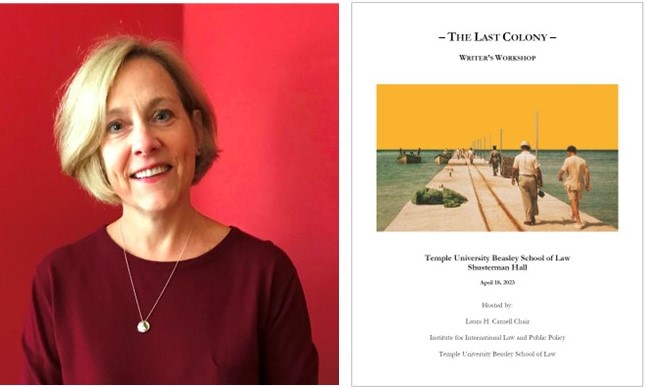
University of Georgia School of Law Professor Diane Marie Amann was one of about two dozen experts in international law and policy who participated Tuesday in a daylong writers’ workshop in Philadelphia, centered on a new book, The Last Colony: A Tale of Exile, Justice and Britain’s Colonial Legacy.

Last Colony charts the journey, through many national and international courtrooms, that led to the 2019 Advisory Opinion of the International Court of Justice on case related to colonization in the Indian Ocean region: Legal Consequences of the Separation of the Chagos Archipelago from Mauritius in 1965. The book appeared in the United Kingdom in 2022 and will be released in the United States later this year. Its author, University College London Law Professor Philippe Sands KC, counsel for Mauritius in the ICJ proceedings, was among those who took part in Tuesday’s event.

Workshop sponsors were the Institute for International Law & Public Policy and the Laura H. Carnell Chair at Temple University Beasley School of Law; the principal organizer was Temple Law Professor Jeffrey Dunoff, Laura R. Carnell Professor of Law. Papers are set to be published in a forthcoming issue of the Temple Journal of International & Comparative Law.

Amann is is Regents’ Professor of International Law and Emily & Ernest Woodruff Chair in International Law, and a Faculty Co-Director of our Dean Rusk International Law Center here at Georgia Law. For Tuesday’s workshop, she prepared a paper entitled “What Figures Lurk on Madame’s Path? Reflections on Philippe Sands’ Last Colony.”

Georgia Law students named top oralists, and team finishes in world’s top 16, at Jessup International Law Moot Court

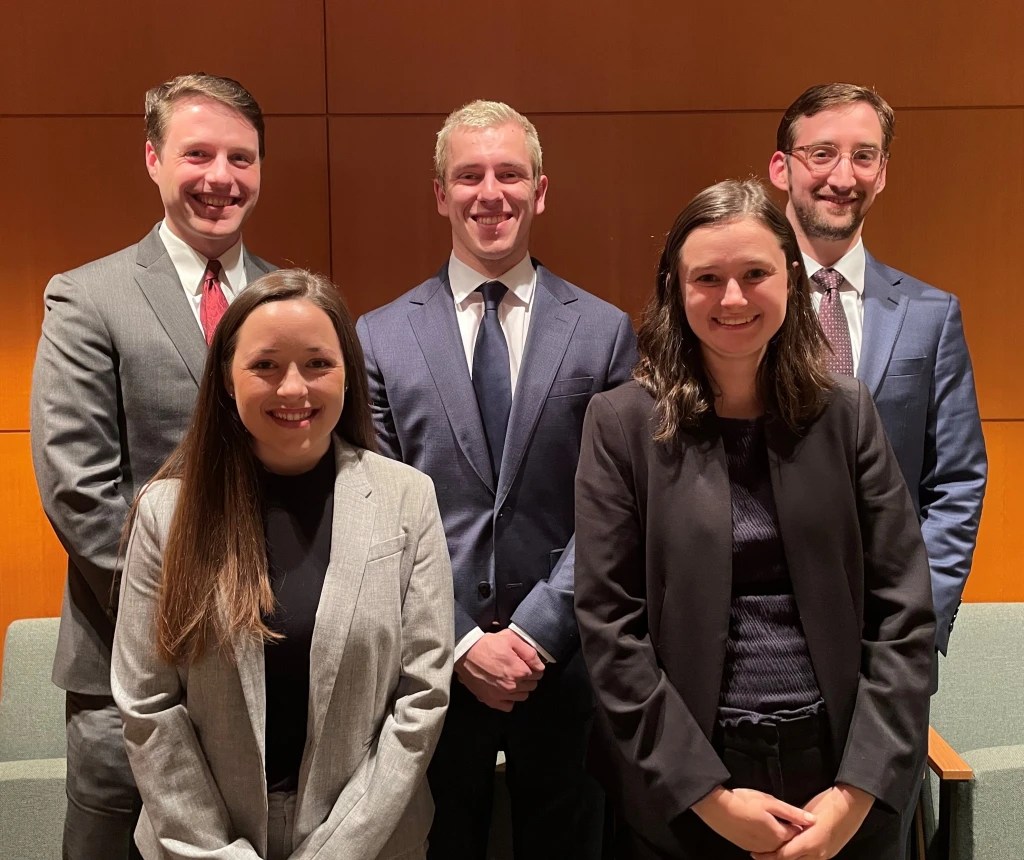
Our exceptionally talented team of University of Georgia School of Law students – 2Ls Millie Price, Courtney Robinson, Caleb Grant, James Stewart, and Alex Krupp – competed last week through to the Octofinals of one of the world’s most prestigious law tournaments, the Philip C. Jessup International Law Moot Court Competition.

2022 Georgia Law Jessup team: clockwise from upper left, Caleb Grant, James Stewart, Alex Krupp, Millie Price, Courtney Robinson

Making their achievement even sweeter, team member Robinson tied as the best overall oralist through the Advanced Rounds, while teammate Stewart was named fifth best. They and they teammates prepared written memorials and gave oral arguments as if they were appearing before the International Court of Justice, the judicial arm of the United Nations which adjudicates international law disputes.

In reaching the Octofinals, the Georgia Law team bested many other competitors, in a tournament that attracted nearly 3,500 students from about 700 law schools in 100 countries and jurisdictions. They lost in that International Round to a team from Canada’s University of Western Ontario. Winning the entire tournament was Harvard, against whom Georgia had competed last month in Jessup’s U.S. championship round.

Leading the team were 3L coach Courtney Hogan and faculty advisor/coach Anna White Howard, both themselves former Jessup advocates.

The team benefited from moots and other assistance by many members of the Georgia Law community, including: Professor Melissa J. “MJ” Durkee, Associate Dean for International Programs and Director of the law school’s Dean Rusk International Law Center, and Professors Diane Marie Amann and Harlan Grant Cohen, the Center’s Faculty Co-Directors; Georgia Law Dean Peter B. “Bo” Rutledge; Kellie Casey, Director of Advocacy; Anne Burnett, Foreign and International Law Librarian; Professors Nathan S. Chapman, Rob McNiff, and Lori A. Ringhand; and alums, Judge Ben Cheesbro, Ellen Clarke, Erik Chambers Myra Creighton, Amy Helmick, and Roger Grantham..

The Washington, D.C.-based International Law Students Association is Jessup’s primary host, with the law firm of White & Case sponsoring the International Rounds as well as some national competitions.

Dean Rusk International Law Center hosts “International Law and the Ukraine-Russia Conflict,” featuring Georgia Law Professors Amann, Cohen, and Durkee

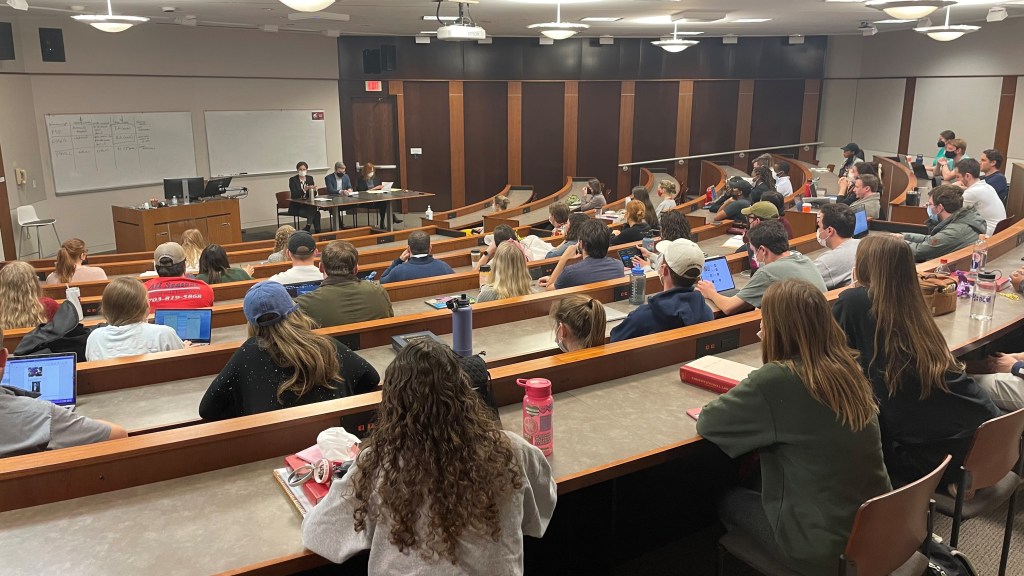
Nearly a hundred members of the University of Georgia School of Law community took part Wednesday in “International Law and the Ukraine-Russia Conflict,” a forum hosted by our Dean Rusk International Law Center and presented by three international law experts on the law school’s faculty.

The armed conflict began on February 24, 2022, when Russian military troops invaded the neighboring state of Ukraine, entering the latter country at points on its northern, eastern, and southern borders. At this writing just a week later, thousands of persons, civilians and combatants alike, reportedly had been killed, and, according to UN High Commissioner for Refugees Filippo Grandi, more than a million Ukrainians had been forcibly displaced.

At Wednesday’s forum, each of the three Georgia Law professors first offered a brief overview of a particular aspect of the armed conflict:

  • Our Center’s Director, Melissa J. “MJ” Durkee, who is also Associate Dean for International Programs and Allen Post Professor, began by outlining the international rules that have outlawed aggressive war – that is, one country’s unjustified invasion of another – since the adoption of the 1945 Charter of the United Nations. She explained why reasons that Russia has put forward do not constitute legally valid justifications for the invasion, and further emphasized the threat that Russia’s actions place on the international rules-based order that came into being after the Allied victory in World War II. In so doing, Durkee cited a UN General Assembly resolution, adopted Wednesday by a huge majority of votes, which condemned Russia’s actions as violative of this order.
  • Next came Harlan Grant Cohen, who is Gabriel M. Wilner/UGA Foundation Professor in International Law and one of our Center’s 2 Faculty Co-Directors. Cohen focused on economic sanctions that have been levied against Russia in the last week, by individual countries including the United States and also by international organizations including the European Union. While noting that these types of economic actions had been developed in response to Iran’s nuclear program, Cohen stressed that the extent and impact of the sanctions already imposed against Russia is unprecedented.
  • Then followed our Center’s other Faculty Co-Director, Diane Marie Amann, who is also Regents’ Professor of International Law and Emily & Ernest Woodruff Chair in International Law. She addressed international humanitarian law, the body of law concerned with the ways that armies and armed groups actually conduct the war. She underscored that this body of law concerns itself with all sides of the conflict, regardless of who started the conflict: fighters on either side may be found liable for violations, and thus charged with war crimes. Amann concluded with a look at forums already engaged to review legal issues arising out of the war, among them the European Court of Human Rights, International Criminal Court, and International Court of Justice.

The forum concluded with a lively and wide-ranging question-and-answer period.

Judge Joan Donoghue, Sibley Lecturer at Georgia Law, elected President of International Court of Justice

The Honorable Joan E. Donoghue, the American judge on the International Court of Justice, today was elected President of the International Court of Justice, the Hague-based institution known colloquially as the World Court.

She is the 3d American to serve a term as President, following Green H. Hackworth (1955-58) and Stephen M. Schwebel (1997-2000), and also the 2d woman, following Dame Rosalyn Higgins of the United Kingdom (2006-09).

We at the University of Georgia School of Law Dean Rusk International Law Center are pleased to welcome this news, not least because of Judge Donoghue’s generosity over the years toward our law school community:

  • In April 2012, a little more than a year before her initial election to the ICJ, Donoghue visited Georgia Law’s Athens campus to deliver our 108th Sibley Lecture. Her talk, entitled “The Role of the World Court Today,” (video) outlined the court’s history as the judicial organ of the United Nations, as well as the nature and evolution of its jurisdiction over disputes between nation-states and certain advisory matters. The text was published at 47 Georgia Law Review 181 (2012).
  • On occasions thereafter, as part of our Global Governance Summer School, the judge and her staff kindly hosted our students as they received a tour of the court’s seat, the Peace Palace, as well as a briefing on the court’s work.

As explained at the ICJ website:

“The President presides at all meetings of the Court; he/she directs its work and supervises its administration, with the assistance of a Budgetary and Administrative Committee and various other committees, all composed of Members of the Court. During judicial deliberations, the President has a casting vote in the event of votes being equally tied.”

Before joining the ICJ, Donoghue was Principal Deputy Legal Adviser in the U.S. Department of State, a position in which her duties included advising the Secretary of State and other officials on all aspects of international law. She’d practiced at State since 1984, with a few breaks to serve as Deputy General Counsel for the U.S. Department of the Treasury and General Counsel for Freddie Mac. She holds bachelor’s and law degrees from the Santa Cruz and Berkeley campuses, respectively, of the University of California.

Having been elected President by a vote of her peers on the court, Judge Donoghue will serve a 3-year term – as will her colleague who was elected Vice-President, Judge Kirill Gevorgian of the Russian Federation.

2019 Global Governance Summer School concludes with briefings at the International Court of Justice and the International Criminal Court

THE HAGUE – On this final day of the 2019 Global Governance Summer School, students visited two preeminent international tribunals — the International Court of Justice and the International Criminal Court — for high level briefings. They were also treated to a visit from Dr. Kaitlin Ball (JD ’14), a Georgia Law alumna who recently finished a PhD at Cambridge and is living in Europe.

The group started the day at the International Court of Justice (ICJ) for an audience with Hendrik Denys, law clerk to the Honorable Joan Donoghue, the American judge on the International Court of Justice. Mr. Denys, an alumnus of our partner school, KU Leuven, spoke with students about the history of the Peace Palace, the structure and procedure of the Court, and several representative decisions of the ICJ’s jurisprudence. He also provided advice for preparing a career in international law.

In the afternoon, the group visited the International Criminal Court (ICC), located on the dunes near The Hague’s North Sea coast. Student first had a meeting with Prosecutor Fatou Bensouda, for whom our summer school’s co-director, Georgia Law Professor Diane Marie Amann, serves as Special Adviser on Children in & affected by Armed Conflict. Bensouda described her own path to practicing international criminal law. While acknowledging the barriers to achieving justice, she expressed the urgency of continuing the effort, on behalf of global society as well as the victims of international crimes.

The second audience at the ICC was with the Honorable Kimberly Prost of Canada, who serves as a Judge in the Trial Division. Judge Prost discussed the history of the Court and the many of the challenges facing it. She also emphasized the important concept of complementarity in regards to the ICC’s relationship to national courts.

Students also had the opportunity to view the confirmation of charges against Al Hassan, who is suspected of war crimes and crimes against humanity allegedly committed in 2012 and 2013 in Timbuktu, Mali. During the portion of the hearing that time permitted the group to observe, students heard from one of the Legal Representatives of the Victims, who emphasized the impact of the alleged crimes.

All in all, it was a great day, a successful trip, and we look forward to returning next year!

Briefings from eminent international law judges, plus meetings at Lebanon tribunal, conclude our 2018 Global Governance Summer School

From left, at the Peace Palace, Georgia Law’s Global Governance Summer School students Saif Ahmed, Mills Culver, Bryant Oliver, Maddie Neel, Frances Plunkett, Brooke Carrington, Hanna Karimipour, and Caroline Harvey

THE HAGUE – Briefings from two eminent international law judges anchored the conclusion of our 2018 Global Governance Summer School (prior posts).

This morning, students heard from Sir Christopher Greenwood, a Briton who serves as a member of the Iran-United States Claims Tribunal. Though a presentation accented by anecdotes, he explained the history of US-Iran relations that led to establishment of the tribunal in 1981, the work of the tribunal over the last several decades, and its pending cases.

The presentation by Judge Greenwood, who had served from 2009 until early this year on the International Court of Justice, followed presentations at the latter court yesterday afternoon.

Most notably, the Honorable Joan Donoghue of the United States, one of the ICJ’s 15 permanent judges, spoke yesterday with students, both about the melding of the common and civil law systems in the court’s procedures and about the challenges of judging in the international context.

Also at the ICJ, Julia Sherman, a Judicial Fellow who works with Judge Donoghue, provided a tour of the ICJ’s headquarters, the 105-year-old Peace Palace. Sherman led students through the life cycle of an ICJ case, and also gave overviews of some recently decided ICJ cases.

Our summer school had started yesterday at the Special Tribunal for Lebanon, where representatives of the various court organs spoke to students. They included: Kirsten Calhoun, a Legal Officer in Chambers, who gave an overview of the tribunal’s history and mandate, as well as an introduction to the applicable law; Peter Koelling, Chief of the Registry’s Court Management Services Section; TJ Adhihetty, Trial Counsel in the Office of the Prosecutor, who walked students through the prosecution’s case in Prosecutor v. Ayyash et al., focusing on call data records; and Marie-Pier Barbeau, Legal Officer in the Legal Advisory Section of the tribunal’s Defence Office, and Jason Antley, Associate Legal Officer representing the interests of defendant Salim Jamil Ayyash, who discussed the challenges of representing the named defendants in absentia.

The Global Governance Summer School having come to and end, some students began or continued Global Externships, while others traveled in Europe before returning to the United States.
Professor Amann publishes “Bemba and Beyond,” on accountability and command responsibility, at EJIL: Talk!

One week after the International Criminal Court Appeals Chamber acquitted a Congolese politician-warlord whom a Trial Chamber unanimously had convicted of rape, pillage, and other crimes, practitioners and scholars continue to debate the decision’s significance. Indeed, the case, Prosecutor v. Bemba, has been invoked in both the papers so far presented at the 2-day ICC Scholars Forum now under way at Leiden Law School’s Hague campus.

My own initial thoughts – concerned not about the decision’s fact-based details but rather to its refashioning of the legal doctrine of command responsibility – have been published at EJIL: Talk!, the blog of the European Journal of International Law. My post, entitled “In Bemba and Beyond,” discusses command responsibility as “a time-honored doctrine with roots in military justice and international humanitarian law.” Placing this appeals judgment in the context of other decisions, the post warns:

“Together, such rulings suggest a turn away from the goal of assigning responsibility at high levels, and toward a jurisprudence which acknowledges (with regret) the commission of crimes, yet holds no cognizable legal person responsible.”

Full post here.

(Cross-posted from Diane Marie Amann)