Georgia Law Professor Desirée LeClercq leads experiential learning opportunity for students in Atlanta

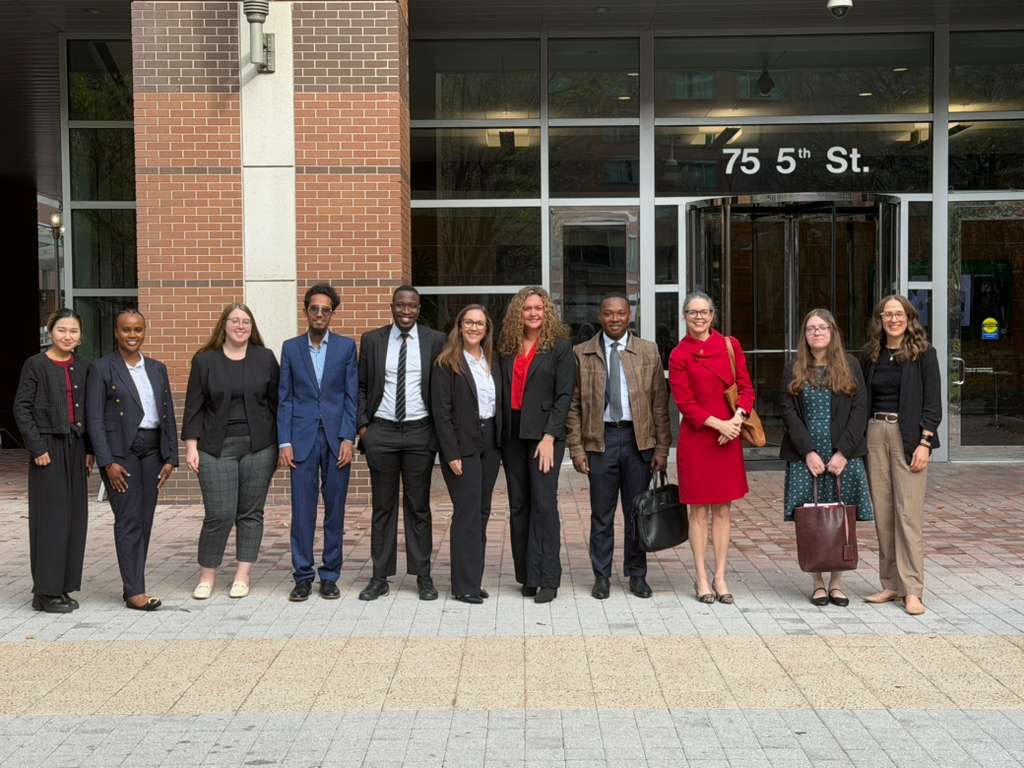
In November, University of Georgia School of Law Professor Desirée LeClercq traveled to Atlanta with a group of students as the culmination of their semester-long exploration of international trade.

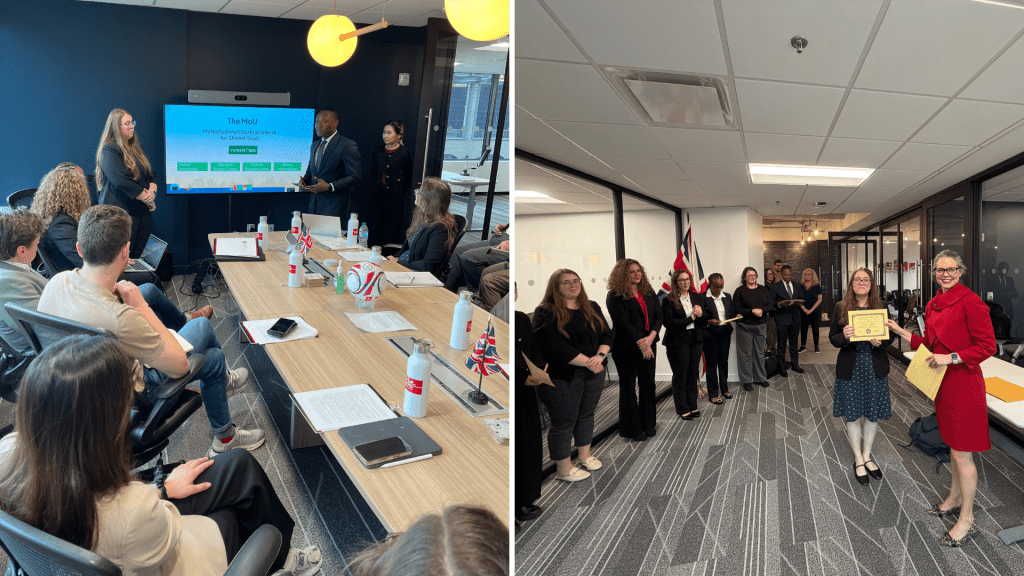
15 students, including J.D., LL.M., and Graduate Certificate in International Law students, spent the semester examining potential trade and investment opportunities between the State of Georgia and the United Kingdom from an interdisciplinary perspective. They researched and wrote a paper examining key export and import sectors in Georgia and the United Kingdom, and then prepared a hypothetical Memorandum of Understanding (MoU) between the two. The students spent the day in Atlanta presenting to, and fielding technical questions from, three different audiences: representatives from the state of Georgia, transactional and international lawyers from Eversheds Sutherland, and foreign diplomats from the U.K. consulate.

Georgia Department of Economic Development

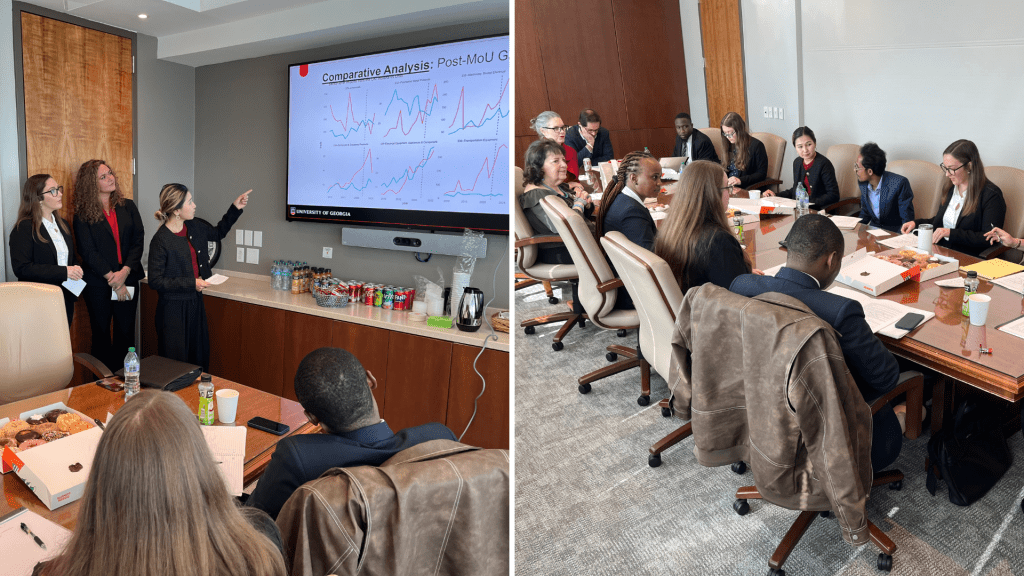
The group’s first stop of the day was hosted by the Georgia Department of Economic Development (GDEcD), the state’s sales and marketing arm, and had in attendance other state representatives.

At the GDEcD, Madina Bekisheva (GCIL student), Sutton Eady (J.D. ’27), Md. Asaduzzaman Jabin (GCIL student), and Jalyn Ross (J.D. ’27) worked together to present their portion of the hypothetical legal instrument. In their presentation, the group argued for greater collaboration and synergies between the state and the United Kingdom to attract, facilitate, and potentially grow trade. Their arguments centered on export and import data from similarly situated states and novel predictive models they had built demonstrating how enhanced collaborations with the United Kingdom could increase trade and job opportunities in Georgia. The students used the model to identify specific sectors in industry, renewable energy, commerce, and agriculture, among others, where Georgia’s economy and workers could benefit.
Eversheds Sutherland

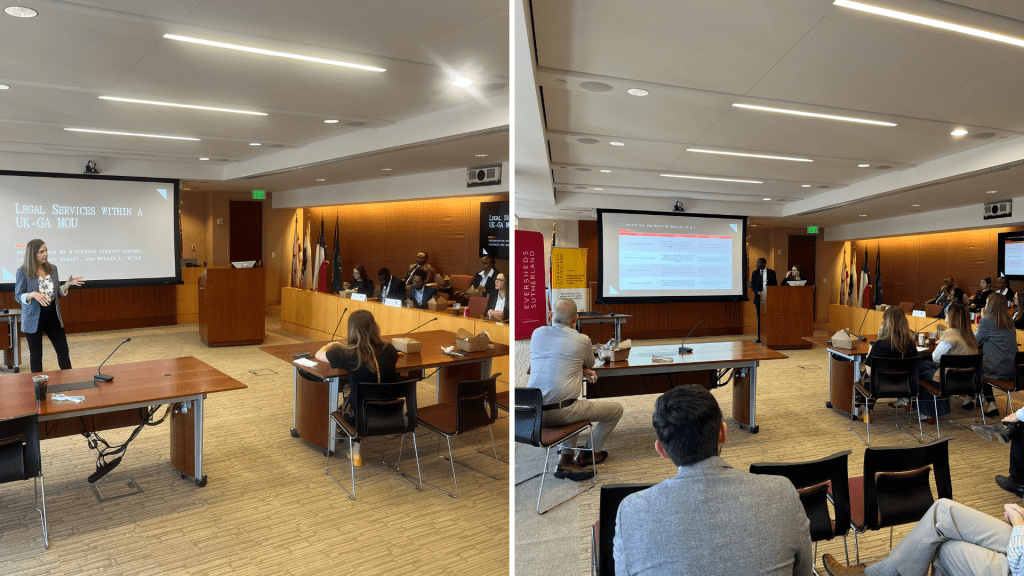
The group’s second stop of the day was the Atlanta office of Eversheds Sutherland, a global law firm specializing in corporate, energy, litigation, tax, and real estate. This firm has a meaningful relationship with the UK, as it is where the Eversheds law firm originated prior to their 1988 merger with Sutherland. The firm’s global headquarters is located in London, and its historic ties to the country are evident in their presence throughout the British legal market. Students Leighlee Mahony (J.D. ’26) and N’Guessan “Clement” Kouame (LL.M. ’24, J.D. ’26) presented. Both students argued that enhanced trade and investment collaboration between Georgia and the United Kingdom could offer reciprocity in sectors, including legal services.

The students were hosted by Jenny Lambert, Partner, and attended by several practicing attorneys in transactional and international work. The students benefitted both from the lunch that Eversheds Sutherland generously provided, as well as in-depth and vigorous questioning by the firm’s attorneys.
British Consulate General Atlanta

The group’s third and final stop of the day was the British Consulate General Atlanta. Students Maya Roper (J.D. ’27), Victor Azure (LL.M. ’26), Wambui Kamau (LL.M. ’26), and Madina Bekisheva (GCIL student) presented the group’s data and modeling to U.K. diplomats and officials. The group again walked the audience through specific trade and industry sectors, with a special focus on battery production for electric vehicles, the Georgia aerospace industry’s advantage, and veterinary medicine.
Student Reflections

“Coming from a non-law background in Computer Science, I learned that successful trade and partnerships do not thrive on innovation alone. They must be shaped by policy and political realities, economic conditions, population needs, national interests, and stakeholder relationships. The Atlanta trip made this clear by showing how quickly trade negotiations can shift based on context, not on the brilliance of the technology or business itself.” – Md. Asaduzzaman Jabin (GCIL student)

“This course was a great blend of theory and practice, requiring intensive and insightful legal research to understand and gather the materials, as well as concise, precise, and clear drafting of the MoU. The most significant site visit for me was the visit to the Georgia Department of Economic Development. It was a great experience to compare our findings with the department’s work and its vision for improvement. It was also interesting to know that people at the GDDE were doubtful about the use of models for the prediction of growth or value from MoUs. It shows how sometimes new technology may face skepticism for its implementation and convince people to advance or improve their old methods.” – N’Guessan “Clement” Kouame (LL.M. ’24, J.D. ’26)
2024 Annual Report for the Dean Rusk International Law Center published

As the year draws to a close, we at the University of Georgia School of Law‘s Dean Rusk International Law Center are pleased to share our annual report, detailing a wide range of international activities and achievements that contributed to our #20 U.S. News ranking for international law programs in the United States in 2024. This year’s report highlights:

  • Faculty publications and awards
  • Global Governance Summer School
  • Global Externships Overseas
  • Master of Laws (LL.M.) program
  • Visiting Research Scholars
  • International events and conferences
  • International advocacy
  • Rusk Center Council
  • Global Partnerships
  • And more!

The 2024 annual report can be accessed here.

Georgia Law 3L Andrew Arrington reflects on significance of his Global Externship in Estonia

Today, we welcome a guest post by Andrew Arrington, a member of the Georgia Law class of 2024. Through the Global Externships Overseas (GEO) initiative, Andrew was able to extern with Sorainen, an international business law firm based in Tallinn, Estonia.

I vividly remember my first day at Sorainen, tidying my hair anxiously in the reflection of the gold elevator. It was not only the first day of my 1L summer job, but it was my first time working abroad, and I did not know what to expect. I was relieved that my apartment was only a five-minute walk from my office, but I still got there so early that I ordered breakfast and coffee in a quiet, ultramodern café next door.

As the elevator counted down to the lobby floor, I mumbled the phrase, “Tere. Mina olen Andrew,” to myself over and over, unsure if my pronunciation was even intelligible. With a ding, I was warmly greeted by the woman at the front desk. I watched my soon-to-be coworkers passing by my conference room, putting up their coats and bags in the cloakroom next door, while I waited for my boss to arrive. My anxiety finally melted when Katriina, who interviewed me months earlier, saw me sitting in the office and burst in to give me a hug. It was then I knew I was in for a special summer.

The Global Externship Overseas initiative was a moonshot for me. What I originally imagined as a substitute for not studying abroad in undergrad turned out to be the best career decision I made during law school because of the depth of legal work and client interaction I had over the span of two short months. Through the tireless work of staff at the Dean Rusk International Law Center, including Sarah Quinn and Catrina Martin, my description of a hypothetical dream placement working on data privacy in Europe, possibly in Estonia, became a reality. This request was the result of being a first-generation law student who had just graduated from Georgia Tech; at this point, I was really only familiar with the field of data privacy law after taking a class with Professor Swire and Dr. Anton at my undergraduate institution. I had my sights set on Estonia because I was familiar with the country’s leadership in technology innovation and entrepreneurship in Europe. 

I was proudly the first American intern in a couple of decades at Sorainen. During my summer there, I gained contracting skills, including with software as a service (SaaS) contracts, data protection agreements, and other standard GDPR privacy agreements. I was also able to research national security implications, genetic material requirements, and the brand new EU sanctions on Russia. I wrote memos on the effects of the then-nascent Digital Services Act and Digital Markets Act. When my time in the office came to a close, I was asked if I would like to work for a client full-time as the designated trainee to a general counsel for Pactum while I worked remotely from my home in the US. This was another great experience of implementing GDPR requirements through vetting vendors and researching the impact of US state privacy laws on a dual US-EU business.

By the end of my summer at Sorainen, I had colleagues who not only translated meetings in English for me, but also translated our nights out at the local museum. These are colleagues I am still in touch with and exchange Christmas cards with two years later.

Because of my decision to pursue a GEO, I fell in love with a place I would have never visited otherwise. I became a local at the bakery around the corner ordering rhubarb pastries in Estonian. I knew I reached local status when a new clerk working asked me a question about change in Estonian. I ate pine needle ice cream on walks by myself after work along cobblestone streets, and I was driven out of the city to Viru Bog by my fellow summer interns to visit one of the most beautiful natural parks I have ever been to. I had coworkers go out of their way to give me visits of their hometown during the weekends, and I also had an unforgettable office outing playing cards on the rooftop under the midnight sun. 

I cannot recommend enough to my fellow students the professional value of not only being able to work in a legal environment abroad but also the memories that Georgia Law and the Center made possible through the GEO program. This opportunity increased my contract drafting and editing abilities tremendously, provided opportunities to interact directly with clients, and exposed me to data privacy and compliance work. Now every time I interview, it is the topic that people most want to talk about, and I not only have a wealth of legal experiences to draw upon but also a reminder of the summer of a lifetime.

***

Applications are now open for summer 2024 Global Externships Overseas (GEO). This initiative places University of Georgia School of Law students in four-to-twelve week international placements each summer, where they gain substantive, hands-on experience in diverse areas of legal practice. Over the last fifteen years, more than 200 Georgia Law students have completed a GEO in law firms, government agencies, corporate legal departments, intergovernmental organizations, and nongovernmental organizations around the world.

Current 1Ls and 2Ls are encouraged to apply for summer GEOs. All applicants should reference this instructional video for step-by-step information regarding how to create and successfully complete an application for GEOs in UGA’s Study Away Portal by the March 1 deadline. For more information, email: ruskintlaw@uga.edu

UGA Law coursework to begin for new cohort of students seeking Graduate Certificate in International Law

The start of the spring 2024 semester next week marks the arrival of the third cohort of Graduate Certificate in International Law students here at the University of Georgia School of Law.

Administered through UGA Law’s Dean Rusk International Law Center, postgraduate students from other disciplines within the university will earn this academic certificate following their successful completion, in classes alongside J.D., LL.M., and M.L.S. students, of fifteen credit hours chosen from among the law school’s rich comparative, transnational, and international law curriculum; courses include Public International Law, International Human Rights, International Trade Law, Immigration Law, International Law Colloquium, and Global Governance.

Joining the law school’s first two cohorts (introduced here and here), this third class of seven students includes:

Five doctoral students, including: Madina Bekisheva and Elizabeth Stark, both a Ph.D. students in the School of Public and International Affairs studying Political Science and International Affairs; Nathanael Mickelson and Hao Yang, both Ph.D. students in the Franklin College of Arts & Sciences, studying History and Geography, respectively; and Anastasia Marx, a Ph.D. student in the School of Engineering, studying Biomedical Engineering.

Two master’s students, including: Emilio Suarez Romero, a graduate student in the College of Agricultural and Environmental Sciences, who is pursuing a Master of Science in Horticulture, and Michael Williams, a graduate student in the School of Public and International Affairs, who is pursuing a Masters of Public Administration.

All information about the Graduate Certificate in International Law, including upcoming application cycles and upcoming virtual information sessions, can be found here.