Bruner is the Stembler Family Distinguished Professor in Business Law at the University of Georgia School of Law and serves as a faculty co-director of the Dean Rusk International Law Center.
The University of Georgia School of Law’s spring 2025 International Law Colloquium welcomed Professor Christopher Bruner, who presented his working paper, “Sustainable Corporate Governance and Prospects for a US Value Chain Due Diligence Law.” Joshua Barkan, Associate Professor in the Department of Geography at the University of Georgia, served as Bruner’s faculty discussant.
Bruner is the Stembler Family Distinguished Professor in Business Law at the University of Georgia School of Law and serves as a faculty co-director of the Dean Rusk International Law Center. Bruner’s scholarship centers around corporate law, corporate governance, comparative law and sustainability.
Below is an abstract of Bruner’s working paper:
Laws requiring multinational companies to undertake due diligence to detect, prevent, and mitigate human rights and environmental abuses in their value chains have proliferated across Europe, and the European Union has adopted a directive to harmonise such national laws. This chapter assesses the prospects for enactment of such a value chain due diligence law in the United States.
Although such laws are often conceptualised as an extension of corporate law, they can just as readily be conceptualised as an extension of trade law – and the latter approach offers real potential to sidestep anti-ESG and anti-sustainability sentiment among the US political right. Packaged as a trade initiative, the prospects for bipartisanship improve because the political left and right can each embrace the effort by reference to policy preferences resonating with their respective bases. To the progressive left, such laws raise labour and environmental standards globally, while to the conservative right, such laws protect domestic industry from unfair foreign competition.
The chapter first examines corporate politics in the United States, discussing how fundamental corporate governance debates revolve around thorny ideological issues that strongly polarise the political left and right, diminishing the prospects for a value chain due diligence law conceptualised as an extension of corporate law. It then examines trade politics in the United States, discussing how framing by reference to trade improves the prospects for a US value chain due diligence law by sidestepping such ideological issues and giving both the political left and right plausible ways to view such a law as a victory for their respective bases. The chapter concludes with discussion of trade-offs raised by these differing modes of legal strategy and institutionalisation, observing that the corporate law approach offers broader reach with weaker enforcement while the trade law approach offers narrower reach with stronger enforcement.
This year, Professor Desirée LeClercq is overseeing the colloquium, which is designed to introduce students to features of international economic law through engagement with scholars in the international legal field. To view the full list of International Law Colloquium speakers, visit our website.
This program is made possible through the Kirbo Trust Endowed Faculty Enhancement Fund and the Talmadge Law Faculty Fund.
University of Georgia School of Law professor Christopher M. Bruner was featured in Insurance Day, published by London-based Lloyd’s List Intelligence. The article by Ben Margulies, titled “Can the UK Capture Captives?,” discusses the UK government’s effort to create a competitive captive insurance regime.
Bruner shared his thoughts on the factors that make a jurisdiction attractive for establishing captive domiciles, suggesting that smaller jurisdictions can offer fast and flexible policymaking processes. Their small size “makes co-ordination much easier among all the relevant public and private constituencies and it renders their commitment to attractive regulatory structures more credible. They’re highly dependent on these service offerings economically and the market knows it.” London, however, offers competitive advantages in its own right. “London’s main advantage is the extraordinary breadth and depth of corporate and financial services offerings in one place,” Bruner explains. “It’s the ultimate one-stop shop, including in risk management, which provides a strong foundation in the form of pre-existing professional and regulatory know-how.”
Christopher M. Bruner is the Stembler Family Distinguished Professor in Business Law at the University of Georgia School of Law and serves as a faculty co-director of the Dean Rusk International Law Center.
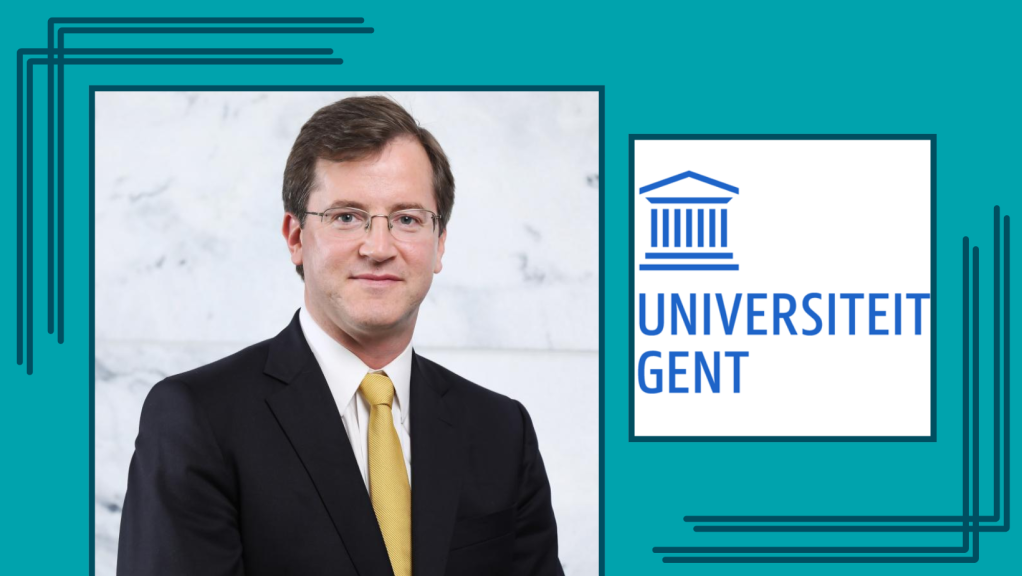
Christopher M. Bruner, Stembler Family Distinguished Professor in Business Law and Faculty Co-Director of the Dean Rusk International Law Center, gave the keynote address for a symposium on “Corporate Sustainability Due Diligence (CSDD), Sustainability, and Corporate Law” at Ghent University Law School in Belgium during May. Bruner’s keynote was titled “Developments and Debates on Corporate Sustainability in the US,” and the symposium was co-sponsored by the journal European Company Case Law (ECCL).
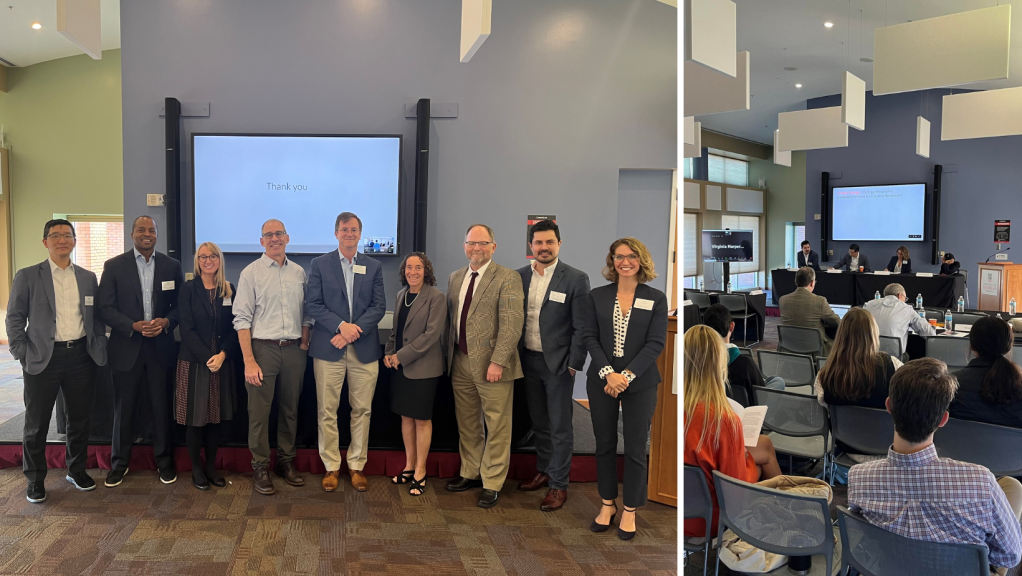
As posted previously, speakers representing a diverse range of doctrinal, institutional, and jurisdictional perspectives gathered on October 16 to discuss the array of contemporary ESG and corporate sustainability initiatives, mapping this rapidly evolving global landscape and engaging with the host of complex international and comparative legal challenges they raise.
Keynoting the conference was University of Pennsylvania Carey School of Law Professor Jill E. Fisch, Saul A. Fox Distinguished Professor of Business Law; Co-Director, Institute for Law & Economics.
The video links are as follows:
Introduction and Panel 1: ESG and Sustainable Finance, with Usha Rodrigues, University Professor and M.E. Kilpatrick Chair of Corporate Finance and Securities Law, University of Georgia School of Law; George S. Georgiev, Associate Professor of Law, Emory University School of Law; Virginia Harper Ho, Professor of Law, City University of Hong Kong; Stephen Park, Associate Professor of Business Law and Satell Fellow in Corporate Social Responsibility, University of Connecticut School of Business; and Anne Tucker, Professor of Law, Georgia State University College of Law.
Panel 2: Corporate Law, Corporate Governance and Sustainability, with Christopher M. Bruner, Stembler Family Distinguished Professor in Business Law and Faculty Co-Director of the Dean Rusk International Law Center, University of Georgia School of Law; Matthew T. Bodie, Robins Kaplan Professor of Law, University of Minnesota Law School; Andrew Johnston, Professor of Company Law and Corporate Governance, University of Warwick School of Law; Lindsay Sain Jones, Assistant Professor, University of Georgia Terry College of Business; and Omari Scott Simmons, Professor of Law, George Washington University Law School.
Panel 3: Multinational Corporations and Global Value Chains, with Harlan G. Cohen, Gabriel M. Wilner/UGA Foundation Professor in International Law and Faculty Co-Director of the Dean Rusk International Law Center, University of Georgia School of Law (and the GJICL’s Faculty Advisor); Sarah Dadush, Professor of Law, Rutgers Law School; David Hess, Professor of Business Law and Business Ethics, University of Michigan Stephen M. Ross School of Business; Kish Parella, Class of 1960 Professor of Ethics and Law, Washington and Lee University School of Law; and Jaakko Salminen, Associate Senior Lecturer, Department of Law, Lund University.
Keynote Addressby Jill E. Fisch, Saul A. Fox Distinguished Professor of Business Law and Co-Director of the Institute for Law and Economics, University of Pennsylvania Carey Law School
This event was cosponsored by the Dean Rusk International Law Center.


 exchange of notes