University of Georgia School of Law Professor Diane Marie Amann recently gave an online lecture entitled “Justice for Child-Taking and Other Crimes against and affecting Children” as part of “International Criminal Law, Conflict Resolution and Transitional Justice,” the week-long 24th Specialization Course in International Criminal Law for Young Penalists, held in Sicily, at the Siracusa International Institute for Criminal Justice and Human Rights, Italy.
Amann is Regents’ Professor of International Law, Emily & Ernest Woodruff Chair in International Law, and a Faculty Co-Director of our Dean Rusk International Law Center here at Georgia Law. Her Siracusa lecture drew upon her expertise on children, violence, conflict, and justice. Her most recent publication in this field is “Child-Taking,” 45 Michigan Journal of International Law 305 (2024); all her related publications are available here.
Amann is Regents’ Professor of International Law, Emily & Ernest Woodruff Chair in International Law, and a Faculty Co-Director of our Dean Rusk International Law Center here at Georgia Law.
Here’s the abstract for Professor Amann’s article:
“Conventional narratives tend to represent the post-World War II international criminal proceedings as a men’s project, thus obscuring the many women who participated, as lawyers, journalists, analysts, interpreters, witnesses, and defendants. Indeed, two women stood trial before Nuremberg Military Tribunals. This article examines the case of the only woman found not-guilty: Inge Viermetz, who had been an administrator at Lebensborn, the Nazi SS adoption and placement agency. The article outlines the prosecution’s child-taking case against Viermetz, as well as her successful gendered self-portrayal as a conventionally feminine caregiver. With references to Professor Megan A. Fairlie, at whose memorial symposium it was presented, the article concludes by considering contemporary implications of this acquittal at Nuremberg.”
University of Georgia School of Law Professor Diane Marie Amann recently took part in a New York conference that launched the Children and Crimes Against Humanity Coalition, formed to ensure that child justice is embedded in a treaty to be negotiated at the United Nations.
Professor Amann, who chaired a conference panel entitled “Increasing Visibility of Crimes Affecting Children and New Crimes Against Children,” commented on drafts and is an individual endorser of the Coalition white paper. Here at Georgia Law, she is Regents’ Professor of International Law, Emily & Ernest Woodruff Chair in International Law, and a Faculty Co-Director of our Dean Rusk International Law Center. She was Special Adviser to International Criminal Court Prosecutor Fatou Bensouda on Children in & affected by Armed Conflict from 2012 to 2021, and has served since 2023 on the Bring Back Kids UA Task Force. Her recent publications in this field include “Child-Taking,” 45 Michigan Journal of International Law 305 (2024), and “International Child Law and the Settlement of Ukraine‑Russia and Other Conflicts,” 99 International Law Studies 559 (2022).
By U.N. General Assembly resolution, states will conclude the Crimes Against Humanity Treaty – known formally as the Convention on the Prevention and Punishment of Crimes Against Humanity – following diplomatic plenipotentiary conferences in 2028 and 2029. Preparatory meetings will take place in the interim, beginning next January.
The treaty’s text will derive from draft articles adopted in 2019 by the International Law Commission, and from amendments to those articles which U.N. member states may propose during the negotiation process.
Through efforts like the Columbia conference and the just-released white paper, the Children and Crimes Against Humanity Coalition will endeavor to promote states’ proposals to include in child-related provisions in the final treaty text. Its white paper proposes, inter alia: that every person under 18 be defined as a child; that the crime of persecution expressly include age as a prohibited ground; and the enumeration of acts that may constitute crimes against humanity explicitly include recruitment and use of children by armed groups and armed forces, as well as forced marriage. Further provisions relate to national justice and reparations proceedings; among these is the proposal that any child suspected of having committed a crime against humanity will be treated in a country’s child justice system, and not via an adult criminal prosecution.
The white paper’s authors are Véronique Aubert (Save the Children), Zoé Bertrand (Global Survivors Fund), Janine Morna (Amnesty International), and Zama Neff (Human Rights Watch). Those nongovernmental organizations co-sponsored the May 5 conference, along with various units of Columbia University and the U.N. permanent missions of Andorra, Brazil, Malta, Mexico, and the United Kingdom.
University of Georgia School of Law alumna and Dean Rusk International Law Center Council member Tess Davis (J.D. ’09) was featured in the documentary “LOOT: A Story of Crime and Redemption,” which highlights the illicit art dealings of Western museums.
From remote Cambodian villages to elite art institutions in New York, LOOT : A Story of Crime & Redemption is a daring look into the underbelly of the multi-billion-dollar art market and the deadly reality behind “blood antiquities” filling Western museums today. During Cambodia’s civil war, British “adventurer-scholar” Douglas Latchford led an extensive criminal network, looting centuries-old temples hidden within landmine-filled jungles. The film offers access to key players, including “Blue Tiger” a former child soldier turned looter who now fights to return stolen artifacts.
The film tells the gripping story of the contrast of rich and poor as viewers learn about multi-million-dollar sales of works looted by Cambodian farmers paid $20.00 per week while risking their lives. LOOT : A Story of Crime and Redemption also takes viewers behind-the-scenes as stolen pieces are returned to Cambodia, including some arriving from New York’s Met Museum in July 2024. With thousands of pieces still overseas, Cambodia’s relentless struggle continues against the most powerful figures in the art world today.
Tess Davis, a lawyer and archaeologist by training, is Executive Director of the Antiquities Coalition, a nonprofit dedicated to the preservation and protection of art, artifacts, and cultural pieces. She oversees the organization’s work to fight cultural racketeering and also manages the day-to-day operations of the institute’s staff in Washington, DC, as well as programs overseas. Since 2013, Davis has been affiliated with the Scottish Centre for Crime and Justice Research, at the University of Glasgow. She came to Scotland from the Lawyers’ Committee for Cultural Heritage Preservation — a not-for-profit institution based in Washington, DC — where she was Executive Director until 2012. She previously worked for the nongovernmental organization Heritage Watch in Cambodia, first as Project Coordinator, and finally Assistant Director. Her career began at the Archaeological Institute of America.
Over the last decade, Davis has conducted extensive field research on the illicit trade in Cambodian antiquities, as well as legal research on the kingdom’s cultural property law. She also conceptualized and implemented a number of exciting projects in the country, including an exhibition at Angkor Wat about threats facing the temple, a hotline for the public to report archaeological discoveries or looting, and a children’s book entitled “If the Stones Could Speak.” From 2012-2014, she directed a legal internship program in Phnom Penh for international students from the Tulane-Siena Institute, who assist the Cambodian Ministry of Culture and Fine Arts with their legal needs. Davis has been a legal consultant for the Cambodian and US governments and works with both the art world and law enforcement to keep looted antiquities off the market. She writes and speaks widely on these issues — having been published in the New York Times, Wall Street Journal, the Los Angeles Times, CNN, the Huffington Post, and various scholarly publications — and featured in documentaries.
Her co-panelist was Linos-Alexandre Sicilianos, who is Professor of Law at the University of Athens, Greece, and the former President of the European Court of Human Rights. Moderating was Israr Khan, President of the Oxford Union, a 200-year-old debating society which draws much of its membership from the University of Oxford.
Amann is Regents’ Professor of International Law, Emily & Ernest Woodruff Chair in International Law, and a Faculty Co-Director of our Dean Rusk International Law Center here at Georgia Law.
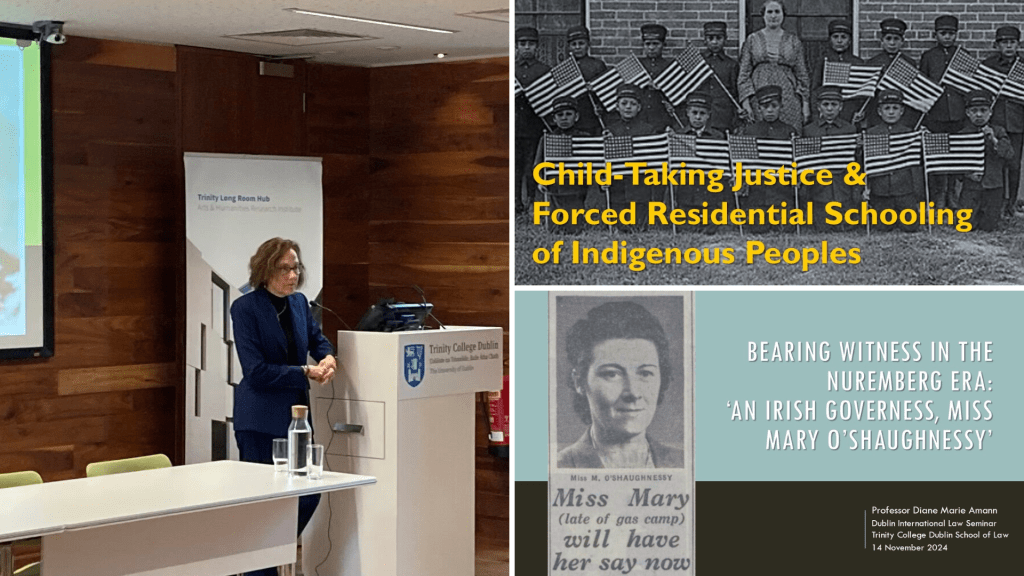
University of Georgia School of Law Professor Diane Marie Amann recently spoke on “Child-Taking Justice and Forced Residential Schooling of Indigenous Americans” at Washington University School of Law in St. Louis.
Her presentation was part of a spring semester WashU Law International Law Colloquium organized by Professor MJ Durkee, who is the William Gardiner Hammond Professor of Law and Director of the Whitney R. Harris World Law Institute. Durkee joined that faculty in 2023, after serving as an Allen Post Professor, Associate Dean for International Programs, and Director of the Dean Rusk International Law Center here at Georgia Law.
The discussant for Amann’s paper was Lecturer Steve Alagna, who is an enrolled citizen of the Iowa Tribe of Kansas and Nebraska, and whose WashU Law Appellate Clinic just filed an amicus brief in federal appellate litigation which seeks redress, under the United States’ Native American Graves Protection and Repatriation Act, for survivors of Indigenous children who died and were buried at a former residential school site.
Amann is Regents’ Professor of International Law, Emily & Ernest Woodruff Chair in International Law, and a Faculty Co-Director of our Dean Rusk International Law Center here at Georgia Law. The paper she presented at WashU builds upon research that she published as “Child-Taking,” 45 Michigan Journal of International Law 305 (2024).
Presented her work in progress, “Child-Taking Justice and Forced Residential Schooling of Indigenous Peoples,” as part of the Bonavero Perspectives workshop series at the Oxford Faculty of Law Bonavero Institute of Human Rights. Moderating was another Bonavero Research Visitor, Professor Eva Marie Belser of the University of Fribourg in Switzerland.
Amann is Regents’ Professor of International Law, Emily & Ernest Woodruff Chair in International Law, and a Faculty Co-Director of our Dean Rusk International Law Center here at Georgia Law, where she teaches Public International Law, Constitutional Law, and various upper-division courses exploring interrelations between national and international legal frameworks.
Amann is Regents’ Professor of International Law, Emily & Ernest Woodruff Chair in International Law, and a Faculty Co-Director of our Dean Rusk International Law Center here at Georgia Law.
Her article, which draws upon her ongoing research into lawyers and other women professionals played at post-World War II trials, forms part of the journal’s special review series marking the centenary of the Hague Academy of International Law.
Available here, the article focuses on the life of one “Nuremberg woman,” Dr. Aline Chalufour, who attended the Academy in 1937 and again in 1957. Her experiences both shed light on how marginalized groups fared in the Academy’s first 100 years, and also call upon the Academy, and the field it promotes, to do better in the next 100 years.
Amann is Regents’ Professor of International Law, Emily & Ernest Woodruff Chair in International Law, and a Faculty Co-Director of our Dean Rusk International Law Center here at Georgia Law. She has pursued a research-intensive semester this autumn, primarily as a Research Visitor at the Oxford Faculty of Law Bonavero Institute of Human Rights and Visiting Fellow at Exeter College Oxford.
University of Georgia School of Law Professor Diane Marie Amann recently gave a public lecture entitled “Child-Taking: Unlawful Transfer plus Identity Alteration, in Ukraine and Beyond,” at the University of Reading School of Law in Reading, United Kingdom, as part of that law school’s Global Law at Reading (GLAR) lecture series.
Her presentation drew upon her just-published article, “Child-Taking,” 45 Michigan Journal of International Law 305 (2024).
Amann is Regents’ Professor of International Law, Emily & Ernest Woodruff Chair in International Law, and a Faculty Co-Director of our Dean Rusk International Law Center here at Georgia Law. This fall, she is spending a research-intensive semester in the United Kingdom, where she is a Research Visitor at the Oxford Faculty of Law Bonavero Institute of Human Rights and Visiting Fellow at Exeter College Oxford.