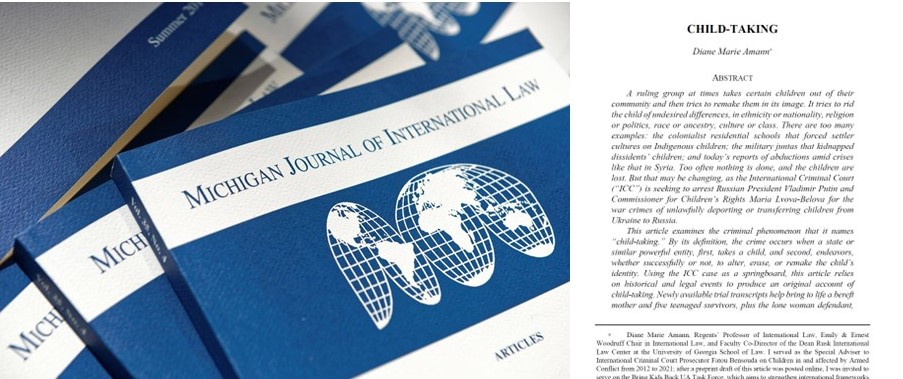
Georgia Law Professor Diane Marie Amann publishes “Child-Taking” in Michigan Journal of International Law

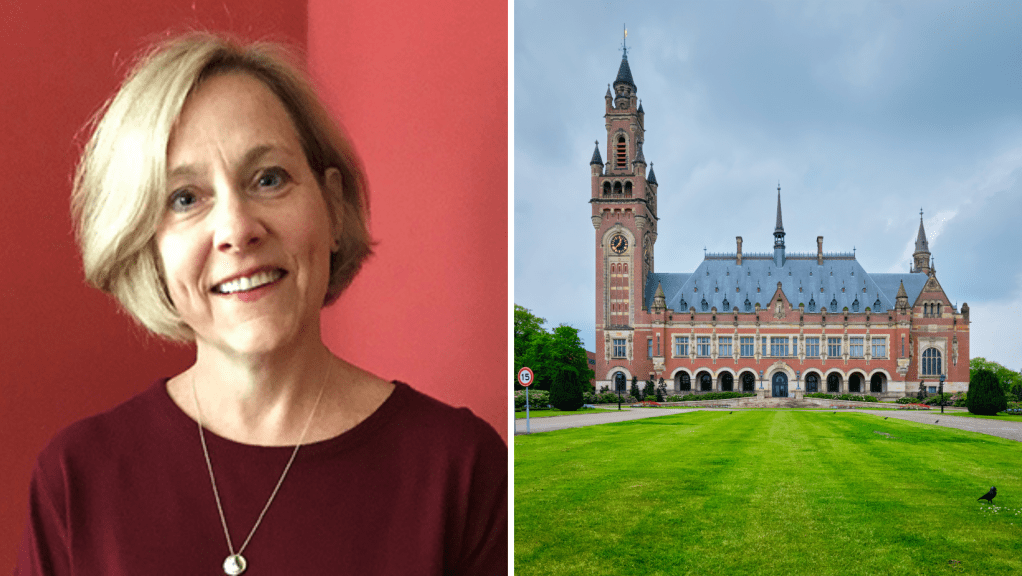
“Child-Taking,” an article by University of Georgia School of Law Professor Diane Marie Amann, has just been published at 45 Michigan Journal of International Law 305-79 (2024).

As theorized in the article, “child-taking” occurs when a state or similar powerful entity takes a child and then endeavors to alter, erase, or remake the child’s identity. It is a criminal phenomenon that has been repeated across decades and centuries. On rare occasion, criminal prosecutions have occurred, as with the Situation in Ukraine before the International Criminal Court. More often redress, if any, must take place in other forums. The article thus considers these other types of transitional justice, with particular attention to the legacies of forced residential schooling imposed upon Indigenous children in the United States, Canada, and elsewhere.

Amann presented aspects of this research at numerous venues, including King’s College London, Yale University, the University of Cambridge, University College London, and the American Society of International Law Annual Meeting.

Amann is Regents’ Professor of International Law, Emily & Ernest Woodruff Chair in International Law, and a Faculty Co-Director of our Dean Rusk International Law Center here at Georgia Law. She served from 2012 to 2021 as International Criminal Court Prosecutor Fatou Bensouda’s Special Adviser on Children in & affected by Armed Conflict.

Here’s the abstract of the “Child-Taking” article, the print version of which is available here:

A ruling group at times takes certain children out of their community and then tries to remake them in its image. It tries to rid the child of undesired differences, in ethnicity or nationality, religion or politics, race or ancestry, culture or class. There are too many examples: the colonialist residential schools that forced settler cultures on Indigenous children; the military juntas that kidnapped dissidents’ children; and today’s reports of abductions amid crises like that in Syria. Too often nothing is done, and the children are lost. But that may be changing, as the International Criminal Court (“ICC”) is seeking to arrest Russian President Vladimir Putin and Commissioner for Children’s Rights Maria Lvova-Belova for the war crimes of unlawfully deporting or transferring children from Ukraine to Russia.

“This article examines the criminal phenomenon that it names ‘child-taking.’ By its definition, the crime occurs when a state or similar powerful entity, first, takes a child, and second, endeavors, whether successfully or not, to alter, erase, or remake the child’s identity. Using the ICC case as a springboard, this article relies on historical and legal events to produce an original account of child-taking. Newly available trial transcripts help bring to life a bereft mother and five teenaged survivors, plus the lone woman defendant, who testified at a little-known child-kidnapping trial before a postwar Nuremberg tribunal. Their stories, viewed in the context of the evolution of international child law, inform this article’s definition. These sources further reveal child-taking to be what the law calls a matter of international concern. At its most serious, child-taking may constitute genocide or another crime within the ICC’s jurisdiction. Yet even if circumstances preclude punishment in that permanent criminal court, child-taking remains a grave offense warranting prosecution or other forms of local and global transitional justice. This is as true for the Indigenous children of residential schools in North America, Australia, and elsewhere, and for children in Syria and many other places in the world, as it is for the children of Ukraine.

Georgia Law Professor Amann a Research Visitor at Oxford’s Bonavero Institute of Human Rights

Georgia Law Professor Diane Marie Amann is in the United Kingdom during this Fall 2024 semester, serving as a Research Visitor at the Bonavero Institute of Human Rights, Oxford University Faculty of Law.

The faculty sponsor for Amann’s visit is Professor Dapo Akande. Oxford’s Chichele Professor of Public International Law and a member of the U.N. International Law Commission, he has just been nominated as the UK candidate for election to the International Court of Justice.

Amann, who is Regents’ Professor, Emily & Ernest Woodruff Chair in International Law, and Faculty Co-Director of the Dean Rusk International Law Center here at the University of Georgia School of Law, held the same Oxford post during another research-intensive semester, Spring 2018.

She plans to pursue her scholarship related to women professionals who played roles in international criminal trials after World War II and also her work on child rights, especially as they relate to armed conflict and similar violence.

As a Research Visitor, she also will have the opportunity to take part in Bonavero Institute activities, and will benefit from Oxford’s libraries, seminars and lectures, and other offerings.

The Bonavero Institute was founded in 2016 as a unit of the Oxford Faculty of Law, under the direction of Professor Kate O’Regan, a former judge on the Constitutional Court of South Africa.

Georgia Law Professor Diane Marie Amann quoted on proposed aggression tribunal in Portuguese paper

Professor Diane Marie Amann recently was featured in Expresso, a newspaper based in Lisbon, Portugal, regarding efforts to hold Russian officials accountable for the war in Ukraine.

The May 10 article entitled “Conselho da Europa quer julgar agressão russa num tribunal especial: é desta que Moscovo vai pagar a fatura da guerra?” – in English, “The Council of Europe Wants to Judge Russian Aggression in a Special Court: Is this How Moscow Will Pay the Bill for the War?” – was written by Mara Tribuna.

Reviewing various obstacles to these efforts, Tribuna quoted Amann as follows (in translation):

“One question, obviously, is whether this court will be able to arrest the accused leaders,” acknowledges Diane Marie Amann. Still, she points out, “this is a challenge in all criminal cases, and the magnitude of the challenge should not impede the effort to ensure justice.”

Recalling the March 17, 2023, arrest warrants issued by the International Criminal Court against Russian President Vladimir Putin and his Children’s Rights Commissioner Maria Lvova-Belova (about which Amann has written here), Tribuna wrote:

Although neither has been detained – which highlights the challenge that any legal system faces when trying to guarantee justice while the conflict is ongoing – the decision had effects, considers Amann. “It raised public awareness about the criminal allegations and encouraged states and civil society actors to call for the return of children.”

Amann is Regents’ Professor of International Law, Emily & Ernest Chair in International Law, and Faculty Co-Director of the Dean Rusk International Law Center here at the University of Georgia School of Law. She writes and teaches in areas including transnational and international criminal law, child and human rights, constitutional law, and global legal history.

Georgia Law 2L Aubrey “Ellie” Wilson-Wade attends ASIL Abroad meeting in Switzerland

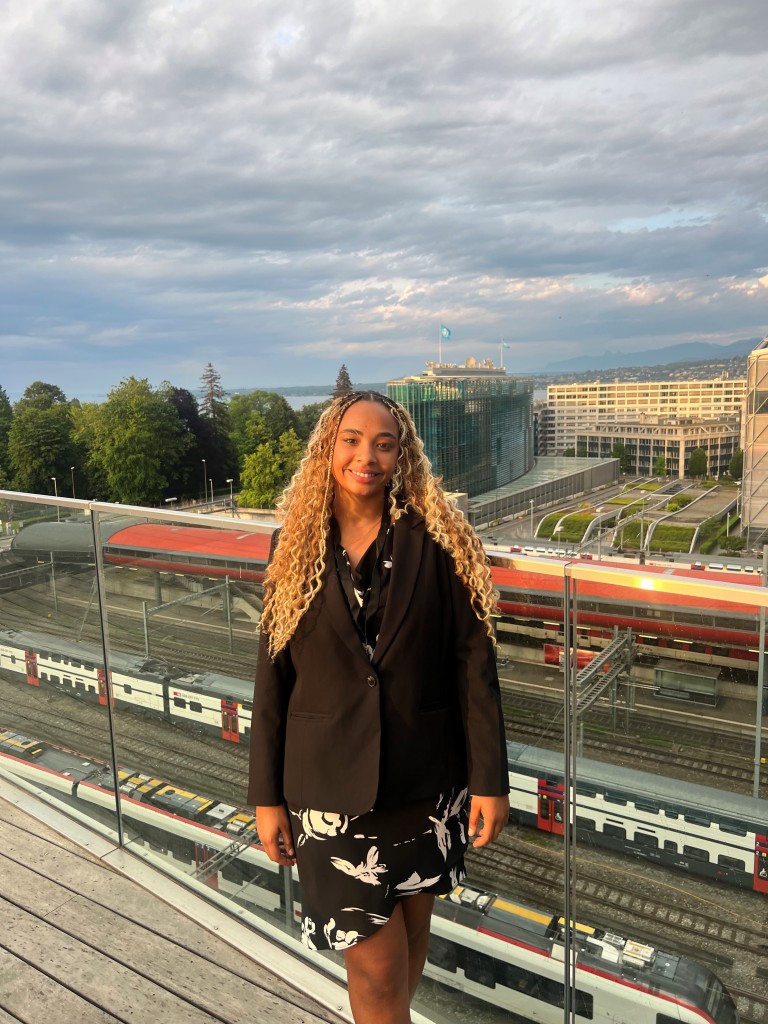
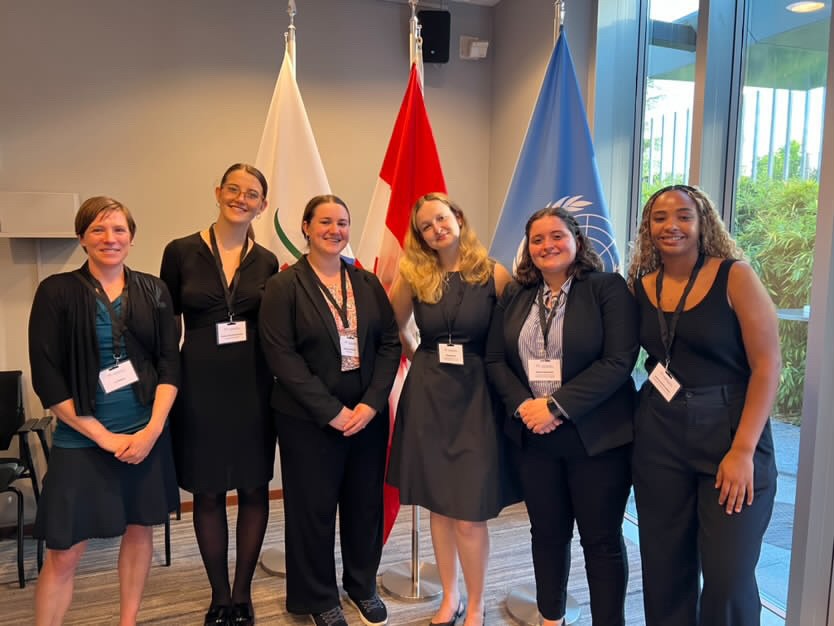
University of Georgia School of Law student, rising 2L Aubrey “Ellie” Wilson-Wade, recently attended the American Society of International Law (ASIL)’s 2024 ASIL Abroad meeting on June 5-6 at the University of Geneva in Geneva, Switzerland. The two-day conference consisted of dual parallel tracks on Human Rights, International Humanitarian Law, International Criminal Law (Track 1) and International Dispute Resolution & International Economic Law (Track 2). Georges Abi-Saab (honorary professor at The Geneva Graduate Institute) delivered a keynote speech, with Laurence Boisson de Chazournes (University of Geneva) as discussant. Below, Wilson-Wade reflects on her experience as an attendee of the conference. Georgia Law is an academic partner of ASIL.

I am so grateful to have had the opportunity to attend the 2024 ASIL Abroad Conference in Geneva, Switzerland. I was able to attend sessions in both track 1 and track 2, as I have an interest in both tracks’ topics. The most memorable sessions that I attended included “Enforcement of Arbitral Awards Rendered Against States” and “Compensation in International Law.” Additionally, I was able to see a mock arbitration related to growing tensions between investment treaties and environmental protection. These panels taught about investment and trade disputes in international law.

My favorite session was titled “Gender, Sexualized Violence, and Conflict: Incorporating the Women, Peace, and Security Agenda into Global Atrocity Prevention Efforts.” The panelists, including Priya Gopalan, Vanessa Murphy, and Dalila Seoane, were able to share their firsthand knowledge and experience working on issues related to gender-based violence.

Overall, the conference was a once-in-a-lifetime learning experience and every panel had an array of diverse perspectives and ideas. Not only was the substantive portion of the conference great, but I also met so many legal professionals and students during my time in Geneva. In just two days, I was able to connect with students attending law school throughout the United States, as well as from schools in England, Brazil, and Geneva. I was also able to network with legal professionals from all over the world.

As a first-year law student, it was a unique opportunity to learn about intricacies of international law outside of the typical classroom setting from professionals in the field. Additionally, it was a great way to make connections with international lawyers and law students. I would highly recommend any student who wishes to globalize their legal perspective and education to attend this conference.

Georgia Law Professor Amann presents “Child-Taking” at Yale University

Professor Diane Marie Amann recently presented her research on “Child-Taking” as a guest lecturer in a course on the Russo-Ukrainian War taught at Yale University this semester. Students from Yale’s law school, management school, and school of global affairs comprise the class, which is taught by Yale Law Professor Eugene R. Fidell and Margaret M. Donovan.

Amann is Regents’ Professor of International Law, Emily & Ernest Chair in International Law, and Faculty Co-Director of the Dean Rusk International Law Center here at the University of Georgia School of Law. She writes and teaches in areas including child and human rights, constitutional law, transnational and international criminal law, and global legal history.

Amann’s online guest lecture drew from her article, “Child-Taking,” soon to be published in the Michigan Journal of International Law. (Preprint draft available at SSRN.) As Amann theorizes it, child-taking occurs when a state or similarly powerful entity abducts children from their community and then endeavors to remake the children in its own image. This conduct, involving children taken from Ukraine, lies at the heart of the International Criminal Court warrants pending against President Vladimir Putin and another top Russian official. The article also examines other examples of the phenomenon, including the Nazis’ kidnappings of non-German children during World War II and the forced placement of Indigenous children into boarding schools in North America, Australia, and elsewhere.

Amann also has presented this scholarship at meetings of the American Society of International Law and at University College London Faculty of Laws and King’s College London Department of War Studies.

Georgia Law Professor Diane Marie Amann presents on Nuremberg woman defendant at conference in memory of FIU Law Professor Megan A. Fairlie

University of Georgia School of Law Professor Diane Marie Amann spoke last week at a conference which paid tribute to Professor Megan A. Fairlie (1971-2022), an international criminal law scholar who had presented her own work at our law school’s Dean Rusk International Law Center.

Most recently, Dr. Fairlie had taken part in a 2019 symposium entitled “International Criminal Court and the Community of Nations,” and she published her presentation, “Defense Issues at the International Criminal Court,” in the Georgia Journal of International and Comparative Law symposium issue.

In recognition of Fairlie’s scholarship on persons accused by international criminal tribunals, Amann chose to present “Inge Viermetz, Woman Acquitted at Nuremberg,” at Friday’s conference.

Entitled “Perspectives on the International Criminal Court and International Criminal Law and Procedure: A Symposium in Memory of Megan Fairlie,” the conference took place at Miami’s Florida International University College of Law. Dr. Fairlie had taught there from 2007 – the same year she earned her Ph.D. in International Human Rights Law from the Irish Centre for Human Rights, National University of Ireland-Galway – until her death in December 2022.

Amann, who is Regents’ Professor of International Law, Emily & Ernest Woodruff Chair in International Law, and Faculty Co-Director of the Dean Rusk International Law Center here at Georgia Law, has published frequently on women professionals during the post-World War II trials at Nuremberg and elsewhere.

Georgia Law Professor Amann featured in The Wall Street Journal on Gaza ruling by International Court of Justice

University of Georgia School of Law Professor Diane Marie Amann was featured in The Wall Street Journal regarding the recent order of the International Court of Justice in the Genocide Convention case which South Africa has filed against Israel. 

The article titled “World Court Rejects Demands for Gaza Cease-Fire” was written by Jess Bravin and was published on January 26.

After reporting the opinion of Utah Law Professor Amos Guiora , that both parties won something, and that, in the words of the article, “Israel avoided a legal ruling that would force it either to stop military operations or defy the world court,” Bravin then wrote:

Still, the conduct of the Gaza campaign received no pass, said Diane Marie Amann, an international-law professor at the University of Georgia. ‘Israel will need to adjust if it wishes to comply with the court’s order,’ she said.

Amann is Regents’ Professor, Emily & Ernest Woodruff Chair in International Law, and Faculty Co-Director of the Dean Rusk International Law Center here at the University of Georgia School of Law. She teaches and publishes regularly on matters relating to international law.

UGA Law Professor Amann presents “Child-Taking” scholarship at British universities in Cambridge and London

University of Georgia School of Law Professor Diane Marie Amann, whose expertise includes child rights, international criminal law, and global legal history, recently discussed her research on “child-taking” at two universities in the United Kingdom.

At the end of September Amann – who is Regents’ Professor of Law, Emily & Ernest Woodruff Chair in International Law, and Faculty Co-Director of the Dean Rusk International Law Center – presented “Child-Taking and Human Rights Law” at the 2023 European Human Rights Law Conference. Entitled “Human Rights Law: Prospects, Possibilities, Fears & Limitations,” the two-day conference took place at the University of Cambridge Faculty of Law.

Last week, she gave a public lecture on “Child-Taking in International Criminal Law” at King’s College London Department of War Studies.

Both talks drew from Amann’s forthcoming article, “Child-Taking,” to be published in the Michigan Journal of International Law.

As Amann theorizes it, child-taking occurs when a state or similarly powerful entity abducts children from their community and then endeavors to remake the children in its own image. This conduct lies at the heart of the International Criminal Court warrants pending against President Vladimir Putin and another top Russian official. The article also examines other examples of the phenomenon, including the Nazis’ kidnappings of non-German children during World War II and the forced placement of Indigenous children into boarding schools in North America, Australia, and elsewhere.

UGA Law professor Diane Marie Amann and UCL Professor Martins Paparinskis

UGA Law Professor Amann presents “Child-Taking and the International Criminal Arrest Warrant” at University College London Faculty of Laws

University of Georgia School of Law Professor Diane Marie Amann, an expert on child and human rights, international criminal law, and the laws of war, presented a lecture entitled “Child-Taking and the International Criminal Arrest Warrant” at University College London Faculty of Laws in June.

News that the International Criminal Court is seeking the arrest of Russia’s President, Vladimir Putin, and Child Rights Commissioner, Maria Lvova-Belova, drew attention to the war crimes charged: “unlawful deportation of population (children)” and “unlawful transfer of population (children) from occupied areas.” Professor Amann’s lecture examined these and similar crimes, which she labels “child-taking.” International child-taking trials date to the Nuremberg tribunals, and have continued in modern forums like the ICC. Court records demonstrate that child-taking is no minor crime. Its present gravity and future consequences are heavy; so too, the prosecutorial burdens of securing indictments, conviction, and redress.

This presentation was chaired by UCL Professor of Public International Law, Martins Paparinskis.

Amann is the Regents’ Professor of International Law, the Emily & Ernest Woodruff Chair in International Law, and a Faculty Co-Director of the Dean Rusk International Law Center.

Georgia Law Professor Amann takes part in podcast tribute to last surviving prosecutor at post-WWII Nuremberg trials, Benjamin B. Ferencz (1920-2023)

Among the international law experts featured in a podcast honoring the last surviving Nuremberg prosecutor is a Faculty Co-Director of our Center, Professor Diane Marie Amann.

The tribute, entitled “In Memoriam: Benjamin B. Ferencz,” was released recently at Asymmetrical Haircuts: Your International Justice Podcast. In it, the podcast’s co-founders, journalists Janet Anderson and Stephanie van den Berg, first provided their own memories of Ferencz, who died on April 7 in Florida, at age 103. They continue with comments not only from Professor Amann, but also from Christopher “Kip” Hale, Adama Dieng, David Donat Cattin, and Ferencz’ son, Don Ferencz.

As a twenty-something lawyer, Ferencz had played a role post-World War II trials at Nuremberg, leading the Einsatzgruppen trial. (His wife, Gertrude Fried Ferencz (1919-2019), likewise worked at the trials, in administrative capacities.) He remained active throughout his life in promoting international criminal law – to quote his own favorite phrase, campaigning for “Law, Not War.”

The comments by Amann, who is Regents’ Professor of International Law and Emily & Ernest Woodruff Chair in International Law here at the University of Georgia School of Law, drew from a tribute she posted here the day after Ferencz’ passing.

(Depicted in photo montage at podcast website: from top left, Amann interviewing Ferencz at International Humanitarian Law Dialogs, Chautauqua, New York; Ferencz with inter alia his son Don Ferencz, Kip Hale, and then-Prosecutor of the International Criminal Court, Fatou Bensouda; prosecutor Ferencz addressing a court at Nuremberg; and Ferencz on a bench dedicated to him at the Peace Palace at The Hague, the Netherlands, in which the phrase “Law Not War” has been carved)