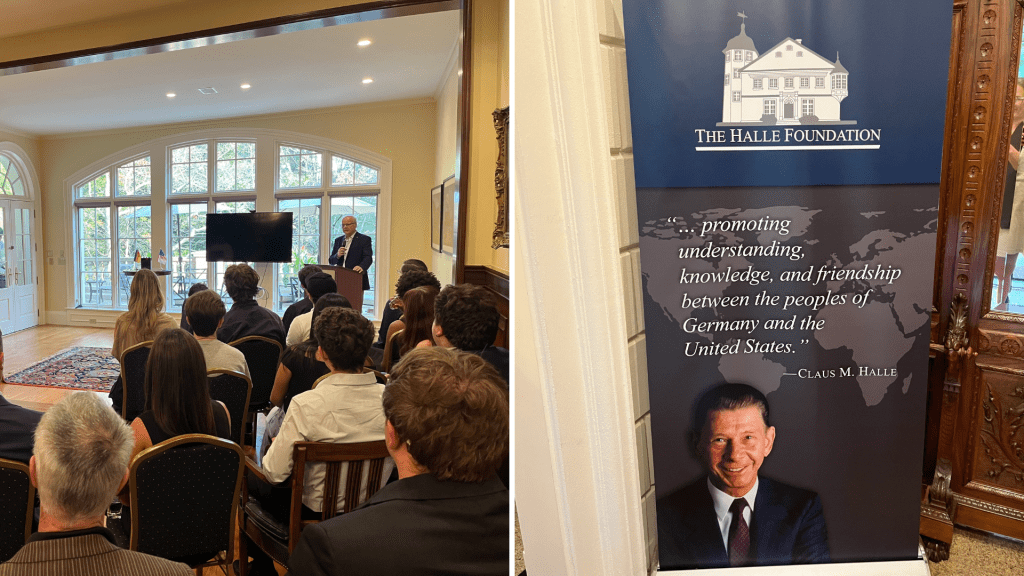
Last week, the University of Georgia School of Law’s Dean Rusk International Law Center participated in a dinner reception celebrating global education and the philanthropic generosity of the Halle Foundation, supporting American-German educational exchange. This event was jointly sponsored by the University of Georgia’s Department of Germanic and Slavic Studies and the Office of Global Engagement.
The mission of The Halle Foundation is to promote understanding, knowledge, and friendship between the people of Germany, as seen in its European context, and those of the United States. In furtherance of this mission, the Foundation supports, primarily through grantmaking, initiatives and activities with a preference to organizations and institutions operating within, or with some discernable connection to, the state of Georgia. UGA has several international mobility initiatives, including Georgia Law’s semester-long Global Externships Overseas (GEO) initiative, that are beneficiaries of the Halle Foundation.
The evening program began with welcoming remarks by Dr. Eike Jordan, Chairman of the Board of Trustees of the Halle Foundation and Dr. Martin Kagel, Associate Provost for Global Engagement, UGA Office of Global Engagement. Then, faculty and administrators at UGA who oversee initiatives benefitting from the Halle Foundation’s support spoke about the impact that their grants have on students. Speakers included: Dr. Jan Uelzmann, Co-Director of Film, Art, and Cultural History in Berlin program; Dr. Heide Crawford, Co-Coordinator of ENGR-GRMN Dual Degree Program, Director of the Freiburg Study Abroad program; and Sarah Quinn, Director of the Dean Rusk International Law Center.
Then, UGA students shared reflections about what their time abroad in Germany meant to them academically, professionally, and personally. Georgia Law student Pace Cassell (J.D. ’26) spoke about her experience as a legal extern at Baker Tilly in Hamburg, Germany during the spring 2025 semester through the semester-long GEO initiative, jointly administered by the Center and the DC Semester in Practice. Cassell is the recipient of a grant from the Halle Foundation, awarded to the law school in summer 2024 to support six students over three years participate in semester-long externships in Germany.
***
Applications are open for fall 2027 semester-long Global Externships Overseas (GEOs). All current 1Ls and 2Ls are invited to submit an application by February 15. For more information and the application, please email: ruskintlaw@uga.edu
Today, we welcome a guest post by Daniel “Tripp” Vaughn, a member of the University of Georgia School of Law class of 2025. Vaughn participated in a semester-long international externship in spring 2025. The semester-long externships overseas initiative is an extension of the Center’s existing Global Externships Overseas and is offered jointly between the Center and the law school’s Clinical and Experiential Program. Vaughn’s post describes his experience as a legal extern with Van Bael & Bellis, a law firm working on EU and national competition law, EU trade and customs law, regulatory law, as well as Belgian business law. Vaughn was based in Brussels, Belgium, where he worked under Georgia Law alumnus Porter Elliott (J.D. ’96).This was Vaughn’s third Global Externship Overseas during his time at Georgia Law. He is now living in Leuven, Belgium, where he is pursuing a Master of Laws (LL.M.) degree at KU Leuven.
Last spring, I spent my final semester of law school working as a legal extern at Van Bael & Bellis (VBB), a Belgian law firm consisting of three offices in London, Brussels, and Geneva. VBB specializes in European and international legal work across three main categories: trade, antitrust, and corporate regulatory compliance. The firm’s composition truly represents its international focus, employing attorneys from more than 20 different countries. Just my office alone was shared with interns from Belgium, France, Ireland, Italy, Germany, and Spain.
This international diversity, strongly reminiscent of the city of Brussels itself, created a uniquely open-minded and welcoming atmosphere at the firm. Every day, whether through work projects or casual conversations, I learned more about countries and legal systems all across the world. The sheer breadth of nationalities, experiences, and perspectives held by VBB’s attorneys ensured that everyone in the office was still expanding their understanding of business and law. In this context, it was clear throughout the firm that questions were not only expected but also encouraged. As an extern, this atmosphere afforded me an incredible opportunity to add to my knowledge and experience before graduating law school.
This open mentality compounded the impact from my involvement in VBB’s extremely varied legal work, spanning from sanctions compliance and antidumping investigations to client alerts on upcoming legislation and updating internal materials on EU antitrust laws. I gained firsthand experience working on US-EU and EU-China trade disputes, including assessing tariffs and determining the correct classifications for products. When the EU proposed new legislation, I researched its impacts and together with expert attorneys wrote alerts for specifically affected clients as well as general takeaways. As part of my externship I also assisted many other tasks as well, including me in projects in over 20 different countries with different legal systems and approaches to corporate law.
However, of these many fascinating projects I had the opportunity to work on during my externship, sanctions compliance proved to be the most impactful and enduring. This work included researching involved parties of proposed transactions to ensure that the actions contemplated would pose minimal compliance risks from a sanctions perspective. While simple in concept, sanctioned parties would often go to great lengths to disguise their presence in transactions through strings of shell companies across the globe and the suppression of any information related to their ownership. Further complications often arose from the differences between UK, US, and EU sanction regimes, including the scope of sanctions, the jurisdiction of corresponding regulatory agencies, and the applicable penalties for noncompliance.
Despite these challenges, I began to increasingly enjoy the research and analysis required. Tracking down the ownership and control of various companies, which is often not openly disclosed information, consisted of sifting through media articles, social media posts, NGO reports, and other publicly accessible data such as ship transponders and locations. This process often felt like solving a particularly difficult puzzle, piecing together various clues to get a clearer picture of the involved parties and sanctions risks. Due to the lack of available information, many times the ownership or control of involved parties could not be definitively determined. However, it was incredibly satisfying when hours or days of research and seemingly unrelated shreds of information finally came together and yielded important conclusions.
I am extremely grateful for the experiences and opportunities given to me by Van Bael & Bellis. My time with the many talented attorneys at the firm opened my eyes to fields and career opportunities in international law that I never would have believed existed. As I am currently returning to Belgium for my Master of Laws (LL.M.) degree at KU Leuven, I am confident that my time with VBB will prove invaluable to me.
***
Applications are open for spring 2026 semester-long Global Externships Overseas (GEOs). All current 2Ls and 3Ls are invited to submit an application by September 15. For more information and the application, please email: ruskintlaw@uga.edu
Today, we welcome a guest post by Andrew Arrington, a member of the Georgia Law class of 2024. Through the Global Externships Overseas (GEO) initiative, Andrew was able to extern with Sorainen, an international business law firm based in Tallinn, Estonia.
I vividly remember my first day at Sorainen, tidying my hair anxiously in the reflection of the gold elevator. It was not only the first day of my 1L summer job, but it was my first time working abroad, and I did not know what to expect. I was relieved that my apartment was only a five-minute walk from my office, but I still got there so early that I ordered breakfast and coffee in a quiet, ultramodern café next door.
As the elevator counted down to the lobby floor, I mumbled the phrase, “Tere. Mina olen Andrew,” to myself over and over, unsure if my pronunciation was even intelligible. With a ding, I was warmly greeted by the woman at the front desk. I watched my soon-to-be coworkers passing by my conference room, putting up their coats and bags in the cloakroom next door, while I waited for my boss to arrive. My anxiety finally melted when Katriina, who interviewed me months earlier, saw me sitting in the office and burst in to give me a hug. It was then I knew I was in for a special summer.
The Global Externship Overseas initiative was a moonshot for me. What I originally imagined as a substitute for not studying abroad in undergrad turned out to be the best career decision I made during law school because of the depth of legal work and client interaction I had over the span of two short months. Through the tireless work of staff at the Dean Rusk International Law Center, including Sarah Quinn and Catrina Martin, my description of a hypothetical dream placement working on data privacy in Europe, possibly in Estonia, became a reality. This request was the result of being a first-generation law student who had just graduated from Georgia Tech; at this point, I was really only familiar with the field of data privacy law after taking a class with Professor Swire and Dr. Anton at my undergraduate institution. I had my sights set on Estonia because I was familiar with the country’s leadership in technology innovation and entrepreneurship in Europe.
I was proudly the first American intern in a couple of decades at Sorainen. During my summer there, I gained contracting skills, including with software as a service (SaaS) contracts, data protection agreements, and other standard GDPR privacy agreements. I was also able to research national security implications, genetic material requirements, and the brand new EU sanctions on Russia. I wrote memos on the effects of the then-nascent Digital Services Act and Digital Markets Act. When my time in the office came to a close, I was asked if I would like to work for a client full-time as the designated trainee to a general counsel for Pactum while I worked remotely from my home in the US. This was another great experience of implementing GDPR requirements through vetting vendors and researching the impact of US state privacy laws on a dual US-EU business.
By the end of my summer at Sorainen, I had colleagues who not only translated meetings in English for me, but also translated our nights out at the local museum. These are colleagues I am still in touch with and exchange Christmas cards with two years later.
Because of my decision to pursue a GEO, I fell in love with a place I would have never visited otherwise. I became a local at the bakery around the corner ordering rhubarb pastries in Estonian. I knew I reached local status when a new clerk working asked me a question about change in Estonian. I ate pine needle ice cream on walks by myself after work along cobblestone streets, and I was driven out of the city to Viru Bog by my fellow summer interns to visit one of the most beautiful natural parks I have ever been to. I had coworkers go out of their way to give me visits of their hometown during the weekends, and I also had an unforgettable office outing playing cards on the rooftop under the midnight sun.
I cannot recommend enough to my fellow students the professional value of not only being able to work in a legal environment abroad but also the memories that Georgia Law and the Center made possible through the GEO program. This opportunity increased my contract drafting and editing abilities tremendously, provided opportunities to interact directly with clients, and exposed me to data privacy and compliance work. Now every time I interview, it is the topic that people most want to talk about, and I not only have a wealth of legal experiences to draw upon but also a reminder of the summer of a lifetime.
***
Applications are now open for summer 2024 Global Externships Overseas (GEO). This initiative places University of Georgia School of Law students in four-to-twelve week international placements each summer, where they gain substantive, hands-on experience in diverse areas of legal practice. Over the last fifteen years, more than 200 Georgia Law students have completed a GEO in law firms, government agencies, corporate legal departments, intergovernmental organizations, and nongovernmental organizations around the world.
Current 1Ls and 2Ls are encouraged to apply for summer GEOs. All applicants should reference this instructional video for step-by-step information regarding how to create and successfully complete an application for GEOs in UGA’s Study Away Portal by the March 1 deadline. For more information, email: ruskintlaw@uga.edu
Today we welcome a guest post by Meredith Williams, a member of the University of Georgia School of Law Class of 2024. Meredith is one of several UGA Law students to participate in a semester-long international externship, a pilot extension of our existing Global Externships Overseas initiative. This pilot is a joint initiative between the Dean Rusk International Law Center and the law school’s Clinical and Experiential Program. Meredith’s post describes her experience attending an international convention as part of her externship.
I am spending the fall semester of my 3L year working as a legal extern with Weickmann, an intellectual property law firm located in Munich, Germany. I work under Dr. Udo W. Herberth (LL.M., ’96), who heads the firm’s brands and designs group.
A highlight of my global externship thus far has been attending the second annual Bavarian International Trademark Association (“BITMA”) convention, which Dr. Herberth founded. The conference took place over two days, during which I met trademark and patent attorneys from fourteen different countries. On the first day, attorneys from each country presented on the topics of 1) use and 2) jurisdiction.
My externship and this conference in particular have crystalized for me how intellectual property is an increasingly international area of law. Many clients and companies wish to register, maintain, and prevent infringement of their trademarks in more than one country; yet, there are nuanced and important distinctions between different jurisdictions’ requirements and timelines. In a field of law where adding value to a brand is crucial, it is important to be aware of these differences and stay on top of deadlines.
I enjoyed learning from the diverse group of individuals at the BITMA conference. For example, a topic I found compelling was the question of translation of trademark languages. In Canada, the Quebec charter regarding French language has been amended. Attorneys at the conference suggested this will have an impact on trademarks because the French portion of the mark must be twice the size, yet the entire trademark need not be translated. For example, in Quebec, an Apple store could display a large “Le Magasin” before “Apple,” and not have to translate “Apple” into “Pomme.” Further, in Japan, there are four different scripts, which create even more nuance to registering a word mark. These evaluations go into much more detail than we had time to cover during the conference, but it has piqued my interest as something I had never thought about living in the English-dominant US.
Another aspect of the BITMA conference that I enjoyed was the balance between personal and professional. The group of 25 of us shared many meals, watched the traditional Bavarian parade for the opening weekend of Oktoberfest, and eventually made our way to the festivities. While the substantive knowledge I acquired from this group is important, I also learned a lot from interacting with everyone on a personal level. Dr. Herberth fostered a warm and supportive atmosphere throughout the convention. This type of collegial experience served as a reminder that there is value in getting to know colleagues as people outside of work. The BITMA group treated me as an equal and were interested in my path and life. It reminded me that I want to lend a helping hand to law students and those in the early stages of their careers as I progress through mine.
I look forward to the second half of my semester working at Weickmann. I thank UGA Law for leaving such a lasting, positive impression on Dr. Herberth; it is for this reason that he was incentivized to provide educational experiences for UGA Law students like myself, and it is also why I know that I, too, want to provide this type of experience to a UGA Law student one day.



 exchange of notes