Amann, who is Regents’ Professor of International Law, Emily & Ernest Woodruff Chair in International Law, and a Faculty Co-Director of our Dean Rusk International Law Center here at Georgia Law, is a Visiting Academic this semester at University College London Faculty of Laws.
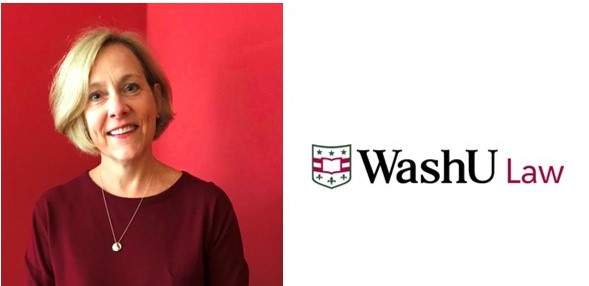
Her commentary on Prosecutor v. Bemba, a 2018 judgment of acquittal by the ICC Appeals Chamber, first appeared as “In Bemba, Command Responsibility Doctrine Ordered to Stand Down.” It then was included in this 2025 Brill Publishers collection, edited by UCLA Law Professor Richard H. Steinberg. Also contributing to the book’s section on the Bemba judgment were attorney Nadia Carine Fornel Poutou and law professors Miles Jackson (Oxford), Michael Newton (Vanderbilt), and Leila Nadya Sadat (Washington University).
“The acceptance of commander’s responsibility is, in effect, acceptance of authority over persons permitted to kill. With that acceptance comes a heavy burden, grown out of practical and moral concerns and reflected in longstanding legal doctrine. At odds with this burden was the judgment of acquittal that the International Criminal Court Appeals Chamber entered in Bemba in 2018. Originally appearing in an online forum, this commentary argues for a statutory construction that better would serve the purposes of the ICC and the command responsibility doctrine.”
University of Georgia School of Law Professor Diane Marie Amann recently spoke on “Child-Taking Justice and Forced Residential Schooling of Indigenous Americans” at Washington University School of Law in St. Louis.
Her presentation was part of a spring semester WashU Law International Law Colloquium organized by Professor MJ Durkee, who is the William Gardiner Hammond Professor of Law and Director of the Whitney R. Harris World Law Institute. Durkee joined that faculty in 2023, after serving as an Allen Post Professor, Associate Dean for International Programs, and Director of the Dean Rusk International Law Center here at Georgia Law.
The discussant for Amann’s paper was Lecturer Steve Alagna, who is an enrolled citizen of the Iowa Tribe of Kansas and Nebraska, and whose WashU Law Appellate Clinic just filed an amicus brief in federal appellate litigation which seeks redress, under the United States’ Native American Graves Protection and Repatriation Act, for survivors of Indigenous children who died and were buried at a former residential school site.
Amann is Regents’ Professor of International Law, Emily & Ernest Woodruff Chair in International Law, and a Faculty Co-Director of our Dean Rusk International Law Center here at Georgia Law. The paper she presented at WashU builds upon research that she published as “Child-Taking,” 45 Michigan Journal of International Law 305 (2024).
Presented her work in progress, “Child-Taking Justice and Forced Residential Schooling of Indigenous Peoples,” as part of the Bonavero Perspectives workshop series at the Oxford Faculty of Law Bonavero Institute of Human Rights. Moderating was another Bonavero Research Visitor, Professor Eva Marie Belser of the University of Fribourg in Switzerland.
Amann is Regents’ Professor of International Law, Emily & Ernest Woodruff Chair in International Law, and a Faculty Co-Director of our Dean Rusk International Law Center here at Georgia Law, where she teaches Public International Law, Constitutional Law, and various upper-division courses exploring interrelations between national and international legal frameworks.
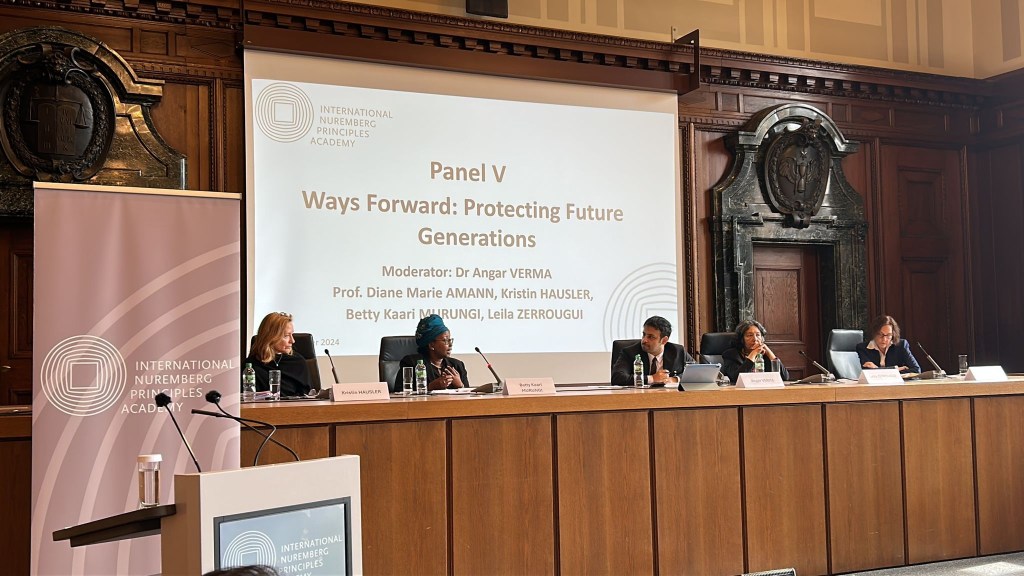
University of Georgia School of Law Professor Diane Marie Amann spoke at last week’s Nuremberg Forum 2024, the annual three-day meeting of the International Nuremberg Principles Academy. It was held in the Nuremberg, Germany, courtroom where hundreds of Nazi defendants were tried in the wake of World War II.
The theme of this year’s Forum was “For Every Child: Protecting Children’s Rights in Armed Conflict.” Amann spoke on the closing panel, “Ways Forward: Protecting Future Generations,” pictured above. She is pictured at right along with, l to r: Kristin Hausler; Betty Kaari Murungi; moderator Angar Verma; and Leila Zerrougui.
Amann gave an overview of her new article “Child-Taking,” 45 Michigan Journal of International Law 305 (2024), with focus on forced residential schooling of Indigenous children. As theorized in the article available here, child-taking occurs when a state or similar powerful entity takes a child and then endeavors to alter, erase, or remake the child’s identity. Though a criminal phenomenon, it may be redressed not only in criminal justice systems, but also through transitional justice mechanisms.
Amann is Regents’ Professor of International Law, Emily & Ernest Woodruff Chair in International Law, and a Faculty Co-Director of our Dean Rusk International Law Center here at Georgia Law. She served from 2012 to 2021 as International Criminal Court Prosecutor Fatou Bensouda’s Special Adviser on Children in & affected by Armed Conflict. This fall, she is spending a research-intensive semester in the United Kingdom, where she is a Research Visitor at the Oxford Faculty of Law Bonavero Institute of Human Rights.
As theorized in the article, “child-taking” occurs when a state or similar powerful entity takes a child and then endeavors to alter, erase, or remake the child’s identity. It is a criminal phenomenon that has been repeated across decades and centuries. On rare occasion, criminal prosecutions have occurred, as with the Situation in Ukraine before the International Criminal Court. More often redress, if any, must take place in other forums. The article thus considers these other types of transitional justice, with particular attention to the legacies of forced residential schooling imposed upon Indigenous children in the United States, Canada, and elsewhere.
Amann is Regents’ Professor of International Law, Emily & Ernest Woodruff Chair in International Law, and a Faculty Co-Director of our Dean Rusk International Law Center here at Georgia Law. She served from 2012 to 2021 as International Criminal Court Prosecutor Fatou Bensouda’s Special Adviser on Children in & affected by Armed Conflict.
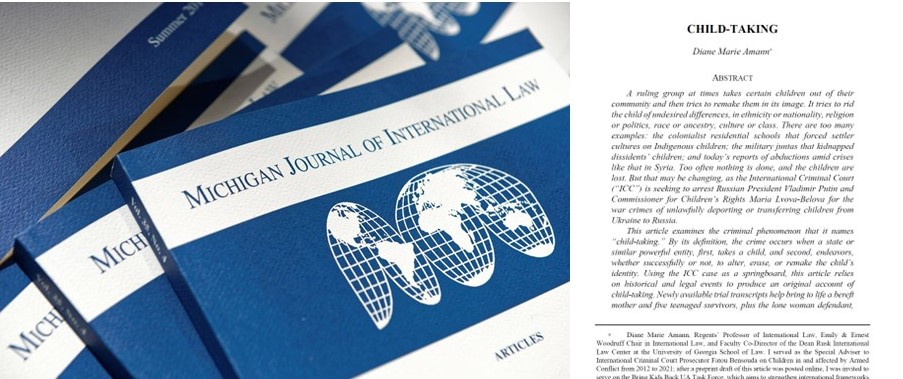
Here’s the abstract of the “Child-Taking” article, the print version of which is available here:
A ruling group at times takes certain children out of their community and then tries to remake them in its image. It tries to rid the child of undesired differences, in ethnicity or nationality, religion or politics, race or ancestry, culture or class. There are too many examples: the colonialist residential schools that forced settler cultures on Indigenous children; the military juntas that kidnapped dissidents’ children; and today’s reports of abductions amid crises like that in Syria. Too often nothing is done, and the children are lost. But that may be changing, as the International Criminal Court (“ICC”) is seeking to arrest Russian President Vladimir Putin and Commissioner for Children’s Rights Maria Lvova-Belova for the war crimes of unlawfully deporting or transferring children from Ukraine to Russia.
“This article examines the criminal phenomenon that it names ‘child-taking.’ By its definition, the crime occurs when a state or similar powerful entity, first, takes a child, and second, endeavors, whether successfully or not, to alter, erase, or remake the child’s identity. Using the ICC case as a springboard, this article relies on historical and legal events to produce an original account of child-taking. Newly available trial transcripts help bring to life a bereft mother and five teenaged survivors, plus the lone woman defendant, who testified at a little-known child-kidnapping trial before a postwar Nuremberg tribunal. Their stories, viewed in the context of the evolution of international child law, inform this article’s definition. These sources further reveal child-taking to be what the law calls a matter of international concern. At its most serious, child-taking may constitute genocide or another crime within the ICC’s jurisdiction. Yet even if circumstances preclude punishment in that permanent criminal court, child-taking remains a grave offense warranting prosecution or other forms of local and global transitional justice. This is as true for the Indigenous children of residential schools in North America, Australia, and elsewhere, and for children in Syria and many other places in the world, as it is for the children of Ukraine.
University of Georgia School of Law student, rising 3L Erin Nalley, recently attended the University of Liverpool School of Law and Social Justice’s second annual Summer School in partnership with the Council of Europe. This year’s Summer School took place in Liverpool, UK from July 8-19 and centered on the theme “Council of Europe at 75: Protecting Human Rights, Democracy, and the Rule of Law in a Rapidly Changing World.“ Below, Nalley reflects on her experience as the first Georgia Law student to attend the Summer School. The University of Georgia and the University of Liverpool are institutional partners.
I have been very fortunate this summer to have the opportunity to represent the University of Georgia School of Law at the University of Liverpool’s second Summer School in the Law of the Council of Europe. This year, the Summer School celebrated the 75th anniversary of the Council of Europe and focused on Protecting Human Rights, Democracy, and the Rule of Law in a Rapidly Changing World. This included focusing on emerging technologies, such as Artificial Intelligence and Neurotechnology, and their interaction with human rights. This is only the second year the University of Liverpool has hosted this Summer School. Still, their unique connection and work with the Council of Europe allows them to provide students and working professionals from around the world with an amazing opportunity to learn not only about the Council of Europe but also about emerging human rights challenges.
As this Summer School focuses on issues that come before the Council of Europe and other European Committees and Tribunals, attendees are mainly from European countries, although not all are European Union countries. I met colleagues from over 20 different countries including Italy, Switzerland, Germany, Ireland, and more. This year there was especially great representation of Balkan states like Bosnia and Herzegovina, Kosovo, North Macedonia, Romania, and Serbia. There were also other participants from countries outside of Europe, including India. This experience was truly diverse and allowed me to make many connections and friendships with those around the world.
For two weeks, I attended lectures on a variety of issues including topics such as AI technology, organ trafficking, the Venice Commission, and counter-terrorism laws. Our lectures were given by practicing lawyers, judges, and academic professionals. There were around 3-4 lectures a day from Monday through Friday. The last day included closing remarks and talks about the future of the Council of Europe and the European Court of Human Rights. All attendees were awarded a certificate for our participation in the Summer School as well.
Although I was the only participant from the United States, I found a lot of common ground with my cohort. I was able to travel around the city and try new restaurants with the same people I could sit with and have a deep and meaningful discussion on human rights issues around the world. My experience was not just academic, but it was also cultural and communal.
Within the city of Liverpool, there are many museums and landmarks. There are many connections to American history, Irish culture, and of course, the Beatles throughout the city. Liverpool is also a great location for trying new foods and drinks. Because of their proximity to Ireland, Irish culture and food is very prominent in Liverpool which means you can experience both English and Irish cuisine in one town. Because of its location on the western coast of England, Liverpool also situated visitors well for additional travel. I was able to take a day trip over one of my weekends to Dublin, and some of my colleagues traveled to Wales and Scotland in their free time.
The University of Liverpool Summer School has been a wonderful experience. Liverpool’s location is great not only for learning more about European and international law, but for getting to experience other countries and cultures as well. The University of Liverpool works hard to use its connections with the Council of Europe to promote and help build the networks of its Summer School participants. It is a fantastic opportunity to build relationships with legal professionals from all over the world in a short amount of time.
I hope to pursue a career in international law after graduation, and this experience will assist me in reaching that goal in many ways. It has allowed me to network with professionals and learn about human rights issues I may hope to work on after law school.
***
For more information about attending Liverpool Summer School, please email the Center: ruskintlaw@uga.edu
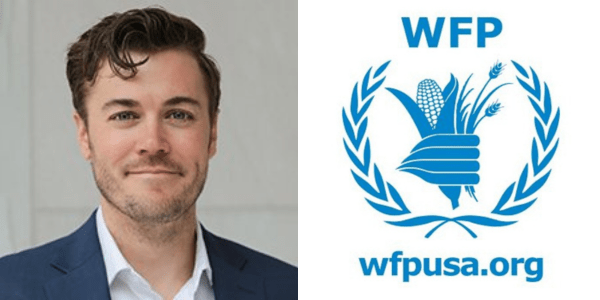
Senior director of Public Policy and Research at World Food Program USA (WFP USA) Chase Sova spoke to students about the intersection of international law and policy as it relates to the global challenge of food insecurity Monday here at the University of Georgia School of Law.
Sova began his talk by explaining the relationship between WFP USA, a US-based non-profit organization, and the United Nations World Food Programme, which the WFP USA works to support stateside. He then discussed the global food insecurity landscape and how it is driven primarily by climate change, conflict, and economic disruptions, or shocks. Sova established links between international trade law and food insecurity, especially in the context of recent global events like the COVID-19 pandemic and the Russian invasion of Ukraine. He introduced students to the current debates about whether policies resulting in extreme food insecurity and starvation could be violations of international human rights law. Students were able to ask Sova questions about his educational background, his advice to those seeking careers in public service, and job opportunities for students interested in the work of the WFP USA.
Before his current position with WFP USA, Sova worked with the United Nations Food and Agriculture Organization (FAO), International Center for Tropical Agriculture (CIAT) and the CGIAR Research Program on Climate Change, Agriculture and Food Security (CCAFS). He has consulted with the World Bank, Johns Hopkins, and Tufts University. Interested in the intersection of food insecurity and conflict, humanitarian assistance, climate change, and sustainable agriculture, Sova has worked on food systems in 15 developing countries across Latin America, sub-Saharan Africa and South Asia. He has led several major research initiatives including WFP USA’s Winning the Peace: Hunger and Instability flagship report. Sova has served as an expert witness at the Senate Foreign Relations Committee, his writing has been featured extensively in peer-reviewed journals, and he regularly lectures on food insecurity at Universities in Washington, D.C. He delivered a TEDx talk on “Winning the Long Game in the Fight to End Hunger” in 2018. Sova earned his Ph.D. from Oxford University.




 exchange of notes