The University of Georgia School of Law has announced the creation of the Community Health Law Partnership Clinic Fund. The Thorpe family, which includes 2014 alumnus Benjamin W. “Ben” Thorpe and his mother Dr. Barbara Williams, has pledged $350,000 to enable the clinic to build on its tradition of interdisciplinary advocacy at the intersection of immigration status and health.
The clinic’s first post-graduate fellow, Thomas Evans, will join the Community HeLP team in July, 2024. Evans is a 2022 magna cum laude graduate of the law school who participated in both the Community HeLP clinic and the Jane Wilson Family Justice Clinic and received the Ellen Jordan Award for Outstanding Public Interest Student. He is currently a staff attorney in the pro se office at the 11th Circuit Court of Appeals.
To learn more about the Community HeLP Clinic and their advocacy work in immigration, click here.
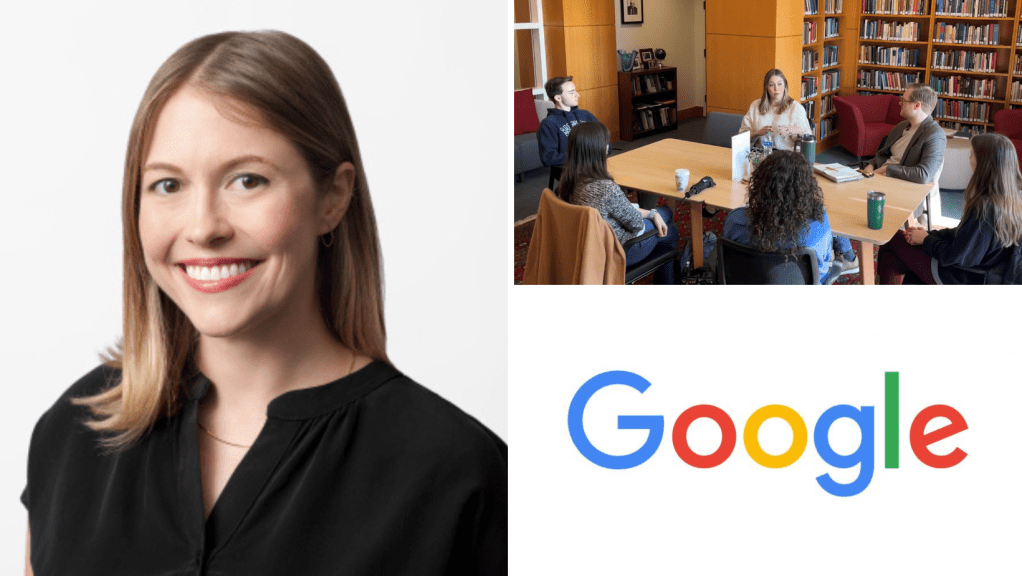
University of Georgia School of Law alumna Ellen Clarke (J.D., ’14), security counsel at Google, recently spoke to students about her career in data protection law at the Dean Rusk International Law Center’s Louis B. Sohn Library.
Students from Georgia Law’s International Law Society and Privacy, Security, and Technology Law Society attended the talk. Clarke began by discussing her professional background and explaining how her experience prosecuting white collar crime at the U.S. Department of Justice provided her with the skills and experiences to successfully transition into her current role at Google. As security counsel, Clarke advises on global data security and law enforcement issues. Students asked Clarke about her opinions on Artificial Intelligence, her decision to become a licensed solicitor in England and Wales, and about the realities of her day-to-day work at Google.
Before joining Google, Clarke prosecuted competition crimes as a trial attorney in the Washington Criminal I Section of the Antitrust Division of the U.S. Department of Justice. She joined the DOJ through the Attorney General’s Honors Program. Clarke previously served as a law clerk to Judge Richard W. Story of the U.S. District Court for the Northern District of Georgia. She received an Advanced Diploma in Data Protection Law from the Honorable Society of King’s Inns, a J.D. degree magna cum laude from the University of Georgia School of Law, and a B.S. in Foreign Service from Georgetown University. She is licensed as an attorney in Georgia and Washington, D.C., as registered in-house counsel in California, and as a solicitor in England and Wales. Clarke is currently an Adjunct Professor of Law at Georgia Law, where she teaches a mini-course entitled Cybercrime.
Today, we welcome a guest post by Andrew Arrington, a member of the Georgia Law class of 2024. Through the Global Externships Overseas (GEO) initiative, Andrew was able to extern with Sorainen, an international business law firm based in Tallinn, Estonia.
I vividly remember my first day at Sorainen, tidying my hair anxiously in the reflection of the gold elevator. It was not only the first day of my 1L summer job, but it was my first time working abroad, and I did not know what to expect. I was relieved that my apartment was only a five-minute walk from my office, but I still got there so early that I ordered breakfast and coffee in a quiet, ultramodern café next door.
As the elevator counted down to the lobby floor, I mumbled the phrase, “Tere. Mina olen Andrew,” to myself over and over, unsure if my pronunciation was even intelligible. With a ding, I was warmly greeted by the woman at the front desk. I watched my soon-to-be coworkers passing by my conference room, putting up their coats and bags in the cloakroom next door, while I waited for my boss to arrive. My anxiety finally melted when Katriina, who interviewed me months earlier, saw me sitting in the office and burst in to give me a hug. It was then I knew I was in for a special summer.
The Global Externship Overseas initiative was a moonshot for me. What I originally imagined as a substitute for not studying abroad in undergrad turned out to be the best career decision I made during law school because of the depth of legal work and client interaction I had over the span of two short months. Through the tireless work of staff at the Dean Rusk International Law Center, including Sarah Quinn and Catrina Martin, my description of a hypothetical dream placement working on data privacy in Europe, possibly in Estonia, became a reality. This request was the result of being a first-generation law student who had just graduated from Georgia Tech; at this point, I was really only familiar with the field of data privacy law after taking a class with Professor Swire and Dr. Anton at my undergraduate institution. I had my sights set on Estonia because I was familiar with the country’s leadership in technology innovation and entrepreneurship in Europe.
I was proudly the first American intern in a couple of decades at Sorainen. During my summer there, I gained contracting skills, including with software as a service (SaaS) contracts, data protection agreements, and other standard GDPR privacy agreements. I was also able to research national security implications, genetic material requirements, and the brand new EU sanctions on Russia. I wrote memos on the effects of the then-nascent Digital Services Act and Digital Markets Act. When my time in the office came to a close, I was asked if I would like to work for a client full-time as the designated trainee to a general counsel for Pactum while I worked remotely from my home in the US. This was another great experience of implementing GDPR requirements through vetting vendors and researching the impact of US state privacy laws on a dual US-EU business.
By the end of my summer at Sorainen, I had colleagues who not only translated meetings in English for me, but also translated our nights out at the local museum. These are colleagues I am still in touch with and exchange Christmas cards with two years later.
Because of my decision to pursue a GEO, I fell in love with a place I would have never visited otherwise. I became a local at the bakery around the corner ordering rhubarb pastries in Estonian. I knew I reached local status when a new clerk working asked me a question about change in Estonian. I ate pine needle ice cream on walks by myself after work along cobblestone streets, and I was driven out of the city to Viru Bog by my fellow summer interns to visit one of the most beautiful natural parks I have ever been to. I had coworkers go out of their way to give me visits of their hometown during the weekends, and I also had an unforgettable office outing playing cards on the rooftop under the midnight sun.
I cannot recommend enough to my fellow students the professional value of not only being able to work in a legal environment abroad but also the memories that Georgia Law and the Center made possible through the GEO program. This opportunity increased my contract drafting and editing abilities tremendously, provided opportunities to interact directly with clients, and exposed me to data privacy and compliance work. Now every time I interview, it is the topic that people most want to talk about, and I not only have a wealth of legal experiences to draw upon but also a reminder of the summer of a lifetime.
***
Applications are now open for summer 2024 Global Externships Overseas (GEO). This initiative places University of Georgia School of Law students in four-to-twelve week international placements each summer, where they gain substantive, hands-on experience in diverse areas of legal practice. Over the last fifteen years, more than 200 Georgia Law students have completed a GEO in law firms, government agencies, corporate legal departments, intergovernmental organizations, and nongovernmental organizations around the world.
Current 1Ls and 2Ls are encouraged to apply for summer GEOs. All applicants should reference this instructional video for step-by-step information regarding how to create and successfully complete an application for GEOs in UGA’s Study Away Portal by the March 1 deadline. For more information, email: ruskintlaw@uga.edu
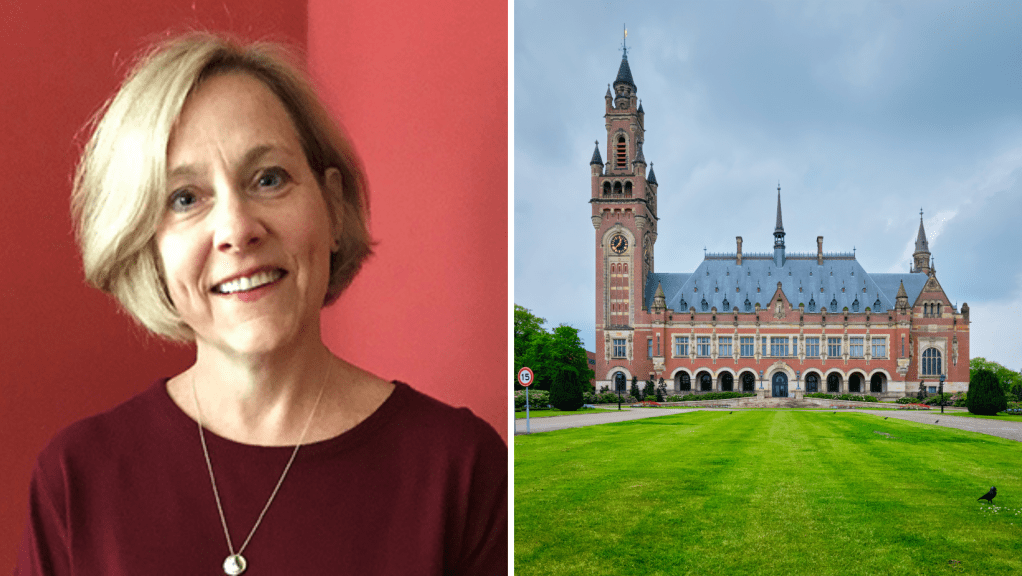
University of Georgia School of Law Professor Diane Marie Amann spoke last week at a conference which paid tribute to Professor Megan A. Fairlie (1971-2022), an international criminal law scholar who had presented her own work at our law school’s Dean Rusk International Law Center.
Most recently, Dr. Fairlie had taken part in a 2019 symposium entitled “International Criminal Court and the Community of Nations,” and she published her presentation, “Defense Issues at the International Criminal Court,” in the Georgia Journal of International and Comparative Law symposium issue.
In recognition of Fairlie’s scholarship on persons accused by international criminal tribunals, Amann chose to present “Inge Viermetz, Woman Acquitted at Nuremberg,” at Friday’s conference.
Amann, who is Regents’ Professor of International Law, Emily & Ernest Woodruff Chair in International Law, and Faculty Co-Director of the Dean Rusk International Law Center here at Georgia Law, has published frequently on women professionals during the post-World War II trials at Nuremberg and elsewhere.
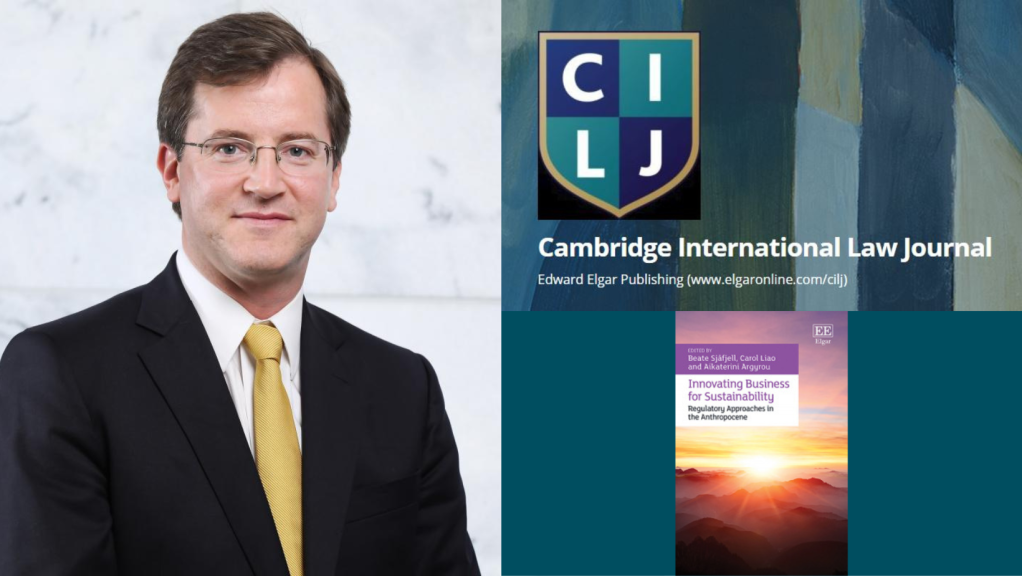
Christopher M. Bruner, Stembler Family Distinguished Professor in Business Law and Faculty Co-Director of the Dean Rusk International Law Center, published a review of a book titled Innovating Business for Sustainability: Regulatory Approaches in the Anthropocene (edited by B. Sjåfjell, C. Liao and A. Argyrou), in the Cambridge International Law Journal in December.
Challenging current attitudes to governance and regulation in business, this timely book ascertains how regulatory approaches can innovate to ensure sustainable business that contributes to social justice for current and future generations within ecological limits.
Combining a research-based approach with a gendered perspective of how sustainability goals are shaped and how businesses should engage with them, this pioneering book creates a comprehensive and contemporary understanding of what sustainability means for business. Identifying the limitations of current approaches to gender and equality alongside the weaknesses of current regulatory and theoretical approaches in business, chapters seek to enhance the practical understanding and embeddedness of sustainability into business within legal and regulatory landscapes. Insights from an international collection of expert scholars in fields ranging from sustainability science to law offer meaningful alternatives to the sustainable business status quo on both conceptual and concrete levels.
Providing a regulatory analysis of business positioned in a systems-based sustainability research framework, this book will prove an invaluable resource for students and scholars of sustainability science, business and management, and law and regulation. With practical insights, it will also prove essential for policymakers working in business regulation and sustainability in business.
Prior posts on Bruner’s scholarship can be found here.
University of Georgia School of Law Professor Diane Marie Amann was featured in The Wall Street Journal regarding the recent order of the International Court of Justice in the Genocide Convention case which South Africa has filed against Israel.
After reporting the opinion of Utah Law Professor Amos Guiora , that both parties won something, and that, in the words of the article, “Israel avoided a legal ruling that would force it either to stop military operations or defy the world court,” Bravin then wrote:
Still, the conduct of the Gaza campaign received no pass, said Diane Marie Amann, an international-law professor at the University of Georgia. ‘Israel will need to adjust if it wishes to comply with the court’s order,’ she said.
Amann is Regents’ Professor, Emily & Ernest Woodruff Chair in International Law, and Faculty Co-Director of the Dean Rusk International Law Center here at the University of Georgia School of Law. She teaches and publishes regularly on matters relating to international law.
Christopher M. Bruner, Stembler Family Distinguished Professor in Business Law and Faculty Co-Director of the Dean Rusk International Law Center, presented his working paper, “Prospects for a US Value Chain Due Diligence Law,” at a conference hosted by Tilburg Law School in the Netherlands titled “Connecting Responsible Organizations: Legal Strategies for Sustainability in Global Value Chains.”
Bruner participated in the panel titled “Sustainable corporate governance and tax transparency.” The conference, hosted by Tilburg’s Department of Private, Business & Labour Law, aimed to provide a platform for legal experts to discuss environmental and social sustainability challenges in global value chains.
Prior posts on Bruner’s scholarship can be found here.
Vyas: I enjoyed Complex Litigation with Professor Elizabeth Burch. It was a challenging course, but Professor Burch is amazing. She has so much knowledge about the topic and structured the class around discussion so that we were all able to learn together. I also enjoyed hearing from two judges who were guest speakers.
Menon: It’s hard to pick, but before UGA Law, I never had the opportunity to learn about the field of privacy law. I enjoyed Global Data Privacy in Practice with Professor Joe Kaufmann. This is a field that I will continue to explore when I return to India.
What was the most surprising or unexpected aspect of law school in the United States?
Vyas: I was so impressed by the time management skills of my peers. One of the best pieces of advice that I received was from a 2L who recommended that I do my assigned readings daily rather than letting them accumulate, since it is very difficult to catch up. At JGLS, we of course have assigned readings, but there are smaller assessments throughout the semester that assist you with structuring your time. Here, since grades are only based on the final exams, you have to manage your assignments and your time independently of those benchmarks.
Menon: I was surprised by the fact that law school is a self-taught environment, which I experienced firsthand in my classes. Students teach themselves the material throughout the semester, and their understanding is perfected by the professors in classes. This is a markedly different approach than the pedagogical approach in Indian law schools, where I would describe the classroom experience as being more guided by the professor. At UGA Law, professors treat students as professionals right, and I think that this learning environment helped me to grow both as a law student and as a person.
What was your favorite thing about living in Athens?
Vyas: Being from New Delhi, India, I would consider myself to be a big city person. However, I fell in love with the small-town vibe of Athens. It has such a unique character and sense of community, especially on football game days and for community events like the Wild Rumpus. Everyone in Athens is also incredibly warm and welcoming.
Menon: The best thing about Athens is that it is a town full of life and character. The transformation of Athens on gamedays was something that I have never seen before. I loved the culture around college football here and how it is something that is enjoyed across generations. For example, when I was walking around campus during a home game, I came across so many families dressed up in their UGA gear and with faces painted, all equally enthusiastic about cheering on the Dawgs. In India, this sort of team spirit for professional sports is usually limited to young adults. It was refreshing and fun to see it be shared among young and old alike here in Athens.
What will you tell your JGLS classmates about your semester at UGA Law?
Vyas: The education is very challenging and helped me to break out of my comfort zone in so many ways. I would tell them that if they are seeking a challenge and opportunities for personal, academic, and professional growth, they should participate in a semester-long exchange at UGA Law.
Menon: I would tell them that academically, they will have access to incredible faculty and courses at UGA Law. Of course, the experience will be difficult, but it will be worth it. I also think that there are a lot of similarities between JGLS and UGA Law that will lessen the transitional period and will help students to maximize their time here on campus. Everything from the climate to the academic rigor is similar.
What would you like UGA Law students to know about JGLS?
Vyas: If you participate in a semester-long exchange at JGLS, you’ll have access to a wide range of courses. It’s a great place to expand your academic horizons and get a non-western perspective on legal topics. You’ll also have the opportunity to make life-long connections with students and faculty who themselves have global networks and communities. It will definitely be a cultural adjustment, but people will be very welcoming and it will be such a worthwhile experience for on all levels.
Menon: Western culture is very different from Indian or Asian culture. JGLS offers a sweet spot between the two: it is an Indian community that is very international and inclusive. I think it is the perfect opportunity for an American student to experience and learn about India and its legal system while still retaining many touchpoints of familiarity. Like our exchange experience here in the United States, it will be an opportunity for incredible growth.
* * * *
The University of Georgia School of Law offers a semester-long international exchange for J.D. students with our institutional partner, O.P. Jindal Global Law School. This exchange offers students access to a wide range of international law courses and professors, as well as unique professional development opportunities. This immersive placement allows students to take courses in English while living on campus and becoming part of an international law community. Through the tuition-exchange model, students pay their regular tuition to UGA Law for the semester, in addition to a small pre-determined fee by JGLS.
UGA Law is now accepting applications for students interested in spending the fall 2024 semester at JGLS. For more information about the exchange program, please visit our website.
University of Georgia School of Law alumnus Alexander White (J.D., ’09), Privacy Commissioner of Bermuda, spoke to students about current developments and careers in the field of data privacy and cybersecurity in the Dean Rusk International Law Center’s Louis B. Sohn Library this week.
Students from UGA Law’s International Law Society and Privacy, Security, and Technology Law Society attended the talk and asked questions regarding recent data privacy and cybersecurity regulations and comparative privacy regimes, such as Europe’s General Data Protection Regulation. White provided insight into the various ways students can enter into this rapidly-evolving field at both the domestic and international level, emphasizing the importance of taking related coursework and participating in international programming during law school. He mentioned the transformative impact of his own Global Externship Overseas experience in Cambodia, work that he believes mirrors his current position’s mandate to “create laws around the proper and ethical way to do something.” White also offered his perspective on emerging concepts such as Artificial Intelligence and how they impact data privacy, specifically for regulators.
White started his career in insurance and became certified in multiple jurisdictions under the International Association of Privacy Professionals. In 2014, he transitioned into the privacy field with his appointment as the State Deputy Chief Privacy Officer for the South Carolina Department of Administration, tasked with developing a statewide privacy program. White was appointed by former Secretary Jeh Johnson to the U.S. Department of Homeland Security Data Privacy and Integrity Advisory Committee (DPIAC) for a three-year term in 2017. Three years later, the Governor of Bermuda appointed White as founding head of the country’s data protection authority as Bermuda’s first Privacy Commissioner in 2020. White also teaches a Comparative Privacy Law course at UGA Law.
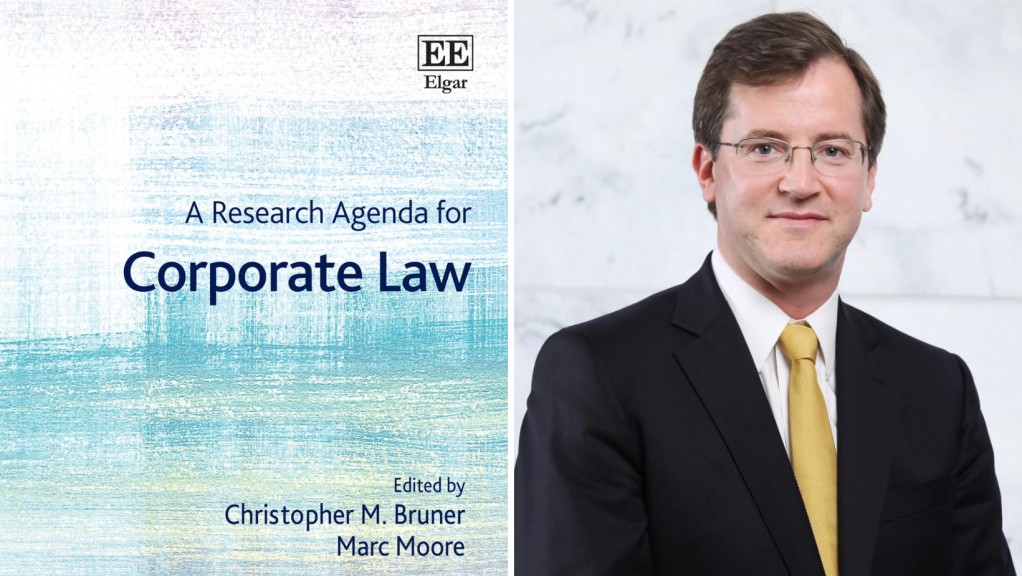
Christopher M. Bruner, Stembler Family Distinguished Professor in Business Law and Faculty Co-Director of the Dean Rusk International Law Center, recently co-edited the book A Research Agenda for Corporate Lawwith Marc Moore, Professor of Corporate/Financial Law, University College London Faculty of Laws.
This timely Research Agenda explores key dynamics and cutting-edge developments within corporate law. Bringing together a diverse range of scholars hailing from different jurisdictions, ideological perspectives, and methodological backgrounds, it provides a roadmap for future research in the field.
Through the investigation of different doctrinal and normative issues, leading scholars consider how evolving conceptual foundations, capital markets, social and cultural contexts, and technologies may impact corporate law and governance research. Ground-breaking contributions examine the increasingly global nature of corporate production and investment markets and the influence this has on the wider dynamics in the field, suggesting new directions for navigating this complex and fascinating terrain.
Students and scholars of corporate law, corporate governance, and law and business will value the innovative ideas unpacked in this state-of-the-art Research Agenda. Its forward looking and practical insights will also benefit practitioners and policymakers in corporate law, corporate governance, sustainability, and business law.
Prior posts on Bruner’s scholarship can be found here.





 exchange of notes