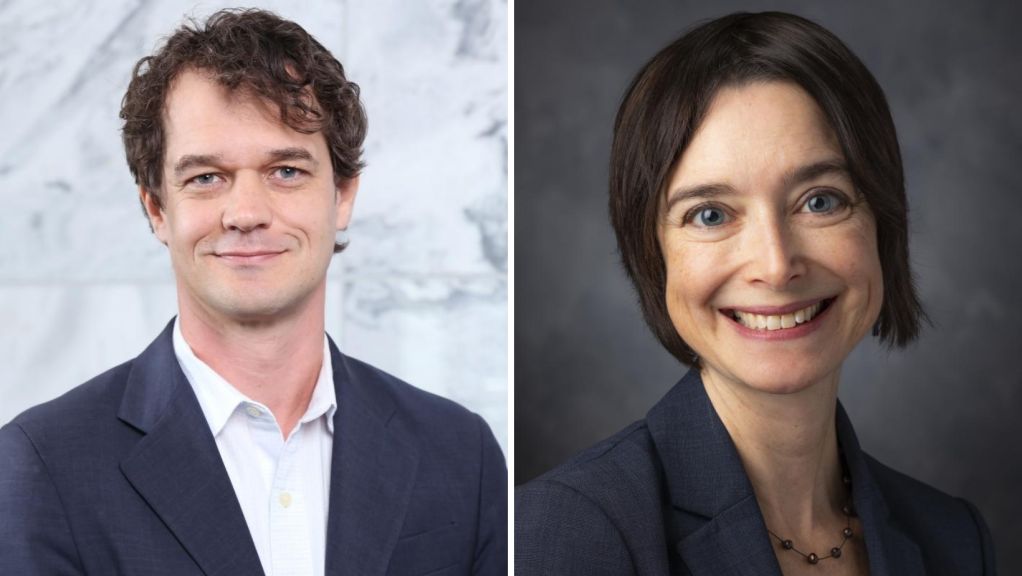
Georgia Law Professors Cade and Norins present at AALS Conference on Clinical Legal Education

Professors Jason A. Cade and Clare R. Norins presented at the Association of American Law Schools’ 2024 Conference on Clinical Legal Education during May. Below are descriptions of their panel discussions:

Rapid-Response Legal Support for Movements: Seeking Immigration Protections for Organizing Workers

In the lead-up to and aftermath of DHS announcing new immigration protections for worker witnesses and amidst a rising tide of labor organizing across the country, immigrant workers and their organizations have turned to immigration lawyers—and especially law school clinics—as essential support for their campaigns. As law school clinics seek to respond to these requests, faculty and students are building a variety of rapid-response models to meet the movement moment, ranging from organizing-oriented individual representation to mass pro se legal clinics and everything in between. Along the way, legal teams must confront key values and ethics questions in movement lawyering as well as build best practices in this emerging area of legal expertise. These teams were integral to the advocacy push that resulted in the new guidance and are continuing to push for effective implementation that delivers for organizing workers and their organizations.

Presenters will share their varied approaches to key choices in organizing rapid response legal support for preparing deferred action for labor enforcement applications. These approaches will include reflection on the following questions:

  • What legal models have worked well to respond to the growing need for legal support?
  • How do we effectively involve students in building and implementing these legal models?
  • How do we as legal advocates integrate organizing objectives, such as group solidarity and worker leadership, into efforts to provide large-scale legal services?
  • How do we structure organizer, volunteer, and legal team information sharing to build trust and facilitate shared goals in representation and advocacy while also minimizing risk from disclosure of sensitive information?
  • How do we work in coalition to advocate on individual cases and broader policy issues throughout implementation so that these immigration protections deliver for organizing workers and their organizations?

Through guided discussion and breakout exercises, this concurrent session will pose questions about the value, and risk, of engaging in wide-ranging advocacy and litigation in a law school clinic. Ten years after the Ferguson uprising, we have taken many lessons from social movements and how we can challenge and dismantle systems of oppression and injustice. We also continue to ask critical questions about the role that we, as lawyers, play in structural and systemic change. We hope to use this session to surface both the benefits and challenges of this kind of collaborative lawyering and to get audience input on best practices for moving forward.

In addition to Cade, this panel included Katherine Evans, Duke University School of Law; Georgina Olazcon Mozo, University of Washington School of Law; Zaida C. Rivera, Seattle University School of Law; and Mary Yanik, Tulane University Law School.

Wide Ranging Litigation and Advocacy as Resistance and Resilience in a Law School Clinic?

In this concurrent session, presenters, all co-counsel in the Oldaker v. Giles litigation, will explore the challenges and benefits of wide-ranging litigation and advocacy as tools of resistance and resilience in a clinical setting. In Oldaker, the presenters and their co-counsel filed litigation on behalf of fourteen women who suffered medical abuse at the Irwin County Detention Center in Georgia.

In addition to Cade and Norins, this panel included Sabrineh Ardalan, Harvard Law School; and Sarah Sherman-Stokes, Boston University School of Law.  

Jason A. Cade is Associate Dean for Clinical Programs and Experiential Learning, J. Alton Hosch Professor of Law & Community Health Law Partnership Clinic Director. In addition to overseeing the law school’s 11 in-house clinics and 7 externship programs, Cade teaches immigration law courses and directs the school’s Community Health Law Partnership Clinic (Community HeLP), in which law students undertake an interdisciplinary approach to immigrants’ rights through individual client representation, litigation, and project-based advocacy before administrative agencies and federal courts.

Clare R. Norins, who also presented on the panel The Privacy Paradox: Balancing Transparency and Privacy in the Quest for Justice at this conference, is an assistant clinical professor and the inaugural director of the School of Law’s First Amendment Clinic, which represents clients in federal and state court on a range of First Amendment and media law issues. Representative matters include social media blocking by government officials, retaliatory arrest, the right to record, challenges to unconstitutional permit requirements, assertion of the journalist privilege under the Georgia Shield law, and defamation defense.

Georgia Law Professor Amann presents at Eleventh Circuit Judicial Conference

Professor Diane Marie Amann recently presented “Human Trafficking Law” to judges in the U.S. Court of Appeals for the Eleventh Circuit as part of the circuit’s 2024 Judicial Conference.

Amann situated the crime of human trafficking within efforts to combat illicit flows of myriad goods, ranging from armaments to endangered animal species. She then considered the interplay of multilateral treaties and national statutes by comparing U.S. and British precedents on whether diplomatic immunity applies in cases alleging domestic servitude.

The talk furthered outreach efforts by the American Society of International Law, on whose Judicial Education Committee Amann serves.

Amann is Regents’ Professor of International Law, Emily & Ernest Chair in International Law, and Faculty Co-Director of the Dean Rusk International Law Center here at the University of Georgia School of Law. She writes and teaches in areas including transnational and international criminal law, child and human rights, constitutional law, and global legal history.

Georgia Law Professor Cade publishes article in the Wisconsin International Law Journal

Professor Jason A. Cade recently published “Challenging the Criminalization of Undocumented Drivers Through a Health Justice Framework” in 41 Wisconsin International Law Journal 325 (2024) (symposium issue).

From the abstract:

States increasingly use driver’s license laws to further policy objectives unrelated to road safety. This symposium contribution employs a health justice lens to focus on one manifestation of this trend—state schemes that prohibit noncitizen residents from accessing driver’s licenses and then impose criminal sanctions for driving without authorization. Status-based no-license laws not only facilitate legally questionable enforcement of local immigration priorities but also impose structural inequities with long-term health consequences for immigrants and their family members, including US citizen children. Safe, reliable transportation is a significant social determinant of health for individuals, families, and communities. Applying a health justice lens to the weaponization of no-license laws against noncitizens will both catalyze new legal challenges and create momentum for coalition building and policy reforms.

Jason A. Cade is Associate Dean for Clinical Programs and Experiential Learning, J. Alton Hosch Professor of Law & Community Health Law Partnership Clinic Director. In addition to overseeing the law school’s 11 in-house clinics and 7 externship programs, Cade teaches immigration law courses and directs the school’s Community Health Law Partnership Clinic (Community HeLP), in which law students undertake an interdisciplinary approach to immigrants’ rights through individual client representation, litigation, and project-based advocacy before administrative agencies and federal courts.

Georgia Law 2L Madison Graham on her D.C. Semester externship at NATO HQ SACT: “a dream come true”

University of Georgia School of Law 2L Madison Graham recently completed an externship in Norfolk, Virginia, in the legal department of HQ SACT, a leading unit of the North Atlantic Treaty Organization. This externship forms part of Georgia Law’s D.C. Semester in Practice initiative, in partnership with NATO Allied Command Transformation. Graham arrived at Georgia Law after working as a Staff Assistant and Legislative Correspondent in the U.S. Senate. As an undergraduate at the University of Tennessee, Knoxville, Graham interned for the USDA in Washington, D.C. Her law school experiences have included service as an Editorial Board Member of the Georgia Journal of International & Comparative Law, a summer internship at Brussels-based law firm Van Bael & Bellis through the Global Externships Overseas initiative, and President of the International Law Society. Below, Graham reflects on her experiences as an extern with NATO HQ SACT this semester.

I first heard about the opportunity to intern with NATO through the University of Georgia School of Law and the Dean Rusk International Law Center nearly three years ago. At the time, I was only beginning to think about law school and where I might apply. Eventually, however, opportunities like this one are the reason I came to Georgia Law. Getting to spend the spring semester in the Office of the Legal Advisor at NATO’s Headquarters Supreme Allied Command Transformation (HQ SACT) was nothing short of a dream come true.

Fortunately, the mere fact of doing the externship is not where the dream ended. Not only was I working in the midst of an international organization, I was also physically working on a section of the biggest naval base in the world. Because of these two features, I received uniquely multifaceted exposure to both the complexities of working in an international organization, as well as the realities of working in a military environment. As a law student interested in pursuing a career in the national security realm of federal public service, this exposure could not have been more valuable.

The substance of the work was also incredibly rewarding. The Office of the Legal Advisor performs an wide variety of legal roles to support HQ SACT’s mission, and I was fortunate to experience parts of each.

First, the office provides legal assistance to the international military staff of HQ SACT. This is usually in the form of helping them obtain local driver licenses, helping their spouses obtain work permits, assisting with traffic tickets, ensuring their visas are up to date, and preparing powers of attorney for outgoing military personnel. Personally, I found this facet of my work to be an incredibly eye-opening and important reminder of how hard it is to legally transition to life in America. But even further, this work involved communicating with NATO staff from each of the 32+ NATO member countries. This was a test of my ability to communicate clearly, anticipate needs and expectations based on certain peoples’ backgrounds, and generally remind myself of how much peoples’ own cultural perceptions affect their approach to life. As an undergraduate anthropology major, I thought I was prepared for this, but could not have expected how much this work experience even further tested and honed these skills for me.

Second, the Office of the Legal Advisor supports HQ SACT through a variety of more general counsel duties. This might include anything from advising on intellectual property rights, contracting, employment law, operational law, and international law. However, the office prides itself on supporting the endeavors of other sections of HQ SACT – ensuring that their plans and processes are within legal possibility. Because of this, the work of the office is largely dependent on the needs and processes of other offices. In my case, this meant I got to help with contracting guidance for contracting officers in the procurement branch, as well as helping to draft another HQ SACT-wide directive for the permissible use of funding for staff morale and welfare activities. This was a great way to hone the knowledge and skills from previous semesters’ contracting and drafting classes, while also having to adapt to the unique requirements NATO has for such documents.

The highlight of my time, however, may have been the multiple educational and coursework opportunities I was able to participate in. These ranged from online, subject-specific courses – on topics like counterterrorism and gender perspectives in armed conflict – to a week-long Strategic Writing Course, to sitting in on meetings with representatives from the International Committee on the Red Cross. Lastly, the Office of the Legal Advisor hosted a week-long Legal Gathering, with legal advisors from several NATO commands around the world invited to talk about each other’s ongoing work and areas in need of assistance. This as a great opportunity to meet other European lawyers with their own unique backgrounds, as well as learn more about NATO’s structure and the roles of each command. Most importantly, however, my supervisors were incredibly supportive of my participation in all these learning opportunities. It is well-understood that just being in the room, taking in as much information as you can, is so valuable to a young student.

Lastly, I was lucky enough to work with incredible colleagues in HQ SACT during my externship. For example, interns from all over Europe, working in other offices at HQ SACT, welcomed me with open arms and have become close friends. I would, however, like to specifically thank my supervisors and colleagues in the Office of the Legal Advisor: Monte DeBoer, Theresa Donahue, Renata Vaisviliene, Cyrille Pison, Kathy Hansen-Nord, Mette Hartov, Agathe Tregarot, and Galateia Gialitaki. Their kindness, patience, and overall support made an already incredible experience even more special. From bi-weekly staff meetings to monthly staff lunches, to staff birthday celebrations, I felt welcomed as a full member of the team from my first day to my last.

I could not be more thankful for my time at NATO HQ SACT, and was reminded of that each time I was asked: “so how do you get to be here?” Over the course of the semester, I must have watched at least a dozen people marvel at the fact that Georgia Law has this externship opportunity available to students. Its uniqueness cannot be understated; I firmly believe it is an something every student at Georgia Law – regardless of your current interests may be – should at least take a moment to appreciate, if not consider doing themselves.

***

For more information and to apply for the NATO Externship, please visit our website.

UGA Professor Kalyani Ramnath named 2024 ACLS Fellow

Kalyani Ramnath, Assistant Professor in the Department of History at the Franklin College of Arts & Sciences and Assistant Professor (by courtesy) at the University of Georgia School of Law, is a recipient of an American Council of Learned Societies (ACLS) Fellowship for her project, “Adrift in the Indian Ocean: Abandonment, Law, and the Making of Maritime Sovereignty.”

From Ramnath’s abstract:

“‘Adrift in the Indian Ocean’ explores how and why empires and nation-states looked beyond land-based territorial conquests and claimed maritime spaces. It is a history of sovereignty and placemaking set in the Indian Ocean from the 18th century onwards, one where imperial officials and scientists confronted the differing views of space held by maritime and coastal communities. Legal fictions such as the territorial sea’ or ‘historic waters’ emerged from these encounters, showing how oceanic space patrolled for security was eventually enclosed as property. Exploring key sites looking out to the ocean from south Indian coasts, ‘Adrift’ shows how people and places once abandoned are dredged up during present-day legal disputes over maritime boundaries in the Indian Ocean.

This fellowship follows Dr. Ramnath’s publication of her first book, Boats in a Storm: Law, Migration, and Decolonization in South and Southeast Asia, 1942–1962, with Stanford University Press. To read more about this publication, please click here.

Ramnath received her Ph.D. in history from Princeton University in 2018, and was a Prize Fellow in Economics, History, and Politics at the Center for History and Economics at Harvard University from 2018 – 2021. She also holds a bachelor’s degree in arts and law (B.A., LL.B. (Hons.) (JD equivalent) from the National Law School of India University (NLSIU) and a master’s degree in law (LL.M.) from the Yale Law School.

Ninth Annual AtlAS Lecture speaker, Emory Professor Stacie Strong, considers use of artificial intelligence in international arbitration proceedings

A member of the Dean Rusk International Law Center’s staff, Global Practice Preparation Assistant Catrina Martin, attended this year’s ninth annual Atlanta International Arbitration Society (AtlAS) lecture, “Rage Against the Machine: Governing the Use of AI in International Arbitration.” AtlAS is one of the Center’s institutional partners, and Georgia Law alumnus Dr. Christof Siefarth (LL.M., ’88) is the newly-elected president. Below are some of Martin’s reflections of the event.

Earlier this month, the Atlanta International Arbitration Society co-hosted its 9th annual lecture with the Charlotte International Arbitration Society, held at Wyche Law Firm in downtown Greenville, South Carolina. Stacie Strong, Acting Professor of Law at Emory University Law, presented “Rage Against the Machine: Governing the Use of AI in International Arbitration,” to a hybrid crowd of practitioners, students, and academics.

Her lecture discussed the potential copyright concerns in using AI, such as who owns the created data, as well as privacy concerns given that AI generators have the ability to move past firewalls and other security measures. Discussion included a critique of how the increasing use of AI in arbitration, and across the broader legal field, is training students and young lawyers for the profession, and developing the building block skills of research, writing, and cite checking.

Strong advised that in arbitration, both parties agree during preliminary discussions on the use of AI, and that arbitrators proactively raise the issue with their clients.

Martin reflected on the value of this topic for law students in particular:

“[Strong’s] perspective is helpful for students who are interested in best practices in arbitration, and especially those ‘digital natives,’ for whom AI usage feels like a natural extension of technology already ingrained in their legal education, such as LexisNexis case searches. For students who are interested in international arbitration, generative AI use may offer cost and time savings on the front end, but the pitfalls, especially when arbitrating across common- and civil-law countries, outweigh this potential.”

Strong has taught at law schools around the world and has acted as a dual-qualified (England-US) practitioner with major international law firms in the UK and the US. She has also written over 130 books, articles, and other works and has acted as an expert consultant to a variety of governmental, non-governmental and intergovernmental organizations. A full biography can be found on Emory University’s website.

Georgia Law Professor Cade featured in The Atlanta Journal-Constitution

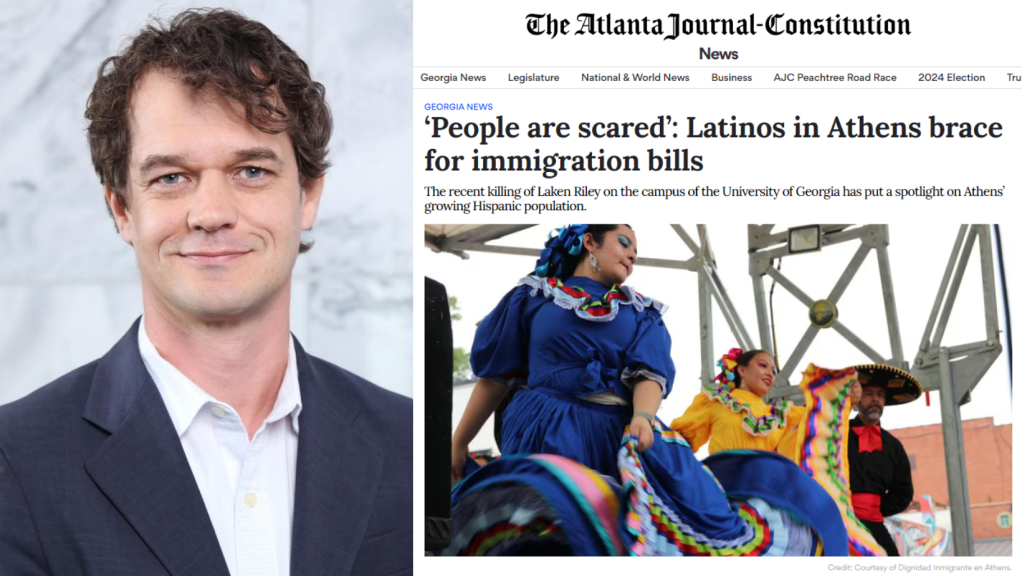
Professor Jason A. Cade was recently featured in The Atlanta Journal-Constitution regarding the University of Georgia School of Law’s Community Health Law Partnership Clinic, (“Community HeLP Clinic”). The article titled “‘People are scared’: Latinos in Athens brace for immigration bills” was written by Lautaro Grinspan and centered around the legislative consequences of the recent loss of Laken Riley on the University of Georgia campus, which put a spotlight on the growth of Athens’ Hispanic population. 

As stated in the article:

“The growth of the community has created significant demand for legal services to help with immigration cases. Those with limited means have only one pro-bono provider to turn to: a legal clinic at the University of Georgia School of Law, run by Professor Jason Cade.”

The Community HeLP Clinic focuses on interdisciplinary advocacy at the intersection of immigration status and health, including humanitarian and family-based immigration benefits, advocacy on behalf of noncitizen workers and detainees, and public education.

In reference to the Clinic within the article, Professor Cade said:

“We have the U.S. citizen children of the families that we serve very much in mind and are trying to do what we can to kind of reduce stress and stigma from their lives.”

Jason A. Cade is Associate Dean for Clinical Programs and Experiential Learning, J. Alton Hosch Professor of Law & Community Health Law Partnership Clinic Director. In addition to overseeing the law school’s 11 in-house clinics and 7 externship programs, Cade teaches immigration law courses and directs the school’s Community Health Law Partnership Clinic (Community HeLP), in which law students undertake an interdisciplinary approach to immigrants’ rights through individual client representation, litigation, and project-based advocacy before administrative agencies and federal courts.

To read the full article, please click here. To learn more about the Clinic, please click here.

Georgia Law alumnus elected as president of the Atlanta International Arbitration Society

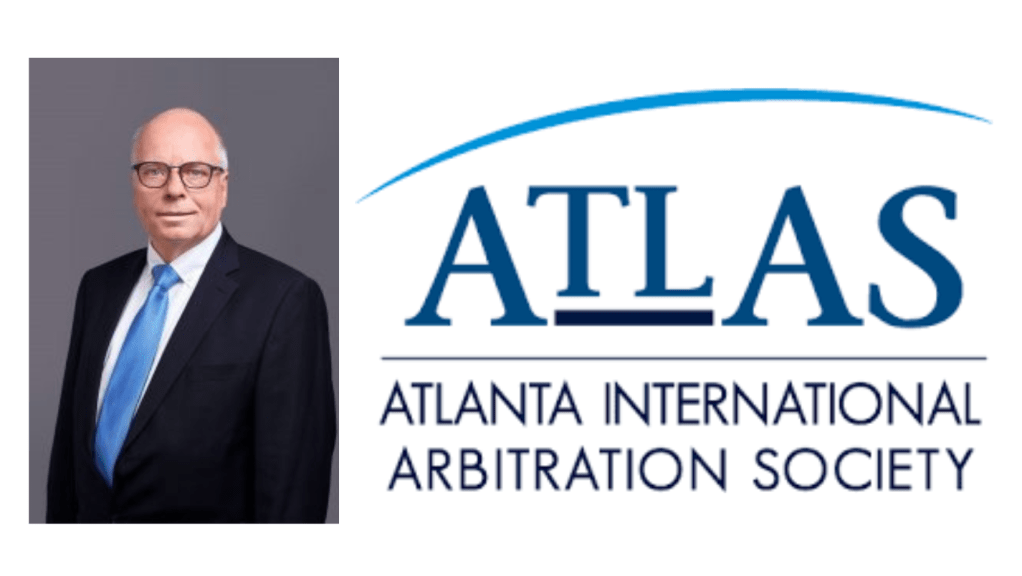
The Atlanta International Arbitration Society (“AtlAS”) recently elected University of Georgia School of Law alumnus and Rusk Council member Dr. Christof Siefarth (LL.M., ‘86) as President.

Siefarth is currently a partner at the German law firm Bodenheimer. He took office as President after AtlAS’s plenary meeting at Smith, Gambrell & Russell in March. Siefarth has been active in AtlAS throughout its 14-year history.

Siefarth has significant experience in arbitration throughout Europe, Asia, and the United States. He has participated on many AtlAS conference panels over the years, and he also has led discussions at AtlAS’s plenary meetings, including in December 2022, where the topic was “U.S. Experience with DIS Arbitration.” Siefarth is licensed to practice law in Germany and New York.

AtlAS’ mission is to promote and enhance Atlanta as a place to resolve the world’s business disputes using international arbitration and mediation. The University of Georgia School of Law is a founding organization and hosts its annual lecture every three years. Both Dean & Talmadge Chair of Law Peter B. “Bo” Rutledge and director of the Dean Rusk International Law Center Sarah Quinn serve on the organization’s Board of Directors.

International law at University of Georgia, administered by Dean Rusk International Law Center, earns #20 U.S. News ranking

Last week, the U.S. News rankings placed our international law curriculum here at the University of Georgia School of Law at No. 20 in the United States.

For over a decade, our international law initiatives have ranked in the top 20 or so among U.S. law schools. In this year’s rankings, our international law curriculum tied with Northwestern University (Pritzker) Law, University of California (Davis)  Law, and Vanderbilt University for the No. 20 spot. (The University of Georgia School of Law, as a whole, earned a No. 20 ranking this year for the second year in a row, as is posted here.)

Our international law achievement is due in no small part to the enthusiastic support and hard work of everyone affiliated with Georgia Law’s four-decades-old-old Dean Rusk International Law Center. As chronicled at this Exchange of Notes blog and our Center website, these include:

► Superb members of the law faculty, including: Dean Peter B. “Bo” Rutledge, an international arbitration expert; the Center’s Faculty Co-Directors, Professors Diane Marie Amann, an expert in peace-and-security fields including the laws of war, child rights, and international criminal justice, and Christopher M. Bruner, a comparative corporate governance scholar. Among those supporting their efforts are many other Georgia Law faculty and courtesy faculty members, including: Thomas Burch, who leads the Appellate Clinic that has won clients relief under the Convention Against Torture; Anne Burnett, foreign and international law research librarian; Jason Cade and Clare Norins, who recently led a clinical team in securing federal redress for immigration detainees; Nathan S. Chapman, a scholar of due process and extraterritoriality; Jessica L. Heywood, Director of the Washington, D.C. Semester in Practice; Thomas E. Kadri, whose expertise includes cybercrime and global data privacy; Elizabeth Weeks, a health law specialist; Jonathan Peters, a journalism and law professor expert in international media and free speech; Laura Phillips-Sawyer, an expert in antitrust law and policy; Kalyani Ramnath, a global legal historian who focuses on South Asia; Lori A. Ringhand, a scholar of comparative constitutional law and elections law; Tim Samples, whose scholarship includes global digital platforms agreements; Kent Barnett, Sonja West, and Elizabeth Chamblee Burch, who have presented overseas on administrative law, media law, and civil procedure, respectively; Adam D. Orford, an environmental and energy law scholar; Kristen E. Shepherd, who developed and teaches the Legal Spanish curriculum; Walter Hellerstein, a world-renowned tax specialist; and Michael L. Wells, a European Union scholar.

► Talented students pursuing J.D., M.S.L., and LL.M. degrees, as well as Graduate Certificates in International Law. They include: our Center’s Student Researcher and Graduate Assistant; the staffers and editors of the Georgia Journal of International and Comparative Law who produce one of the country’s oldest student journals, and who led our 2023 conference, “ESG and Corporate Sustainability: Global Perspectives on Regulatory Reform”; the advocates on the Philip C. Jessup International Law Moot Court, the LL.M.s’ International Commercial & Investment Arbitration Moot Competition, and the Willem C. Vis International Commercial Arbitration Moot; student clinicians in our Appellate Litigation Clinic who have argued asylum cases before U.S. Courts of Appeals, as well as those in our Community HeLP Clinic, Jane W. Wilson Family Justice Clinic, and First Amendment Clinic who have litigated claims for detainees and other immigration clients; participants in our summer and semester-long Global Externships as well as our full-semester NATO Externship and other D.C. Semester in Practice placements; participants in our Global Governance Summer School and our bilateral exchanges; those who were able to attend professional conferences, including the ABILA International Law Weekend and the ASIL Annual Meeting through the support of Louis B. Sohn professional development scholarships; and the student leaders of our International Law Society.

► Superb Center staff like Sarah Quinn, Laura Tate Kagel, Mandy Dixon, and Catrina Martin, who administer the LL.M. degree and the Graduate Certificate in International Law, international trainings, the Visiting Researcher initiative, bilateral exchanges, Global Governance Summer School, Global Externships Overseas, international events, and more.

► Visiting Scholars and Researchers, including, Mine Turhan, an assistant professor of administrative law in the Faculty of Law at the Izmir University of Economics in Türkiye, and Daesun Kim, an attorney practicing law in Vietnam who specializes in cross-border M&A, foreign investment, and public-private partnerships. 

► Academics, practitioners, and policymakers, from all over the world, who have contributed to our events – conferences, workshops, and lectures, such as our ongoing Consular Series and International Law Colloquium, which this year included the visit of Rachel Galloway, British consul general in Atlanta, and Georgetown Law Professor Cliff Sloan, as well as a new events series highlighting the U.S. Department of State and U.S. Department of Education’s International Education Week.

► Graduates who excel as partners in international commercial law firms, as heads of nongovernmental organizations and international organizations, as in-house counsel at leading multinational enterprises, and as diplomats and public servants – and who give back through participation in our Dean Rusk International Law Center Council, through mentoring, speaking with students (like Kannan Rajarathinam, Eduardo Conghos, Alexander White, Ellen Clarke, and Clete Johnson), and through other support.

► Our valued partnerships, with Georgia Law student organizations; with leading higher education institutions such as the Leuven Centre for Global Governance Studies at KU Leuven in Belgium, our partner in our Global Governance Summer School, as well as O.P. Jindal Global University’s Jindal Global Law School in India and Bar Ilan University’s Faculty of Law in Israel, with which we have student and faculty exchanges; with organizations like the American Branch of the International Law Association, the American Society of International Law, and the European Society of International Law, in which our faculty have held leadership roles, as well as Global Atlanta, the Atlanta International Arbitration Society; and with university units like the School of Public & International Affairs, the Terry College of Business, the Grady School of Journalism, the African Studies Institute, the Center for International Trade and Security, and the Willson Center for Humanities & Arts.

With thanks to all, we look forward to continuing to strengthen our initiatives in international, comparative, transnational, and foreign relations law – not least, in the preparation of Georgia Law students to practice in our globalized legal profession.

Georgia Law students attend ASIL annual meeting through professional development scholarships

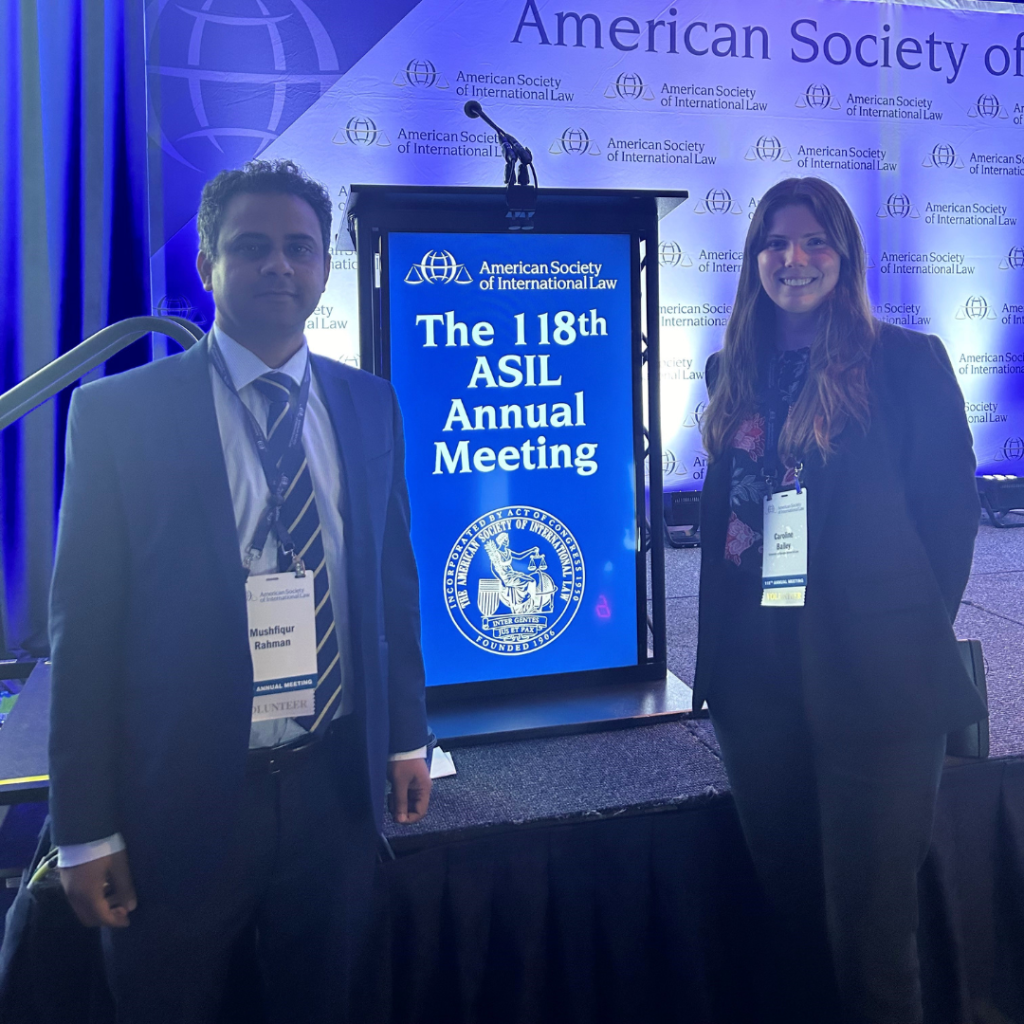
This year, two University of Georgia School of Law students volunteered at the 118th Annual Meeting of the American Society of International Law in Washington, D.C. Pictured above, they are, from left, LL.M. student M. Mushfiqur Rahman and 3L Caroline Bailey. This year’s ASIL Annual Meeting convened with the theme “International Law in an Interdependent World.”

The Louis B. Sohn Professional Development Fellowship, awarded by the law school’s Dean Rusk International Law Center, supported the Bailey’s travel to the conference. Rahman was supported by a new scholarship, the Naresh Gehi Annual Award.

Reflecting on the most memorable panel discussions she attended during the conference, Bailey stated:

“I particularly enjoyed the panel titled ‘If Nature has Rights, Who Speaks on its Behalf?’ Tribal Attorney and Director of CDER’s Tribal Rights of Nature Program, Frank Bibeau, Senior Lecturer and ARC Research Fellow at the University of Melbourne Law School, Dr. Erin O’Donnell, and Director at the Max Planck Institute for Comparative Public Law and International Law in Heidelberg, Anne Peters provided valuable perspectives and insightful commentary on the role of international lawyers in the protection of and advocacy for the legal rights of the environment. It was interesting to hear about the balance between environmental rights and sustainable development, as well as the recent developments around the world in establishing rights for rivers.

Rahman explained how meaningful these types of experiences can be for law students, especially LL.M.s:

“In building a legal career in the U.S. market, and especially with the difficulty of being an international student, one must not stop learning and developing his expertise in their chosen field. This is a long continuous process To that end, it is very necessary to take advantage of opportunities like the ASIL Annual Meeting. Attending the meeting is also helpful for students with ambitions who want not just to see themselves working in big law firms, but working on a bigger platform from a variety of viewpoints.

To read prior posts about Georgia Law students volunteering at the ASIL Annual Meeting, please click here, here, and here.