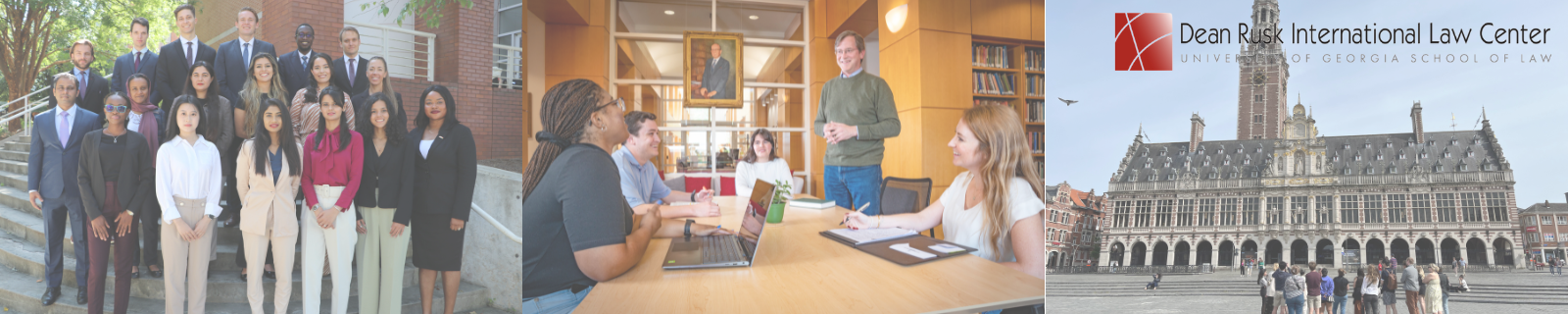
Welcoming the newest class of Master of Laws (LL.M.) students to UGA Law

With the Fall 2023 semester in full swing, we at the Dean Rusk International Law Center are proud to welcome another class of talented lawyers, now studying for our University of Georgia School of Law Master of Laws (LL.M.) degree.

The group of 18 hails from 14 different countries in Africa, Asia, Europe, and the Americas, including Nigeria, Ethiopia, India, Germany, Argentina, Romania, Brazil, Russia, Côte d’Ivoire, Ukraine, Ghana, China, Bangladesh, and Afghanistan. Among them are lawyers and other professionals specializing in a wide range of fields including corporate law, alternative commercial dispute resolution, immigration law, bankruptcy law, family law, corporate sports law, international trade, business law, cybersecurity and digital fraud, refugee and asylum law, technology law, tax law, and criminal law.

They are pictured above, standing on the steps of Dean Rusk Hall. From the left to right – top row: Daniel Danca, Bohdan Krivuts, Savelii Elizarov, Cornelius Bulanov, N’guessan Clément Kouame, Jonas Römer; middle row: Md Mushfiqur Rahman, Eman Abdella Ali, Quraisha Sherzad, Raissa dos Santos Bastos Rolim, Gracia Varinia Rojas Mina Bogliotti, Agostina Calamari; bottom row: Victoria Agbakwuru, Xinyi Nie, Shivani Ravi Prakash, Naina Bishnoi, Amanda Pinto, and Lydia Lartey.

This Class of 2024 joins a tradition that began at the University of Georgia School of Law in the early 1970s, when a Belgian lawyer became the first foreign-trained practitioner to earn a UGA Law LL.M. degree. In the ensuing four decades, the law school and its Dean Rusk International Law Center have produced nearly 600 LL.M. graduates, with ties to nearly 100 countries and every continent in the world.

Side by side with J.D. candidates, LL.M.s follow a flexible curriculum tailored to their own career goals – goals that may include preparation to sit for a U.S. bar examination, or pursuit of a concentration affording advancement in their home country’s legal profession or academic institutions.

The application for the LL.M. Class of 2025 is now open; for information or to apply for LL.M. studies, see here.

UGA Professor Ramnath publishes first book, “Boats in a Storm: Law, Migration, and Decolonization in South and Southeast Asia, 1942–1962”

Kalyani Ramnath, Assistant Professor in the Department of History at the Franklin College of Arts & Sciences and Assistant Professor (by courtesy) at UGA Law, is publishing her first book, Boats in a Storm: Law, Migration, and Decolonization in South and Southeast Asia, 1942–1962, with Stanford University Press.

Below is a description of the book:

For more than century before World War II, traders, merchants, financiers, and laborers steadily moved between places on the Indian Ocean, trading goods, supplying credit, and seeking work. This all changed with the war and as India, Burma, Ceylon, and Malaya wrested independence from the British empire. Set against the tumult of the postwar period, Boats in a Storm centers on the legal struggles of migrants to retain their traditional rhythms and patterns of life, illustrating how they experienced citizenship and decolonization. Even as nascent citizenship regimes and divergent political trajectories of decolonization papered over migrations between South and Southeast Asia, migrants continued to recount cross-border histories in encounters with the law. These accounts, often obscured by national and international political developments, unsettle the notion that static national identities and loyalties had emerged, fully formed and unblemished by migrant pasts, in the aftermath of empires.

Drawing on archival materials from India, Sri Lanka, Myanmar, London, and Singapore, Kalyani Ramnath narrates how former migrants battled legal requirements to revive prewar circulations of credit, capital, and labor, in a postwar context of rising ethno-nationalisms that accused migrants of stealing jobs and hoarding land. Ultimately, Ramnath shows how decolonization was marked not only by shipwrecked empires and nation-states assembled and ordered from the debris of imperial collapse, but also by these forgotten stories of wartime displacements, their unintended consequences, and long afterlives.

On September 21 at 4:00 pm, at the University of Georgia Zell Miller Learning Center, a book release and reception will be held in honor of Professor Ramnath’s work. This event is open to the public.

UGA Law Professor Bruner presents “Managing Fraud Risk in the Age of AI” at the National University of Singapore (NUS)

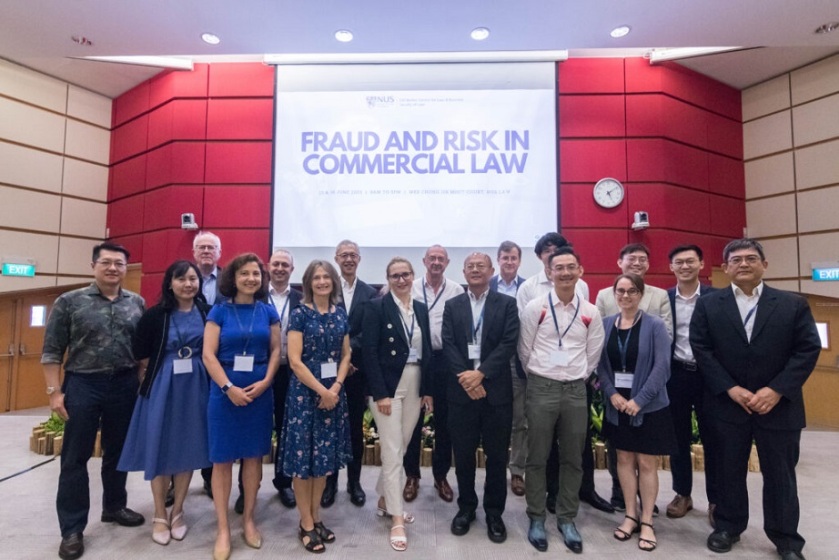
Professor Christopher Bruner, the Stembler Family Distinguished Professor in Business Law and a newly appointed Faculty Co-Director of the Dean Rusk International Law Center, presented “Managing Fraud Risk in the Age of AI” at the National University of Singapore (NUS) in June.

Bruner’s talk was part of a conference titled Fraud and Risk in Commercial Law, organized by Professors Paul Davies (University College London) and Hans Tjio (NUS) and hosted by the EW Barker Centre for Law & Business at the NUS Faculty of Law.

Below is Bruner’s presentation abstract:

Artificial Intelligence (AI) applications are widely expected to revolutionize every dimension of business. This paper explores current and potential impacts of AI on corporate management of fraud risk in both operational and compliance contexts. Much attention has been paid to the operational efficiencies that AI applications could enable in numerous industry settings, and such systems have already become central to a range of services in certain industries – notably finance. Heavy reliance on algorithmic processes can be expected to give rise, however, to a range of risks, including fraud risks. New forms of internal fraud risk, emanating from intra-corporate actors, as well as external fraud risk, emanating from extra-corporate actors, are already placing greater demands on the compliance function and requiring greater corporate investment in responsive AI capacity to keep pace with the evolving risk management environment. At the same time, these developments have already begun to prompt reevaluation of conventional legal theories of fraud that took shape, in commercial and financial contexts alike, by reference to human actors, as opposed to algorithmic processes.

The paper begins with an overview of growing operational reliance upon increasingly sophisticated AI applications across various industry settings, reflecting the increasingly data-intensive nature of modern business. It then explores forms of internal and external fraud risk that may arise from efforts to exploit weaknesses in operational AI, which efforts may themselves involve sophisticated deployment of malicious extra-corporate AI applications – ‘offensive AI’, as the cyber security industry describes it. This can in turn be expected to require responsive corporate efforts in the form of ‘defensive AI’, and the paper describes burgeoning efforts along these lines, as well as the increasing pressure to devote substantial resources and managerial attention to these dynamics that may arise from both corporate law and commercial realities. Finally, the paper analyzes shortcomings of conventional legal theories of fraud in this context. Here the paper assesses the difficulty of applying concepts such as deception, scienter, reliance, and loss causation to algorithmic processes lacking conventional capacity for intentionality and defying conventional explanation as to how inputs and outputs logically relate – a reflection of the AI ‘black box’ problem. The paper concludes with proposals to reform corporate oversight duties to incentivize managerial attention to these issues, and to reform conventional legal theories of fraud to disincentivize malicious AI applications.

UGA Law professor Diane Marie Amann and UCL Professor Martins Paparinskis

UGA Law Professor Amann presents “Child-Taking and the International Criminal Arrest Warrant” at University College London Faculty of Laws

University of Georgia School of Law Professor Diane Marie Amann, an expert on child and human rights, international criminal law, and the laws of war, presented a lecture entitled “Child-Taking and the International Criminal Arrest Warrant” at University College London Faculty of Laws in June.

News that the International Criminal Court is seeking the arrest of Russia’s President, Vladimir Putin, and Child Rights Commissioner, Maria Lvova-Belova, drew attention to the war crimes charged: “unlawful deportation of population (children)” and “unlawful transfer of population (children) from occupied areas.” Professor Amann’s lecture examined these and similar crimes, which she labels “child-taking.” International child-taking trials date to the Nuremberg tribunals, and have continued in modern forums like the ICC. Court records demonstrate that child-taking is no minor crime. Its present gravity and future consequences are heavy; so too, the prosecutorial burdens of securing indictments, conviction, and redress.

This presentation was chaired by UCL Professor of Public International Law, Martins Paparinskis.

Amann is the Regents’ Professor of International Law, the Emily & Ernest Woodruff Chair in International Law, and a Faculty Co-Director of the Dean Rusk International Law Center.

Welcoming Mine Turhan, Visiting Scholar at UGA Law’s Dean Rusk International Law Center

We at the University of Georgia School of Law Dean Rusk International Law Center are pleased to welcome a new Visiting Research Scholar: Mine Turhan, Assistant Professor of Administrative Law in the Faculty of Law at the Izmir University of Economics in Türkiye. She holds an LL.M. degree and a Ph.D. in Public Law from Dokuz Eylül University in Izmir, Türkiye.

Professor Turhan plans to conduct research on comparative administrative procedure between the United States and the European Union during her stay at the Dean Rusk International Law Center. Her project will focus on procedural due process rights, in particular the right to be heard before administrative agencies, and it will analyze how individual rights are protected by different procedures in the U.S. and the European Union against arbitrary actions on the part of administrative agencies.

Professor Turhan is sponsored as a Visiting Research Scholar by UGA Law Professor David E. Shipley, the Georgia Athletic Association Professor in Law. Professor Shipley teaches administrative law and civil procedure.

Turhan’s research is supported by a fellowship from the Scientific and Technological Research Council of Türkiye (TÜBİTAK) within the scope of the International Postdoctoral Research Fellowship Program. Her visit continues our Center’s long tradition of hosting scholars and researchers whose work touches on issues of international, comparative, or transnational law. Details and an online application to become a visiting scholar here.

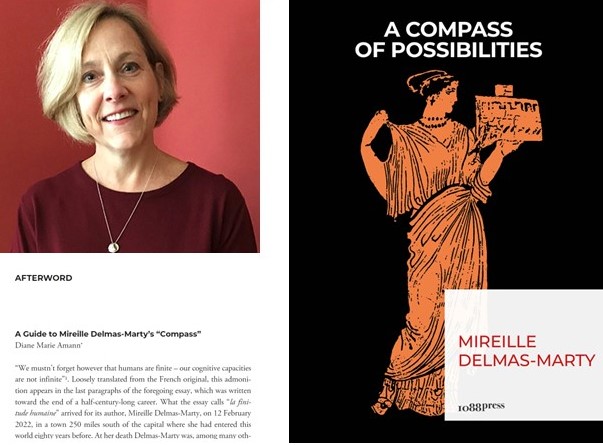
Georgia Law Professor Amann publishes afterword to new volume translating work by legal thinker Mireille Delmas-Marty

University of Georgia School of Law Professor Diane Marie Amann contributed the afterword to a just-published volume featuring an English translation of an important work by the late Mireille Delmas-Marty (1941-2022), Collège de France de Paris law professor and one of the pre-eminent legal thinkers of her generation.

Co-editors of the volume, A Compass of Possibilities, are law professors Emanuela Fronza (University of Bologna, Italy) and Chiara Giorgetti (University of Richmond). Fronza also wrote an Epilogue to the main work. Subtitled “Global Governance and Legal Humanism,” the book offers, in translation, Delmas-Marty’s 2011 closing lecture at Collège de France, entitled “Une boussole des possibles. Gouvernance mondiale et humanismes juridiques.” Publishing the new work is 1088 Press, a University of Bologna imprint.

Amann – who is Regents’ Professor of International Law, Emily & Ernest Woodruff Chair in International Law, and a Faculty Co-Director of our Dean Rusk International Law Center here at Georgia Law – was a longtime colleague of Delmas-Marty. Amann’s role in their collaborations included a year-long stint as professeure invitée at Université de Paris 1 (Panthéon-Sorbonne), where Delmas-Marty then taught; a lecture at Collège de France; and annual participation in a decade of gatherings of the Réseau ID franco-américain/French-American Network on the Internationalization of Law.

Amann’s afterword is titled “A Guide to Mireille Delmas-Marty’s “Compass'”; it appears at pp. 55-64 of the new volume. Here’s the abstract from a pre-publication version of Amann’s afterword, available at SSRN:

“This essay appears as the Afterword (pp. 55-64) to a volume featuring an important work by the late Mireille Delmas-Marty (1941-2022). A Collège de France de Paris law professor and one of the pre-eminent legal thinkers of her generation, Delmas-Marty and the essay’s author were longtime colleagues and collaborators. The volume contains an English translation of a 2011 lecture by Delmas-Marty, originally titled “Une boussole des possibles: Gouvernance mondiale et humanismes juridiques.” Amann’s essay surveys that writing, in a manner designed to acquaint non-francophone lawyers and academics with Delmas-Marty’s vast and visionary œuvre.”

Georgia Law Professor MJ Durkee’s “The Pledging World Order” published in new Yale Journal of International Law issue

The latest publication by University of Georgia School of Law Professor Melissa J. “MJ” Durkee is now in print at Yale Journal of International Law.

The article by Durkee, who is Associate Dean for International Programs, Director of the Dean Rusk International Law Center, and Allen Post Professor here at Georgia Law, is “The Pledging World Order,” 48 Yale J. Int’l L. 1 (2023).

Here’s the SSRN abstract:

“There is an emerging world order characterized by unilateral pledges within a legal or ‘legal-ish’ architecture of commitments. The pledging world order has materialized in the international legal response to climate change and in other diverse sites. It crosses and blurs the public-private divide. It erodes distinctions between multilateralism and localism, law and not-law, and progress and stasis. It is both a symptom of and a contributor to the dismantling of the Westphalian and postwar orders. Its report card is mixed: While pledging can be highly ineffective as a legal technology, the pledging world order may respond to some legitimacy concerns that attach to earlier orders. And this may be the best available method to respond to important global commons problems like climate change, biodiversity loss, orbital debris, and other emerging issues.

“This Article makes three principal contributions. First, it identifies pledging as a treaty design choice and contrasts it with a variety of standard forms of international lawmaking. Second, it casts pledging as a trans-regime, trans-substantive ordering device that appears both inside and outside of law, in public and private sites, and at all levels of organization. Third, it identifies features of the world order that pledging reflects. Specifically, the pledging world order privileges function over status, departs from the top-down methods of deep cooperation common to the postwar legal order, and embraces a form of coordinated autonomy. Reformers might make design choices to improve this order, try to reclaim features of older orders, or reject both paths and turn to something new.”

Prior posts on Durkee’s presentations of this scholarship here.

International law at University of Georgia, administered by Dean Rusk International Law Center, earns #15 U.S. News ranking

Delighted to report that the just-released U.S. News rankings place our international law curriculum here at the University of Georgia School of Law at No. 15 in the United States.

This excellence rating caps a decade in which our international law initiatives have ranked in the top 20 or so among US law schools. In this year’s rankings, our international law curriculum tied with UCLA Law for the No. 15 spot. (The University of Georgia School of Law, as a whole, earned a No. 20 ranking this year, as it posted here.)

Our international law achievement is due in no small part to the enthusiastic support and hard work of everyone affiliated with Georgia Law’s four-decades-old-old Dean Rusk International Law Center. As chronicled at this Exchange of Notes blog and our Center website, these include:

► Superb members of the law faculty, including: Dean Peter B. “Bo” Rutledge, an international arbitration expert; our Center’s Director, Melissa J. “MJ” Durkee, whose expertise includes international business law, international environmental law, and space law; the Center’s Faculty Co-Directors, Professors Diane Marie Amann, an expert in peace-and-security fields including the laws of war, child rights, and international criminal justice, and Harlan G. Cohen, an expert in global governance, trade, and foreign relations law. Among those supporting their efforts are many other Georgia Law faculty and courtesy faculty members, including: Professors Zohra Ahmed, whose interests include law and political economy; Christopher M. Bruner, a comparative corporate governance scholar; Thomas Burch, who leads the Appellate Clinic that has won clients relief under the Convention Against Torture; Anne Burnett, foreign and international law research librarian; Jason Cade and Clare Norins, who recently led a clinical team in securing federal redress for immigration detainees; Nathan S. Chapman, a scholar of due process and extraterritoriality; Jessica L. Heywood, Director of the Washington, D.C. Semester in Practice; Thomas E. Kadri, whose expertise includes cybercrime and global data privacy; Fazal Khan and Elizabeth Weeks, health law specialists; Jonathan Peters, a journalism and law professor expert in international media and free speech; Laura Phillips-Sawyer; Kalyani Ramnath, a global legal historian who focuses on South Asia; Lori A. Ringhand, a scholar of comparative constitutional law and elections law; Tim Samples, whose scholarship includes global digital platforms agreements; Kent BarnettSonja West, and Elizabeth Chamblee Burch, who have presented overseas on administrative law, media law, and civil procedure, respectively; Walter Hellerstein, a world-renowned tax specialist; Michael L. Wells, a European Union scholar; and Anna Howard White, who led our champion Jessup International Moot Court Team.

► Talented students pursuing JDMSL, and LLM degrees, as well as Graduate Certificates in International Law. They include: our Center’s many Student Ambassadors; the staffers and editors of the Georgia Journal of International and Comparative Law who produce one of the country’s oldest student journals, and who led our October 2022 conference, “The Law of Global Economic Statecraft”; the advocates on the Philip C. Jessup International Law Moot Court, the LL.M.s’ International Commercial & Investment Arbitration Moot Competition, and the Willem C. Vis International Commercial Arbitration Moot; student clinicians in our Appellate Litigation Clinic who have argued asylum cases before U.S. Courts of Appeals, as well as those in our Community HeLP Clinic, Jane W. Wilson Family Justice Clinic, and First Amendment Clinic who have litigated claims for detainees and other immigration clients; participants in our Global Externships as well as our full-semester NATO Externship and other D.C. Semester in Practice placements; and the student leaders of our International Law Society.

► Superb Center staff like Laura Tate KagelSarah QuinnMandy Dixon, and Catrina Martin.

► Visiting Scholars and Researchers, including, most recently, Professor Brianne McGonigle Leyh and Maisie Hopkins from the Netherlands’ Utrecht University, Daesun Kim, a comparative administrative law researcher; and Professor Natalia Pires de Vasconcelos, Insper São Paulo, Brazil.

► Academics, practitioners, and policymakers, from all over the world, who have contributed to our events – conferences, workshops, and lectures, including our ongoing Consular Series and International Law Colloquium, as well as this past semester’s Space Law Speaker Series, part of a minicourse that culminated in a daylong problem-solving exercise.

► Graduates who excel as partners in international commercial law firms, as heads of nongovernmental organizations and international organizations, as in-house counsel at leading multinational enterprises, and as diplomats and public servants – and who give back through participation in our Dean Rusk International Law Center Council, through mentoring, and through other support.

► Our valued partnerships, with Georgia Law student organizations; with leading higher education institutions such as the Leuven Centre for Global Governance Studies in Belgium, our partner in our Global Governance Summer School,  as well as O.P. Jindal University in India and Bar Ilan University in Israel, with which we have student and faculty exchanges; with organizations like the American Branch of the International Law Association, the American Society of International Law, and the European Society of International Law, in which our faculty have held leadership roles, as well as Global Atlanta, the World Affairs Council of Atlanta, the Atlanta International Arbitration Society; and with university units like the School of Public & International Affairs, the Terry College of Business, the Grady School of Journalism, the African Studies Institute, and the Willson Center for Humanities & Arts.

With thanks to all, we look forward to continue strengthening our initiatives in international, comparative, transnational, and foreign relations law – not least, in the preparation of Georgia Law students to practice in our 21st C. globalized legal profession.

Bon voyage to students taking part in Georgia Law global summer initiatives

In the weeks ahead, more than two dozen students will travel to participate in two global practice preparation offerings administered by the University of Georgia School of Law Dean Rusk International Law Center. These are the:

GGSS

This year’s Global Governance Summer School will focus on economic and human rights. It’s set to begin at the end this month, when students will travel to Belgium for a week of lectures led by Georgia Law Professor Zohra Ahmed as well as Leuven professors. The first week of this for-credit course also will include professional development briefings at the European Parliament, the North Atlantic Treaty Organization, and a private law firm.

Then programming shifts to The Hague, Netherlands, where Professor Melissa J. “MJ” Durkee, the Center’s Director, Associate Dean for International Programs, and Allen Post Professor at Georgia Law, will lead briefings at the International Criminal Court, the International Court of Justice, the International Residual Mechanism for Criminal Tribunals, and Leiden University. Casey Graham, Sarah Quinn, and Catrina Martin will provide logistical assistance during the program. (Above, many in the group gather for a predeparture photo.)

Seventeen Georgia Law students will take part: Andrew Arrington, Hao Chen “Bobby” Dong, and Marly “Jansen” Killian, Allison Reid, all rising 3Ls; Mona Abboud, Madison Graham, Megan Jones, Anna “Carolina” Mares, Erin Nalley, Caden Pruitt, Hannah Silvers, Tiffany Torchia, Daniel “Tripp” Vaughn, all rising 2Ls; and Alma Bajramovic, Thomas Kingsley, Angela Mossgrove, Jasmine Underwood, all pursuing Graduate Certificates in International Law.

GEO

Our Center’s Global Externship Overseas initiative places Georgia Law students in externships lasting between four and twelve weeks. It thus offers students the opportunity to gain practical work experience in a variety of legal settings worldwide. Some students opt to combine the GEO opportunity with participation in GGSS.

This summer, fifteen Georgia Law students are set to pursue Global Externships Overseas, in practice areas such as privacy and technology law, international environmental law, intellectual property law, European Union competition and trade law, international arbitration, corporate law, and human rights law.

Private-sector placements among rising 3Ls include: Caroline Bailey, GreenCo S.A., Buenos Aires, Argentina; Hao Chen “Bobby” Dong, Baker Tilly, Hamburg and Frankfurt, Germany; Matthew Philips, PSA Legal, New Delhi, India; Benjamin Siegel, Soreinen, Tallinn, Estonia. Among rising 2Ls, private-sector placements include: Mona Abboud, Alston & Bird, Brussels, Belgium; Madison Graham, Van Bael & Bellis, Brussels, Belgium; Sierra Hamilton, Weickmann & Weickmann, Munich, Germany; Anna “Carolina” Mares, Houerbi Law Firm, Tunis, Tunisia; Matthew McKaig, GÖRG, Berlin, Germany; Caden Pruitt, Bodenheimer, Cologne, Germany; Daniel “Tripp” Vaughn, Deloitte, Baku, Azerbaijan.

Public-sector placements include: rising 3L Allison Reid, Eliberare, Brasov, Romania; and rising 2Ls Jasmine Furin, Office of the Privacy Commissioner, Hamilton, Bermuda; Bryonna Howard, No Peace Without Justice, Brussels, Belgium; and Erin Nalley, New Zealand Department of Conservation, Wellington, New Zealand.

More information on both of these Georgia Law initiatives here.

Georgia Law Professor Jason Cade presents on immigration at Wisconsin International Law Journal symposium

Professor Jason A. Code, an immigration law expert here at the University of Georgia School of Law, presented in April as part of the Wisconsin International Law Journal 2023 symposium, “Immigration and Access to Legal Resources for Migrants and Refugees,” held at the University of Wisconsin Law School in Madison.

Cade, who is Associate Dean for Clinical Programs and Experiential Learning, J. Alton Hosch Professor of Law, and Director of the Community HeLP Clinic at Georgia Law, gave a presentation entitled “Not Just a Pandemic Problem: Administrative Failures in the Humanitarian Immigration System” in a panel exploring the impact of the Covid-19 pandemic. Other panelists included Evelyn Marcelina Rangel-Media, Temple University Beasley School of Law, Wooksoo Kim, University at Buffalo School of Social Work, and Emily Ryo, University of Southern California Gould School of Law.