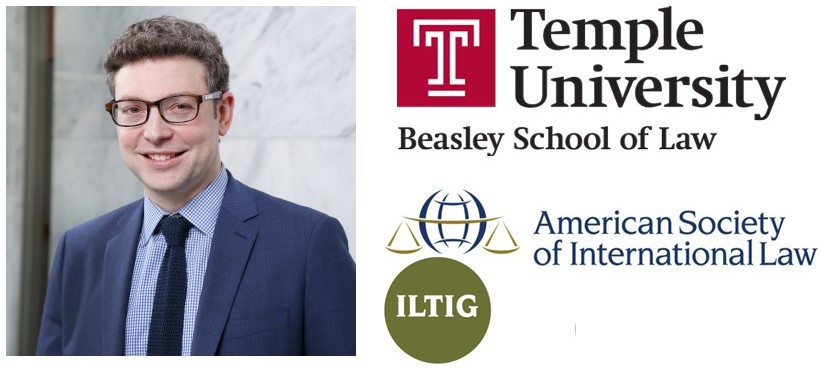
Georgia Law Professor Harlan G. Cohen presents paper on trade-security measures at Temple Law-ASIL workshop

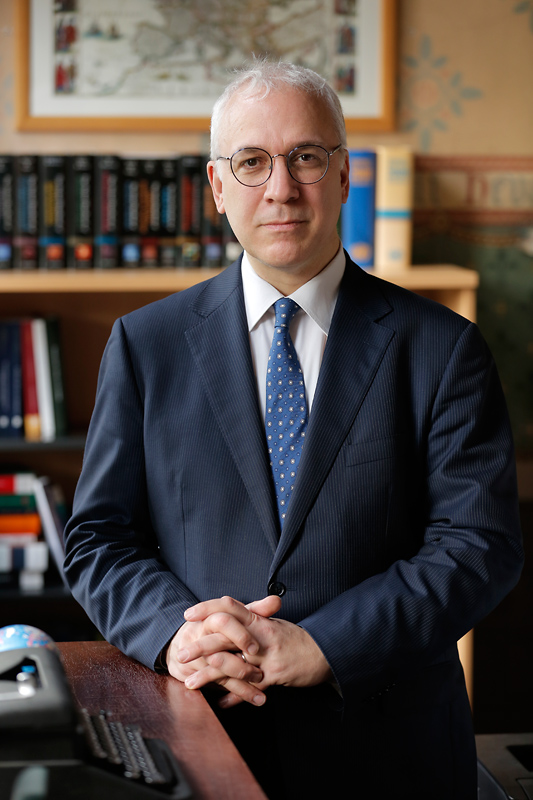
Harlan Grant Cohen, who is Gabriel M. Wilner/UGA Foundation Professor in International Law and Faculty Co-Director of the Dean Rusk International Law Center here at the University of Georgia School of Law, took part earlier this month in a workshop at Temple University Beasley School of Law in Philadelphia.

Cohen presented “Toward Best Practices for Trade-Security Measures” at the workshop, which waswhich was organized by Temple Law Professor J. Benton Heath and hosted by Temple Law’s Institute for International Law and Public Policy, in coordination with the American Society of International Law International Legal Theory Interest Group.

Within the overall theme of “The Concept of Security in International Law,” the workshop brought together scholars from a range of fields in order to address shifting understandings of security in international law and foreign affairs, as well as how law can respond to these developments.

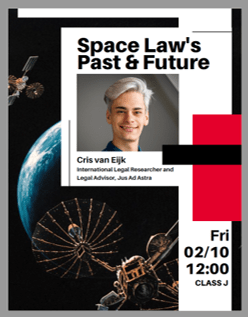
Late addition to Georgia Law’s Space Law Speaker Series: Cris van Eijk on “Space Law’s Past and Future,” tomorrow

Pleased to announce a late addition to the Space Law Speaker Series we’ve been hosting this semester here at the University of Georgia School of Law Dean Rusk International Law Center: Cris van Eijk, International Legal Researcher and Legal Advisor for Jus Ad Astra, will present at 12 noon this Friday, February 10, in Room J-347 Hirsch Hall.

Jus Ad Astra – a Latinism for “law (or rights) to the stars” – is, according to its website, “a legal project aimed at developing an authoritative international treatise clarifying the fundamental legal principles and human rights applicable to current and future human activities across outer space.”

In addition to advising for Jus Ad Astra, van Eijk is the author of thought-provoking publications on space law. He holds degrees from University of Cambridge, where he was a Senior Associate Editor for the Cambridge University Human Rights Law Journal, and Leiden University.

His presentation Friday substitutes for a scheduled speaker who was unable to take part. It will mark the third of four presentations in the Space Law Speaker Series, which, as detailed here, is part of a Spring Semester course led by our Center’s Director, Professor Melissa J. “MJ” Durkee, who is also Georgia Law’s Associate Dean for International Programs and Allen Post Professor.

Georgia Law Professor Walter Hellerstein presents on tax obligations on digital platforms at conference in Vienna

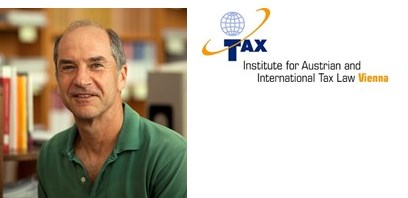
Walter Hellerstein, Distinguished Research Professor & Shackelford Distinguished Professor in Taxation Law Emeritus here at the University of Georgia School of Law, recently presented in Vienna, Austria, as part of a panel entitled “Obligations Imposed on Digital Platforms Regarding VAT/GST,” concerning tax obligations imposed on digital platforms.

His presentation formed part of “Court of Justice of the European Union: Recent VAT Case Law,” a 3-day conference at the Institute for Austrian & International Tax Law, Vienna University of Economics & Business.

In addition to Austria and the United States, the conference included judges, academics, and practitioners from Australia, Belgium, Canada, Finland, Germany, Ireland, Italy, Luxembourg, Malta, the Netherlands, Spain, Sweden, and the United Kingdom.

Georgia Law Professor MJ Durkee presents “Pledging World Order” in Brooklyn Law School colloquium

Professor Melissa J. “MJ” Durkee, the law school’s Associate Dean for International Programs, Director of the Dean Rusk International Law Center, and Allen Post Professor, presented her scholarship online Monday as part of the Brooklyn Colloquium on International Economic Law sponsored by the Block Center for International Business Law at New York’s Brooklyn Law School. Hosts were Brooklyn Law faculty members Stephen Dean and Irene Ten Cate.

Durkee presented “Pledging World Order,” forthcoming soon in volume 48, issue 1, of the Yale Journal of International of Law.

Georgia Law 3L Collin Douglas on his D.C. Semester externship at NATO HQ SACT: “unique law school experience”

Pleased today to welcome this post by University of Georgia School of Law student Collin Douglas, who described his recently completed Fall 2022 externship in Norfolk, Virginia, in the legal department of HQ SACT, a leading unit of the North Atlantic Treaty Organization. This externship forms part of Georgia Law’s D.C. Semester in Practice initiative, in partnership with NATO Allied Command Transformation. Collin arrived at Georgia Law with a background in international affairs, having earned master’s and bachelor’s degrees in that field from the University of Oklahoma. His law school experiences have included service as Executive Articles Editor of the Georgia Journal of International & Comparative Law, internships at USAID and the Documentation Center of Cambodia, and work as a research assistant for a climate and security institute. Collin is due to receive his J.D. degree this May.

My time at the NATO Supreme Allied Command Transformation Office of the Legal Advisor was an incredibly rewarding and valuable experience. It was a completely unique law school experience, and allowed me to do work I could not do elsewhere.

In the wake of the February 2022 Russian invasion of Ukraine, the mission of NATO has felt that much more vital. The invasion of Ukraine gave NATO a renewed focus and drive, and that fact was clear from the ever-quickening pace of work around NATO SACT. The Legal Advisor performs a wide variety of legal roles within NATO SACT to support the mission, and I was able to interact with all of those roles.

As soon as I began working, I was treated as an equal member of the team and trusted with important work. One of the responsibilities of the Office of the Legal Advisor is to provide legal aid support to the international military staff of NATO SACT. This support ranges from advising on how to handle speeding tickets to coordinating with the State Department on visa issues. Within a few weeks of starting work, I was the first person who greeted any legal assistance client who walked in the door, of which there were 10-20 every day. Talking with NATO personnel from 32+ different countries exposed me to 32+ different legal perspectives and cultures. This fact gave the legal assistance portion of the work its own international perspective, as we often had to anticipate things like the Norwegian perspective on landlord-tenant issues, the German perspective on automobile sales, Albanian frustration with the visa process, or simply whether someone fully grasped the legal aspects of something they were involved with.

The Office of the Legal Advisor also performs the more typical general counsel duties of any other large organization, but with the added (and interesting) layer of being an international organization. This work covers contracting, employment intellectual property issues, and much more. This work does not differ significantly from that of a general counsel’s office in a large corporation. Where it does differ is the immunity that NATO receives under the treaties that make up the NATO system. I was able to support this work by researching and helping to articulate NATO’s view on its own immunity. Doing work of this kind for an international organization is such a rare opportunity, and I jumped on the chance to contribute to it.

My externship at NATO was part of the UGA Law Semester in D.C. program, led by Professor Jessica Heywood, so I took part in two classes that greatly contributed to my time at NATO. As part of this program we heard each week from a different lawyer working in Washington, D.C. This provided an excellent opportunity to learn about the many career paths available to attorneys who want to work in the nation’s capital. I also had a weekly class session with other students doing similar externship experiences; this allowed me to better understand my strengths and weaknesses in the workplace and to grow as an individual.

I am extremely grateful for my time at NATO SACT. There is no other law school experience that compares to it. I want to thank my amazing colleagues Monte DeBoer, Mette Hartov, Theresa Donahue, Kathy Hansen-Nord, Vincent Grassin, Butch Bracknell, Madeleine Goddrie, and Galateia Gialitaki.

Georgia Law Professor Louis B. Sohn (1914-2006), noted international law expert, featured as “Groundbreaker”

A renowned member of the University of Georgia School of Law faculty, Louis B. Sohn (1914-2006), is the latest subject in the university’s “Georgia Groundbreaker” news series.

Author Robin Lally starts her article, “Louis B. Sohn: An international legal scholar,” with these apt words:

“Louis B. Sohn spent his life promoting international law and peace.”

The article proceeds to discuss his birth in the city now known as Lviv, Ukraine, and his move to the United States in 1939, just weeks before the Nazi invasion. Installed at Harvard, he helped to draft the United Nations Charter, wrote many books, including the co-authored World Peace through World Law.

As a Georgia Law professor teaching human rights law and law of the sea from 1981 to 1991, Sohn mentored a generation of students. Lally’s article quotes several such Georgia Law alums: Jean-Marie Henckaerts (prior posts), who is a Legal Adviser at the International Committee of the Red Cross in Geneva, Switzerland; Susan Timberlake, a former United Nations lawyer; former U.S. diplomat Kit Traub (prior post); and Paige Otwell (prior posts), an Assistant District Attorney in Athens-Clarke County.

The article features many photographs of Sohn, and pays tribute to his donation of 5,000 volumes from his personal collection, now formed the Louis B. Sohn Library on International Relations. Housed in the Dean Rusk International Law Center, it is a branch of Alexander Campbell King Law Library at Georgia Law

Also quoted is Regents’ Professor Diane Marie Amann, who holds the Emily & Ernest Woodruff Chair in International Law, which Sohn had inaugurated upon his arrival at Georgia Law. Amann said:

“‘Professor Sohn was a path breaker in international human rights law, the law of peace, and international environmental law, fields of keen interest to our students, important to our world …'”

KU Leuven Professor Jan Wouters to speak on “European Union as Global Actor” this Thursday at Georgia Law

Professor Jan Wouters, international law scholar and Director of the Leuven Centre for Global Governance Studies at Belgium’s KU Leuven, will give a lecture entitled “The European Union as a Global Actor: Potential and Challenges” at 1 p.m. this Thursday, January 26, in the Sanders Boardroom at the University of Georgia School of Law.

Academic partners since 2015, the Leuven Centre and Georgia Law’s Dean Rusk International Law Center co-present a Global Governance Summer School, among other collaborations. (prior posts)

Wouters is Full Professor of International Law and International Organizations, Jean Monnet Chair ad personam EU and Global Governance, and founding Director of the Institute for International Law at the Leuven Centre for Global Governance Studies, an interdisciplinary research unit that holds the status within its university of both a Jean Monnet and KU Leuven Centre of Excellence. Additionally, Wouters is a visiting professor at Sciences Po and Paris-2 (Panthéon-Assas) in France, LUISS University in Italy, and the College of Europe in Belgium, as well as an adjunct professor of EU and human rights law Columbia University in New York. His most recent publications, all of them 2022 volumes which he co-edited, are: EU Industrial Policy in the Multipolar Economy; The G20, Development and the UN 2030 Agenda; Research Handbook on Global Governance, Business and Human Rights; and The Nexus Between Organized Crime and Terrorism.

Event details here.

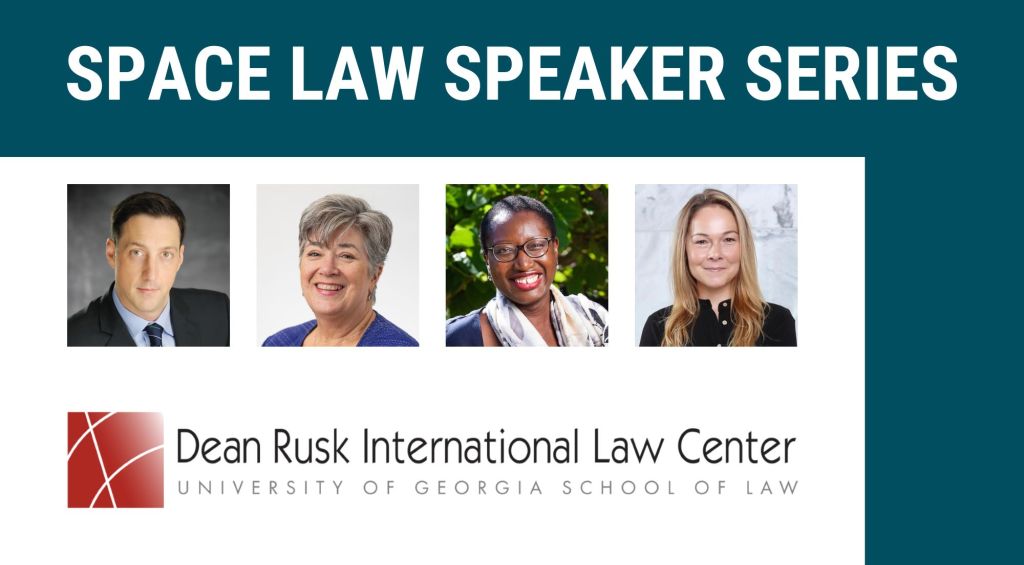
Scholars and practitioners of space law to speak at Georgia Law as part of new international law course led by Center’s Director, Professor MJ Durkee

Leading scholars and practitioners of space law will speak here at the University of Georgia School of Law as part of a new semester-long course in international law taught by Professor Melissa J. “MJ” Durkee, the law school’s Associate Dean for International Programs, Director of the Dean Rusk International Law Center, and Allen Post Professor.

The Spring 2023 Space Law Speaker Series will feature (pictured above, left to right):

January 20, “Space Law Fundamentals”: Christopher Johnson, Space Law Advisor for the Secure World Foundation, Adjunct Professor at Georgetown University Law Center in Washington, D.C., and member of the Paris-based International Institute of Space Law

January 25, “Contemporary Space Governance”: Tanja Masson-Zwaan, Assistant Professor and Deputy Director of the International Institute of Air and Space Law at Leiden University in the Netherlands, and President Emerita of the International Institute of Space Law

February 10, “Customary Law Principles in Space Law”: Timiebi Aganaba, Assistant Professor of Space and Society in the School for the Future of Innovation in Society at Arizona State University, also affiliated with ASU’s Interplanetary Initiative, Global Futures Lab, and Sandra Day O’Connor College of Law

February 17, “Regulating Space Junk”: Kathleen Doty, Advisor for Non-Proliferation Treaties & Agreements in the Global Security, Technology, and Policy group at the Seattle-based Pacific Northwest National Laboratory, and former Director of our Dean Rusk International Law Center

Presentations will be open to all at Georgia Law. Students enrolled in the for-credit course will draw from knowledge gained during the speaker series to pitch solutions to a space law problem – the issue of debris in space, known colloquially as “space junk.” Working with them will be Professor Durkee. She too is a scholar in this area, having published “Interstitial Space Law” and “The Future of Space Governance,” the latter an essay in a Georgia Journal of International and Comparative Law symposium issue on the subject.

Supporting the speaker series as part of their work on Georgia Law’s Graduate Certificate in International Law – for which this is a required course – are the staff members of the Center’s Global Practice Preparation portfolio, Sarah Quinn and Catrina Martin.

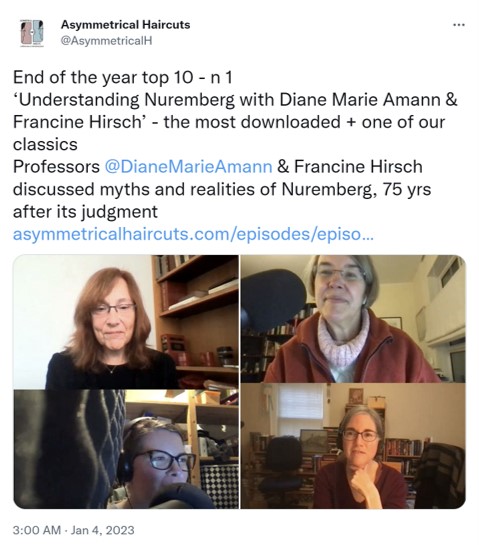
Nuremberg podcast with Georgia Law Professor Amann top download of 2022

Understanding Nuremberg,” with Professor Diane Marie Amann, a Faculty Co-Director of our Dean Rusk International Law Center here at the University of Georgia School of Law, and University of Wisconsin Professor Francine Hirsch, was the most-downloaded 2022 episode of Asymmetrical Haircuts: Your International Justice Podcast.

As quoted in a prior post, the hosts, Hague-based journalists Janet Anderson and Stephanie van den Berg, described the podcast (available here) as a discussion of “what we think we know (and what we don’t) about Nuremberg trials.”

Amann, Regents’ Professor of International Law and Emily & Ernest Woodruff Chair in International Law here at Georgia Law, is writing Nuremberg Women, a book about the roles that lawyers and other women professionals played at the post-World War II trial before the International Military Tribunal. Hirsch, the Vilas Distinguished Achievement Professor of History at the University of Wisconsin-Madison, is author of the award-winning Soviet Judgment at Nuremberg: A New History of the International Military Tribunal After World War II (202o).

Georgia Law coursework begins for new class of students seeking Graduate Certificate in International Law

3L Nishka Malik (far left) and 2L Andrew Arrington (second from far right) introduce Georgia Law’s Alexander Campbell King Law Library to new Graduate Certificate in Law students; from left, Hayley Worsfold, Michael Parks, Benjamin Maurice Roy, and Angela Mossgrove

This New Year marks the arrival of the second class of Graduate Certificate in International Law students here at the University of Georgia School of Law.

Through the initiative of the law school’s Dean Rusk International Law Center, postgraduate students from other disciplines within the university will earn this academic certificate following their successful completion, in classes alongside J.D., LL.M., and M.L.S. students, of fifteen credit hours chosen from among the law school’s rich comparative, transnational, and international law curriculum; courses include Public International Law, International Human Rights, International Trade Law, Immigration Law, International Law Colloquium, and Global Governance.

Joining the first cohort, this second class of five students includes:

Three doctoral students, all from the Franklin College of Arts and Sciences: Thomas Kingsley, a Ph.D. candidate in Linguistics who is researching the effects of significant language contact, primarily in the Balkans and Central Asia; Angela Mossgrove, a Ph.D. candidate in Linguistics focusing on Syntax; and Benjamin Maurice Roy, a Ph.D. candidate in History, whose research focuses on the cognitive history of tobacco in the nineteenth century.

Two master’s students, both from the School of Public and International Affairs: Michael Parks, a candidate for the M.A. in International Affairs, and Hayley Worsfold, a candidate for the Master of International Policy degree.

Details on application of and matriculation toward the Graduate Certificate in International Law are available here and by contacting the initiative’s administrator, Sarah Quinn, Associate Director for Global Practice Preparation at the Dean Rusk International Law Center, squinn[at]uga.edu.