UGA Law professor Diane Marie Amann and UCL Professor Martins Paparinskis

UGA Law Professor Amann presents “Child-Taking and the International Criminal Arrest Warrant” at University College London Faculty of Laws

University of Georgia School of Law Professor Diane Marie Amann, an expert on child and human rights, international criminal law, and the laws of war, presented a lecture entitled “Child-Taking and the International Criminal Arrest Warrant” at University College London Faculty of Laws in June.

News that the International Criminal Court is seeking the arrest of Russia’s President, Vladimir Putin, and Child Rights Commissioner, Maria Lvova-Belova, drew attention to the war crimes charged: “unlawful deportation of population (children)” and “unlawful transfer of population (children) from occupied areas.” Professor Amann’s lecture examined these and similar crimes, which she labels “child-taking.” International child-taking trials date to the Nuremberg tribunals, and have continued in modern forums like the ICC. Court records demonstrate that child-taking is no minor crime. Its present gravity and future consequences are heavy; so too, the prosecutorial burdens of securing indictments, conviction, and redress.

This presentation was chaired by UCL Professor of Public International Law, Martins Paparinskis.

Amann is the Regents’ Professor of International Law, the Emily & Ernest Woodruff Chair in International Law, and a Faculty Co-Director of the Dean Rusk International Law Center.

Welcoming Mine Turhan, Visiting Scholar at UGA Law’s Dean Rusk International Law Center

We at the University of Georgia School of Law Dean Rusk International Law Center are pleased to welcome a new Visiting Research Scholar: Mine Turhan, Assistant Professor of Administrative Law in the Faculty of Law at the Izmir University of Economics in Türkiye. She holds an LL.M. degree and a Ph.D. in Public Law from Dokuz Eylül University in Izmir, Türkiye.

Professor Turhan plans to conduct research on comparative administrative procedure between the United States and the European Union during her stay at the Dean Rusk International Law Center. Her project will focus on procedural due process rights, in particular the right to be heard before administrative agencies, and it will analyze how individual rights are protected by different procedures in the U.S. and the European Union against arbitrary actions on the part of administrative agencies.

Professor Turhan is sponsored as a Visiting Research Scholar by UGA Law Professor David E. Shipley, the Georgia Athletic Association Professor in Law. Professor Shipley teaches administrative law and civil procedure.

Turhan’s research is supported by a fellowship from the Scientific and Technological Research Council of Türkiye (TÜBİTAK) within the scope of the International Postdoctoral Research Fellowship Program. Her visit continues our Center’s long tradition of hosting scholars and researchers whose work touches on issues of international, comparative, or transnational law. Details and an online application to become a visiting scholar here.

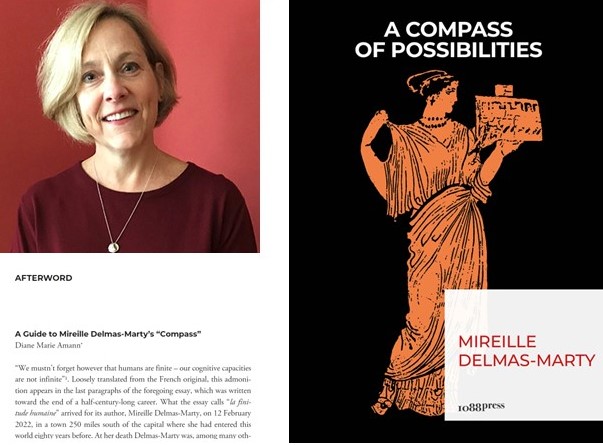
Georgia Law Professor Amann publishes afterword to new volume translating work by legal thinker Mireille Delmas-Marty

University of Georgia School of Law Professor Diane Marie Amann contributed the afterword to a just-published volume featuring an English translation of an important work by the late Mireille Delmas-Marty (1941-2022), Collège de France de Paris law professor and one of the pre-eminent legal thinkers of her generation.

Co-editors of the volume, A Compass of Possibilities, are law professors Emanuela Fronza (University of Bologna, Italy) and Chiara Giorgetti (University of Richmond). Fronza also wrote an Epilogue to the main work. Subtitled “Global Governance and Legal Humanism,” the book offers, in translation, Delmas-Marty’s 2011 closing lecture at Collège de France, entitled “Une boussole des possibles. Gouvernance mondiale et humanismes juridiques.” Publishing the new work is 1088 Press, a University of Bologna imprint.

Amann – who is Regents’ Professor of International Law, Emily & Ernest Woodruff Chair in International Law, and a Faculty Co-Director of our Dean Rusk International Law Center here at Georgia Law – was a longtime colleague of Delmas-Marty. Amann’s role in their collaborations included a year-long stint as professeure invitée at Université de Paris 1 (Panthéon-Sorbonne), where Delmas-Marty then taught; a lecture at Collège de France; and annual participation in a decade of gatherings of the Réseau ID franco-américain/French-American Network on the Internationalization of Law.

Amann’s afterword is titled “A Guide to Mireille Delmas-Marty’s “Compass'”; it appears at pp. 55-64 of the new volume. Here’s the abstract from a pre-publication version of Amann’s afterword, available at SSRN:

“This essay appears as the Afterword (pp. 55-64) to a volume featuring an important work by the late Mireille Delmas-Marty (1941-2022). A Collège de France de Paris law professor and one of the pre-eminent legal thinkers of her generation, Delmas-Marty and the essay’s author were longtime colleagues and collaborators. The volume contains an English translation of a 2011 lecture by Delmas-Marty, originally titled “Une boussole des possibles: Gouvernance mondiale et humanismes juridiques.” Amann’s essay surveys that writing, in a manner designed to acquaint non-francophone lawyers and academics with Delmas-Marty’s vast and visionary œuvre.”

Georgia Law Professor MJ Durkee’s “The Pledging World Order” published in new Yale Journal of International Law issue

The latest publication by University of Georgia School of Law Professor Melissa J. “MJ” Durkee is now in print at Yale Journal of International Law.

The article by Durkee, who is Associate Dean for International Programs, Director of the Dean Rusk International Law Center, and Allen Post Professor here at Georgia Law, is “The Pledging World Order,” 48 Yale J. Int’l L. 1 (2023).

Here’s the SSRN abstract:

“There is an emerging world order characterized by unilateral pledges within a legal or ‘legal-ish’ architecture of commitments. The pledging world order has materialized in the international legal response to climate change and in other diverse sites. It crosses and blurs the public-private divide. It erodes distinctions between multilateralism and localism, law and not-law, and progress and stasis. It is both a symptom of and a contributor to the dismantling of the Westphalian and postwar orders. Its report card is mixed: While pledging can be highly ineffective as a legal technology, the pledging world order may respond to some legitimacy concerns that attach to earlier orders. And this may be the best available method to respond to important global commons problems like climate change, biodiversity loss, orbital debris, and other emerging issues.

“This Article makes three principal contributions. First, it identifies pledging as a treaty design choice and contrasts it with a variety of standard forms of international lawmaking. Second, it casts pledging as a trans-regime, trans-substantive ordering device that appears both inside and outside of law, in public and private sites, and at all levels of organization. Third, it identifies features of the world order that pledging reflects. Specifically, the pledging world order privileges function over status, departs from the top-down methods of deep cooperation common to the postwar legal order, and embraces a form of coordinated autonomy. Reformers might make design choices to improve this order, try to reclaim features of older orders, or reject both paths and turn to something new.”

Prior posts on Durkee’s presentations of this scholarship here.

International law at University of Georgia, administered by Dean Rusk International Law Center, earns #15 U.S. News ranking

Delighted to report that the just-released U.S. News rankings place our international law curriculum here at the University of Georgia School of Law at No. 15 in the United States.

This excellence rating caps a decade in which our international law initiatives have ranked in the top 20 or so among US law schools. In this year’s rankings, our international law curriculum tied with UCLA Law for the No. 15 spot. (The University of Georgia School of Law, as a whole, earned a No. 20 ranking this year, as it posted here.)

Our international law achievement is due in no small part to the enthusiastic support and hard work of everyone affiliated with Georgia Law’s four-decades-old-old Dean Rusk International Law Center. As chronicled at this Exchange of Notes blog and our Center website, these include:

► Superb members of the law faculty, including: Dean Peter B. “Bo” Rutledge, an international arbitration expert; our Center’s Director, Melissa J. “MJ” Durkee, whose expertise includes international business law, international environmental law, and space law; the Center’s Faculty Co-Directors, Professors Diane Marie Amann, an expert in peace-and-security fields including the laws of war, child rights, and international criminal justice, and Harlan G. Cohen, an expert in global governance, trade, and foreign relations law. Among those supporting their efforts are many other Georgia Law faculty and courtesy faculty members, including: Professors Zohra Ahmed, whose interests include law and political economy; Christopher M. Bruner, a comparative corporate governance scholar; Thomas Burch, who leads the Appellate Clinic that has won clients relief under the Convention Against Torture; Anne Burnett, foreign and international law research librarian; Jason Cade and Clare Norins, who recently led a clinical team in securing federal redress for immigration detainees; Nathan S. Chapman, a scholar of due process and extraterritoriality; Jessica L. Heywood, Director of the Washington, D.C. Semester in Practice; Thomas E. Kadri, whose expertise includes cybercrime and global data privacy; Fazal Khan and Elizabeth Weeks, health law specialists; Jonathan Peters, a journalism and law professor expert in international media and free speech; Laura Phillips-Sawyer; Kalyani Ramnath, a global legal historian who focuses on South Asia; Lori A. Ringhand, a scholar of comparative constitutional law and elections law; Tim Samples, whose scholarship includes global digital platforms agreements; Kent BarnettSonja West, and Elizabeth Chamblee Burch, who have presented overseas on administrative law, media law, and civil procedure, respectively; Walter Hellerstein, a world-renowned tax specialist; Michael L. Wells, a European Union scholar; and Anna Howard White, who led our champion Jessup International Moot Court Team.

► Talented students pursuing JDMSL, and LLM degrees, as well as Graduate Certificates in International Law. They include: our Center’s many Student Ambassadors; the staffers and editors of the Georgia Journal of International and Comparative Law who produce one of the country’s oldest student journals, and who led our October 2022 conference, “The Law of Global Economic Statecraft”; the advocates on the Philip C. Jessup International Law Moot Court, the LL.M.s’ International Commercial & Investment Arbitration Moot Competition, and the Willem C. Vis International Commercial Arbitration Moot; student clinicians in our Appellate Litigation Clinic who have argued asylum cases before U.S. Courts of Appeals, as well as those in our Community HeLP Clinic, Jane W. Wilson Family Justice Clinic, and First Amendment Clinic who have litigated claims for detainees and other immigration clients; participants in our Global Externships as well as our full-semester NATO Externship and other D.C. Semester in Practice placements; and the student leaders of our International Law Society.

► Superb Center staff like Laura Tate KagelSarah QuinnMandy Dixon, and Catrina Martin.

► Visiting Scholars and Researchers, including, most recently, Professor Brianne McGonigle Leyh and Maisie Hopkins from the Netherlands’ Utrecht University, Daesun Kim, a comparative administrative law researcher; and Professor Natalia Pires de Vasconcelos, Insper São Paulo, Brazil.

► Academics, practitioners, and policymakers, from all over the world, who have contributed to our events – conferences, workshops, and lectures, including our ongoing Consular Series and International Law Colloquium, as well as this past semester’s Space Law Speaker Series, part of a minicourse that culminated in a daylong problem-solving exercise.

► Graduates who excel as partners in international commercial law firms, as heads of nongovernmental organizations and international organizations, as in-house counsel at leading multinational enterprises, and as diplomats and public servants – and who give back through participation in our Dean Rusk International Law Center Council, through mentoring, and through other support.

► Our valued partnerships, with Georgia Law student organizations; with leading higher education institutions such as the Leuven Centre for Global Governance Studies in Belgium, our partner in our Global Governance Summer School,  as well as O.P. Jindal University in India and Bar Ilan University in Israel, with which we have student and faculty exchanges; with organizations like the American Branch of the International Law Association, the American Society of International Law, and the European Society of International Law, in which our faculty have held leadership roles, as well as Global Atlanta, the World Affairs Council of Atlanta, the Atlanta International Arbitration Society; and with university units like the School of Public & International Affairs, the Terry College of Business, the Grady School of Journalism, the African Studies Institute, and the Willson Center for Humanities & Arts.

With thanks to all, we look forward to continue strengthening our initiatives in international, comparative, transnational, and foreign relations law – not least, in the preparation of Georgia Law students to practice in our 21st C. globalized legal profession.

Bon voyage to students taking part in Georgia Law global summer initiatives

In the weeks ahead, more than two dozen students will travel to participate in two global practice preparation offerings administered by the University of Georgia School of Law Dean Rusk International Law Center. These are the:

GGSS

This year’s Global Governance Summer School will focus on economic and human rights. It’s set to begin at the end this month, when students will travel to Belgium for a week of lectures led by Georgia Law Professor Zohra Ahmed as well as Leuven professors. The first week of this for-credit course also will include professional development briefings at the European Parliament, the North Atlantic Treaty Organization, and a private law firm.

Then programming shifts to The Hague, Netherlands, where Professor Melissa J. “MJ” Durkee, the Center’s Director, Associate Dean for International Programs, and Allen Post Professor at Georgia Law, will lead briefings at the International Criminal Court, the International Court of Justice, the International Residual Mechanism for Criminal Tribunals, and Leiden University. Casey Graham, Sarah Quinn, and Catrina Martin will provide logistical assistance during the program. (Above, many in the group gather for a predeparture photo.)

Seventeen Georgia Law students will take part: Andrew Arrington, Hao Chen “Bobby” Dong, and Marly “Jansen” Killian, Allison Reid, all rising 3Ls; Mona Abboud, Madison Graham, Megan Jones, Anna “Carolina” Mares, Erin Nalley, Caden Pruitt, Hannah Silvers, Tiffany Torchia, Daniel “Tripp” Vaughn, all rising 2Ls; and Alma Bajramovic, Thomas Kingsley, Angela Mossgrove, Jasmine Underwood, all pursuing Graduate Certificates in International Law.

GEO

Our Center’s Global Externship Overseas initiative places Georgia Law students in externships lasting between four and twelve weeks. It thus offers students the opportunity to gain practical work experience in a variety of legal settings worldwide. Some students opt to combine the GEO opportunity with participation in GGSS.

This summer, fifteen Georgia Law students are set to pursue Global Externships Overseas, in practice areas such as privacy and technology law, international environmental law, intellectual property law, European Union competition and trade law, international arbitration, corporate law, and human rights law.

Private-sector placements among rising 3Ls include: Caroline Bailey, GreenCo S.A., Buenos Aires, Argentina; Hao Chen “Bobby” Dong, Baker Tilly, Hamburg and Frankfurt, Germany; Matthew Philips, PSA Legal, New Delhi, India; Benjamin Siegel, Soreinen, Tallinn, Estonia. Among rising 2Ls, private-sector placements include: Mona Abboud, Alston & Bird, Brussels, Belgium; Madison Graham, Van Bael & Bellis, Brussels, Belgium; Sierra Hamilton, Weickmann & Weickmann, Munich, Germany; Anna “Carolina” Mares, Houerbi Law Firm, Tunis, Tunisia; Matthew McKaig, GÖRG, Berlin, Germany; Caden Pruitt, Bodenheimer, Cologne, Germany; Daniel “Tripp” Vaughn, Deloitte, Baku, Azerbaijan.

Public-sector placements include: rising 3L Allison Reid, Eliberare, Brasov, Romania; and rising 2Ls Jasmine Furin, Office of the Privacy Commissioner, Hamilton, Bermuda; Bryonna Howard, No Peace Without Justice, Brussels, Belgium; and Erin Nalley, New Zealand Department of Conservation, Wellington, New Zealand.

More information on both of these Georgia Law initiatives here.

Georgia Law Professor Jason Cade presents on immigration at Wisconsin International Law Journal symposium

Professor Jason A. Code, an immigration law expert here at the University of Georgia School of Law, presented in April as part of the Wisconsin International Law Journal 2023 symposium, “Immigration and Access to Legal Resources for Migrants and Refugees,” held at the University of Wisconsin Law School in Madison.

Cade, who is Associate Dean for Clinical Programs and Experiential Learning, J. Alton Hosch Professor of Law, and Director of the Community HeLP Clinic at Georgia Law, gave a presentation entitled “Not Just a Pandemic Problem: Administrative Failures in the Humanitarian Immigration System” in a panel exploring the impact of the Covid-19 pandemic. Other panelists included Evelyn Marcelina Rangel-Media, Temple University Beasley School of Law, Wooksoo Kim, University at Buffalo School of Social Work, and Emily Ryo, University of Southern California Gould School of Law.

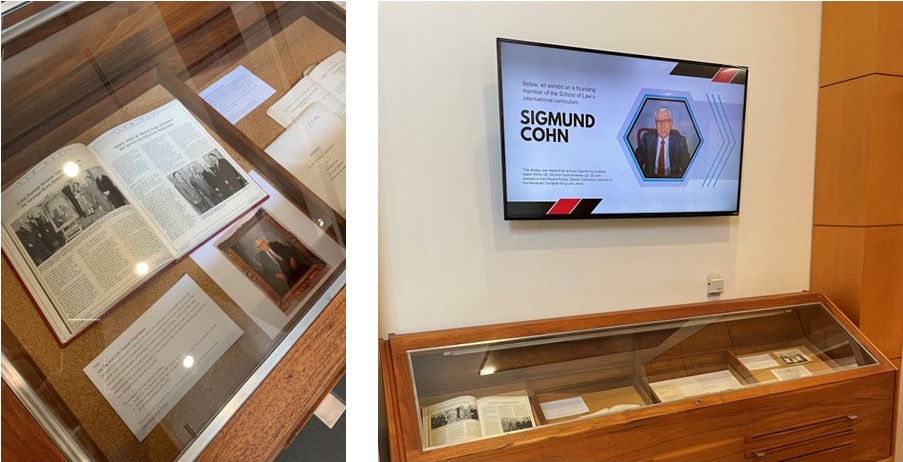
Georgia Law’s first international law professor, Sigmund A. Cohn, featured in Dean Rusk International Law Center exhibit

An ongoing exhibit here at the Dean Rusk International Law Center, University of Georgia School of Law, celebrates the distinguished life and career of Professor Sigmund A. Cohn, who taught the law school’s first international law class, in 1940.

Cohn’s courses, in international law and in comparative law, blazed a trail. Others would follow Cohn’s path; among them, past Georgia Law Professors Dean Rusk, Louis B. Sohn, and Gabriel Wilner.

The exhibit was researched and curated by two of the Center’s Student Ambassadors, 3L Isabel White and 2L Carolina Mares, along with Rachel Evans, Metadata Services & Special Collections Librarian at the law school’s Alexander Campbell King Law Library. It features a collection of archival items about Cohn’s life and work.

Cohn was born in 1898 in Breslau, Germany (now Wrocław, Poland) to a Jewish family. He became a lawyer and then a judge in Germany’s Weimar Republic. But in 1934, Nazi Germany’s antisemitic laws forced him out of his judicial position. Cohn immigrated to Italy for a few years, but then was forced to immigrate once again, to the United States.

He was hired by Georgia Law, and became its first professor of Jewish ancestry, at a time when state laws barred the paying of foreign citizens. His hiring thus was supported financially by Harold Hirsch – then general counsel at the Coca-Cola Co., and the lawyer for whom Georgia Law’s Hirsch Hall is named.

A portrait of Professor Cohn greets visitors to the Dean Rusk International Law Center.

Cohn’s legacy likewise continues in the form of Georgia Law’s highly ranked curriculum (here and here), in global practice preparation and international professional education, benefiting candidates for Juris Doctor, Master of Laws (LL.M.), and Master in the Study of Law (M.S.L.) degrees as well as Graduate Certificate in International Law students.

Georgia Law Professor Amann takes part in podcast tribute to last surviving prosecutor at post-WWII Nuremberg trials, Benjamin B. Ferencz (1920-2023)

Among the international law experts featured in a podcast honoring the last surviving Nuremberg prosecutor is a Faculty Co-Director of our Center, Professor Diane Marie Amann.

The tribute, entitled “In Memoriam: Benjamin B. Ferencz,” was released recently at Asymmetrical Haircuts: Your International Justice Podcast. In it, the podcast’s co-founders, journalists Janet Anderson and Stephanie van den Berg, first provided their own memories of Ferencz, who died on April 7 in Florida, at age 103. They continue with comments not only from Professor Amann, but also from Christopher “Kip” Hale, Adama Dieng, David Donat Cattin, and Ferencz’ son, Don Ferencz.

As a twenty-something lawyer, Ferencz had played a role post-World War II trials at Nuremberg, leading the Einsatzgruppen trial. (His wife, Gertrude Fried Ferencz (1919-2019), likewise worked at the trials, in administrative capacities.) He remained active throughout his life in promoting international criminal law – to quote his own favorite phrase, campaigning for “Law, Not War.”

The comments by Amann, who is Regents’ Professor of International Law and Emily & Ernest Woodruff Chair in International Law here at the University of Georgia School of Law, drew from a tribute she posted here the day after Ferencz’ passing.

(Depicted in photo montage at podcast website: from top left, Amann interviewing Ferencz at International Humanitarian Law Dialogs, Chautauqua, New York; Ferencz with inter alia his son Don Ferencz, Kip Hale, and then-Prosecutor of the International Criminal Court, Fatou Bensouda; prosecutor Ferencz addressing a court at Nuremberg; and Ferencz on a bench dedicated to him at the Peace Palace at The Hague, the Netherlands, in which the phrase “Law Not War” has been carved)

Georgia Law Professor MJ Durkee publishes article on industry groups and international governance in Journal of Human Rights and the Environment

Professor Melissa J. “MJ” Durkee, who is the Associate Dean for International Programs, Director of the Dean Rusk International Law Center, and Allen Post Professor here at the University of Georgia School of Law, has published “Industry Groups in International Governance: A Framework for Reform” in the bi-annual, peer-reviewed Journal of Human Rights and the Environment.

Here’s the abstract:

“The Sustainable Development Goals and the UN Guiding Principles on Business and Human Rights encourage engaging with businesses as partners in important global governance agendas. Indeed, many international organizations are now partnering with business groups to secure funding and private sector engagement. At the same time, reforms at the World Health Organization, Food and Agriculture Organization and others seek to restrain the dangers of mission distortion and capture by business groups. Shareholders at major multinational oil and gas companies also recognize these dangers and seek to rein in lobbying that is at odds with the goals of the Paris Climate Agreement. Despite these tensions, little scholarly attention has been paid to the regulations that govern how industry and trade groups may participate in the work of international organizations. Specifically, little attention has been devoted to how those regulations could best capture the potential benefits of business engagement while restraining the potential harms. This article offers a history of engagement between international organizations and industry and trade associations, reviews arguments for embracing or restraining their participation, and develops a framework for regulations to govern their access.”

A version of this new article also is available at SSRN.