Georgia Law Professor Amann presents at Temple Law workshop on Philippe Sands’ Chagos book, “Last Colony”

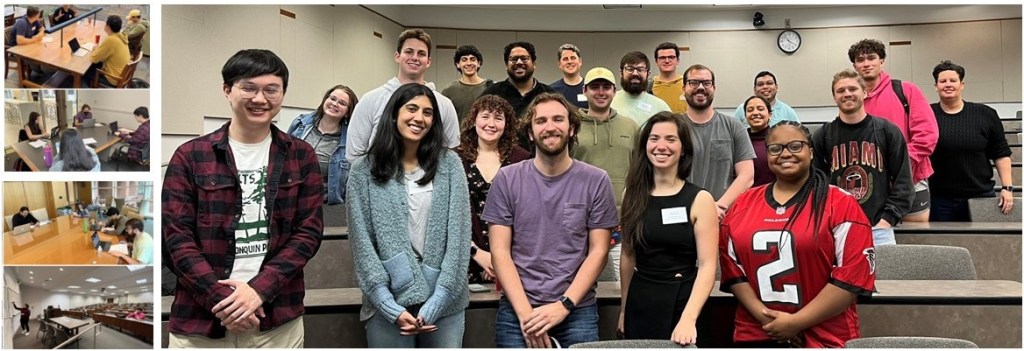
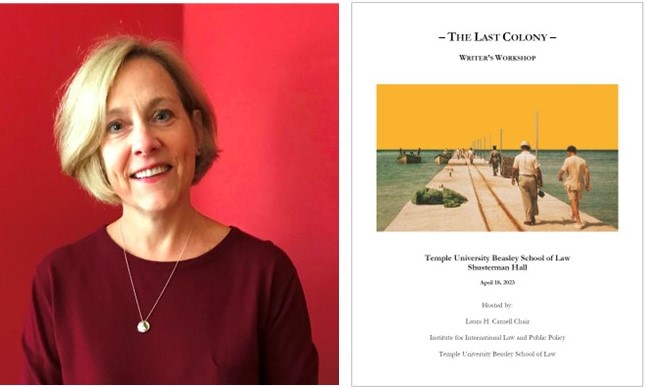
University of Georgia School of Law Professor Diane Marie Amann was one of about two dozen experts in international law and policy who participated Tuesday in a daylong writers’ workshop in Philadelphia, centered on a new book, The Last Colony: A Tale of Exile, Justice and Britain’s Colonial Legacy.

Last Colony charts the journey, through many national and international courtrooms, that led to the 2019 Advisory Opinion of the International Court of Justice on case related to colonization in the Indian Ocean region: Legal Consequences of the Separation of the Chagos Archipelago from Mauritius in 1965. The book appeared in the United Kingdom in 2022 and will be released in the United States later this year. Its author, University College London Law Professor Philippe Sands KC, counsel for Mauritius in the ICJ proceedings, was among those who took part in Tuesday’s event.

Workshop sponsors were the Institute for International Law & Public Policy and the Laura H. Carnell Chair at Temple University Beasley School of Law; the principal organizer was Temple Law Professor Jeffrey Dunoff, Laura R. Carnell Professor of Law. Papers are set to be published in a forthcoming issue of the Temple Journal of International & Comparative Law.

Amann is is Regents’ Professor of International Law and Emily & Ernest Woodruff Chair in International Law, and a Faculty Co-Director of our Dean Rusk International Law Center here at Georgia Law. For Tuesday’s workshop, she prepared a paper entitled “What Figures Lurk on Madame’s Path? Reflections on Philippe Sands’ Last Colony.”

Georgia Law Professor MJ Durkee publishes “Privatizing International Governance” in ASIL Proceedings

Professor Melissa J. “MJ” Durkee, the law school’s Associate Dean for International Programs, Director of the Dean Rusk International Law Center, and Allen Post Professor, has published “Privatizing International Governance” in the Proceedings of the 116th Annual Meeting of the American Society of International Law (Cambridge University Press, 2022).

The essay, a version of which is also available at SSRN, introduced a panel that she organized and chaired at the 2022 ASIL Annual Meeting. Other speakers included: Nora Mardirossian, Columbia Center on Sustainable Investment; Suzy Nikièma, Lead, Sustainable Investment, International Institute for Sustainable Development; and Nancy Thevenin, United States Council for International Business. (prior posts here and here)

Here’s the extract for Professor Durkee’s essay:

“Public-private partnerships of all kinds are increasingly common in the international system. Since United Nations Secretary-General Kofi Annan’s launch of the Global Compact in 2000, the United Nations has increasingly opened up to business entities. Now, the Sustainable Development Goals, the Global Compact, and the Guiding Principles on Business and Human Rights all encourage engaging with business entities as partners in developing and executing global governance agendas. These partnerships are seen by some as indispensable to sustainable development, international business regulation, climate change mitigation, and other global governance agendas. At the same time, UN climate change bodies have been criticized for cozying up to corporate fossil fuel lobbies, global financial governance institutions are charged with leaning toward the interests of the large banking and financial industry they are meant to regulate, and the pharmaceutical industry has been accused of exerting outsized influence in health-related international standard-setting, sometimes against public health objectives. Reforms seek to restrain the dangers of mission-distortion and capture by business groups. The theme of this panel is ‘Privatizing International Governance,’ and this brief framing essay lays out history, context, and the questions these partnerships present.”

Georgia Law students compete in Vis arbitration moot in Vienna, Austria

Top row, Benjamin Price; front row, l to r, Emily Crowell, Hanna Esserman, Yekaterina Ko, Sandon Fernandes, Savannah Grant

A team of students recently represented the University of Georgia School of Law at the annual Willem C. Vis International Commercial Arbitration Moot in Vienna, Austria. 

This year’s team comprised 2Ls Hanna Esserman, Sandon Fernandes, Benjamin Price, and Yekaterina Ko. Among those who supported their efforts were numerous coaches: 3Ls Emily Crowell and Savannah Grant, with support from 3Ls Collin Douglas and Ligon Fant, and Georgia Law Dean Peter B. “Bo” Rutledge.  

Fernandes reflected on his Vis experience, which included not only the team’s competition in Vienna but also its third-place finish in the Florida Bar International Law Section Richard DeWitt Memorial Vis Pre-Moot in Miami this past February: 

“The Vis Moot Court competition provides students with the opportunity to collaborate on a challenging international commercial dispute as if it were a real case. Competing against 378 teams from around the world has given me the ability to analyze complex legal issues from a global perspective.”

Georgia Law professors, alumna, students take part in annual meeting of American Society of International Law

Many members of the University of Georgia School of Law community – professors, alumna, and students – took part in last week’s 117th Annual Meeting of the American Society of International Law, the theme of which was “The Reach and Limits of International Law to Solve Today’s Challenges.”

The annual meeting took place Wednesday-Saturday at several venues in Washington, D.C.

Representatives of Georgia Law, an ASIL Academic Partner, included three scholars affiliated with the law school’s Dean Rusk International Law Center:

The Center’s Director, Melissa J. “MJ” Durkee, who is also Associate Dean for International Programs and Allen Post Professor, moderated a panel entitled “How Does International Law Change? Theories and Concepts of Legal Change.” (photo top row left) It was sponsored by ASIL’s International Legal Theory Interest Group, for which Durkee serves as Chair. Panelists were: Benedict Kingsbury, New York University; Nico Krisch, Graduate Institute of International and Development Studies in Geneva; and Sivan Shlomo Agon, Bar-Ilan University.

Durkee additionally serves on the ASIL Executive Council and the Board of Editors of the American Journal of International Law, and took part in the meetings of both those groups.

Diane Marie Amann, Regents’ Professor of International Law, Emily & Ernest Woodruff Chair in International Law, and one of our Center’s Faculty Co-Directors (above second from left), took part in a late-breaking panel, “ICC Arrest Warrant Against Putin: Impunity in Check?” (photo above left) Amann, an international child law expert and former Special Adviser to the International Criminal Court Prosecutor on Children in & affected by Armed Conflict, spoke on the significance of the fact that crimes against children form the basis of the international arrest warrant issued March 17 against the President and the Children’s Rights Commissioner of Russia. Additional panel participants were: Javier Eskauriatza, University of Nottingham; Marko Milanovic, University of Reading; Saira Mohamed, University of California-Berkeley; and moderator Katherine Gallagher, Center for Constitutional Rights. Panel video here.

Amann also attended the ASIL Executive Council meeting, completing her term as an ASIL Counsellor.

Harlan G. Cohen, Gabriel M. Wilner/UGA Foundation Professor in International Law and Faculty Co-Director of the Dean Rusk International Law Center, took the ASIL General Assembly stage: in his capacity as Chair of the 2023 Book Awards Committee, he co-presented those honors to numerous authors. (photo top row right, from left to right: ASIL President Greg Shaffer, honoree Damilola Olawuyi, ASIL Executive Director Michael Cooper, and Cohen; video 27:09)

Like Durkee, Cohen is a member of the AJIL Board of Editors and took part in the journal’s meeting. The annual meeting completed his service as Chair of ASIL’s International Legal Theory Interest Group.

A distinguished Georgia Law graduate also was featured:

Tess Davis (JD 2009), who is the Executive Director of the D.C.-based Antiquities Coalition and Dean Rusk International Law Center Council member, served as moderator for a session at the Smithsonian National Museum of Asian Art. (photo above right) Entitled “Protecting Cultural Heritage in Conflict Zones: Multi-Disciplinary Approaches,” the discussion also included: Patty Gerstenblith, DePaul University; Brooke Cuven, Cerberus Capital Management; Richard Kurin, Smithsonian Institution; and Zaydoon Zaid, American Foundation for Cultural Research.

Rounding out the contingent were four Georgia Law students, who received Louis B. Sohn Professional Development grants to serve as volunteers at the meeting: 2L Hao Chen “Bobby” Dong, 3L Collin Douglas, LLM candidate Alexandra Lampe, and 1L Mahi Patel.
Georgia Law Professor Harlan Cohen publishes in Temple Law symposium issue exploring book by Anne Orford

Harlan Grant Cohen, who is Gabriel M. Wilner/UGA Foundation Professor in International Law and Faculty Co-Director of the Dean Rusk International Law Center here at the University of Georgia School of Law, has contributed to a special symposium issue containing essays on International Law and the Politics of History, a book published in 2021 by Cambridge University Press and written by Melbourne Law School Professor Anne Orford.

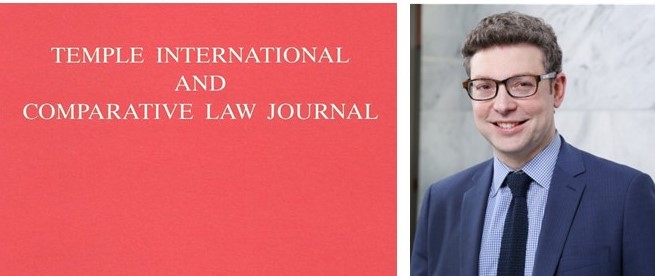
Cohen’s essay, “Journeys through Space and Time While Reading International Law and the Politics of History, Found on a Palimpsest, Translated for You, the Reader,” appears at 36 Temple International & Comparative Law Journal 129 (2022) (SSRN).

The issue developed out of a spring 2022 workshop at Temple University Beasley School of Law in Philadelphia, organized by Temple Law Professor Jeffrey L. Dunoff. As described by Dunoff, Cohen’s essay appears in the issue’s “final cluster of papers,” which consider “disciplinary identities and the politics of the encounter between law and history. ” Dunoff continued:

“Cohen’s highly creative contribution takes the form of a dialogue between study partners attempting to understand a fragmentary portion of a text that purports to describe a conflict between a historian and a legal scholar. This dialogue — which both expressly refers to and is reminiscent of a hevrutah, or partner-based form of studying religious texts common in Jewish communities — defies efforts at summary.

“Suffice to say that it touches on a dazzlingly wide range of issues, including disciplinary identity, different forms of knowledge, competing theories of meaning, the limits of language, and the possibility of plural truths, among other topics.”

Contributing to the special symposium issue — in addition to Cohen, Dunoff, and Orford — were Natasha Wheatley, Afroditi Giovanopoulou, Kunal M. Parker, Morten Rasmussen, Megan Donaldson, Francisco-José Quintana and Sarah M.H. Nouwen, David Schneiderman, Karen J. Alter, Lauri Mälksoo, Oliver Diggelmann, and Steven Ratner.

In day-long event capping Georgia Law course, international law students hack global problem of space debris

Five teams of J.D., LL.M., M.S.L., and Graduate Certificate in International Law students spent Saturday endeavoring to solve the global problem of what to do about the debris – that is, junk – which litters outer space. The day-long “Space Junk Hackathon” was hosted by the University of Georgia School of Law Dean Rusk International Law Center. It brought to a close an innovative Spring 2023 international law course taught by Professor Melissa J. “MJ” Durkee, the law school’s Associate Dean for International Programs, Director of the Dean Rusk International Law Center, and Allen Post Professor.

As detailed in prior posts here and here, this course began with a Space Law Speaker Series featuring, over the course of January and February, presentations by four expert academics and practitioners: Christopher JohnsonTanja Masson-ZwaanCris van Eijk, and Kathleen Doty.

At Saturday’s hackathon, Professor Durkee reviewed with students aspects of the space junk problem, as described by the series of speakers. She noted the inadequacy of existing international and domestic regulations – among them, the 1967 Outer Space Treaty, which was signed on behalf of the United States by then-Secretary of State Dean Rusk, our Center’s namesake.

Having recapped the problem, Durkee told students, “Your task is to solve it!”, by devising law or policy interventions. The star-named student teams, Antares, Polaris, Rigel, Sirius, and Vega, then decamped to breakout rooms and went to work.

At day’s end, the teams presented their proposals before three judges: Professor Durkee, Georgia Law Professor Christian Turner, and Jackson Tilley, Ph.D. candidate at our university’s School of Public & International Affairs. All students were praised for their creative interventions. Team Polaris, comprising Alma Bajramović, Kyle Renner, Bobby Dong, and Nishka Malik, was named the strongest.

Assisting with administration as part of their work on Georgia Law’s Graduate Certificate in International Law – for which this was a required course – were the staff members of our Center’s Global Practice Preparation portfolio, Sarah Quinn and Catrina Martin.

Welcoming Maisie Hopkins and Daesun Kim, Visiting Scholars at Georgia Law’s Dean Rusk International Law Center

We at the University of Georgia School of Law Dean Rusk International Law Center are pleased to welcome to two Visiting Research Scholars:

Maisie Hopkins is a Ph.D. candidate at the Utrecht University School of Governance in the Netherlands. She works jointly at Utrecht and another Dutch university, Leiden, on a project entitled “Complex Global Regulation and Corporate Crime.” Within the overarching frame of how complexity within global governance influences corporate crime and corporate regulatory compliance, Hopkins’ research focuses on how international regime complexity theory applies to specific cases of corporate crime in both the United States and the European Union. Hopkins holds prior law degrees from the University of Amsterdam in the Netherlands and University of Nottingham, England. She worked for a year as a Global Legal Department Intern at Reckitt, a British multinational consumer goods company.

Serving as her Georgia Law faculty sponsor is Professor Melissa J. “MJ” Durkee, who is the law school’s Associate Dean for International Programs, Director of the Dean Rusk International Law Center, and Allen Post Professor.

Daesun Kim is undertaking a comparative administrative law research relating to Vietnam, where he has practiced for several years, and the United States. Specifically, he plans to conduct a comparative analysis of changed circumstances in the two countries’ public-private-partnership projects during the Covid-19 pandemic period. Kim’s practice specialties include public-private partnerships, foreign investments, and cross-border mergers and acquisitions, with a focus on Southeast Asian countries. Holder of a J.D. degree from Handong Global University and a B.A. degree from Chonnam National University, both in Korea, Kim has practiced in Seoul, Korea, and Ho Chi Minh City, Vietnam, at several prestigious law firms, including Shin & Kim LLC and Yulchon LLC, and also was a legal counsel at a Korean construction and energy company, POSCO E&C.

Serving as Kim’s Georgia Law faculty sponsor will be Professor Kent Barnett, Associate Dean for Academic Affairs and J. Alton Professor of Law.

These visits continue our Center’s long tradition of hosting, for brief or extended stays, scholars and researchers whose work touches on issues of international, comparative, or transnational law. Details and an online application to become a visiting scholar here.

Georgia Law Professor Harlan G. Cohen presents paper on trade-security measures at Temple Law-ASIL workshop

Harlan Grant Cohen, who is Gabriel M. Wilner/UGA Foundation Professor in International Law and Faculty Co-Director of the Dean Rusk International Law Center here at the University of Georgia School of Law, took part earlier this month in a workshop at Temple University Beasley School of Law in Philadelphia.

Cohen presented “Toward Best Practices for Trade-Security Measures” at the workshop, which waswhich was organized by Temple Law Professor J. Benton Heath and hosted by Temple Law’s Institute for International Law and Public Policy, in coordination with the American Society of International Law International Legal Theory Interest Group.

Within the overall theme of “The Concept of Security in International Law,” the workshop brought together scholars from a range of fields in order to address shifting understandings of security in international law and foreign affairs, as well as how law can respond to these developments.

Late addition to Georgia Law’s Space Law Speaker Series: Cris van Eijk on “Space Law’s Past and Future,” tomorrow

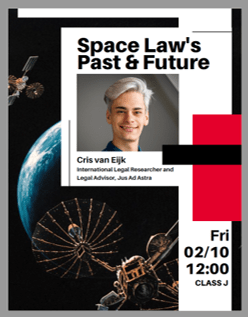
Pleased to announce a late addition to the Space Law Speaker Series we’ve been hosting this semester here at the University of Georgia School of Law Dean Rusk International Law Center: Cris van Eijk, International Legal Researcher and Legal Advisor for Jus Ad Astra, will present at 12 noon this Friday, February 10, in Room J-347 Hirsch Hall.

Jus Ad Astra – a Latinism for “law (or rights) to the stars” – is, according to its website, “a legal project aimed at developing an authoritative international treatise clarifying the fundamental legal principles and human rights applicable to current and future human activities across outer space.”

In addition to advising for Jus Ad Astra, van Eijk is the author of thought-provoking publications on space law. He holds degrees from University of Cambridge, where he was a Senior Associate Editor for the Cambridge University Human Rights Law Journal, and Leiden University.

His presentation Friday substitutes for a scheduled speaker who was unable to take part. It will mark the third of four presentations in the Space Law Speaker Series, which, as detailed here, is part of a Spring Semester course led by our Center’s Director, Professor Melissa J. “MJ” Durkee, who is also Georgia Law’s Associate Dean for International Programs and Allen Post Professor.

Georgia Law Professor Walter Hellerstein presents on tax obligations on digital platforms at conference in Vienna

Walter Hellerstein, Distinguished Research Professor & Shackelford Distinguished Professor in Taxation Law Emeritus here at the University of Georgia School of Law, recently presented in Vienna, Austria, as part of a panel entitled “Obligations Imposed on Digital Platforms Regarding VAT/GST,” concerning tax obligations imposed on digital platforms.

His presentation formed part of “Court of Justice of the European Union: Recent VAT Case Law,” a 3-day conference at the Institute for Austrian & International Tax Law, Vienna University of Economics & Business.

In addition to Austria and the United States, the conference included judges, academics, and practitioners from Australia, Belgium, Canada, Finland, Germany, Ireland, Italy, Luxembourg, Malta, the Netherlands, Spain, Sweden, and the United Kingdom.